
What Are Compromise Offers Under Evidence Law?
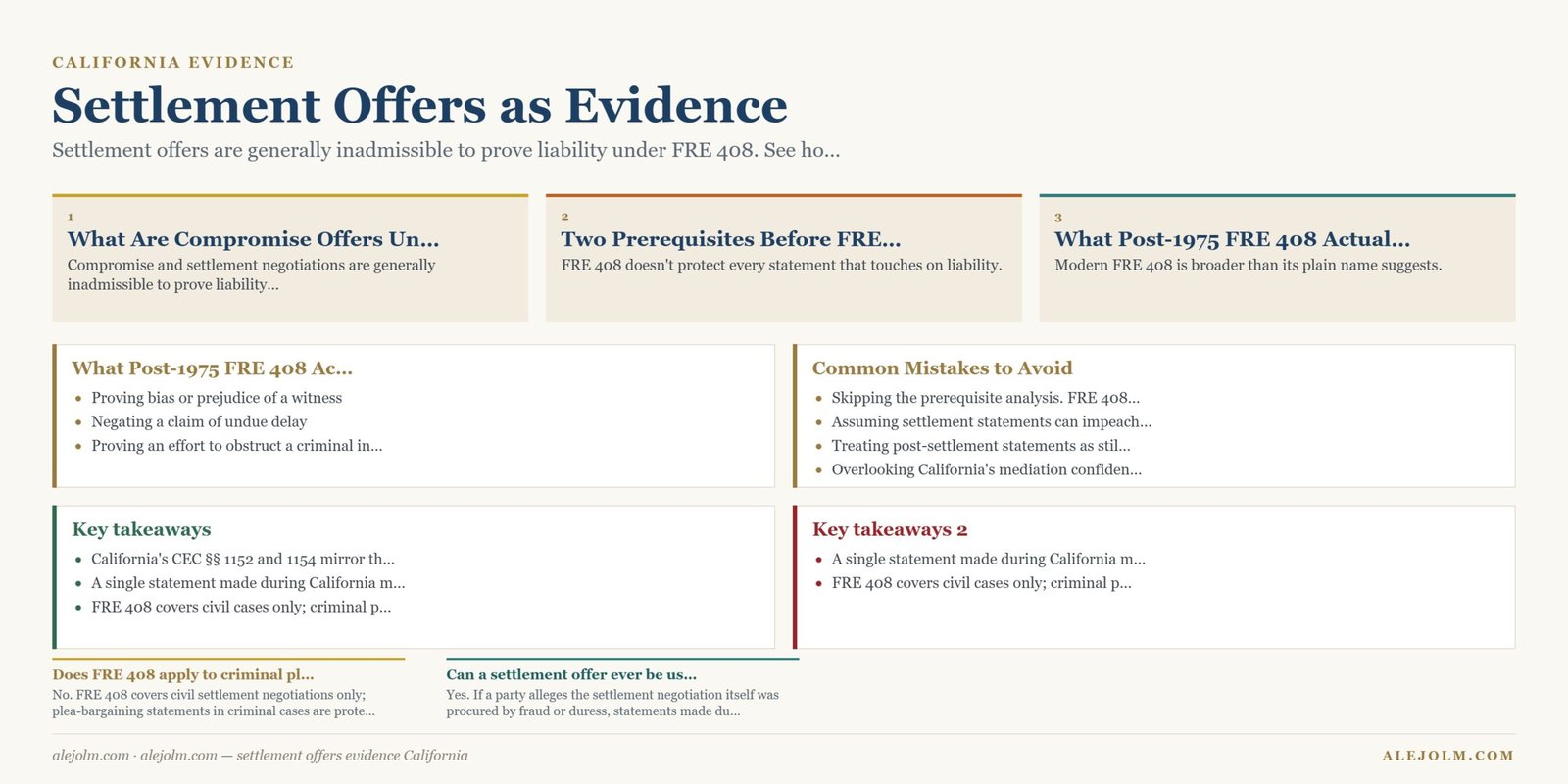
Compromise and settlement negotiations are generally inadmissible to prove liability or the amount of a disputed claim. Federal Rule of Evidence 408 protects not just the offer itself but statements made during the negotiation, and California’s CEC §§ 1152 and 1154 provide overlapping — and in some respects broader — protection, especially around mediation.
The policy goal is straightforward: courts want parties to negotiate honestly without fear that candid settlement talk will be twisted into a courtroom admission of fault.
Two Prerequisites Before FRE 408 Applies
FRE 408 doesn’t protect every statement that touches on liability. Two conditions must exist first:
- A claim has been asserted or implied by the circumstances.
- A genuine dispute exists as to liability or the amount owed.
A spontaneous admission made before any claim exists isn’t protected — it’s just an admission. Similarly, refusing to pay a debt everyone agrees is owed isn’t a “compromise negotiation” because there’s no dispute to compromise. Bar examiners use this prerequisite gap constantly: a defendant who says “yeah, that was my fault” during a casual conversation weeks before any claim is filed has made an unprotected admission, not a protected settlement statement.
What Post-1975 FRE 408 Actually Covers
Modern FRE 408 is broader than its plain name suggests. It excludes not just the compromise offer but all statements made during compromise negotiations — meaning most of what gets said in a settlement conference is off-limits for use at trial, not just the dollar figure on the table.
FRE 408 does allow settlement-related evidence for other purposes, including:
- Proving bias or prejudice of a witness
- Negating a claim of undue delay
- Proving an effort to obstruct a criminal investigation or prosecution
Critically, FRE 408 does not permit using a settlement statement to impeach a witness with a prior inconsistent statement — a rule students frequently get backward on multiple-choice questions.
FRE 408 vs. California’s Compromise and Mediation Rules
California layers two separate protections on top of each other: the general compromise-offer exclusion in CEC § 1152/§ 1154, and a much stronger mediation confidentiality regime under CEC § 1119.
| Feature | Federal Rule (FRE 408) | California (CEC §§ 1152, 1154, 1119) |
|---|---|---|
| Protects compromise offers | Yes | Yes, under §§ 1152/1154 |
| Protects statements made during negotiation | Yes (post-1975 amendment) | Yes |
| Mediation-specific confidentiality | No separate federal mediation privilege in FRE 408 itself | Yes — CEC § 1119 makes nearly all mediation communications confidential and inadmissible, a distinct and broader protection layered on top of § 1152 |
| Overlap/double protection | Not applicable | A statement made during a mediated settlement can be protected under both § 1152 (compromise) and § 1119 (mediation confidentiality) |
| Scope | Civil cases; criminal plea talks covered separately by FRE 410 | Civil cases; CEC § 1154 addresses mediated settlement agreements specifically |
This mediation layer is the standout California-specific point. A statement made during a formal mediation session in California can be doubly protected — first as a settlement communication, and separately as a confidential mediation communication under § 1119 — creating a broader shield than anything available under the Federal Rules alone.
Reservation-of-Rights Language Strengthens (But Isn’t Required for) Protection
A settlement offer phrased as “I’ll pay $15,000 without admitting liability” is still protected under FRE 408 even without that reservation language — the rule doesn’t require an explicit disclaimer. But including reservation language makes the protective intent unmistakable to a court and forecloses any argument that the statement was meant as a standalone factual admission rather than a negotiating position.
Worked Example: The Half-Price Settlement Offer
Theo is sued by a former business partner, Yuki, for $50,000 in a contract dispute. During settlement talks, Theo’s attorney offers $10,000 to resolve the matter. Yuki rejects the offer and proceeds to trial. Yuki’s attorney wants to introduce the $10,000 offer at trial, arguing it shows Theo believed he owed something.
Walk through the analysis:
- Prerequisites met? Yes — Yuki has asserted a claim ($50,000), and Theo disputes the amount (he offered only $10,000), so a genuine dispute exists.
- Is the offer protected? Yes, under FRE 408 — the offer to compromise is inadmissible to prove liability or the amount owed, even though logically it might suggest Theo believed he owed something.
- Could it come in for another purpose? Only if offered for something other than liability or amount — for example, to prove Yuki’s attorney’s bias in later testimony, not to prove Theo’s fault.
- California variation: If this settlement offer was exchanged during a formal mediation session, CEC § 1119 would provide an independent, arguably even stronger, confidentiality bar on top of § 1152 — making California’s protection layered where the federal system provides only the § 408 exclusion.
Common Mistakes to Avoid
- Skipping the prerequisite analysis. FRE 408 requires both an asserted claim and a genuine dispute — a pre-claim admission isn’t protected.
- Assuming settlement statements can impeach a witness. They generally cannot — this is an explicit carve-out students often miss.
- Treating post-settlement statements as still protected. Once settlement is reached, later statements about it aren’t shielded as “negotiation” statements anymore.
- Overlooking California’s mediation confidentiality layer. CEC § 1119 is a distinct, broader protection from the general compromise-offer rule and frequently appears as its own tested point.
FAQ
Does FRE 408 apply to criminal plea negotiations?
No. FRE 408 covers civil settlement negotiations only; plea-bargaining statements in criminal cases are protected separately under FRE 410.
Can a settlement offer ever be used to prove fraud?
Yes. If a party alleges the settlement negotiation itself was procured by fraud or duress, statements made during that negotiation may be admissible to prove the fraud, even though the offer itself remains excluded for liability purposes.
Is mediation confidentiality the same thing as the settlement-offer exclusion in California?
No. CEC § 1152/§ 1154 protects compromise offers generally; CEC § 1119 is a separate, broader confidentiality rule specific to formal mediation communications, and both can apply to the same statement.
Key Takeaways
- FRE 408 requires both an asserted claim and a genuine dispute before compromise-negotiation protection applies.
- Post-1975 FRE 408 protects statements made during negotiations, not just the offer itself, but never permits using settlement statements to impeach a witness.
- California’s CEC §§ 1152 and 1154 mirror the federal compromise-offer rule but add a distinct, broader mediation confidentiality protection under CEC § 1119.
- A single statement made during California mediation can be protected under two separate statutes at once.
- FRE 408 covers civil cases only; criminal plea discussions are separately protected under FRE 410.
Related guides
- medical expense payments as evidence
- relevance and probative value in California
- confrontation clause and hearsay
Sources and further reading
- California Evidence Code § 1119 (mediation confidentiality)
- California Evidence Code § 1152
- Federal Rule of Evidence 408
This article is educational and is not legal advice. Consult a licensed California attorney about your situation.