
What Is the Confrontation Clause?
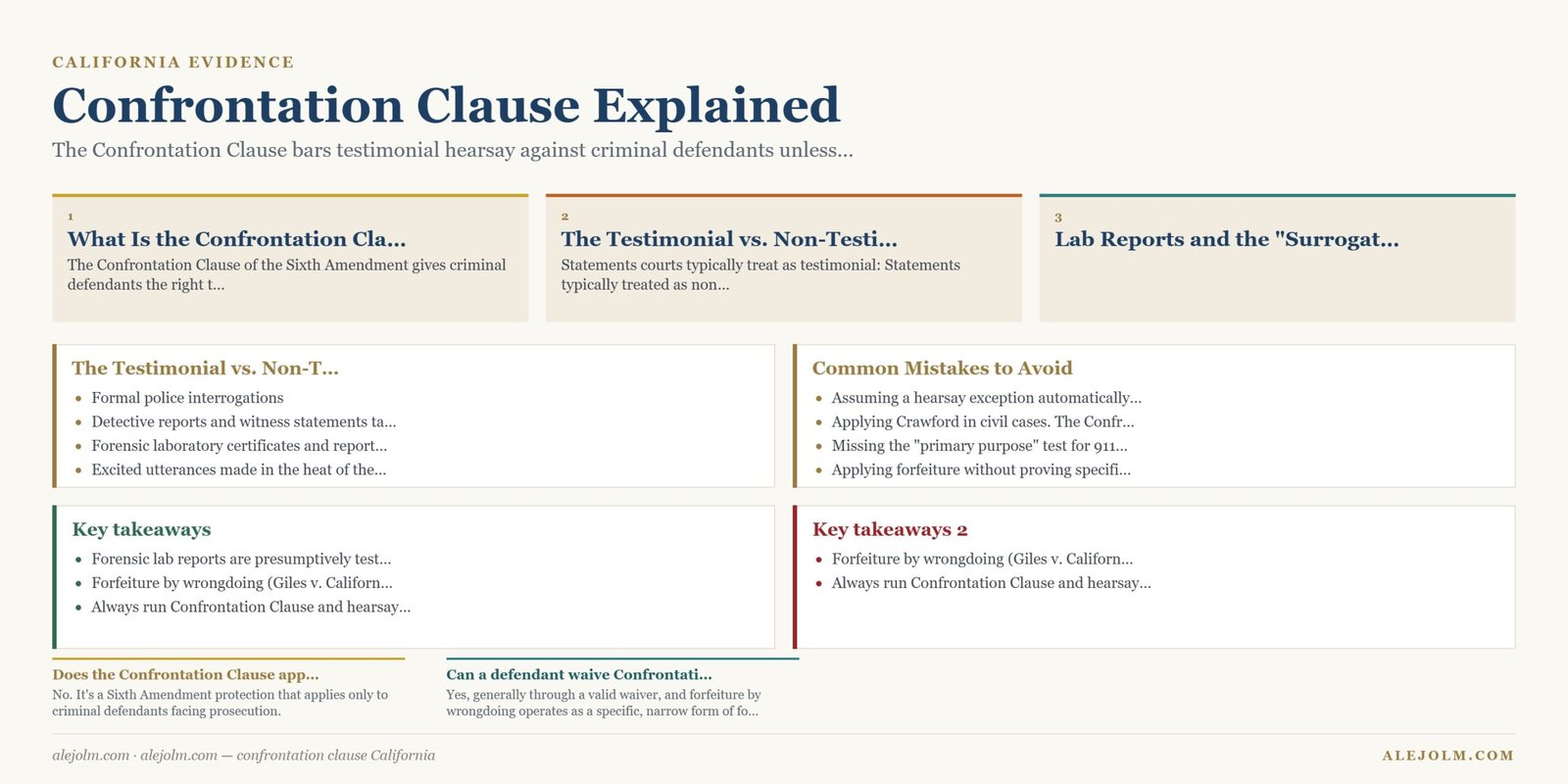
The Confrontation Clause of the Sixth Amendment gives criminal defendants the right to confront the witnesses against them. Since Crawford v. Washington (2004), it bars testimonial out-of-court statements offered against a criminal defendant unless the declarant is unavailable and the defendant had a prior opportunity to cross-examine them. It applies only in criminal cases and operates independently of the hearsay rule.
That independence is the trap. A statement can satisfy a hearsay exception and still be constitutionally excluded — or it can be hearsay-inadmissible on its face and irrelevant to Confrontation Clause analysis because it isn’t testimonial. California defendants get this constitutional protection identically to defendants anywhere else in the country, because it’s a federal constitutional right, not a state evidentiary rule.
The Testimonial vs. Non-Testimonial Distinction
Crawford replaced the older “indicia of reliability” test from Ohio v. Roberts with a bright-line rule: testimonial statements are barred unless the declarant is available for cross-examination (at trial or previously). A statement is testimonial when it’s made with the primary purpose of establishing or proving past events potentially relevant to a later criminal prosecution.
Statements courts typically treat as testimonial:
- Formal police interrogations
- Detective reports and witness statements taken for prosecution
- Forensic laboratory certificates and reports (Melendez-Diaz v. Massachusetts)
Statements typically treated as non-testimonial (and therefore outside Confrontation Clause scrutiny, even if barred or admitted under separate hearsay rules):
- Excited utterances made in the heat of the moment
- Statements to medical providers for treatment purposes
- Business records created in the ordinary course of business
- 911 calls describing an ongoing emergency (per Davis v. Washington‘s primary-purpose test)
The 911-call distinction is a favorite exam fact pattern: a caller describing an active, unfolding threat is non-testimonial (the purpose is resolving an emergency), but the same caller describing what already happened, after the danger has passed, shifts toward testimonial.
Lab Reports and the “Surrogate Analyst” Problem
Melendez-Diaz v. Massachusetts held that forensic laboratory reports are presumptively testimonial. If the prosecution wants to use a lab report to prove, say, drug weight or DNA identification, the analyst who prepared or certified the report generally must testify or be available for cross-examination. Critically, a surrogate analyst — someone else from the lab who didn’t perform the original testing — cannot substitute for the analyst who actually did the work and certified the results. This rule creates real logistical headaches for prosecutors and is heavily tested because it’s counterintuitive: students assume any qualified lab witness will do.
Forfeiture by Wrongdoing: A High Intent Bar
If a defendant’s own misconduct causes a witness to become unavailable, the defendant can forfeit the Confrontation Clause objection — the testimonial statement comes in despite the lack of cross-examination. But Giles v. California set a demanding standard: the defendant must have acted with the specific intent to prevent the witness from testifying. Mere negligence, or even causing the unavailability through unrelated wrongdoing (like killing the witness for a different motive entirely), is not enough on its own to trigger forfeiture. This intent requirement frequently defeats prosecutors’ forfeiture arguments in domestic violence cases where the causal link to witness silencing is murky.
Confrontation Clause vs. Hearsay Rule: Two Separate Filters in California
Because California courts apply Crawford the same way federal courts do (it’s a federal constitutional right binding on the states), there’s no CEC-vs-FRE divergence in the underlying test. But the way the doctrine interacts with California’s hearsay exceptions produces its own exam-relevant nuance.
| Feature | Hearsay Rule (statutory) | Confrontation Clause (constitutional) |
|---|---|---|
| Applies to | Civil and criminal cases | Criminal cases only |
| Governing rule | FRE 802 / CEC § 1200 and their exceptions | Sixth Amendment, as interpreted in Crawford |
| Key question | Is the statement offered for the truth, and does an exception apply? | Is the statement testimonial, and was the declarant subject to cross-examination? |
| Effect of satisfying the other doctrine | A hearsay exception does not immunize a statement from Confrontation Clause exclusion | A non-testimonial statement can still be barred as inadmissible hearsay |
| California-specific wrinkle | CEC § 1349 allows certain prior witness statements when the witness testifies and is cross-examined at trial | Because the witness is present and cross-examined, no Confrontation Clause problem arises under § 1349 scenarios |
The exam-critical point: passing one test does not mean you pass the other. A statement admissible under FRE 804(b)(3) (statement against penal interest) can still violate the Confrontation Clause if it’s testimonial and inculpates a co-defendant who never had a chance to cross-examine the declarant — see also Bruton v. United States for the related problem of a non-testifying codefendant’s confession.
Worked Example: The Domestic Violence 911 Call
Officers respond after Renata calls 911, telling the dispatcher, “He’s hitting me right now, send help.” Renata later refuses to testify at her ex-partner Marcus’s trial for domestic battery. The prosecution wants to play the 911 recording.
Walk through the analysis:
- Is this hearsay? Yes, if offered for the truth of the matter (that Marcus was hitting her) — but it likely qualifies as an excited utterance exception in most jurisdictions.
- Is it testimonial? Apply the primary-purpose test from Davis v. Washington. Because Renata was describing an ongoing emergency as it happened, seeking help rather than building a case, the statement is non-testimonial.
- Confrontation Clause result: Because it’s non-testimonial, Crawford doesn’t bar it even though Renata won’t testify.
- Contrast: If the same statement had been made during a follow-up interview after police secured the scene and the danger had passed, it would likely be testimonial, and Renata’s refusal to testify would bar its use unless Marcus had a prior opportunity to cross-examine her or the prosecution could establish forfeiture by wrongdoing with specific intent.
Common Mistakes to Avoid
- Assuming a hearsay exception automatically satisfies the Confrontation Clause. They’re independent inquiries in criminal cases.
- Applying Crawford in civil cases. The Confrontation Clause is a criminal constitutional protection only.
- Missing the “primary purpose” test for 911 calls. Ongoing-emergency statements are non-testimonial; post-emergency statements usually are testimonial.
- Applying forfeiture without proving specific intent. Giles requires intent to silence the witness, not mere causation of unavailability.
FAQ
Does the Confrontation Clause apply in civil lawsuits?
No. It’s a Sixth Amendment protection that applies only to criminal defendants facing prosecution.
Can a defendant waive Confrontation Clause rights?
Yes, generally through a valid waiver, and forfeiture by wrongdoing operates as a specific, narrow form of forfeiture requiring proof of intent to silence the witness.
Is a surrogate analyst ever acceptable under Melendez-Diaz?
Generally no — the analyst who performed or certified the specific test must be available for cross-examination; a different lab employee testifying in their place does not satisfy the Confrontation Clause.
Key Takeaways
- The Confrontation Clause bars testimonial hearsay against a criminal defendant unless the declarant is unavailable and the defendant had a prior opportunity to cross-examine.
- Crawford v. Washington replaced the reliability-based Ohio v. Roberts test with the testimonial/non-testimonial framework.
- Forensic lab reports are presumptively testimonial (Melendez-Diaz), and a surrogate analyst cannot substitute for the certifying analyst.
- Forfeiture by wrongdoing (Giles v. California) requires specific intent to silence the witness, not mere negligence.
- Always run Confrontation Clause and hearsay as two separate analyses in a criminal case — satisfying one does not satisfy the other.
This article is educational and is not legal advice. Consult a licensed California attorney about your situation.
Related guides
- relevance and probative value in California
- best evidence rule in California
- prior acts and habit evidence