
What Is Transfer of Venue?
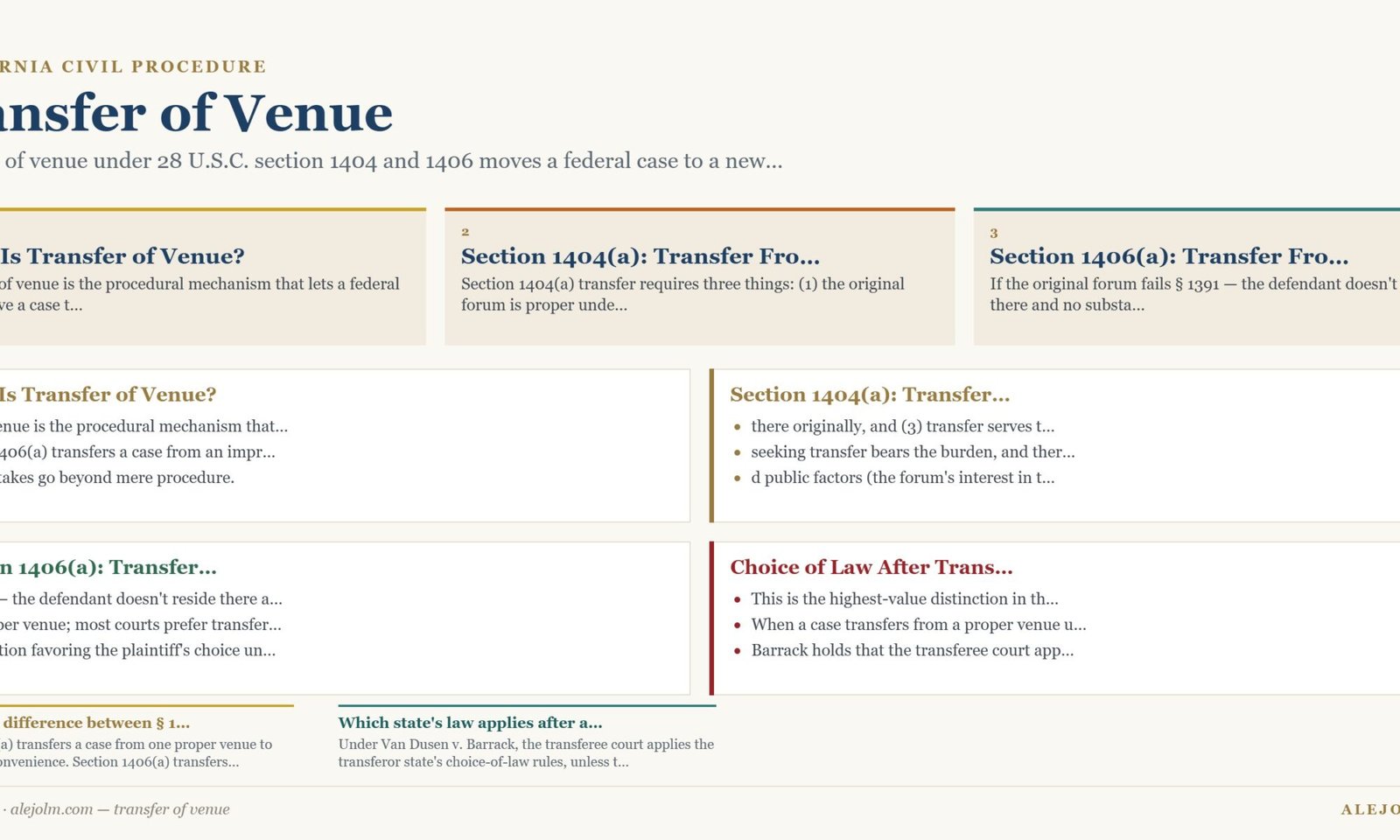
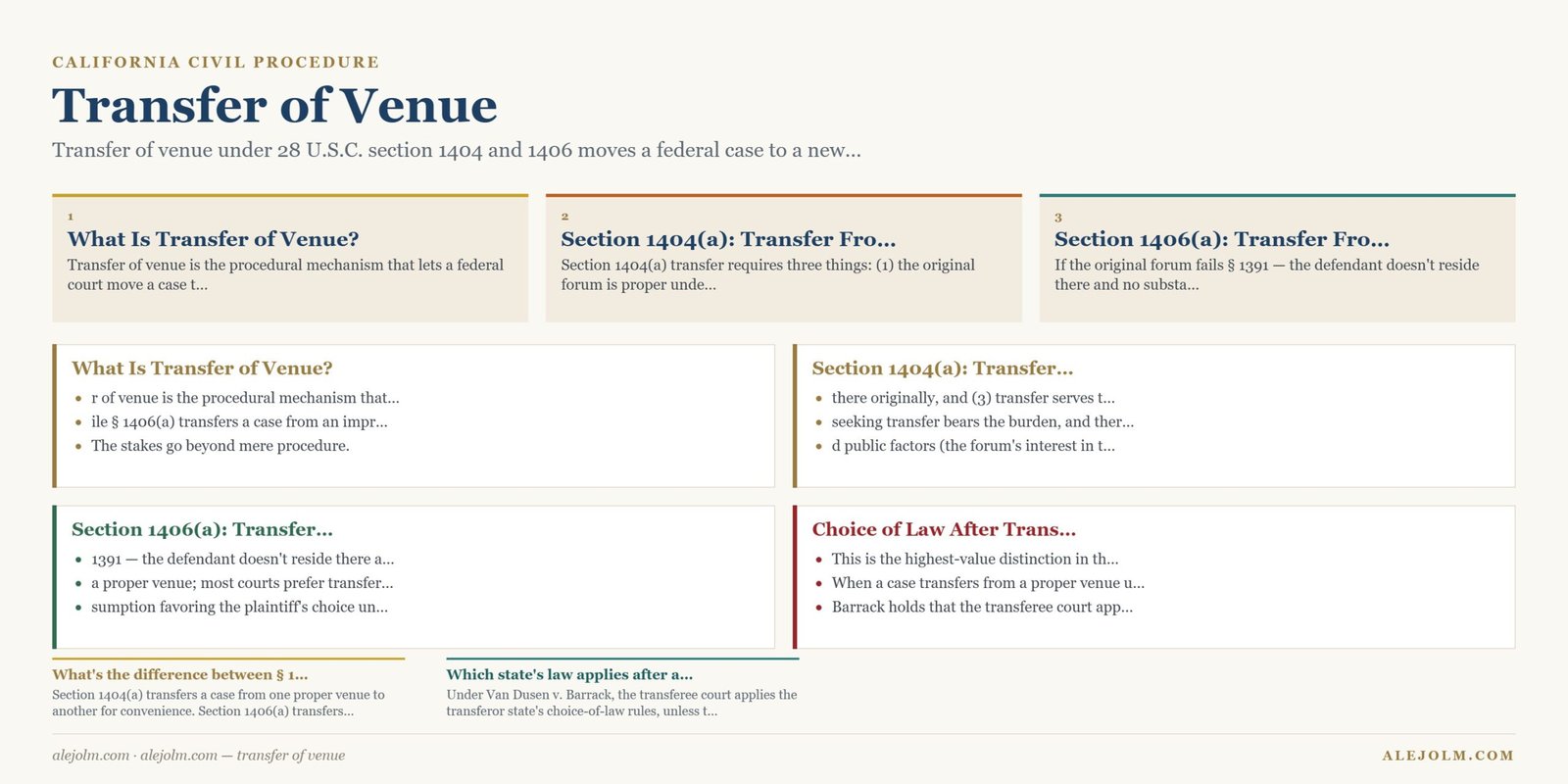
Transfer of venue is the procedural mechanism that lets a federal court move a case to another federal district court. Two different statutes govern it, and mixing them up is one of the most common — and most consequential — mistakes on the California Bar Exam: § 1404(a) transfers a case from a proper venue to another proper venue for convenience, while § 1406(a) transfers a case from an improper venue to a proper one, or dismisses it if justice requires.
The stakes go beyond mere procedure. Which statute applies determines which state’s substantive law follows the case after transfer.
Section 1404(a): Transfer From a Proper Venue
Section 1404(a) transfer requires three things: (1) the original forum is proper under § 1391, (2) the transferee forum is also proper — the case could have been filed there originally, and (3) transfer serves the convenience of parties and witnesses and the interest of justice.
The party seeking transfer bears the burden, and there’s a presumption favoring the plaintiff’s original choice of forum. Courts weigh private factors (access to evidence, witness convenience, travel cost) and public factors (the forum’s interest in the dispute, docket congestion, familiarity with the applicable law).
Section 1406(a): Transfer From an Improper Venue
If the original forum fails § 1391 — the defendant doesn’t reside there and no substantial events occurred there — § 1406(a) applies instead. The court may either dismiss the case or transfer it to a proper venue; most courts prefer transfer to avoid killing the case on a statute-of-limitations technicality. Unlike § 1404, there’s no presumption favoring the plaintiff’s choice under § 1406 — the decision is squarely within the court’s discretion.
| Feature | § 1404(a) | § 1406(a) |
|---|---|---|
| Original venue | Proper | Improper |
| Presumption favoring plaintiff | Yes | No |
| Remedy | Transfer only | Transfer or dismissal |
| Choice-of-law rule on transfer | Transferor’s law (Van Dusen) | Transferee’s own law |
Choice of Law After Transfer: The Van Dusen Rule
This is the highest-value distinction in the whole topic. When a case transfers from a proper venue under § 1404(a), Van Dusen v. Barrack holds that the transferee court applies the transferor state’s choice-of-law rules — not its own. The idea is that a § 1404 transfer changes the courtroom, not the law that governs the plaintiff’s substantive rights.
When a case transfers from an improper venue under § 1406(a), the opposite rule applies: the transferee court applies its own choice-of-law rules. Because venue was never properly established in the original forum, that forum’s law was never validly “in control” of the case to begin with.
The Atlantic Marine Exception for Forum-Selection Clauses
Atlantic Marine Construction, Inc. v. U.S. District Court (2013) carved out a major exception to both the convenience analysis and the Van Dusen rule. A valid forum-selection clause is presumptively enforceable, and a court should grant a § 1404 transfer to the selected forum — even if the ordinary convenience factors wouldn’t otherwise support it.
Critically, when transfer is based on a forum-selection clause, the transferee court applies its own choice-of-law rules, not the transferor’s — an exception to Van Dusen. The theory: parties who agreed to litigate in a specific forum are presumed to have also agreed to that forum’s substantive law.
California’s Transfer Statute
California has its own transfer mechanism under Cal. Code Civ. Proc. § 397, allowing transfer for “the convenience of parties and witnesses,” and California courts generally follow Van Dusen-like principles when transferring cases within the state. When a case moves between federal districts under § 1404, or from federal court to California state court, California applies its own choice-of-law rules — Klaxon principles in a diversity posture, or California’s internal conflict-of-laws rules otherwise — once the case lands in a California forum.
Worked Example
Plaintiff, a State A resident, files suit in federal court in State B against Defendant, a State C resident. The dispute arises entirely from events in State C — negotiation, performance, and breach all happened there. State B has no connection to the case at all. Defendant moves to transfer to State C. State A law has a favorable statute of limitations for Plaintiff; State C law does not.
Analysis: State B is an improper venue under § 1391 — no defendant resides there, and no significant events occurred there — so this is a § 1406(a) transfer, not a § 1404(a) transfer. Because § 1406 governs, the transferee court (State C) applies its own choice-of-law rules once the case arrives, not State A’s favorable rule. If State B had somehow been a proper venue instead, § 1404(a) and Van Dusen would have controlled, and Plaintiff would have kept the benefit of State A’s favorable statute of limitations even after transfer.
Common Mistakes to Avoid
- Applying § 1404 analysis when venue was actually improper — that’s a § 1406 issue with a different choice-of-law consequence.
- Assuming Van Dusen applies when a forum-selection clause is present — Atlantic Marine reverses that rule.
- Applying the “presumption favoring plaintiff’s choice” to a § 1406 transfer, where no such presumption exists.
- Forgetting that the transferee forum must independently be proper before a § 1404 transfer can occur.
FAQ
What’s the difference between § 1404(a) and § 1406(a) transfer?
Section 1404(a) transfers a case from one proper venue to another for convenience. Section 1406(a) transfers a case from an improper venue to a proper one, or dismisses it — and unlike § 1404, no presumption favors the plaintiff’s original forum choice.
Which state’s law applies after a § 1404 transfer?
Under Van Dusen v. Barrack, the transferee court applies the transferor state’s choice-of-law rules, unless the transfer is based on a forum-selection clause, in which case Atlantic Marine directs the transferee court to apply its own choice-of-law rules instead.
Does a forum-selection clause guarantee transfer under § 1404?
Yes, in practice. Atlantic Marine treats a valid forum-selection clause as presumptively enforceable, and courts should grant transfer to the selected forum even when ordinary convenience factors would not otherwise support it.
Key Takeaways
- Section 1404(a) governs transfer from a proper venue; § 1406(a) governs transfer from an improper venue.
- Van Dusen v. Barrack keeps the transferor’s choice-of-law rules alive after a § 1404 transfer.
- Atlantic Marine flips that rule when a forum-selection clause drives the transfer, applying the transferee’s own law instead.
- Section 1406 transfers always use the transferee court’s own choice-of-law rules.
- California’s Code of Civil Procedure § 397 provides a parallel state-court transfer mechanism.
This article is educational and is not legal advice. Consult a licensed California attorney about your situation.