
What Is the Daimler “At Home” Standard?
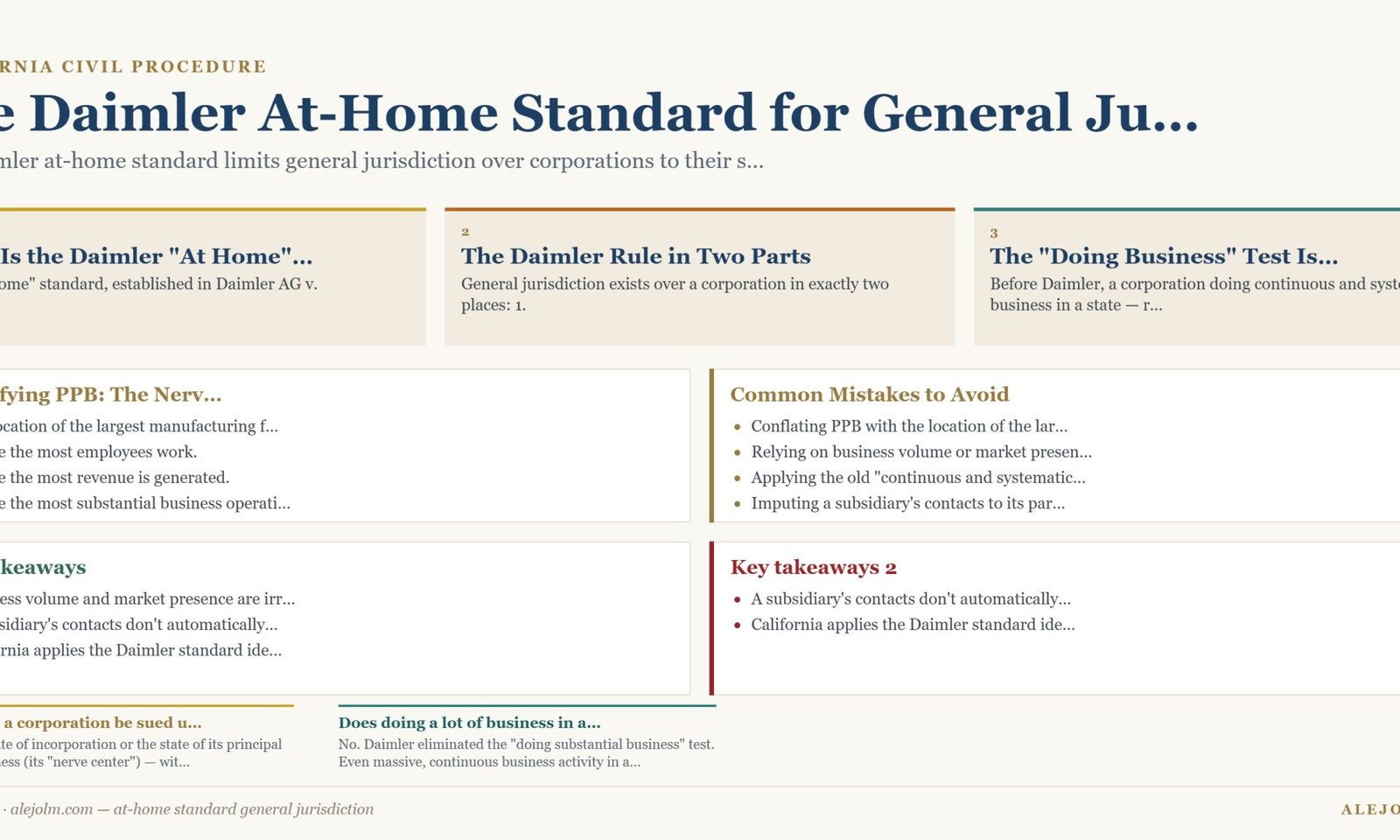
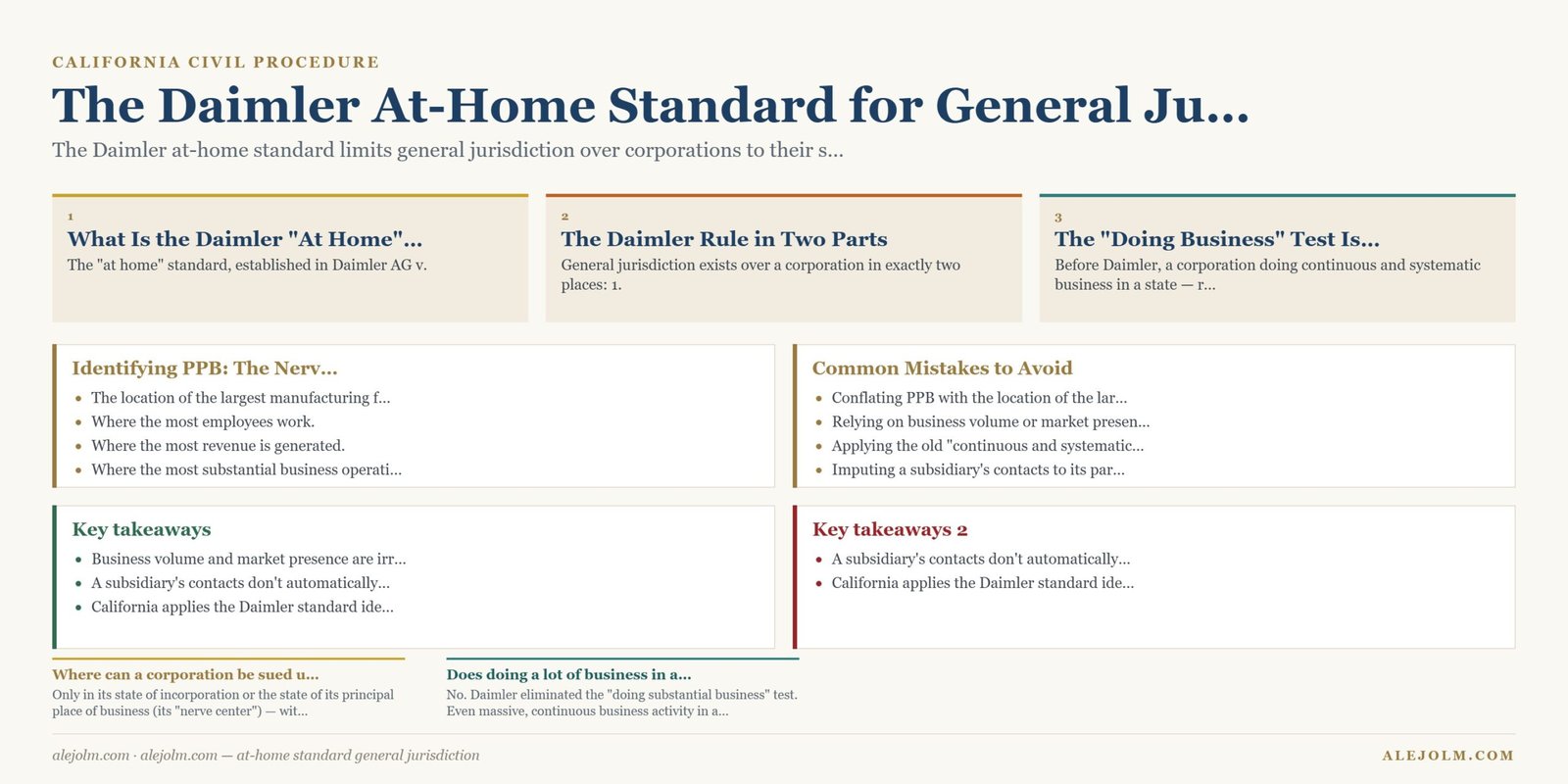
The “at home” standard, established in Daimler AG v. Bauman (2014), sets the threshold for general jurisdiction over a corporate defendant. A corporation is subject to general jurisdiction in a forum only if it is “at home” there — meaning it’s incorporated there, or its principal place of business is located there.
That’s a dramatic narrowing from the pre-Daimler “doing substantial business” test, and it applies nationwide, in both state and federal courts, including California. If you remember one binary rule for general jurisdiction over a company, this is it.
The Daimler Rule in Two Parts
General jurisdiction exists over a corporation in exactly two places:
- The state of incorporation.
- The state of the corporation’s principal place of business (PPB) — defined by Hertz Corp. v. Friend as the corporation’s “nerve center,” the place where officers direct, control, and coordinate its substantial business operations.
A defendant resisting jurisdiction bears no burden here; once Daimler is raised, the plaintiff must affirmatively prove incorporation or PPB in the forum to establish general jurisdiction.
The “Doing Business” Test Is Dead
Before Daimler, a corporation doing continuous and systematic business in a state — regardless of volume or profitability — could face general jurisdiction there. Daimler eliminated that entirely. A corporation can generate a billion dollars a year in a state and still have zero general jurisdiction there if it isn’t incorporated there and its PPB is elsewhere.
Daimler left the door open for “exceptional cases” outside the incorporation/PPB rule but declined to define them, and courts have overwhelmingly refused to manufacture new exceptions since.
Identifying PPB: The Nerve Center, Not the Biggest Facility
The most common student error is conflating PPB with the location of a company’s largest operations. Under Hertz, PPB is not determined by:
- The location of the largest manufacturing facility.
- Where the most employees work.
- Where the most revenue is generated.
- Where the most substantial business operations occur.
PPB is the “nerve center” — where senior management actually directs and controls the company, typically evidenced by headquarters location, board meeting location, and executive residence. A company can have its largest factory in State A and its PPB in State B; only State B (plus the state of incorporation) supports general jurisdiction.
| Basis for general jurisdiction | Valid under Daimler? |
|---|---|
| State of incorporation | Yes |
| State of principal place of business (nerve center) | Yes |
| State with the largest sales volume | No |
| State with the most employees or the biggest factory | No |
| State where the company has done business for decades | No |
Subsidiaries and Foreign Corporations
A subsidiary’s contacts do not impute to its parent corporation for jurisdictional purposes absent an “alter ego” relationship, which requires piercing the corporate veil. A subsidiary’s PPB in a state does not automatically create general jurisdiction over the parent there.
Foreign corporations feel Daimler‘s bite hardest: a corporation with no U.S. incorporation and no U.S.-based PPB generally has no general jurisdiction anywhere in the United States, no matter how much business it does here — it must rely instead on specific jurisdiction tied to the particular claim.
California’s Application of Daimler
Under Cal. Code Civ. Proc. § 410.10, California applies the Daimler/Hertz analysis identically to federal courts. A non-California corporation incorporated elsewhere, with its PPB elsewhere, has no general jurisdiction in California — even if it does enormous business here, since California is a major national commercial hub for countless out-of-state and international companies.
If a defendant’s incorporation and PPB are both outside California, move directly to a specific jurisdiction analysis instead. And remember: a California-incorporated subsidiary of a foreign parent is analyzed independently — the parent’s absence from California doesn’t shield the subsidiary from California general jurisdiction if the subsidiary itself is incorporated or headquartered there.
Worked Example
Manufacturer, incorporated in Japan with its PPB in Tokyo, sells pharmaceuticals into all 50 U.S. states through distributors, generating roughly $500 million in annual U.S. revenue. A consumer injured by Manufacturer’s product in State X, who bought it from a State X pharmacy, sues Manufacturer in State X state court. Manufacturer has no offices, employees, or facilities in State X, and all decisions are made in Tokyo.
Analysis: General jurisdiction fails — Manufacturer is “at home” in neither State X nor anywhere else in the U.S., regardless of its $500 million in American sales. But specific jurisdiction is likely proper: Manufacturer purposefully availed itself of State X by selling its products there through distributors, and the claim arises directly from that contact. The motion to dismiss should be denied on specific jurisdiction grounds, even though general jurisdiction is unavailable.
Common Mistakes to Avoid
- Conflating PPB with the location of the largest operations or most employees.
- Relying on business volume or market presence to support general jurisdiction — it’s irrelevant post-Daimler.
- Applying the old “continuous and systematic” business test, which Daimler eliminated nationwide.
- Imputing a subsidiary’s contacts to its parent without an alter-ego showing.
FAQ
Where can a corporation be sued under general jurisdiction after Daimler?
Only in its state of incorporation or the state of its principal place of business (its “nerve center”) — with rare exceptions the Supreme Court has never clearly defined.
Does doing a lot of business in a state create general jurisdiction over a corporation?
No. Daimler eliminated the “doing substantial business” test. Even massive, continuous business activity in a state does not create general jurisdiction there unless the corporation is also incorporated or headquartered there.
Can a parent company be sued wherever its subsidiary is “at home”?
Generally no. A subsidiary’s contacts, incorporation, and PPB do not impute to its parent for jurisdictional purposes unless the subsidiary is truly an alter ego of the parent.
Key Takeaways
- General jurisdiction over a corporation exists only in its state of incorporation or its principal place of business.
- PPB means the corporate “nerve center” — where management directs operations — not the biggest facility or the most revenue.
- Business volume and market presence are irrelevant to general jurisdiction after Daimler.
- A subsidiary’s contacts don’t automatically create jurisdiction over its parent.
- California applies the Daimler standard identically to federal courts.
This article is educational and is not legal advice. Consult a licensed California attorney about your situation.
Related guides
- specific vs. general jurisdiction
- minimum contacts
- personal jurisdiction framework
- California’s long-arm statute