
What Is a Motion to Quash Service of Summons?
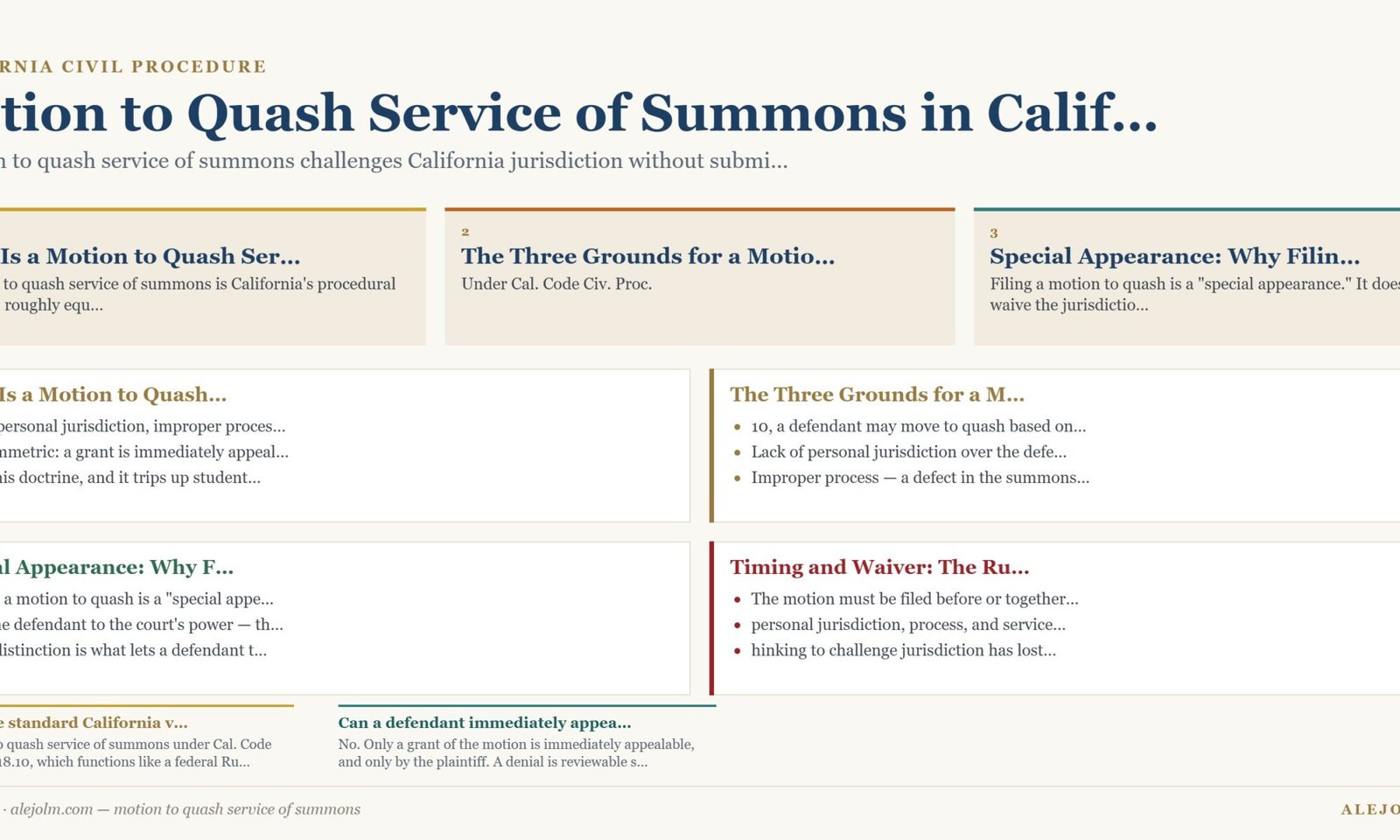
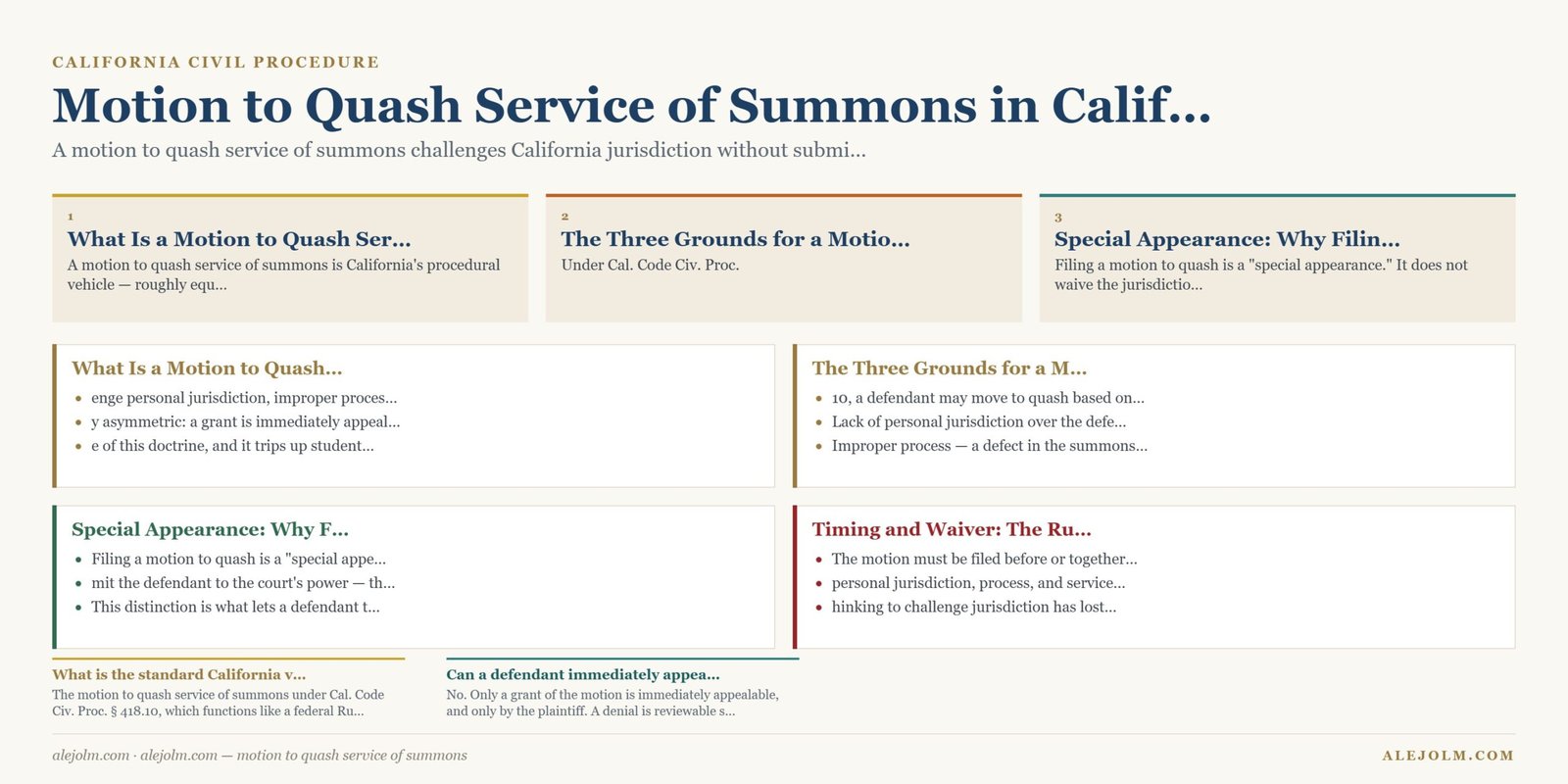
A motion to quash service of summons is California’s procedural vehicle — roughly equivalent to a federal Rule 12(b)(2), (4), or (5) motion — for a defendant to challenge personal jurisdiction, improper process, or improper service, without submitting to the court’s authority. It’s a “special appearance,” and its appellate treatment is sharply asymmetric: a grant is immediately appealable, but a denial is reviewable only by extraordinary writ.
That asymmetry is the single most tested feature of this doctrine, and it trips up students who assume California appellate practice mirrors federal practice.
The Three Grounds for a Motion to Quash
Under Cal. Code Civ. Proc. § 418.10, a defendant may move to quash based on:
- Lack of personal jurisdiction over the defendant.
- Improper process — a defect in the summons document itself.
- Improper service of process — a defect in how service was carried out.
The underlying substantive standards for what counts as valid jurisdiction, process, and service are the same standards covered under personal jurisdiction and service-of-process doctrine generally — the motion to quash is simply how California preserves and raises those defenses in state court.
Special Appearance: Why Filing the Motion Doesn’t Waive the Objection
Filing a motion to quash is a “special appearance.” It does not waive the jurisdictional objection or submit the defendant to the court’s power — the opposite of a general appearance, which would waive the objection. This distinction is what lets a defendant test jurisdiction without gambling on losing the defense entirely.
Timing and Waiver: The Rule That Ends Careers
The motion must be filed before or together with the demurrer, the answer, or a motion to strike. Filing any of those first — or simply failing to raise the motion to quash alongside them — waives the personal jurisdiction, process, and service defenses forever, mirroring the logic of federal Rule 12(h)(1).
A defendant who files an answer before thinking to challenge jurisdiction has lost that defense irreversibly, even if the service really was defective.
The Appellate Asymmetry: The Highest-Yield Rule in This Topic
| Outcome | Appealable how? |
|---|---|
| Motion granted | Immediately appealable by the plaintiff, as a matter of statutory right |
| Motion denied | Not independently appealable — review only by extraordinary writ (mandate or prohibition) |
If the trial court denies the motion, the defendant cannot immediately appeal. The only avenue for immediate review is a writ of mandate or writ of prohibition, which is discretionary and requires the defendant to show that ordinary appeal after final judgment would be an inadequate remedy — not a trivial burden. Without a successful writ petition, the defendant must litigate the entire case to final judgment and raise the jurisdictional defect on ordinary appeal at that point.
What Happens After a Grant?
A grant of the motion doesn’t necessarily end the case for good. The plaintiff can typically refile and effect proper service, re-litigating the jurisdictional question in a fresh action. The motion to quash is a gate, not automatically a final termination of the plaintiff’s claim.
Strategic Considerations While the Motion Is Pending
If the motion is denied and the case proceeds, discovery may begin while the jurisdictional question is still unresolved — whether pending on a writ petition or awaiting final judgment. Because California’s discovery rules interact with the limited/unlimited civil case classification, a defendant facing a denied motion to quash should consider seeking a stay of discovery pending resolution of the jurisdictional issue, to avoid absorbing discovery costs in a case that may ultimately lack jurisdiction altogether.
Worked Example
Defendant, sued in California superior court, timely files and serves a motion to quash service of summons before answering, arguing she has no minimum contacts with California. The trial court denies the motion. Defendant immediately files a notice of appeal from the denial, arguing the jurisdictional issue is too important to wait for final judgment.
Analysis: The appeal must be dismissed as improper. Under California practice, denial of a motion to quash is not independently appealable — only a grant is, as a matter of statutory right for the plaintiff. Defendant’s only avenue for immediate review is an extraordinary writ filed with the Court of Appeal, which is discretionary and requires a strong showing that ordinary appeal would be inadequate. Absent a successful writ petition, Defendant must litigate to final judgment and raise the jurisdictional defect on ordinary appeal, having preserved it by timely filing the motion to quash in the first place.
Common Mistakes to Avoid
- Filing an answer before a motion to quash, which waives the jurisdictional, process, and service defenses forever.
- Assuming a denial of the motion is immediately appealable — only a grant is.
- Confusing a special appearance with a general appearance; the motion to quash preserves the objection rather than waiving it.
- Treating a grant of the motion as res judicata against the plaintiff, when the plaintiff can typically refile with corrected service.
FAQ
What is the standard California vehicle for challenging personal jurisdiction?
The motion to quash service of summons under Cal. Code Civ. Proc. § 418.10, which functions like a federal Rule 12(b)(2), (4), or (5) motion and preserves the jurisdictional objection as a special appearance.
Can a defendant immediately appeal a denied motion to quash?
No. Only a grant of the motion is immediately appealable, and only by the plaintiff. A denial is reviewable solely through an extraordinary writ of mandate or prohibition, which is discretionary.
What happens if a defendant files an answer before moving to quash?
The defendant waives the personal jurisdiction, process, and service defenses forever. The motion to quash must be filed before or together with the demurrer, answer, or motion to strike.
Key Takeaways
- The motion to quash under CCP § 418.10 challenges personal jurisdiction, process, or service without waiving the objection.
- It must be filed before or with the demurrer, answer, or motion to strike, or the defenses are waived.
- A grant is immediately appealable by the plaintiff; a denial is reviewable only by extraordinary writ.
- A grant is not necessarily case-ending — the plaintiff can typically refile with corrected service.
This article is educational and is not legal advice. Consult a licensed California attorney about your situation.