
What Is Joinder of Claims Under Rule 18?
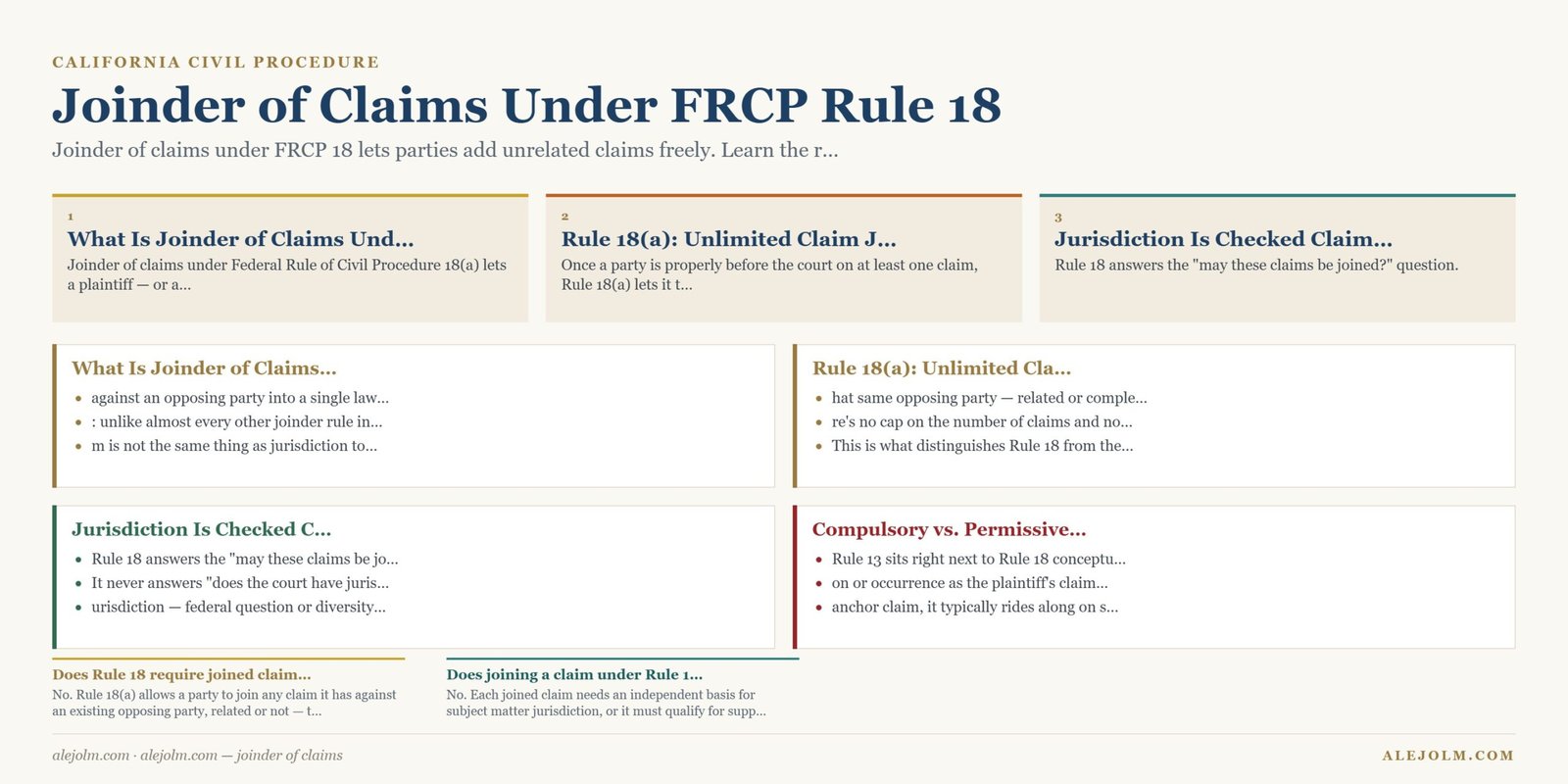
Joinder of claims under Federal Rule of Civil Procedure 18(a) lets a plaintiff — or a defendant asserting a counterclaim, crossclaim, or third-party claim — bring any and every claim it has against an opposing party into a single lawsuit, whether or not those claims are legally or factually related.
That last part is the whole point of Rule 18: unlike almost every other joinder rule in federal practice, it imposes no relatedness requirement at all. But procedural permission to join a claim is not the same thing as jurisdiction to hear it, and that gap is exactly what the California Bar Exam tests.
Rule 18(a): Unlimited Claim Joinder
Once a party is properly before the court on at least one claim, Rule 18(a) lets it tack on any other claim against that same opposing party — related or completely unrelated, as an independent claim or as an alternative theory. There’s no cap on the number of claims and no requirement that they arise from the same transaction or occurrence.
This is what distinguishes Rule 18 from the rules governing parties. Rule 20 (permissive party joinder) and Rule 13(a) (compulsory counterclaims) both require a same-transaction-or-occurrence connection. Rule 18 requires nothing of the sort — it only cares that the parties are already properly in the case.
Jurisdiction Is Checked Claim by Claim
Rule 18 answers the “may these claims be joined?” question. It never answers “does the court have jurisdiction over this claim?” Each joined claim needs its own independent basis for subject matter jurisdiction — federal question or diversity — unless it can ride along on supplemental jurisdiction under 28 U.S.C. § 1367.
Supplemental jurisdiction requires the tacked-on claim to share a “common nucleus of operative fact” with a claim that already has independent jurisdiction, the test from United Mine Workers v. Gibbs. An unrelated claim joined solely because Rule 18 allows it will not automatically qualify for supplemental jurisdiction — it needs its own jurisdictional footing.
| Joinder rule | Relatedness required? | Confers jurisdiction? |
|---|---|---|
| Rule 18(a) — claim joinder | No | No — check separately |
| Rule 13(a) — compulsory counterclaim | Yes (same T/O) | Usually yes, via supplemental jurisdiction |
| Rule 13(b) — permissive counterclaim | No | No — needs independent basis |
| Rule 20 — party joinder | Yes (same T/O + common question) | No — check separately |
Compulsory vs. Permissive Counterclaims
Rule 13 sits right next to Rule 18 conceptually, and the two are frequently tested together. A compulsory counterclaim under Rule 13(a) arises from the same transaction or occurrence as the plaintiff’s claim; it must be raised in the current lawsuit or it is forfeited forever. Because it shares a nucleus of operative fact with the anchor claim, it typically rides along on supplemental jurisdiction without needing its own independent basis.
A permissive counterclaim under Rule 13(b) does not share that same-transaction relationship. It’s optional — the defendant can raise it now or save it for another lawsuit — but if raised, it needs its own independent jurisdictional basis, just like an unrelated claim joined under Rule 18.
California’s Cross-Complaint Approach
California doesn’t use the federal vocabulary of counterclaims, crossclaims, and third-party complaints. Instead, California channels all of these — claims against the original plaintiff, against a co-defendant, or against a new third party — through a single procedural device called a cross-complaint.
California’s substantive philosophy toward claim joinder tracks Rule 18 fairly closely: broad joinder is generally permitted. But the umbrella terminology, and some of the compulsory-cross-complaint waiver mechanics, differ enough from federal practice that a California-flagged essay should use “cross-complaint” rather than “counterclaim.”
Worked Example
Plaintiff sues Defendant in federal court based on diversity jurisdiction, seeking $100,000 for injuries from a car accident. Plaintiff also wants to add a completely unrelated $10,000 breach of contract claim against the same Defendant, arising from a business deal two years earlier with no factual connection to the accident. Defendant argues the contract claim can’t be joined because it’s unrelated.
Analysis: Rule 18(a) permits the joinder outright — a plaintiff may join any claim against an existing opposing party regardless of relatedness. But the contract claim still needs its own jurisdictional basis. Because the parties are the same diverse parties as the accident claim, and a single plaintiff against a single defendant may freely aggregate unrelated claims for amount-in-controversy purposes, the $10,000 contract claim tacks onto the $100,000 accident claim without difficulty. The combined total clears $75,000, diversity is unaffected, and joinder is proper.
Common Mistakes to Avoid
- Assuming Rule 18 joinder automatically brings the joined claim’s jurisdiction along with it.
- Blurring Rule 18 (any claims) with Rule 20 (same-transaction-or-occurrence parties).
- Forgetting that an unrelated joined claim needs independent subject matter jurisdiction or supplemental jurisdiction — it doesn’t get either for free.
- Treating compulsory and permissive counterclaims the same way, when only compulsory counterclaims are mandatory and jurisdictionally “free.”
FAQ
Does Rule 18 require joined claims to be related?
No. Rule 18(a) allows a party to join any claim it has against an existing opposing party, related or not — that is its defining feature compared to Rules 13(a) and 20.
Does joining a claim under Rule 18 automatically give the court jurisdiction over it?
No. Each joined claim needs an independent basis for subject matter jurisdiction, or it must qualify for supplemental jurisdiction by sharing a common nucleus of operative fact with a claim that already has jurisdiction.
What does California call a counterclaim?
California uses the single umbrella term “cross-complaint” to cover claims against the plaintiff, a co-defendant, or a third party, rather than the federal vocabulary of counterclaim, crossclaim, and third-party complaint.
Key Takeaways
- Rule 18(a) allows unlimited joinder of claims against an existing opposing party, with no relatedness requirement.
- Joinder under Rule 18 never confers jurisdiction — check every joined claim independently.
- Compulsory counterclaims (Rule 13(a)) must be raised or are waived; permissive counterclaims (Rule 13(b)) are optional but need independent jurisdiction.
- California organizes all of these claim types under the single “cross-complaint” mechanism.
This article is educational and is not legal advice. Consult a licensed California attorney about your situation.
Related guides
- joinder of parties
- subject matter jurisdiction
- supplemental jurisdiction
- counterclaims and crossclaims
- pleading standards