
What Is Joinder of Parties?
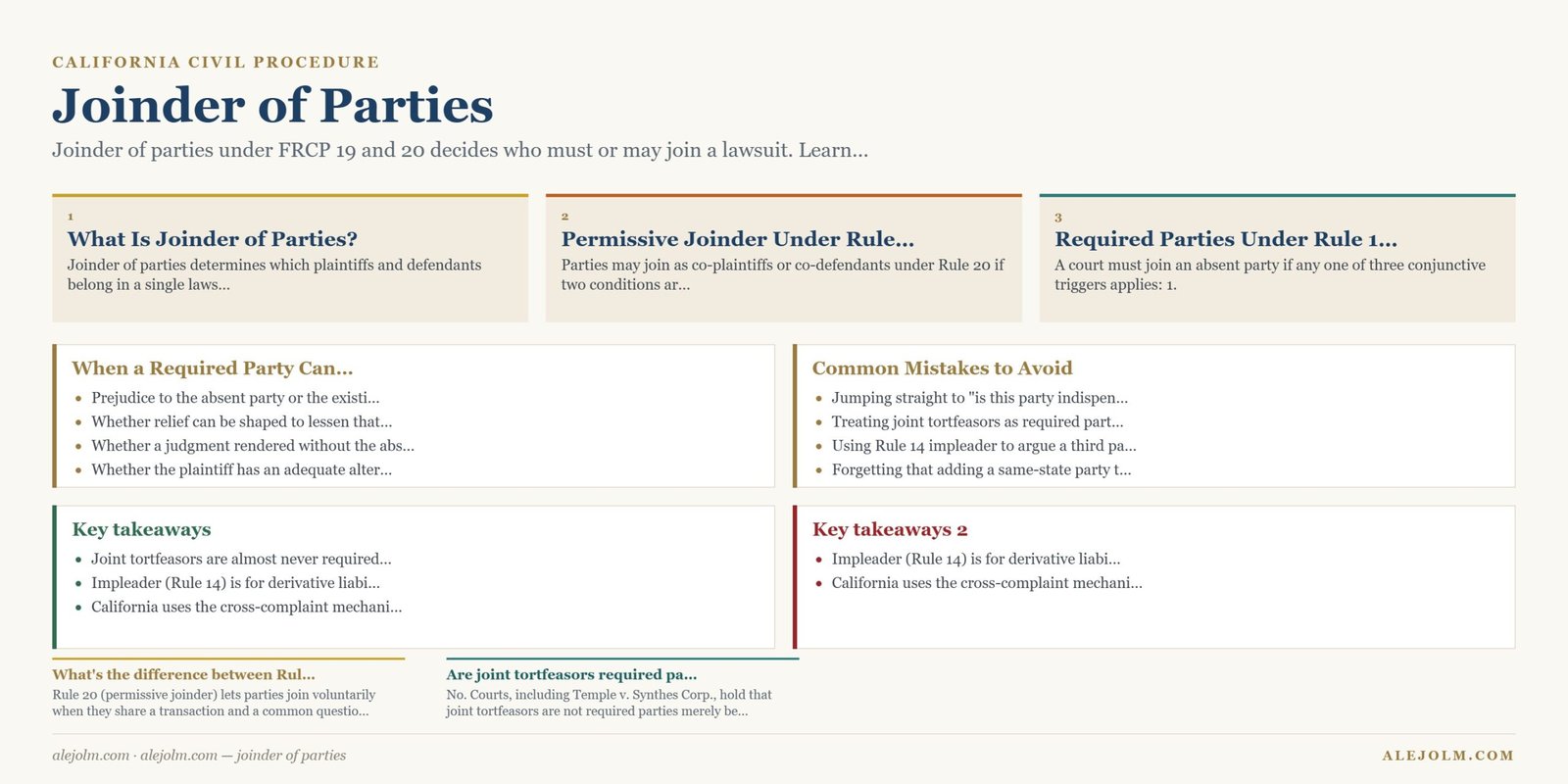
Joinder of parties determines which plaintiffs and defendants belong in a single lawsuit — and, sometimes, which ones the court must add even if nobody asked. Permissive joinder under FRCP Rule 20 lets parties join voluntarily when their claims share a transaction and a common question; required joinder under Rule 19 forces a party into the case when leaving them out would be unfair to everyone involved.
This topic sits at the intersection of procedure and jurisdiction, which is exactly why it shows up so often on the California Bar Exam: adding the “right” party on paper can accidentally destroy diversity jurisdiction.
Permissive Joinder Under Rule 20
Parties may join as co-plaintiffs or co-defendants under Rule 20 if two conditions are met: (1) their claims arise out of the same transaction, occurrence, or series of related transactions or occurrences, and (2) a common question of law or fact runs across them. Courts often apply a flexible “logical relationship” test to the first prong.
Joinder under Rule 20 never creates subject matter jurisdiction on its own — every added party’s claim still needs its own jurisdictional basis, whether independent diversity/federal question or supplemental jurisdiction.
Required Parties Under Rule 19(a)
A court must join an absent party if any one of three conjunctive triggers applies:
- Complete relief cannot be accorded among the existing parties without the absentee.
- The absent party’s ability to protect its own interest would, as a practical matter, be impaired by proceeding without them.
- An existing party would face a substantial risk of multiple or inconsistent obligations because of the absentee’s interest.
These three triggers are tested in sequence before you ever ask whether the party is “indispensable.” Skipping straight to indispensability is the single most common student error on this topic.
Joint tortfeasors are not required parties merely because they share liability. Temple v. Synthes Corp. confirms this: complete relief is normally available from any one joint tortfeasor, so their absence doesn’t trigger Rule 19(a).
When a Required Party Cannot Be Joined: Rule 19(b)
Sometimes a required party can’t be added — joining them would destroy complete diversity, or the court lacks personal jurisdiction over them. Only then does the court reach the Rule 19(b) “equity and good conscience” balancing test, weighing:
- Prejudice to the absent party or the existing parties.
- Whether relief can be shaped to lessen that prejudice.
- Whether a judgment rendered without the absentee would be adequate.
- Whether the plaintiff has an adequate alternative forum if the case is dismissed.
| Question | Rule | Consequence if triggered |
|---|---|---|
| Do the parties share a transaction and common question? | Rule 20 | Permissive joinder allowed |
| Is complete relief impossible without an absentee? | Rule 19(a)(1) | Party is “required” |
| Would the absentee’s own interest be impaired? | Rule 19(a)(2) | Party is “required” |
| Would an existing party face inconsistent obligations? | Rule 19(a)(3) | Party is “required” |
| Can a required party be joined at all? | Rule 19(b) | If not, weigh equity factors — dismiss or proceed |
Impleader Under Rule 14
Rule 14 lets a defending party bring in a third party who may be liable to it for all or part of the plaintiff’s claim — but only for derivative liability, like indemnity or contribution. The impleader must typically be filed within 14 days of the defendant’s answer, or later with leave of court.
Impleader cannot be used to say “someone else is directly liable to the plaintiff instead of me.” That kind of direct-liability argument belongs in the plaintiff’s own complaint, not in a defendant’s third-party claim. Because impleader claims share a common nucleus of operative fact with the main claim, they generally qualify for supplemental jurisdiction.
Intervention Under Rule 24
A nonparty can seek to join a pending suit under Rule 24. Intervention of right requires a timely motion, an interest relating to the property or transaction at issue, practical impairment of that interest without intervention, and inadequate representation by the existing parties — a due process concern traced back to Hansberry v. Lee. Permissive intervention is purely discretionary, requiring only a common question of law or fact and no undue delay or prejudice.
Both joinder and intervention carry the same jurisdictional warning: adding a same-state party in a diversity case can destroy complete diversity.
California’s Cross-Complaint and Special Demurrer
California channels party joinder through the same broad “cross-complaint” mechanism used for claim joinder, rather than the federal terminology of Rules 13, 14, 19, and 20. California treats improper joinder of parties as grounds for a special demurrer, and its rules on what claims must be raised together are generally less draconian than the federal compulsory-counterclaim regime.
Worked Example
Plaintiff, injured in a car accident, sues Driver but does not name Owner — the vehicle’s owner, a passenger at the time, whose vicarious liability as Driver’s employer could independently satisfy any judgment. Owner is not diverse from Plaintiff, while Driver is. Driver argues the case must be dismissed because Owner is an indispensable party whose joinder would destroy diversity.
Analysis: The argument fails. Owner is not even a “required” party under Rule 19(a) — complete relief is available from Driver alone, since a vicariously liable party isn’t required merely because an alternative source of recovery exists, and Owner’s own interests aren’t impaired by being left out. Because Owner never clears the Rule 19(a) threshold, the court never reaches Rule 19(b) indispensability, and the case proceeds against Driver alone without disturbing diversity jurisdiction.
Common Mistakes to Avoid
- Jumping straight to “is this party indispensable” without first checking the three Rule 19(a) triggers.
- Treating joint tortfeasors as required parties when complete relief is available from any one of them.
- Using Rule 14 impleader to argue a third party is directly liable to the plaintiff, instead of derivatively liable to the defendant.
- Forgetting that adding a same-state party through joinder or intervention can destroy complete diversity in a diversity case.
FAQ
What’s the difference between Rule 19 and Rule 20 joinder?
Rule 20 (permissive joinder) lets parties join voluntarily when they share a transaction and a common question. Rule 19 (required joinder) forces an absent party into the case when leaving them out would prevent complete relief, impair their interests, or expose an existing party to inconsistent obligations.
Are joint tortfeasors required parties under Rule 19?
No. Courts, including Temple v. Synthes Corp., hold that joint tortfeasors are not required parties merely because they share liability, since complete relief is ordinarily available from any one of them.
Can impleader under Rule 14 be used to blame someone else entirely?
No. Impleader is limited to derivative liability — a third party who may owe the defendant indemnity or contribution. A defendant cannot use Rule 14 to argue a third party is directly liable to the plaintiff instead.
Key Takeaways
- Permissive joinder (Rule 20) requires a shared transaction and a common question; it never confers jurisdiction on its own.
- Required-party analysis under Rule 19(a) has three conjunctive triggers, checked before any indispensability question under Rule 19(b).
- Joint tortfeasors are almost never required parties.
- Impleader (Rule 14) is for derivative liability only; intervention (Rule 24) requires either a due-process-grounded right or judicial discretion.
- California uses the cross-complaint mechanism and a special demurrer for improper party joinder.
This article is educational and is not legal advice. Consult a licensed California attorney about your situation.