
Most questions about congressional authority are difficult because the enumerated power has to be argued for. The Property Clause is the exception. Article IV, Section 3, Clause 2 gives Congress power to dispose of and make all needful rules and regulations respecting the territory and other property belonging to the United States, and that power is plenary. Where the regulated conduct occurs on federal land, the authority question is answered by the clause alone.
That makes it enormously useful as a diagnostic shortcut. A federal statute prohibiting hunting in a national park, controlling access to a military base, or governing Puerto Rico needs no Commerce Clause analysis at all, and reaching for one wastes effort while inviting error. This guide sets out the scope of the power, its place among the four federal enclaves, and the limits that continue to apply on federal soil.
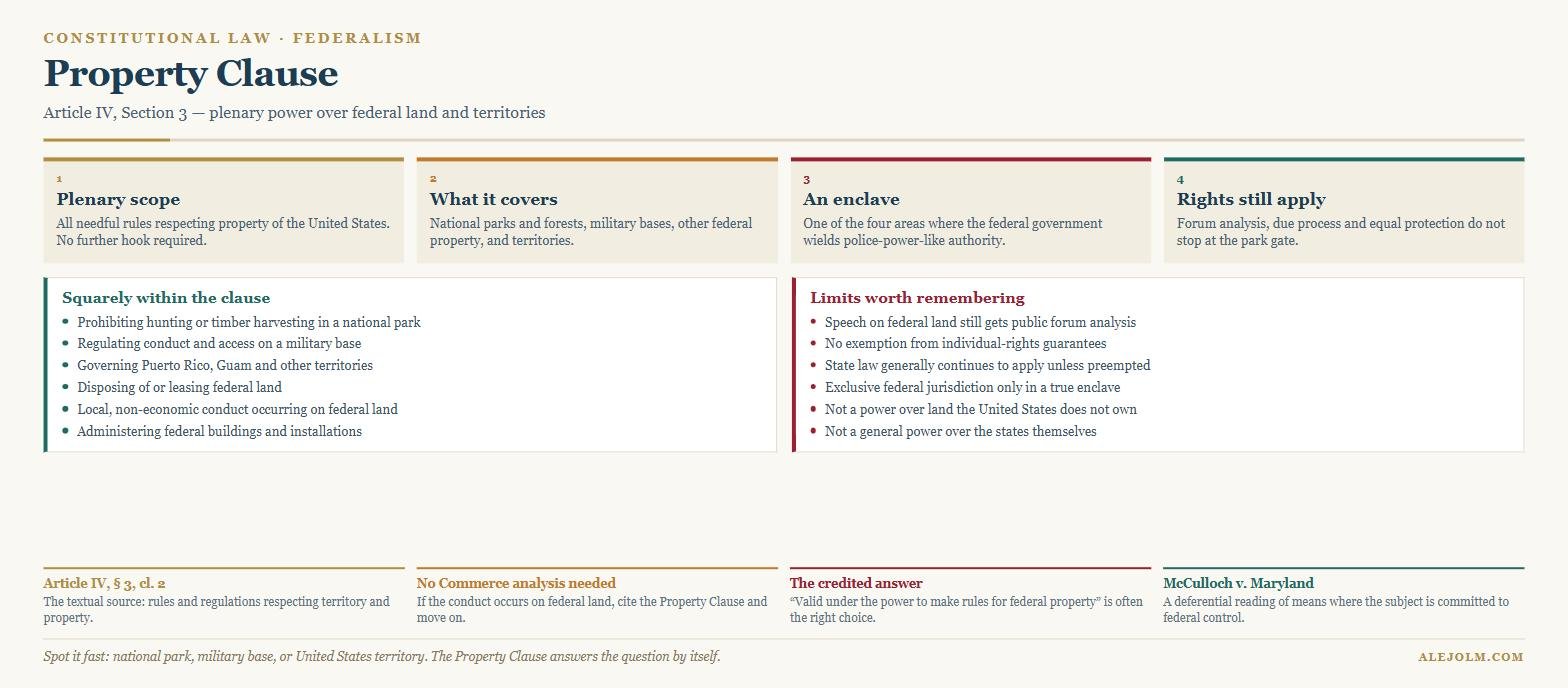
Plenary scope, and why no other hook is needed
The word to hold onto is plenary. Congress does not need to establish that conduct on federal land affects interstate commerce, or that the regulation is necessary and proper to some other end. Ownership supplies the authority. The clause covers both the disposal of federal property — sale, lease, transfer — and the regulation of conduct upon it, and the phrase “all needful rules and regulations” has been read generously.
This matters most where the regulated activity is local and non-economic, because that is exactly the profile that defeats Commerce Clause arguments after United States v. Lopez. Recreational hunting in a national park, littering on a forest trail, unauthorised camping, driving off a designated track — none of these would survive a serious Commerce Clause analysis as free-standing subjects of federal regulation. On federal land the question does not arise.
The practical instruction is a sequencing one. When you see federal legislation directed at conduct in a national park, on a military installation, in a national forest, or in a United States territory, cite the Property Clause and move to the next issue. On multiple-choice questions, “valid under Congress’s power to make rules for federal property” is very often the credited justification precisely where the activity looks too local for commerce.
What the clause covers
Three categories fall within it. Territories of the United States — Puerto Rico, Guam and the others — which Congress governs comprehensively. Federal lands, including national parks and monuments, national forests, military bases and installations, and public domain land. And other property belonging to the United States, which extends beyond real estate to federal buildings and holdings generally.
Two boundaries deserve attention. The clause is a power over what the United States owns; it confers no authority over privately owned land merely because it lies nearby, and no general power over the states themselves. And territorial governance under the clause is not the same thing as statehood — Congress’s authority over a territory is far broader than its authority over a state, which is why the territorial cases sit awkwardly alongside ordinary federalism doctrine.
One of the four enclaves
Federal lands and territories are one of only four settings in which the federal government exercises something amounting to a general police power, the others being the military, Native American reservations and the District of Columbia. Everywhere else, Congress must trace its statute to an enumerated power in the ordinary way.
Understanding the clause as an enclave clarifies why it feels different from the rest of the federalism syllabus. The default rule is that Congress has no general police power and must name a clause; here the clause it names is one that operates like a general police power within a defined geographic scope. So the enclave is not an exception to the enumerated-power requirement so much as an enumerated power that happens to be comprehensive in its own domain.
Exam tip: the moment the facts mention a national park, a military base or a United States territory, stop looking for a commerce nexus. Cite the Property Clause, note that the power is plenary, and spend your effort on the individual-rights issue instead.
The limits that still apply
Plenary power over property is not immunity from the Constitution. Congress remains fully bound by individual-rights guarantees when it regulates federal land, and that is where the real analysis usually lies. Speech on federal property is governed by public forum doctrine exactly as it would be elsewhere — a park, a pavement outside a federal building, or a designated area on a base is classified as a traditional, designated or non-public forum, and the applicable standard follows from that classification, not from the fact of federal ownership.
The same is true of due process and equal protection. A permit scheme for demonstrations on federal land must still satisfy the procedural safeguards demanded of any licensing regime, and a rule distinguishing between classes of visitors is still subject to the ordinary equal protection framework. The Property Clause answers who may regulate; it does not answer whether a particular regulation is constitutional in substance.
A second limit is jurisdictional rather than rights-based, and it is frequently overlooked. State law generally continues to apply on federal land situated within a state unless it is preempted or unless the land is a federal enclave under exclusive federal jurisdiction. Federal ownership does not automatically create a legal vacuum: state criminal law, tort law and property rules commonly continue to operate, and the answer depends on the terms on which the United States acquired the land.
| Federal statute | Authority |
|---|---|
| Ban on hunting in a national park | Property Clause |
| Regulation of conduct on a military base | Property Clause and military power |
| Governing legislation for Puerto Rico or Guam | Property Clause (territories) |
| Lease or sale of public domain land | Property Clause (disposal) |
| Permit scheme for demonstrations in a park | Property Clause plus forum analysis |
| Regulation of private land adjoining a park | Not the Property Clause |
| Speech restriction on federal property | Property Clause plus First Amendment |
| Whether state tort law applies on the land | Enclave and preemption analysis |
Worked example
Congress enacts a statute prohibiting all commercial activity — including commercial hunting and timber harvesting — within a national park located entirely inside a single state. A logging company challenges the statute, arguing that Congress lacked authority because the activity is local and that regulating it intrudes on the state’s reserved powers.
The challenge fails at the threshold. The park is property of the United States, and the Property Clause gives Congress plenary power to make all needful rules respecting it. Prohibiting commercial extraction from federal land is a direct exercise of that power, and the company’s framing of the activity as local is beside the point — locality matters when the asserted authority is the Commerce Clause, which is not needed here. Nor does the state’s reserved police power assist: the reserved powers concern subjects the Constitution did not commit to Congress, and the regulation of federal property plainly was committed. It is worth noting that the statute would probably also survive a Commerce Clause analysis, since commercial timber harvesting is economic activity in a national market, but that argument is unnecessary and a good answer says so.
Change one fact. Suppose the statute instead prohibited the distribution of leaflets anywhere within the park. The authority question is unchanged — the Property Clause still supplies the power — but the constitutional problem shifts entirely to the First Amendment. Park land open to the public is likely a traditional or designated public forum, a blanket ban on leafletting is a content-neutral restriction that is not narrowly tailored, and it would very likely fail. That is the pattern to expect: the Property Clause disposes of the power issue quickly so that the rights issue can be examined properly.
Common mistakes that cost points
- Insisting on a Commerce Clause analysis for conduct on federal land. The Property Clause is an independent, plenary power.
- Treating the clause as immunity from the Constitution. Individual rights apply on federal land exactly as elsewhere.
- Forgetting forum analysis for speech cases. Federal ownership does not decide the standard; the forum classification does.
- Assuming state law never applies on federal land. It generally continues unless preempted or the land is an exclusive-jurisdiction enclave.
- Extending the clause to privately owned land near federal property. The power follows ownership.
- Confusing territorial governance with authority over a state. Congressional power over a territory is far broader.
- Treating the enclave as an exception to the enumerated-power requirement. It is an enumerated power that happens to be comprehensive.
- Reaching for the Necessary and Proper Clause. Nothing further is needed once the Property Clause applies.
Frequently asked questions
Does Congress need a commerce nexus to regulate a national park?
No. The Property Clause is a self-sufficient grant of plenary authority over property belonging to the United States. Even where the regulated activity is local and non-economic — the profile that defeats Commerce Clause arguments — federal ownership supplies the power on its own.
Do constitutional rights apply on federal land?
Fully. Plenary power over property is not an exemption from the Bill of Rights. Speech on federal land is analysed under public forum doctrine, permit schemes must satisfy the usual procedural safeguards, and due process and equal protection apply in the ordinary way.
Does state law stop at the boundary of federal land?
Usually not. State law generally continues to operate on federal land inside a state unless it is preempted or the land was ceded as an enclave under exclusive federal jurisdiction. The answer turns on the terms on which the United States acquired the property, so the facts matter.
The Property Clause and federal land in Los Angeles County, 2026
Congress has power to dispose of and make all needful rules respecting territory and property belonging to the United States, and Kleppe v. New Mexico (1976) confirmed that this authority is broad enough to reach conduct on adjacent non-federal land where necessary to protect federal property. California, where the federal government owns close to half the land area, is where the clause matters most.
Los Angeles County is a striking example. The Angeles National Forest occupies roughly a quarter of the county’s land area, and the Santa Monica Mountains National Recreation Area, a national monument in the San Gabriel Mountains and portions of other federal holdings add further federal acreage. County land use authority simply stops at those boundaries, and Los Angeles County Regional Planning has no jurisdiction over activity on federal land.
The practical consequences of that patchwork:
- County zoning does not apply to federal land. Federal management plans govern, and a county permit is neither required nor sufficient.
- Federal regulation can extend beyond the boundary. Under Kleppe, rules protecting federal resources may reach conduct on neighbouring land.
- Fire responsibility is divided by ownership. Federal, state and county agencies each have primary responsibility for different areas, coordinated by agreement rather than by hierarchy.
- Property tax does not reach federal holdings. The county cannot assess federally owned land, though payments in lieu of taxes may be made under federal statutes.
- Enclaves are a separate category. Where the United States holds exclusive jurisdiction over a site, state law applies only as assimilated by Congress.
- Rights of way and easements are federally granted. Utility and road access across national forest land requires federal authorisation, not a county approval.
For 2026, establish who owns the land before analysing which government regulates it. Read with the absence of a federal police power, intergovernmental immunity and the Takings Clause.
Next steps
This clause is best understood as the enclave exception to a larger rule, so read it beside the no general federal police power principle and then work through the Commerce Clause to see what Congress must ordinarily establish. Because most litigation about federal land concerns expression rather than authority, pair this with public forum doctrine and prior restraint and licensing, which govern demonstrations and permit schemes on public property.
The text of Article IV and the leading commentary are freely available through Justia’s Article IV collection. Cornell’s Legal Information Institute keeps a concise entry with current citations, and candidates should confirm the tested scope against the outlines published by the State Bar of California.
Related guides
 Supreme Court Jurisdiction: Original vs Appellate Power
 The Youngstown Framework: Presidential Power in 3 Zones
 The Eleventh Amendment and State Sovereign Immunity
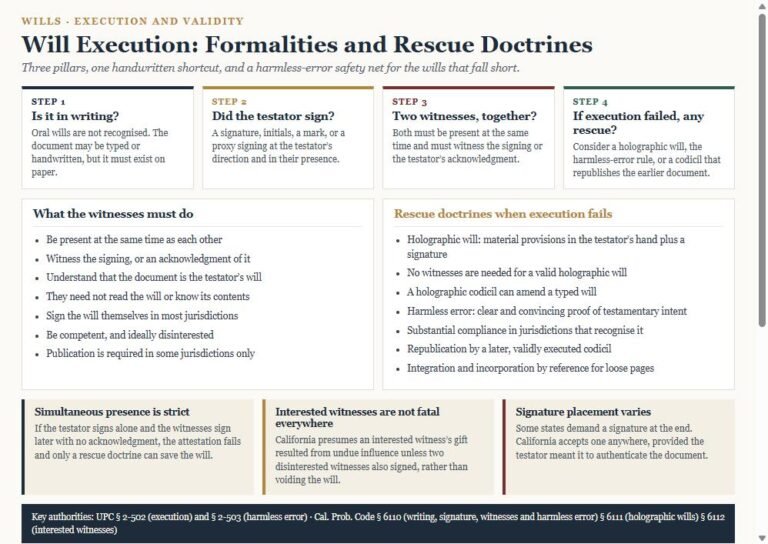 Will Execution Requirements: Formalities and Rescue
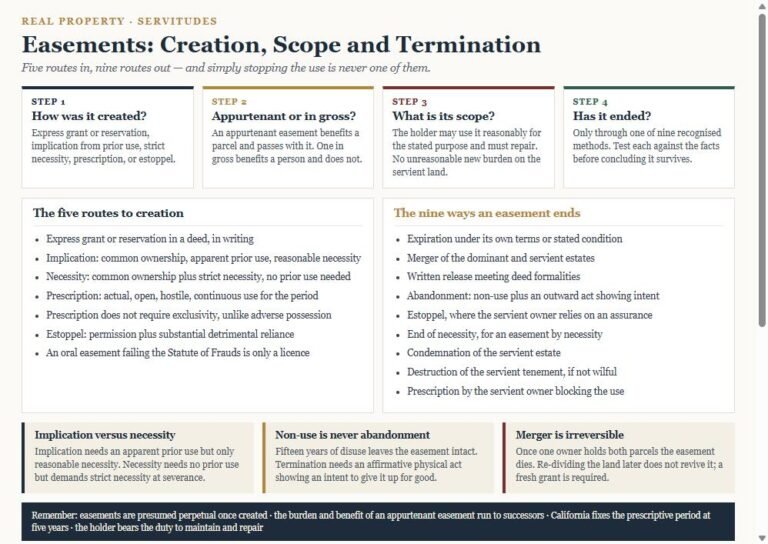 Easements Explained: Creation, Scope and Termination
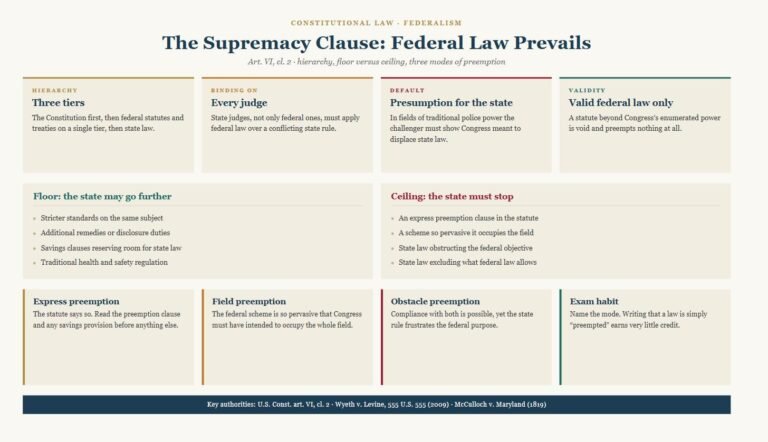 The Supremacy Clause: Floors, Ceilings and Preemption
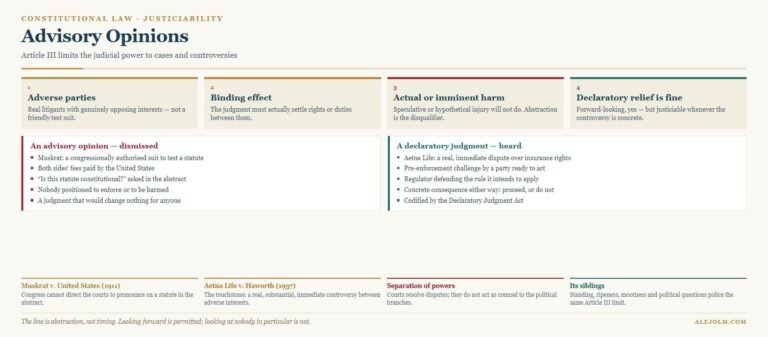 Advisory Opinions: Article III and Declaratory Relief
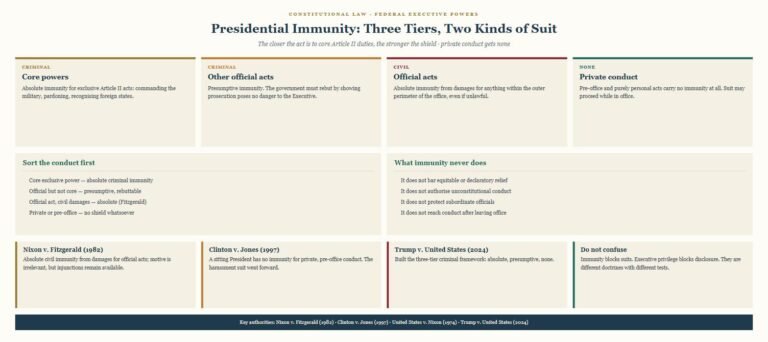 Presidential Immunity: Criminal, Civil and Private Acts
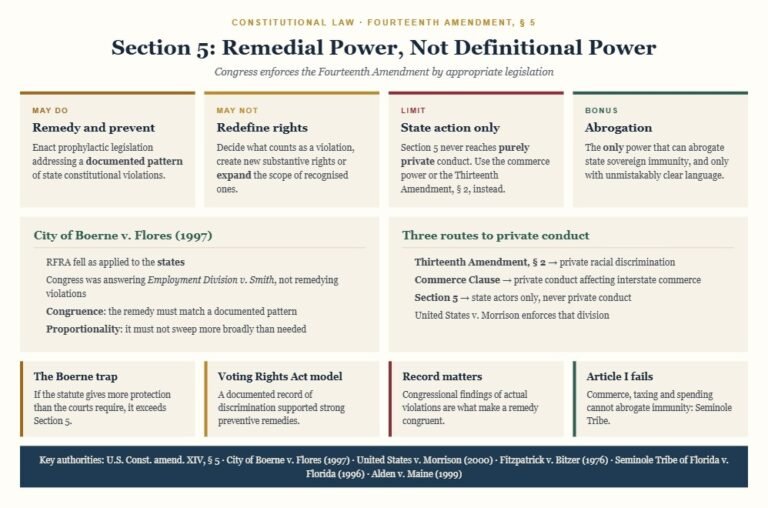 Section 5 Enforcement Power: Remedy, Do Not Redefine
 3 Levels of Scrutiny in Constitutional Law Explained
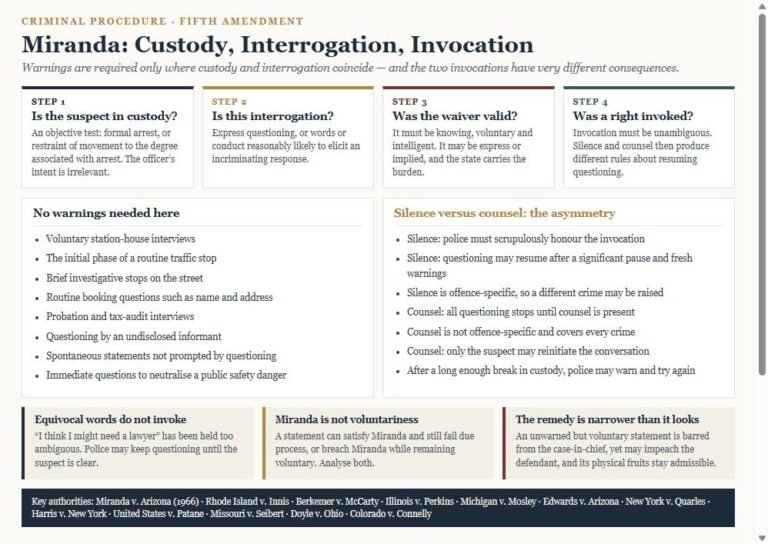 Miranda Rights: Custody, Interrogation and Invocation
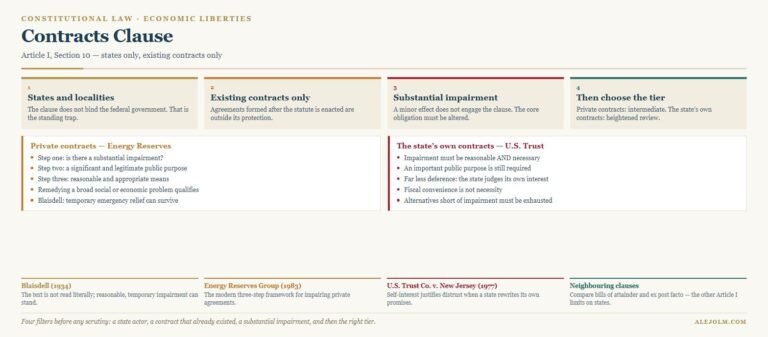 Contracts Clause: When States May Impair Agreements