
There is no single rule of presidential immunity. There are two doctrines — criminal and civil — and within them a graduated set of protections. The organising principle is simple: the closer the conduct sits to the President’s exclusive Article II functions, the stronger the shield; the more it resembles private behaviour, the weaker or non-existent it becomes.
The way to answer these questions is to disaggregate. Identify the type of conduct, then the type of suit, and only then state the rule. Students who reverse that order write confident sentences about the wrong doctrine.
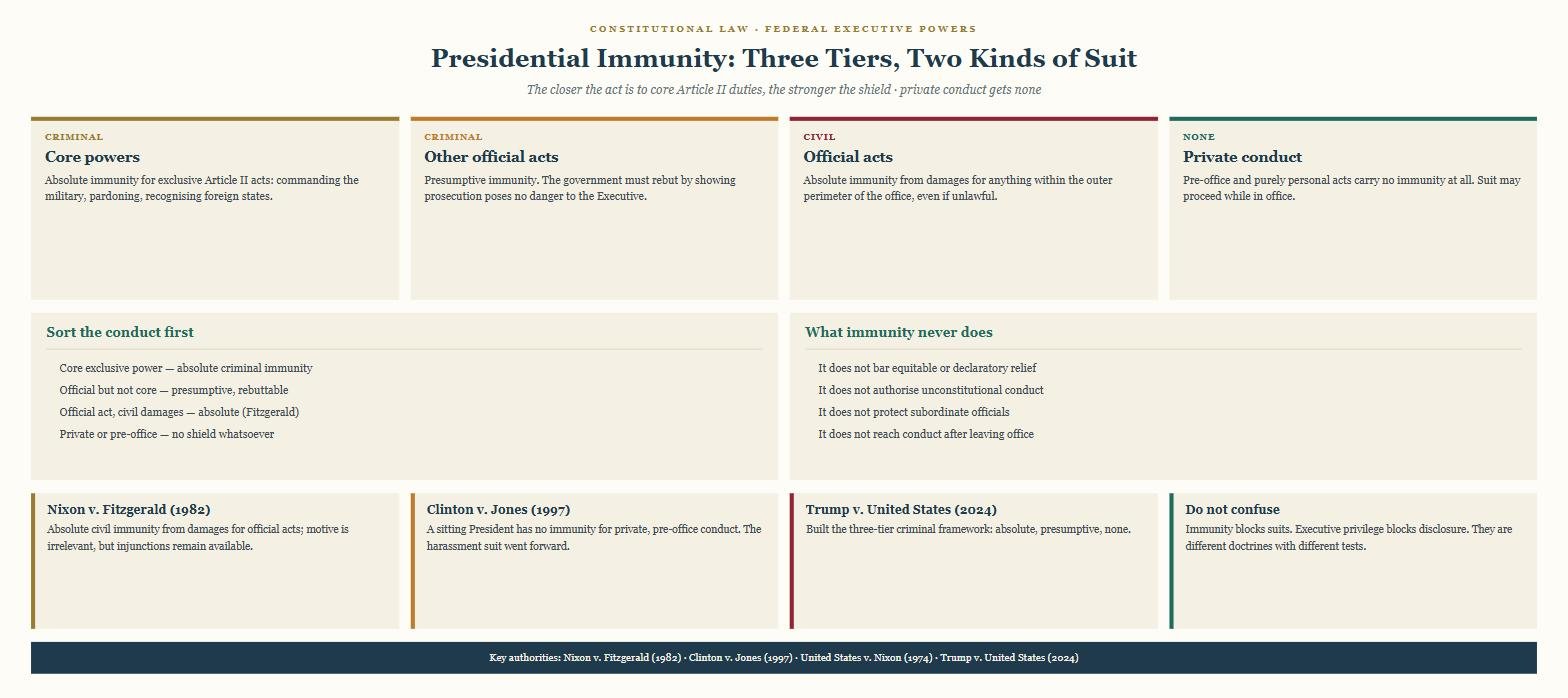
Criminal immunity after Trump v. United States
Trump v. United States (2024) established a three-tier framework. Acts within the President’s exclusive core constitutional powers — commanding the armed forces, granting pardons, recognising foreign governments — carry absolute immunity from criminal prosecution. All other official actions carry at minimum presumptive immunity, and the government bears the burden of rebutting the presumption by showing that prosecution poses no danger of intrusion on the authority and functions of the executive branch. Unofficial and private conduct receives no immunity at all.
The tiering matters because most presidential acts are official without being core. Dismissing a Secretary of State is plainly official, so it draws presumptive protection. Directing a Justice Department investigation is likewise official but not an exclusive constitutional power, so the presumption is rebuttable. A personal financial transaction unconnected to the office falls outside the umbrella entirely.
Civil immunity: absolute but narrow
Nixon v. Fitzgerald (1982) grants the President absolute immunity from civil suits for money damages arising out of any official action taken while in office, including actions later found erroneous or unlawful. The rationale is the unique burden of the presidency and the chilling effect that personal damages liability would create.
Notice three boundaries built into that holding. It covers civil damages, not criminal prosecution. It covers official acts, not private conduct. And it covers monetary damages, not equitable relief — declaratory judgments and injunctions against unconstitutional official action remain available. Absolute civil immunity therefore means the President cannot be made to pay, not that the President is beyond constitutional constraint.
Exam tip: official acts in office give civil immunity under Fitzgerald; core constitutional powers give criminal immunity under Trump v. United States; private or pre-office conduct gives nothing. Two doctrines, three tiers, one classification step.
Private and pre-office conduct
Clinton v. Jones (1997) anchors the outer limit. A sitting President has no immunity from civil suit for conduct unrelated to official duties and occurring before taking office, and the litigation may proceed during the presidency. The suit there concerned alleged conduct while the defendant was Governor of Arkansas, years before the inauguration.
Two features of presidential immunity emerge from that case. It is temporal, protecting only official acts during the presidency, and it is functional, protecting only acts that are official in character. A President who acts in a purely personal capacity remains exposed to civil liability and, potentially, criminal prosecution.
| Conduct | Criminal suit | Civil damages |
|---|---|---|
| Pardon, military command, recognition of a state | Absolute immunity | Absolute immunity |
| Removing a cabinet secretary | Presumptive immunity | Absolute immunity |
| Directing a federal investigation | Presumptive immunity | Absolute immunity |
| Private business dealings in office | No immunity | No immunity |
| Conduct before taking office | No immunity | No immunity (Clinton v. Jones) |
| Any official act, injunction sought | — | Equitable relief available |
Worked example
In his final days in office, a President angered by media criticism directs the Justice Department to investigate and prosecute a newspaper editor for espionage, knowing the allegations are baseless, hoping to intimidate the editor. Six months after leaving office, the editor sues the former President for damages, alleging retaliation for protected speech. The President moves to dismiss on immunity grounds.
Classify first. Directing a federal investigation is an official act, squarely within the outer perimeter of presidential authority over law enforcement, even though the motive was improper. Under Fitzgerald, motive is irrelevant to civil immunity, so the damages claim fails: the former President is absolutely immune from monetary liability for official acts taken in office. Then look for what survives. Equitable relief is not barred by Fitzgerald, so an injunction against continuing retaliation could in principle issue, and the individual Justice Department officers enjoy no presidential immunity and may be sued in their own capacities. A complete answer also flags that modern doctrine has sharply narrowed damages actions against federal officers generally, which is an obstacle independent of immunity.
Change one fact. Suppose the editor instead alleges that the former President defamed him at a private fundraising dinner before the inauguration. Now the conduct is private and pre-office, Clinton v. Jones controls, and no immunity applies at any stage.
Common mistakes that cost points
- Conflating civil and criminal immunity. Civil immunity for official acts is absolute; criminal immunity is graduated.
- Assuming pre-office conduct receives some reduced protection. It receives none.
- Stating that the President is immune without noting that equitable relief remains available.
- Treating every official act as a core constitutional power. Only exclusive Article II functions draw absolute criminal immunity.
- Reading immunity as a licence. It bars certain suits; it never authorises unconstitutional conduct.
- Confusing immunity with executive privilege. One blocks liability, the other blocks disclosure.
- Forgetting that subordinate officials are not covered by presidential immunity.
- Missing the burden allocation. For non-core official acts the government must rebut the presumption, not the President establish it.
Frequently asked questions
Can a sitting President be sued while in office?
Yes, for private conduct. Clinton v. Jones held that a civil action based on unofficial, pre-office behaviour may proceed during the presidency, though courts retain discretion over scheduling.
Does immunity survive leaving office?
For acts taken in office, yes. A former President remains immune from civil damages for official acts performed while serving, and retains the criminal protections recognised in Trump v. United States for those acts.
Is immunity ever defeasible?
Absolute immunity for core powers and for civil damages cannot be overcome. Presumptive criminal immunity for non-core official acts can be, if the government shows prosecution poses no danger of intruding on executive authority and functions.
Official immunity from the President to Los Angeles County, 2026
Trump v. United States (2024) held that a former President enjoys at least presumptive immunity from criminal prosecution for official acts, while Nixon v. Fitzgerald (1982) established absolute civil immunity for official conduct and Clinton v. Jones (1997) confirmed there is none for unofficial acts. The organising idea, that immunity attaches to function rather than to office, runs all the way down to county government, and one of the foundational cases is Californian.
In Imbler v. Pachtman (1976), which arose from a Los Angeles County prosecution, the Supreme Court held that prosecutors are absolutely immune from civil liability for conduct intimately associated with the judicial phase of the criminal process. Deputy district attorneys in the Los Angeles County District Attorney‘s office therefore cannot be sued for charging decisions or trial advocacy, though investigative and administrative conduct attracts only qualified immunity.
The immunity map for county defendants:
- Absolute immunity is function-based. Judges, prosecutors acting as advocates and local legislators voting on ordinances are protected.
- Qualified immunity covers most officers. Sheriff’s Department personnel are shielded unless the right was clearly established at the time.
- The Bane Act has no qualified immunity. Section 52.1 of the California Civil Code gives a state damages remedy for interference with rights by threat or coercion, and plaintiffs plead it precisely to avoid the federal defence.
- The county itself has no immunity. Entity liability under Monell turns on policy or custom, and good faith is no defence.
- Government Claims Act deadlines still apply. State law claims must be presented to the county before suit.
- Investigative conduct is exposed. A prosecutor who fabricates evidence during investigation loses absolute protection.
In 2026, characterise the act, then choose the claim that avoids the strongest available immunity. Read with the Eleventh Amendment, legislative immunity and executive privilege.
Next steps
Read this next to the doctrine it is most often confused with, the Take Care Clause, then look at the powers that draw absolute protection in the Commander-in-Chief power, and finish with the accountability mechanism Congress retains in the impeachment power.
For primary sources, read Nixon v. Fitzgerald and Clinton v. Jones on Justia, review the text of Article II on Cornell Legal Information Institute, and confirm current subject coverage with the State Bar of California.
Related guides
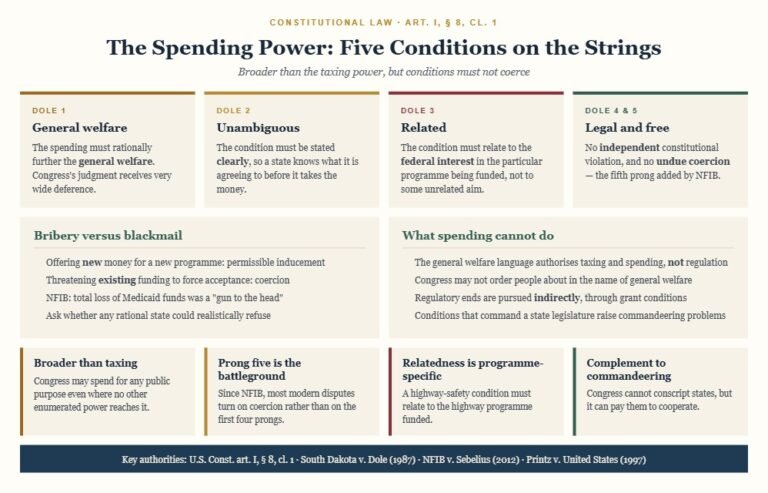 The Spending Power and the Five Dole Test Conditions
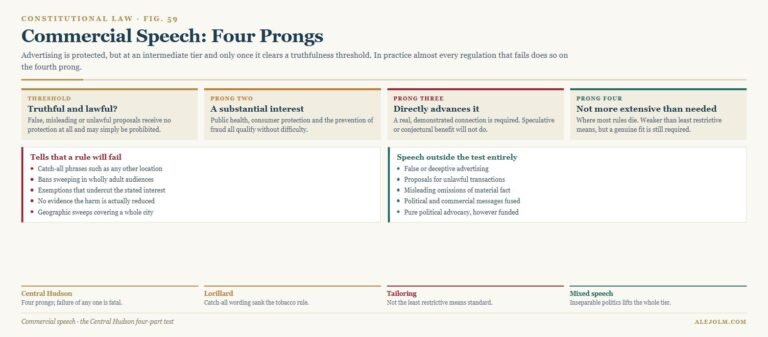 Commercial Speech and the Central Hudson Four-Part Test
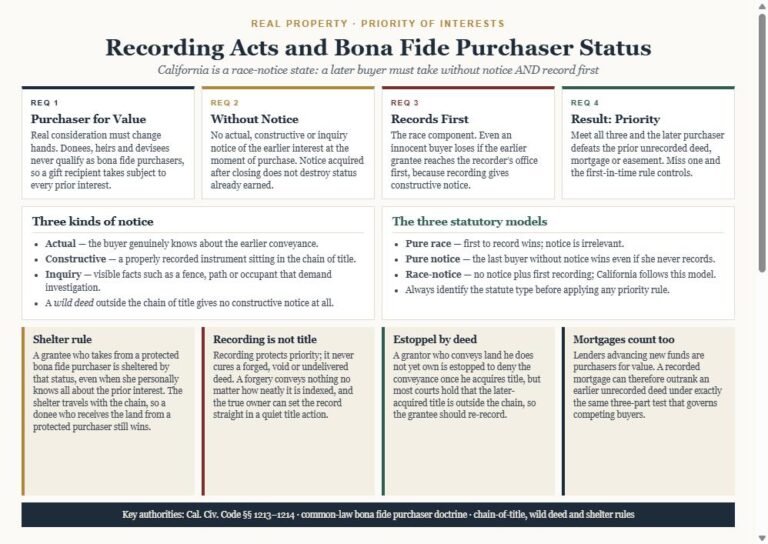 Recording Acts: Race, Notice and Race-Notice Explained
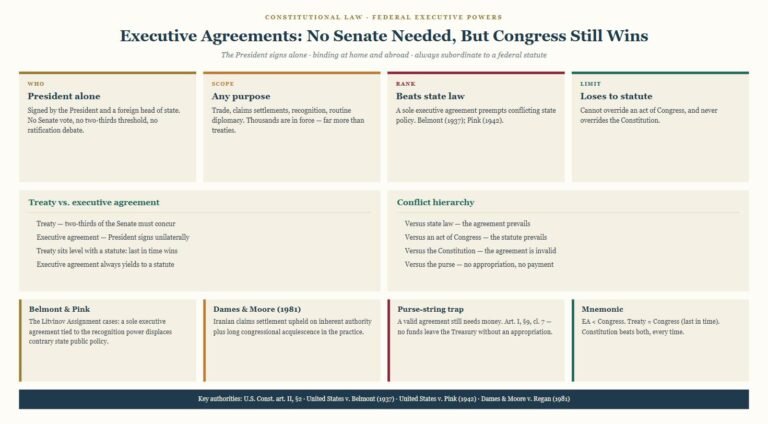 Executive Agreements: The President’s Sole Foreign Power
 3 Levels of Scrutiny in Constitutional Law Explained
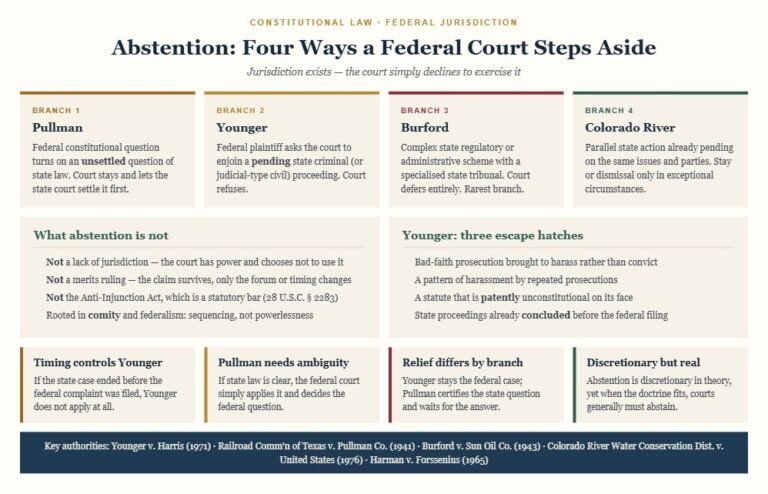 Abstention Doctrine: 4 Ways Federal Courts Step Aside
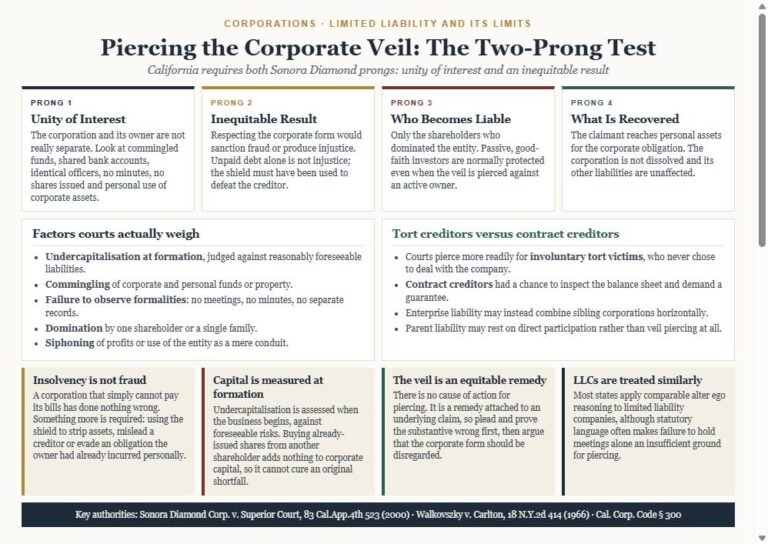 Piercing the Corporate Veil: A Two-Prong Alter Ego Test
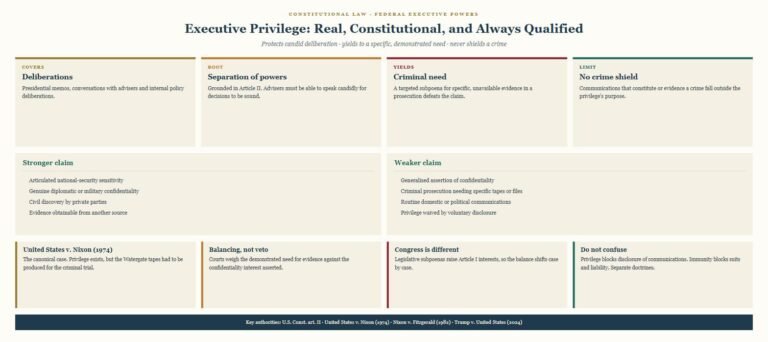 Executive Privilege: A Qualified Right That Must Yield
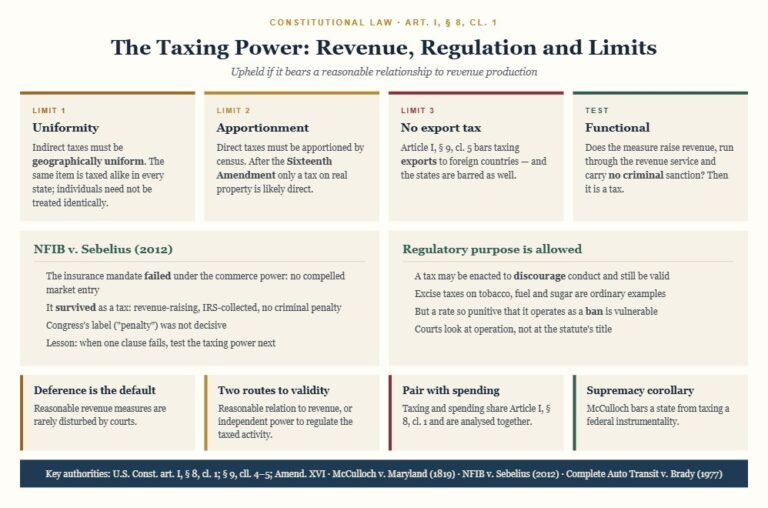 Congress’s Taxing Power: When a Penalty Is Really a Tax
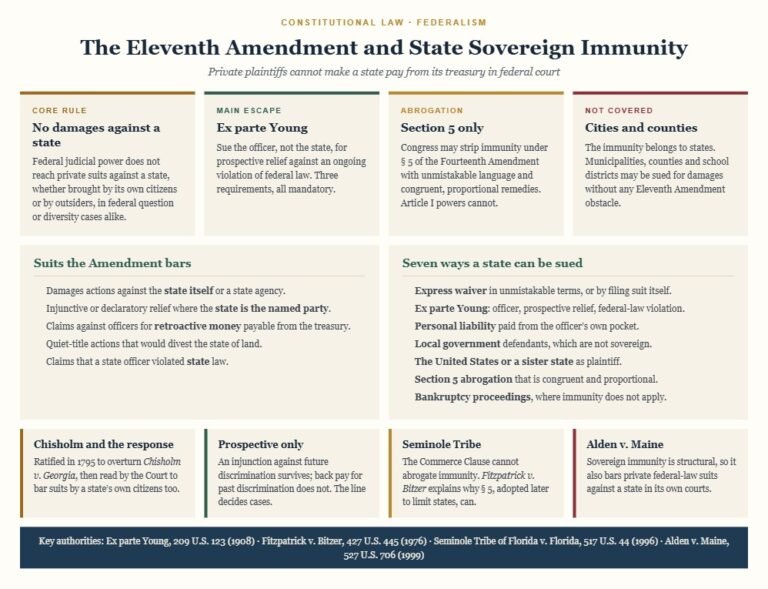 The Eleventh Amendment and State Sovereign Immunity
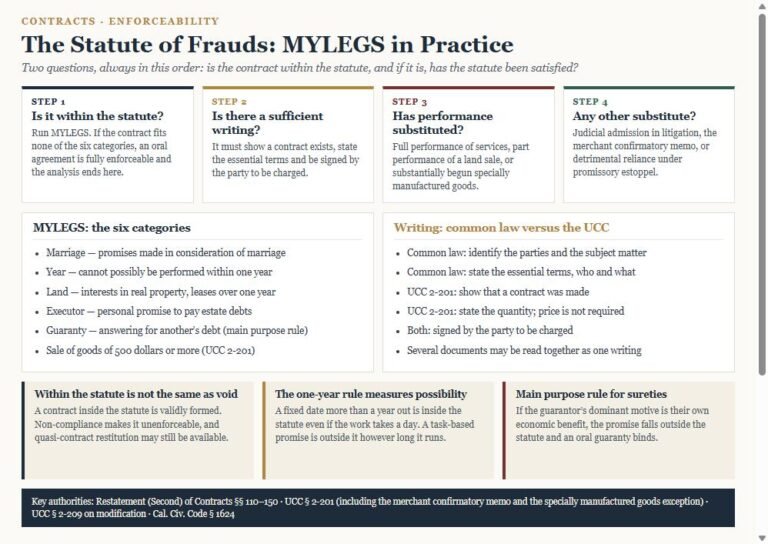 The Statute of Frauds: MYLEGS and How to Satisfy It
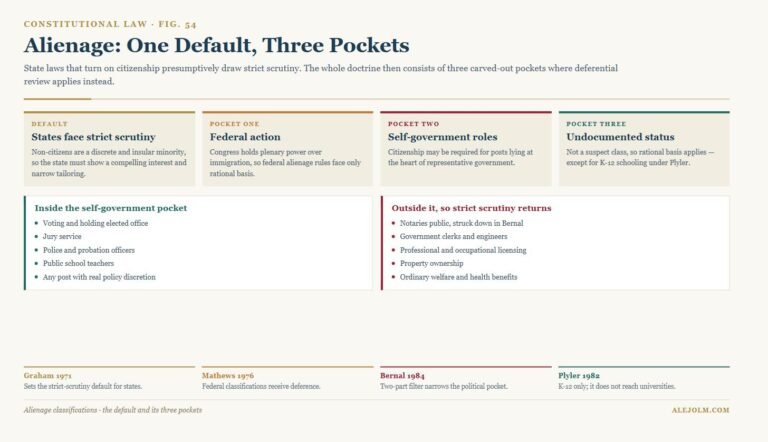 Alienage Classifications: Strict Scrutiny and Its Pockets