
What Is Quasi In Rem Jurisdiction?
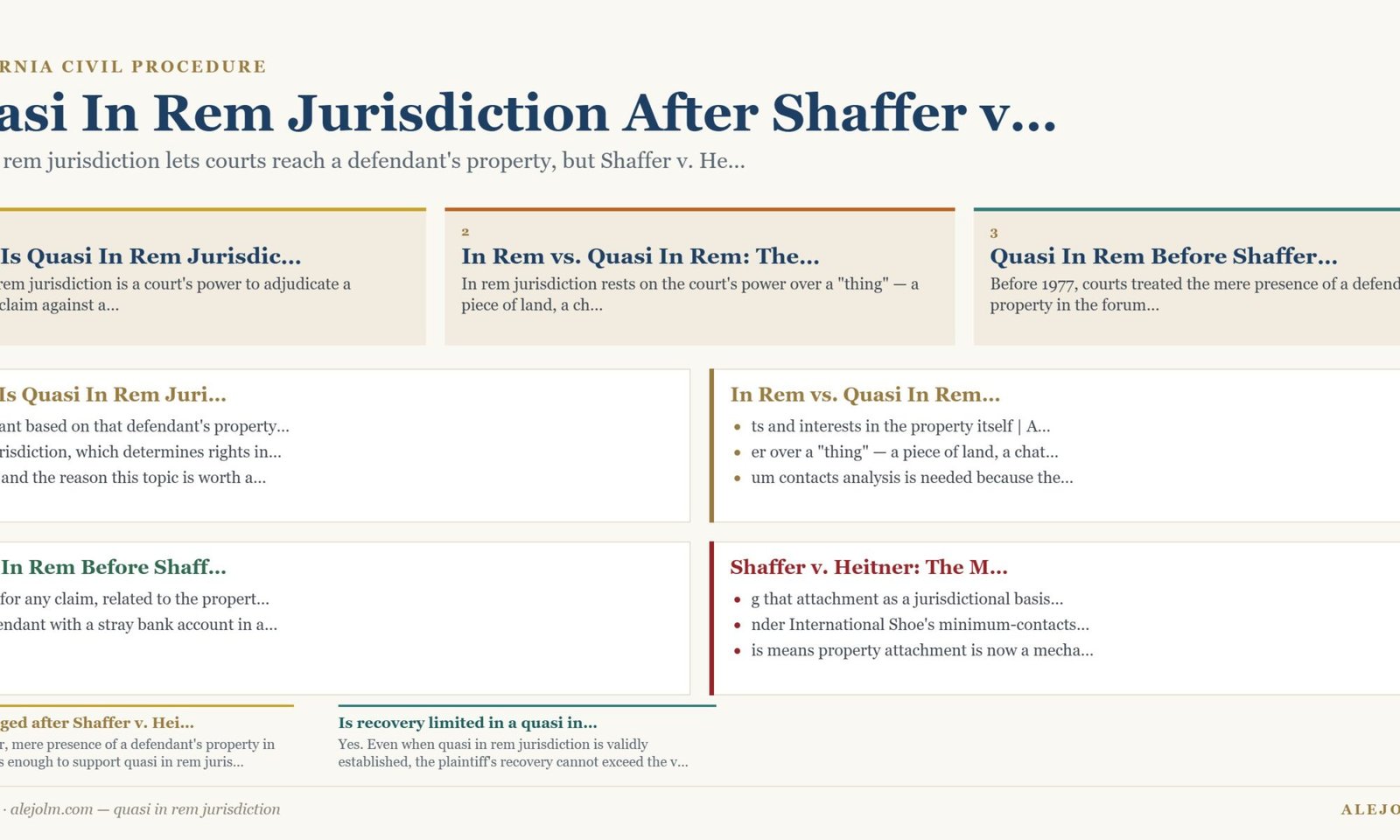
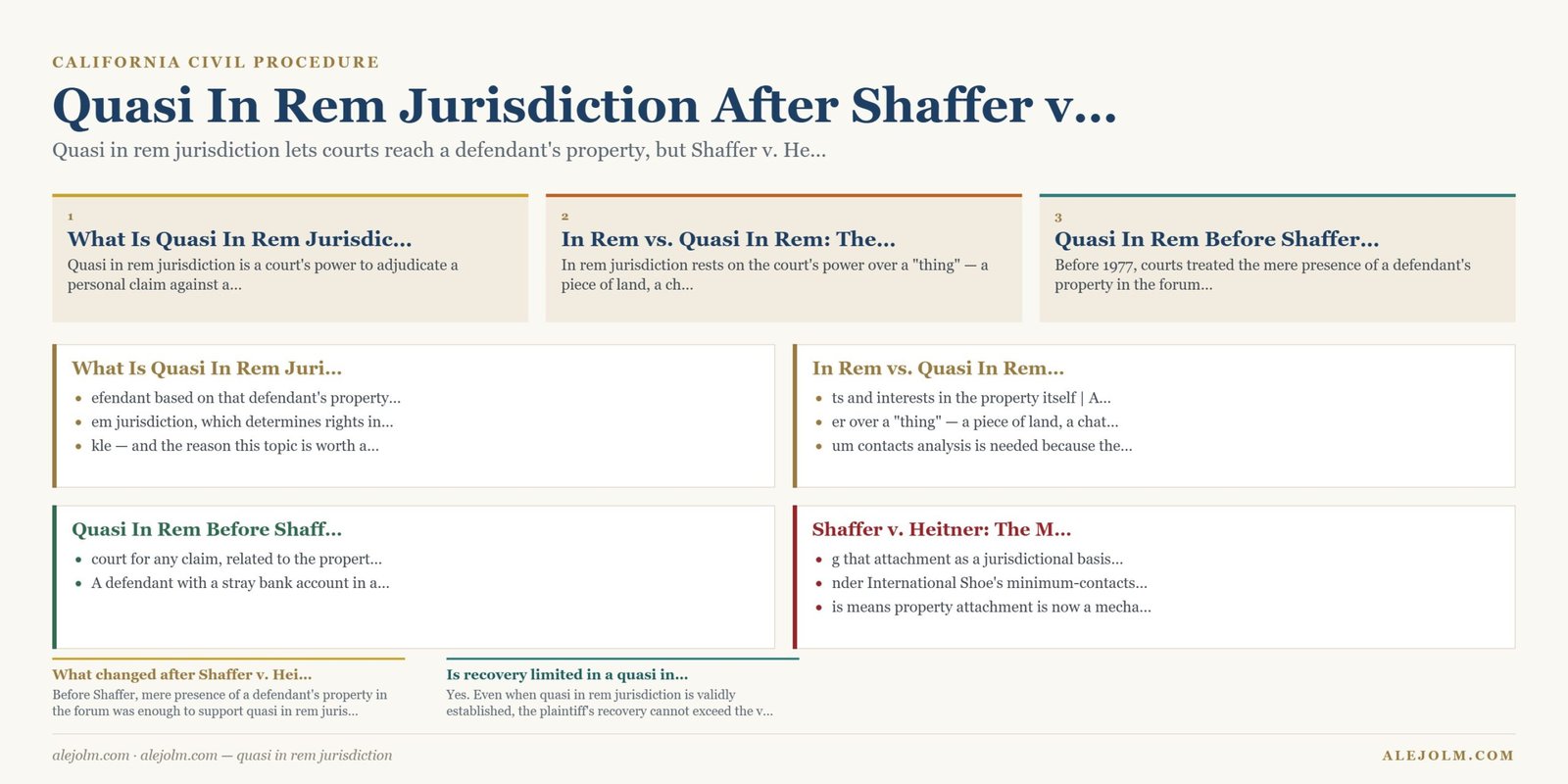
Quasi in rem jurisdiction is a court’s power to adjudicate a personal claim against a defendant based on that defendant’s property located in the forum, with recovery capped at the property’s value. It sits alongside true in rem jurisdiction, which determines rights in the property itself rather than a personal claim against its owner.
The key modern wrinkle — and the reason this topic is worth a dedicated deep dive on the California Bar Exam — is that Shaffer v. Heitner (1977) forced quasi in rem jurisdiction to satisfy the same minimum-contacts test used for ordinary personal jurisdiction.
In Rem vs. Quasi In Rem: The Core Distinction
| Feature | In rem jurisdiction | Quasi in rem jurisdiction |
|---|---|---|
| What’s being adjudicated | Rights and interests in the property itself | A personal claim against the defendant |
| Minimum contacts required? | No — property presence alone suffices | Yes, post-Shaffer |
| Scope of judgment | Binds all persons regarding that property | Binds only the defendant, capped at property’s value |
| Example | Quieting title to land | Attaching a bank account to satisfy an unrelated contract claim |
In rem jurisdiction rests on the court’s power over a “thing” — a piece of land, a chattel, or a bank account — physically or legally located in the forum. No minimum contacts analysis is needed because the court isn’t asserting power over a person, just over the res itself.
Quasi In Rem Before Shaffer: The Old Rule
Before 1977, courts treated the mere presence of a defendant’s property in the forum as sufficient to hale that defendant into court for any claim, related to the property or not, so long as recovery was capped at the property’s value. A defendant with a stray bank account in a state could be sued there on a completely unrelated debt.
Shaffer v. Heitner: The Modern Rule
Shaffer v. Heitner held that attaching a defendant’s property and using that attachment as a jurisdictional basis is not automatically valid just because property sits in the forum. The defendant’s contacts with the forum must be independently analyzed under International Shoe‘s minimum-contacts framework — the same test used for ordinary personal jurisdiction.
In practice, this means property attachment is now a mechanism for securing a judgment, not a standalone jurisdictional basis. Even if minimum contacts exist and quasi in rem jurisdiction is proper, recovery still cannot exceed the value of the attached property — a limitation that doesn’t apply to full personal jurisdiction cases.
California’s Application of Shaffer
California recognizes both in rem and quasi in rem jurisdiction under California Code of Civil Procedure § 410.10 and related attachment statutes (Cal. Code Civ. Proc. § 483.010 et seq.). In rem jurisdiction is most commonly exercised over California real property — a dispute over title to California land can be resolved by California courts regardless of where the parties live.
Quasi in rem is rarer in California practice post-Shaffer, but it can still arise when a defendant’s California bank account or other property is attached and the defendant has at least minimal contacts with the state. California’s attachment and garnishment procedures remain available tools, but Shaffer‘s minimum-contacts requirement still governs whether jurisdiction is constitutionally valid in the first place.
The Three-Question Framework for Property-Based Jurisdiction
When a fact pattern involves property located in the forum, work through these questions in order:
- Is this a pure in rem action — determining title or rights in the property itself, not a claim against the defendant personally? If so, presence of the property is enough; no minimum contacts needed.
- Is this a quasi in rem action — a personal claim against the defendant, using property attachment as the jurisdictional hook? If so, Shaffer requires an independent minimum-contacts analysis.
- If quasi in rem jurisdiction is valid, is recovery capped? Yes — recovery cannot exceed the attached property’s value, even if the claim itself is worth more.
Worked Example
Defendant resides in State A and owns commercial real property in State B worth $500,000. Plaintiff, a State B resident, has a contract dispute with Defendant — a breach of a service contract entirely unrelated to the property — and sues Defendant in State B state court. Plaintiff’s complaint alleges no facts showing Defendant has any contacts with State B beyond owning the property. Plaintiff attaches the property to secure the judgment, and Defendant moves to dismiss for lack of jurisdiction.
Analysis: This is a quasi in rem scenario under Shaffer. Although Defendant owns property in State B, Shaffer requires minimum contacts with the forum before the court can exercise jurisdiction over Defendant personally. The facts show none — the contract dispute is unrelated to the property, and Defendant doesn’t live, work, or do business in State B. Mere ownership of property is insufficient after Shaffer. The motion to dismiss should be granted, unless Plaintiff can establish some separate basis for minimum contacts.
Common Mistakes to Avoid
- Assuming property presence alone equals jurisdiction after Shaffer — it doesn’t.
- Confusing in rem (no minimum contacts needed) with quasi in rem (minimum contacts required post-Shaffer).
- Forgetting that quasi in rem recovery is capped at the attached property’s value, even when the underlying claim is worth more.
- Treating property attachment itself as the jurisdictional basis rather than as a mechanism layered on top of an independent minimum-contacts analysis.
FAQ
What changed after Shaffer v. Heitner?
Before Shaffer, mere presence of a defendant’s property in the forum was enough to support quasi in rem jurisdiction over any claim. After Shaffer, the defendant must also satisfy the International Shoe minimum-contacts test, regardless of the property attachment.
Is recovery limited in a quasi in rem case?
Yes. Even when quasi in rem jurisdiction is validly established, the plaintiff’s recovery cannot exceed the value of the attached property.
Does in rem jurisdiction require minimum contacts?
No. In rem jurisdiction is based on the court’s power over property physically or legally located in the forum, and it does not require a minimum-contacts analysis because it adjudicates rights in the property itself, not a personal claim against the owner.
Key Takeaways
- In rem jurisdiction adjudicates rights in property itself and needs no minimum-contacts showing.
- Quasi in rem jurisdiction involves a personal claim, secured by property, capped at the property’s value.
- Shaffer v. Heitner requires quasi in rem jurisdiction to satisfy the International Shoe minimum-contacts test.
- California recognizes both doctrines under CCP § 410.10, but Shaffer‘s minimum-contacts requirement still applies.
This article is educational and is not legal advice. Consult a licensed California attorney about your situation.
Related guides
- personal jurisdiction framework
- minimum contacts
- in rem jurisdiction
- specific vs. general jurisdiction