
Some of the most memorable speech cases involve no words at all: an armband worn to school, a draft card set alight, a flag burned on a pavement. Conduct of this kind counts as speech, and once it does the government cannot regulate it merely because it is conduct rather than talk.
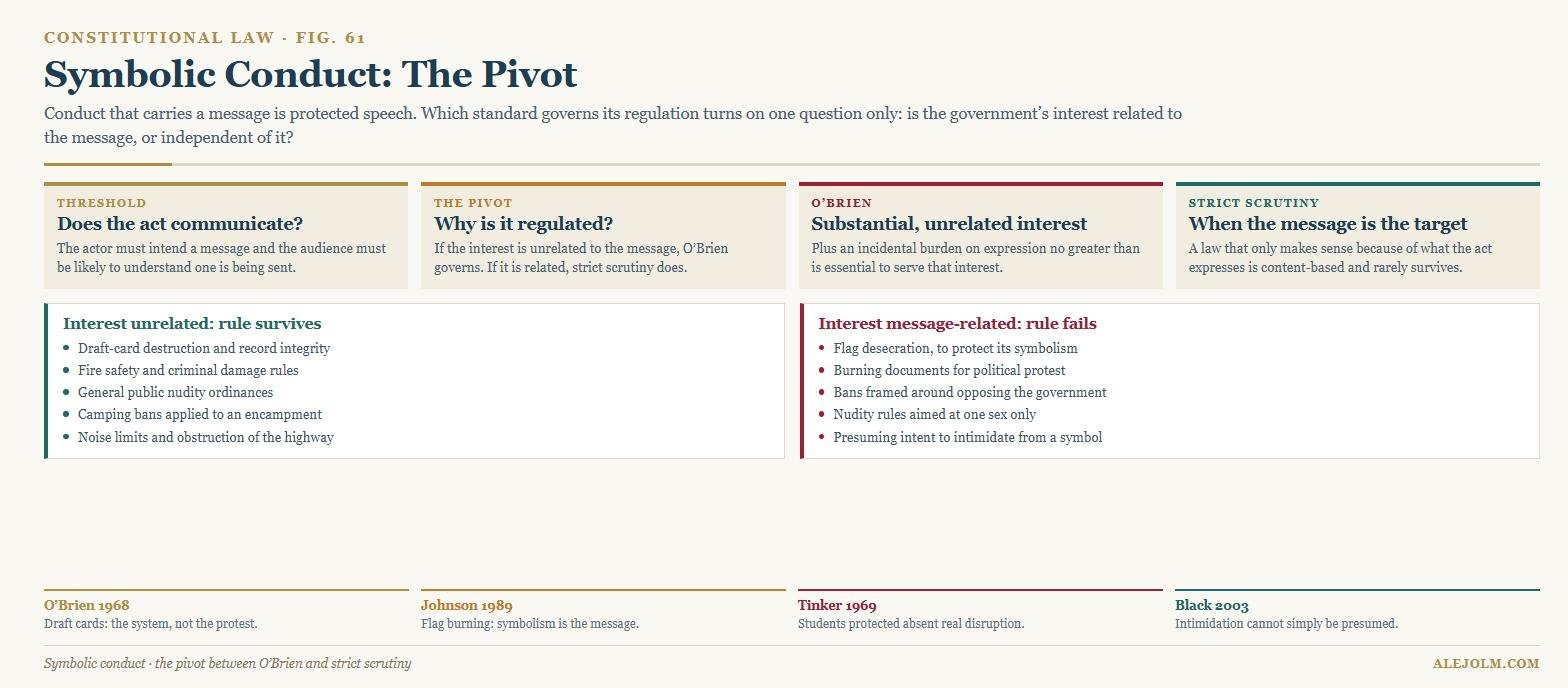
What makes the area tractable is that everything turns on a single pivot. Ask why the government is regulating. If the interest has nothing to do with the message, a deferential intermediate test applies and the rule will usually stand. If the interest exists only because of what the act communicates, the rule is content-based, strict scrutiny follows, and it will almost certainly fall.
The threshold: when conduct becomes speech
Not every action carries a message. Two conditions must be satisfied together: the actor must intend to communicate something, and the audience must be likely to understand that a message is being conveyed. Both halves matter. A private gesture no observer could interpret fails the second limb, and an act done for entirely practical reasons fails the first however much meaning others attach to it afterwards.
The test is deliberately generous once met. Expressive conduct receives the same protection as spoken or written expression; it is not a lesser category. Candidates who begin from the assumption that conduct is presumptively regulable have already reached the wrong answer.
The pivot question
Having established that the conduct is speech, ask what the regulation is actually for. A government interest is unrelated to the message where it addresses the physical or practical consequences of the act: the destruction of a document the administration needs, a fire risk, damage to property, obstruction of a road, noise. Here the deferential test applies.
An interest is message-related where the prohibition only makes sense given what the act expresses. A rule against burning a flag in order to preserve the flag’s symbolic value is the paradigm: the harm the state identifies is the disrespect communicated, which is to say the message itself. Dress that up however you like and it remains a content-based restriction, so strict scrutiny applies and the interest in protecting a symbol from criticism is not compelling.
The most reliable tell is the text of the statute. If a provision applies only where the conduct is undertaken for the purpose of protest, or to express opposition, or to convey contempt, it has written its own content-based character into the operative words and no amount of argument about incidental effects will rescue it.
Exam tip: run the pivot before you name any test. Answers that recite the O’Brien elements and then apply them to a message-targeting statute have skipped the only step that mattered.
The O’Brien test
Where the interest is genuinely unrelated to expression, the regulation must satisfy two requirements. It must serve an important or substantial government interest directed at the non-communicative aspects of the conduct, and the incidental burden on expression must be no greater than is essential to serve that interest.
The tailoring standard here functions at roughly intermediate level. A meaningful fit between the rule and the practical interest is needed, but the least restrictive means is not required. That is why a general prohibition on destroying official records survives even though it catches a protester whose whole point was the destruction, and why a neutral ban on overnight camping can be applied to a protest encampment without becoming a speech restriction.
| Conduct | Government interest |
|---|---|
| Burning a draft card | Integrity of the conscription records system |
| Burning a national flag | Preserving the flag’s symbolic value |
| Wearing an armband at school | Avoiding disruption to teaching |
| Burning a cross at a rally | Preventing intimidation |
| Nude dancing | General public decency and secondary effects |
Students, symbols and threats
Symbolic expression in state schools has its own gloss. Passive, non-disruptive expression by pupils is protected, and officials may suppress it only where it causes material and substantial disruption to the work of the school. That standard is objective. Disapproval of the viewpoint is not disruption, and neither is an unsubstantiated fear that trouble might follow, which is the point most often lost in answers.
Threatening symbolism is treated differently again. A politically loaded symbol displayed at a rally is expressive conduct and is protected. The same symbol placed on an individual’s property as a warning may be a true threat and fall outside protection altogether. What the state cannot do is legislate a shortcut: a statute presuming that every use of the symbol is intended to intimidate removes the element that distinguishes threat from expression, and such a presumption is invalid for overbreadth.
Worked example
City Z prohibits destroying or defacing public monuments “for the purpose of political protest or expressing opposition to government”. A protester burns a replica of the city’s founding charter outside the town hall to denounce corruption and is prosecuted.
Take the threshold first. Burning a founding document outside the seat of government, during a protest about that government, plainly intends a message and would be understood as carrying one. It is expressive conduct. Now the pivot, and the statute answers it against itself: the prohibition operates only where the destruction is for the purpose of protest or opposition. Identical physical conduct performed for any other reason is untouched. The interest is therefore inseparable from the message, the provision is content-based on its face, and strict scrutiny applies. Preserving a replica has no compelling weight, and suppressing criticism of government is not a legitimate objective at all, still less a compelling one. The statute fails. It is also vulnerable independently for overbreadth, since it reaches a wide field of protected political expression.
Change one fact. Suppose the ordinance simply prohibited setting fires or damaging property in the civic square, with no reference to purpose, and the protester were charged under that. The interest would now be fire safety and property protection, wholly unrelated to the message, so the O’Brien test would govern. The interest is substantial, the burden on expression incidental and no greater than necessary, and the conviction would stand — even though the protester loses the particular means he chose.
Common mistakes that cost points
- Applying O’Brien to a statute whose operative words turn on the purpose of protest, which makes it content-based.
- Treating O’Brien as strict scrutiny; it is an intermediate-level test with a weaker tailoring requirement.
- Assuming conduct is presumptively unprotected, when qualifying expressive conduct stands on the same footing as speech.
- Skipping the two-part threshold and asserting that any provocative act is symbolic speech.
- Suppressing student expression on a prediction of disruption rather than evidence of material and substantial disruption.
- Treating all display of a threatening symbol as unprotected, instead of requiring proof of intent to intimidate.
- Missing the overbreadth and vagueness challenges that usually run alongside a symbolic conduct claim.
- Confusing this analysis with forum doctrine, which asks where neutral restrictions apply rather than whether the act is speech.
Frequently asked questions
Why is flag burning protected when draft-card burning is not?
Because the interests differ. Protecting a conscription system from the destruction of its records has nothing to do with the anti-war message, so intermediate review applies and the rule survives. Protecting a flag’s symbolic value is an objection to what the burning says, which makes the restriction content-based and subjects it to strict scrutiny it cannot meet.
Can a school ban political badges or armbands?
Only where the expression causes material and substantial disruption to the school’s work. Officials cannot act on distaste for the message or on speculation that difficulties may arise, so a quiet, passive display by pupils will normally be protected.
Is nude dancing expressive conduct?
It receives some protection, but a generally applicable public-indecency ordinance will usually be upheld under intermediate review, because the asserted interest in public decency and secondary effects is treated as unrelated to any expressive message. A rule targeting only one sex, or only certain venues by their message, would be content-based instead.
Cohen v. California and symbolic conduct in Los Angeles County, 2026
One of the foundational cases on expressive conduct began in a Los Angeles County courthouse corridor. Paul Robert Cohen was convicted under California’s disturbing the peace provisions for wearing a jacket bearing a profane anti-draft slogan, and in Cohen v. California (1971) the Supreme Court reversed, holding that the state could not criminalise the public display of a single offensive word absent a showing of intent to incite or genuine disruption. The decision established that offensiveness alone is not a basis for suppression.
California courts continue to read the California Constitution as providing independent protection for expressive conduct, and the California Penal Code provisions on disturbing the peace and offensive words have been narrowed by decisions requiring that words be likely to provoke immediate violence rather than merely give offence. The practical result in the Los Angeles Superior Court is that prosecutions premised on the content of a message rarely survive.
How the analysis works locally:
- Ask whether the regulation targets the message. If it does, strict scrutiny applies; if it is genuinely neutral, the O’Brien test governs.
- Neutral conduct rules are usually valid. Rules on obstructing sidewalks, camping in county parks or blocking traffic are enforceable even against expressive actors.
- Homelessness enforcement is not a speech case. After Grants Pass v. Johnson (2024) the constraints on ordinances regulating sleeping in public are analysed under the Eighth Amendment rather than the First.
- Courthouse and government building rules are stricter. Non-public forum status permits reasonable restrictions on signs and demonstrations inside county facilities.
- Flag and effigy burning remains protected. Content-based prohibitions on desecration are invalid, though fire and safety rules apply.
- Masks and face coverings need care. Provisions aimed at concealment during unlawful acts are distinguishable from bans on anonymous protest.
For 2026, identify whether the government is regulating the idea or the physical act. Read with the First Amendment framework, public forum doctrine and vagueness and overbreadth.
Next steps
Place this inside the wider routine by reading the First Amendment framework first, then public forum doctrine, which frequently appears in the same fact pattern but asks a different question. The levels of scrutiny explains why the tailoring language shifts between the two tracks, and commercial speech offers a useful contrast in how intermediate review operates elsewhere.
The leading opinions are collected at Justia, the amendment is annotated by the Cornell Legal Information Institute, and current examination scope is published by the State Bar of California.
Related guides
 Campaign Finance and Anonymous Speech: The Core Rules
 Piercing the Corporate Veil: A Two-Prong Alter Ego Test
 The Erie Doctrine Explained: A 4-Step Bar Exam Guide
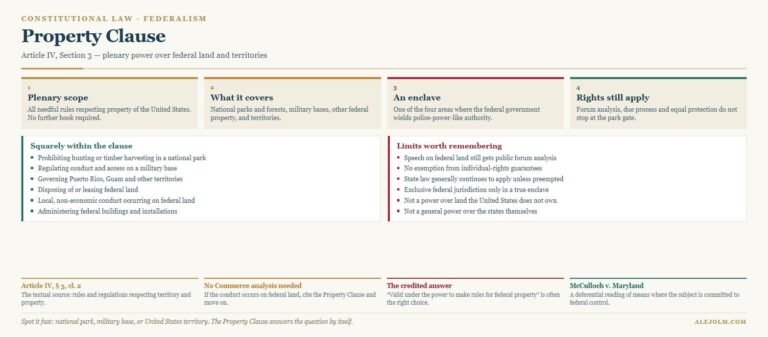 Property Clause: Congress and Federal Lands Explained
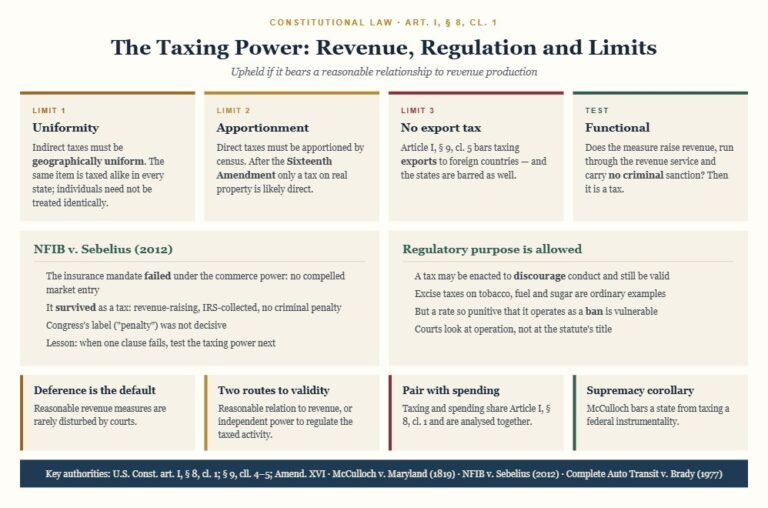 Congress’s Taxing Power: When a Penalty Is Really a Tax
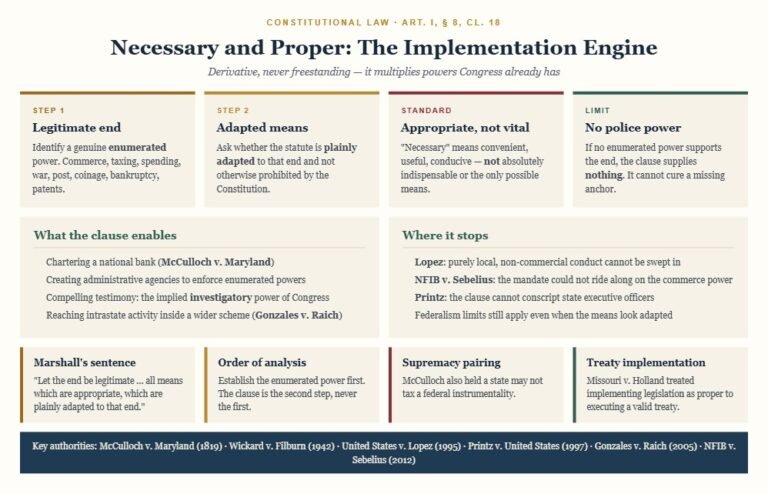 The Necessary and Proper Clause: Congress’s Multiplier
 3 Levels of Scrutiny in Constitutional Law Explained
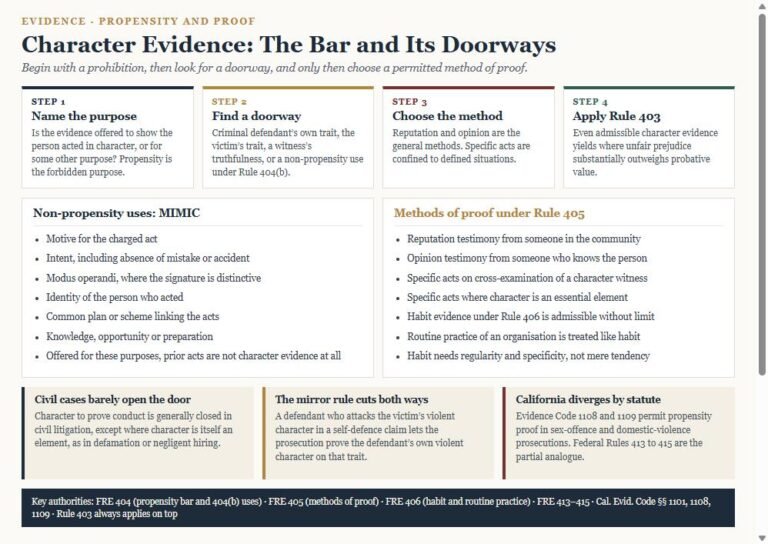 The Character Evidence Rules: Propensity Bar and Doorways
 Ripeness and Mootness: Timing Rules in Federal Court
 Executive Privilege: A Qualified Right That Must Yield
 Miranda Rights: Custody, Interrogation and Invocation
 Freedom of the Press: Publication Liability and Limits