
Advertising was once thought to fall outside the First Amendment entirely. It no longer does, but it occupies a middle position: protected, though at an intermediate tier, and only once it has cleared a threshold requirement of truthfulness. The framework is a four-part test, and in practice the fourth part decides nearly every case.
The efficient way to handle a commercial speech problem is therefore to move quickly through the first three prongs, which the government usually satisfies, and to spend your effort on fit. That is where regulations are actually struck down.
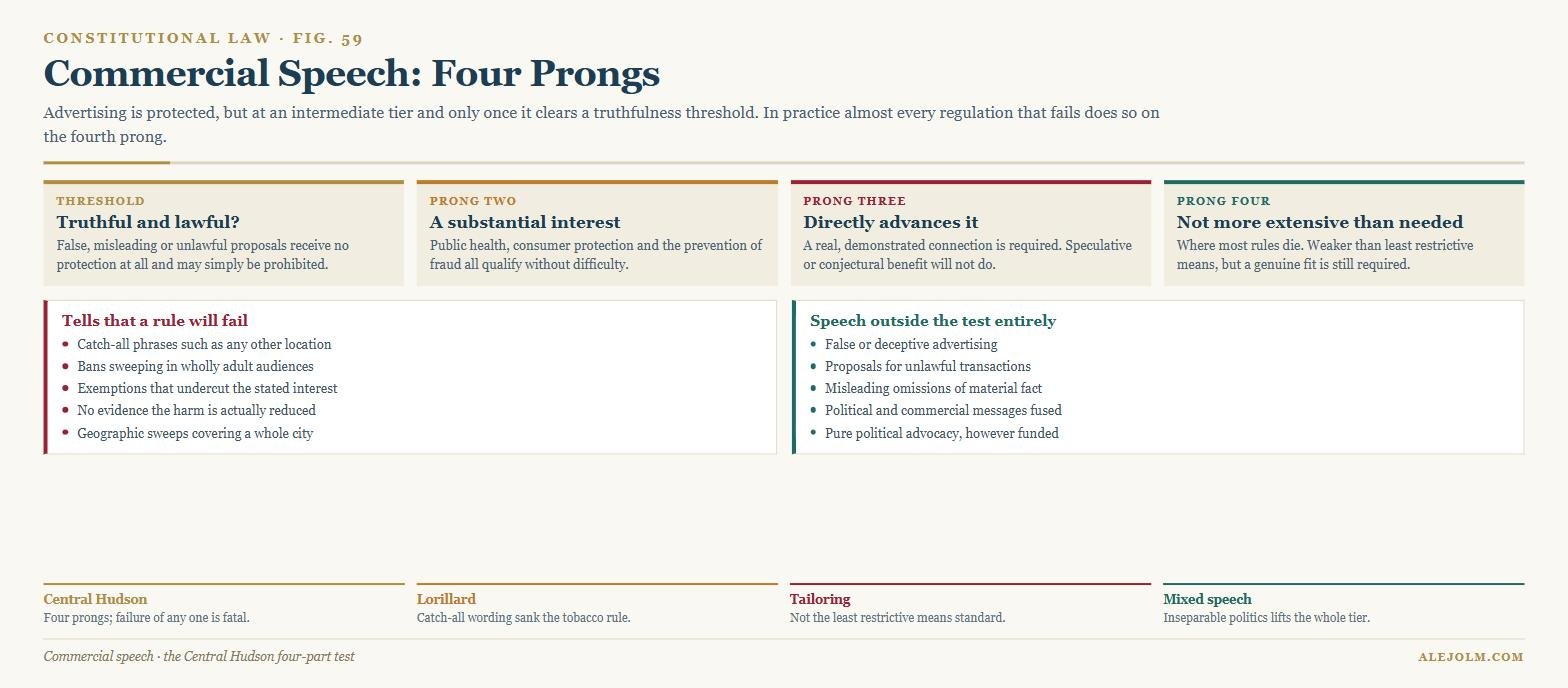
What counts as commercial speech
Commercial speech is expression that does no more than propose a commercial transaction: an advertisement for goods or services, a price list, an invitation to purchase. The definition matters because it determines the tier, and it is narrower than “speech by a business”. A company’s contribution to public debate about regulation is political speech, not commercial speech, even though a commercial motive lies behind it.
Where the two are genuinely fused — a leaflet that both solicits a subscription and argues a political position, in a way that cannot be separated — the whole communication is treated as core protected speech. The intermediate test drops away entirely and the highest level of protection applies. Candidates frequently apply the commercial test to mixed messages and thereby under-protect the speech.
The threshold: truthful and lawful
Before the test begins, the speech must concern lawful activity and must not be misleading. If the advertisement is false, deceptive or fraudulent, or if it proposes an unlawful transaction, it receives no protection whatever and may be prohibited outright. No interest need be identified and no tailoring analysis is performed.
This is a genuine stopping point and it disposes of a category of problems in a single line. An advertisement claiming that a product cures a disease it does not cure, one that omits material facts so as to create a false impression, or one offering something whose sale is illegal, all fail here. Running the four-part test on such facts is wasted effort and signals that the threshold was missed.
The four prongs
For truthful advertising of a lawful product, the government must satisfy each of four requirements. First, the speech concerns lawful activity and is not misleading, which is the threshold restated. Second, the government asserts a substantial interest. Third, the regulation directly advances that interest. Fourth, the regulation is not more extensive than necessary to serve it. Failure of any prong invalidates the rule.
The second prong is rarely contested. Public health, consumer protection, preventing fraud, protecting young people from exposure to age-restricted products — all are comfortably substantial. The third prong has more bite than it appears to: the connection between the restriction and the interest must be real and demonstrated rather than assumed. A regulation supported by nothing but the assertion that it might help will fail, and an exemption scheme so riddled with holes that the asserted harm continues unabated undermines the claim of direct advancement.
The fourth prong is where the argument lives. The standard is weaker than strict scrutiny, so the government need not adopt the least restrictive means available. But a reasonable fit is still required, and a rule substantially broader than its purpose demands will fall.
Exam tip: read the statute for catch-all language. A phrase like “or any other location where minors traditionally gather” is the classic tell of a tailoring failure, because it sweeps in shopping centres, cinemas and parks and ends up banning nearly all outdoor advertising.
| Prong | What it asks |
|---|---|
| Threshold | Is the speech truthful and the activity lawful? |
| Substantial interest | Is the asserted objective genuinely important? |
| Directly advances | Is there real evidence the rule reduces the harm? |
| Not more extensive | Is the fit reasonable rather than sweeping? |
| Mixed speech | Are political and commercial elements inseparable? |
Why the tobacco cases matter
The leading illustration involved a ban on outdoor tobacco advertising within a thousand feet of schools and playgrounds, coupled with a catch-all extending it to any other location where young people traditionally gather. The buffer around schools had a defensible rationale. The catch-all did not, because in a built-up area it covered so much ground that adult consumers of a lawful product were left with almost no channel through which they could lawfully be addressed.
That case is worth remembering for its structure as much as its outcome. The government satisfied the interest prong and largely satisfied direct advancement, then lost on breadth. It also failed independently for vagueness, which is a reminder that a poorly defined speech restriction is exposed on two fronts at once.
Worked example
State N prohibits outdoor advertising of alcoholic drinks within five hundred feet of any school, youth recreation centre or residential neighbourhood. Indoor advertising in bars and off-licences is permitted, as is outdoor advertising of soft drinks. A brewer’s billboard four hundred feet from a school carries the line “the taste of relaxation”. The state orders it removed.
The billboard proposes a commercial transaction, so this is commercial speech. The threshold is satisfied: beer is lawful, and aspirational copy making no health claim and not addressed to children is not misleading. Protecting young people from alcohol marketing is a substantial interest. A buffer around schools and youth centres directly advances it, since those are places children reliably are. The rule then fails on breadth. Extending the ban to all residential neighbourhoods captures areas populated overwhelmingly by adults and, in any ordinary town, leaves almost no lawful outdoor site. That the state simultaneously permits point-of-sale advertising inside off-licences weakens the fit further, because the most targeted marketing is allowed while general outdoor communication with adults is forbidden. The restriction is more extensive than necessary and the brewer succeeds.
Change one fact. Suppose the billboard depicted a cartoon animal and appeared beside a primary school gate, and suppose the statute reached only school perimeters. The advertisement now looks directed at children, the state’s interest maps precisely onto the restriction’s scope, and the narrow buffer is a reasonable fit. The same doctrine now sustains the ban.
Common mistakes that cost points
- Running the four-part test on false or misleading advertising, which receives no protection and stops at the threshold.
- Applying the commercial test to a message in which political and commercial elements are inseparable.
- Requiring the least restrictive means, which is the strict-scrutiny standard rather than the commercial one.
- Treating the substantial-interest prong as contested when it is almost always satisfied.
- Accepting direct advancement on assertion alone, without asking whether evidence supports it.
- Overlooking exemptions that undermine the government’s own theory of how the rule reduces harm.
- Missing catch-all statutory language, which is the most reliable indicator of a tailoring failure.
- Confusing a restriction on advertising with a restriction on the underlying conduct, which raises no speech issue.
Frequently asked questions
Can a state ban advertising for a product it permits people to buy?
Only with difficulty. Where the product is lawful and the advertisement truthful, a wholesale prohibition will usually fail the fourth prong, because banning all communication about a lawful transaction is broader than any legitimate objective requires. Targeted restrictions aimed at particular audiences or places fare much better.
Is professional advertising treated differently?
No. Truthful, non-misleading advertising of professional services is protected commercial speech, so a blanket prohibition on solicitors or other professionals advertising their services cannot stand. Rules against misleading claims remain fully enforceable, since deceptive material never enters the test.
What happens when a message is both political and commercial?
If the elements are genuinely inseparable, the communication is treated as core protected speech and the intermediate test does not apply. The government then faces strict scrutiny for any content-based restriction, which is a considerably higher hurdle.
Commercial speech in California and Los Angeles County, 2026
California produced one of the most consequential modern decisions on what counts as commercial speech. In Kasky v. Nike (2002) the California Supreme Court held that a company’s public statements defending its overseas labour practices could be treated as commercial speech, and therefore subject to the state’s false advertising laws, because they were made by a commercial speaker to a commercial audience about its own products. That framing remains a distinctive feature of California law.
The enforcement architecture matters as much as the doctrine. Sections 17200 and 17500 of the California Business and Professions Code give private parties and public prosecutors, including the Los Angeles County District Attorney, broad authority over misleading commercial statements. Compelled disclosure is the other half of the picture: California requires extensive product warnings, and courts have struck particular warning requirements where the compelled message was not purely factual and uncontroversial, the limit Zauderer imposes.
Local regulation worth knowing:
- Billboards are litigated constantly. Los Angeles sign regulation, including limits on supergraphics and digital conversions, has generated years of First Amendment challenges over on-site and off-site distinctions.
- Cannabis advertising is tightly restricted. State licensing rules limit placement and audience composition, and county and city rules add further constraints.
- Alcohol and tobacco placement rules apply near schools. Location-based advertising limits are generally upheld as furthering a substantial interest.
- Run Central Hudson in order. Lawful and non-misleading speech, substantial government interest, direct advancement, and no more extensive than necessary.
- Purely factual disclosures get lighter review. Compelled statements that are uncontroversial and factual are judged under a more forgiving standard than restrictions.
- Professional advertising is regulated by licensing boards. Rules governing lawyer and medical advertising sit within this framework, not outside it.
For 2026, classify the speech before choosing a standard, because the commercial designation is doing most of the work. Read with the First Amendment framework, government speech and prior restraint.
Next steps
Commercial speech is one branch of a larger routine, so read the First Amendment framework to see where it sits, and public forum doctrine for the separate question of where the advertising appears. The levels of scrutiny explains why the tailoring language differs between tiers, and the actual malice standard covers the other main area where the Amendment reshapes ordinary liability rules.
The leading opinions are collected at Justia, the amendment is annotated by the Cornell Legal Information Institute, and current examination scope is published by the State Bar of California.
Related guides
 Marbury v. Madison and the Power of Judicial Review
 The Erie Doctrine Explained: A 4-Step Bar Exam Guide
 Congress’s Naturalization Power and Citizenship Limits
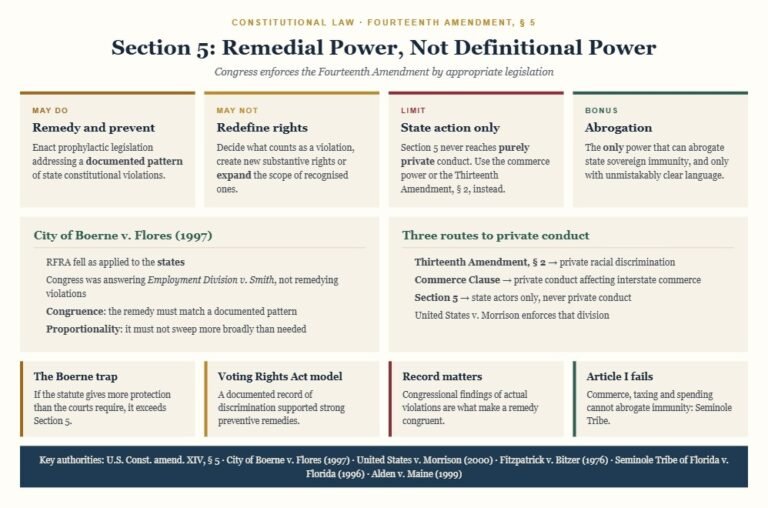 Section 5 Enforcement Power: Remedy, Do Not Redefine
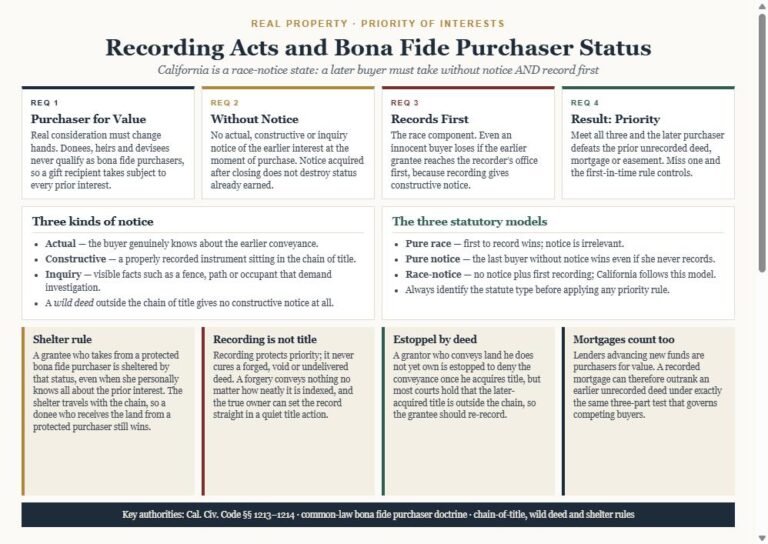 Recording Acts: Race, Notice and Race-Notice Explained
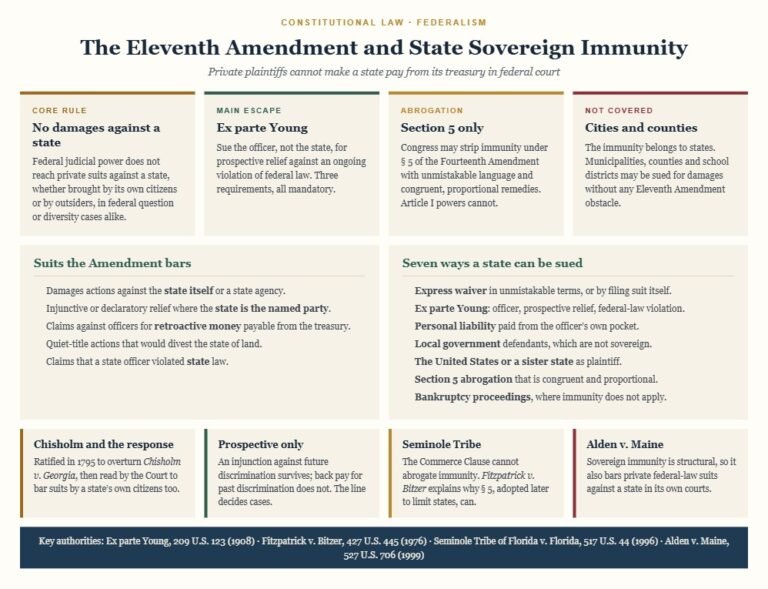 The Eleventh Amendment and State Sovereign Immunity
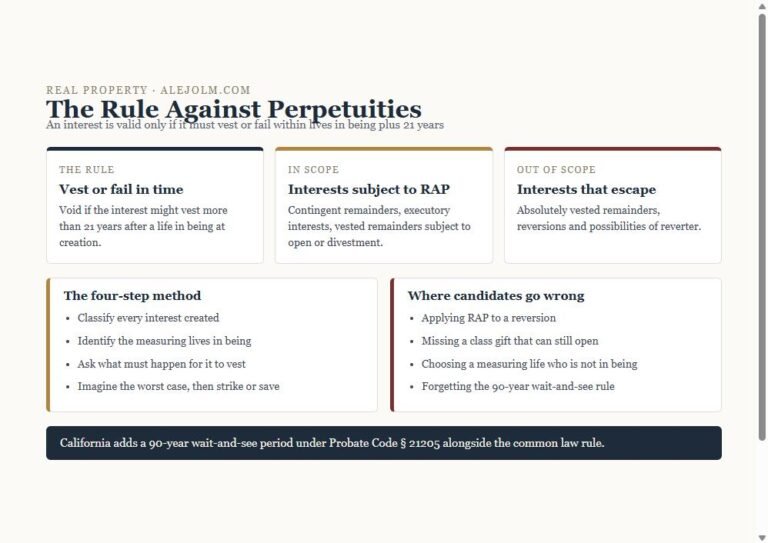 The Rule Against Perpetuities Explained Step by Step
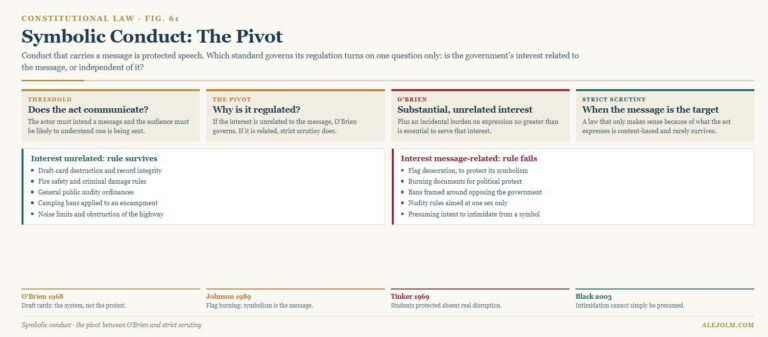 Symbolic Conduct and the O’Brien Test: The Pivot Question
 3 Levels of Scrutiny in Constitutional Law Explained
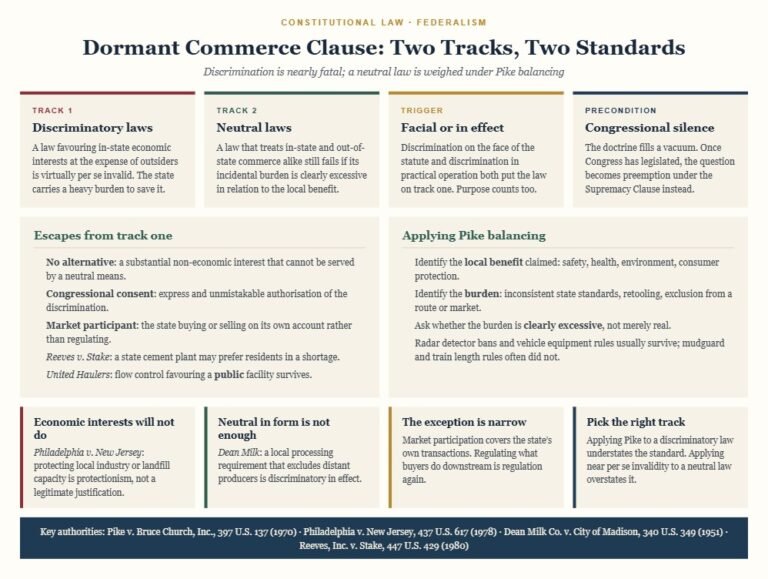 Dormant Commerce Clause: Discrimination vs Pike Balancing
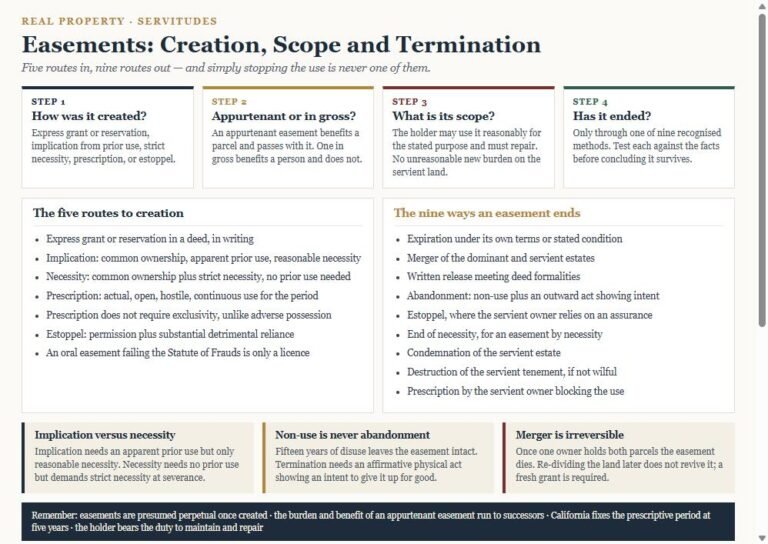 Easements Explained: Creation, Scope and Termination
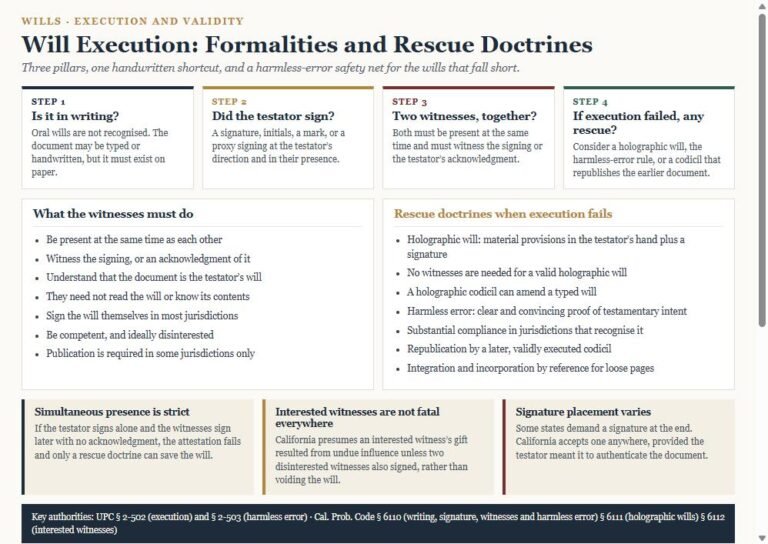 Will Execution Requirements: Formalities and Rescue