
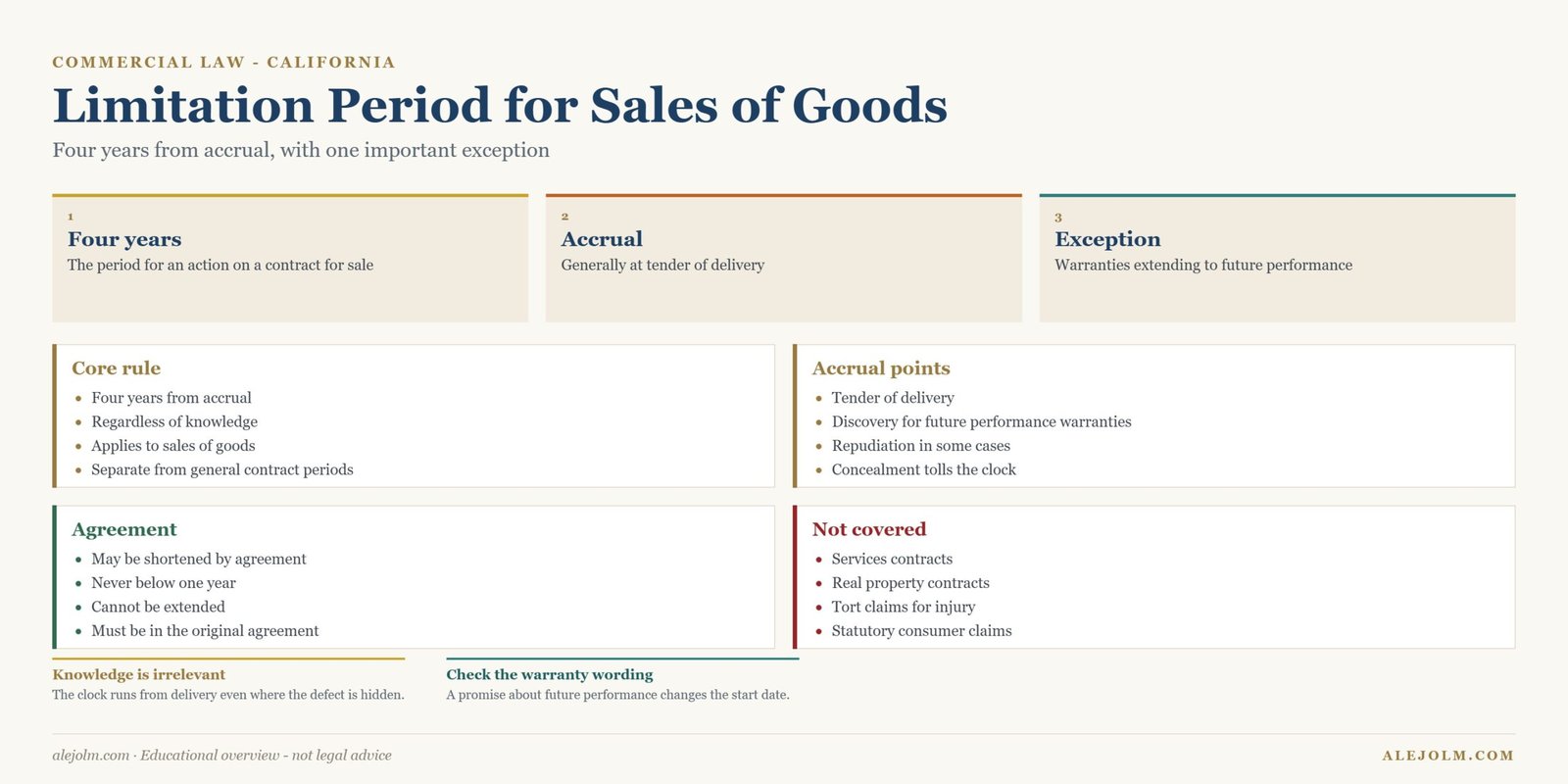
The California Commercial Code sets its own statute of limitations for actions on a contract for the sale of goods. The period is four years, and it runs from the moment the cause of action accrues, which for a breach of warranty is ordinarily the tender of delivery rather than the day the buyer discovers that something is wrong.
That default is harsh, and it catches out buyers who assume the clock starts when a defect appears. The important exception is a warranty that explicitly extends to the future performance of the goods, where the period runs from discovery instead. This guide sets out the rule, the exception, the limits on varying the period by agreement, and how the sales period differs from the general California limitation periods.
The four year period and when it starts
An action for breach of any contract for sale must be commenced within four years after the cause of action has accrued. A breach of warranty accrues when tender of delivery is made, and the buyer lack of knowledge of the breach does not postpone that moment. A latent defect that surfaces five years after delivery is therefore ordinarily out of time, however unfair that feels.
Warranties extending to future performance
The exception applies where a warranty explicitly extends to the future performance of the goods and discovery of the breach must await that performance. A promise that a machine will operate without defect for five years is the paradigm. Where it applies, the cause of action accrues when the breach is or should have been discovered, which can push the deadline years beyond delivery.
Shortening the period by agreement
- Reduction is permitted. The parties may agree in the original agreement to a shorter period.
- One year is the floor. A period shorter than one year is ineffective.
- Extension is not permitted. The parties cannot agree to a period longer than four years.
- The original agreement. The reduction must be part of the original bargain, not added later.
- Consumer scrutiny. Shortened periods in consumer contracts attract unconscionability arguments.
- Separate statutory claims. Consumer protection statutes carry their own periods.
| Claim | Period | Runs from |
|---|---|---|
| Sale of goods, ordinary warranty | Four years | Tender of delivery |
| Sale of goods, future performance warranty | Four years | Discovery |
| Written contract generally | Four years | Breach |
| Oral contract generally | Two years | Breach |
| Fraud | Three years | Discovery |
A worked example
A manufacturer in Santa Fe Springs buys an industrial press and receives a written warranty that the machine will perform without defect for five years from delivery. A structural fault emerges in year three and is discovered shortly afterwards. Because the warranty explicitly extended to future performance, accrual runs from discovery, and the buyer has four years from that point rather than from delivery.
Change the warranty. Suppose the same press came with a general assurance that it was free from defects in materials and workmanship, with no reference to any period of future operation. Accrual runs from tender of delivery, the four years expire in year four, and a claim brought in year seven is time barred even though the buyer could not reasonably have known earlier.
The sales limitation period in California and Los Angeles County in 2026
Distributors, manufacturers and equipment buyers across Los Angeles County routinely discover that their warranty claim is governed by the sales period rather than by the general four year period for written contracts, and that the accrual date is delivery rather than breach. The two periods are the same length, which conceals the difference until the accrual question is examined.
The practical response is to read the warranty wording before anything else. Language that promises performance over a stated period changes the analysis entirely. Where a supplier has actively concealed a defect, the discovery principle may also delay accrual, but that argument requires evidence of concealment rather than mere silence.
- Diary from delivery. Do not assume the clock starts when the problem appears.
- Read the warranty for time language. A stated performance period changes the start date.
- Check for a shortened period. Many supply terms reduce the period to one or two years.
- Do not rely on an extension clause. The statute caps the period at four years.
- Consider parallel claims. Fraud and consumer statutes have their own timing rules.
- Preserve evidence early. Proving concealment requires documents that are easily lost.
For 2026, confirm the current California authority on the sales limitation period, future performance warranties and tolling directly with current authority, since these continue to develop.
Common mistakes to avoid
- Assuming the clock starts at discovery. For ordinary warranties it starts at delivery.
- Applying the general contract period. Sales of goods have their own regime.
- Believing a longer contractual period is enforceable. The statute caps it at four years.
- Accepting a period under one year. Such a reduction is ineffective.
- Treating a repair promise as a future performance warranty. A promise to repair is not always the same thing.
- Ignoring parallel claims. A tort or statutory claim may still be alive when the sales claim is not.
Frequently asked questions
How long do I have to sue over defective goods in California?
Four years from when the cause of action accrued, which for most warranty claims is the tender of delivery rather than the date the defect appeared.
What is a warranty extending to future performance?
One that explicitly promises how the goods will perform over a stated future period, so that a breach cannot be discovered until that performance occurs. Accrual then runs from discovery.
Can a supplier shorten the period in its terms?
Yes, in the original agreement, but not below one year. A clause purporting to extend the period beyond four years is ineffective.
Does the period apply to services?
No. Services and other non goods contracts are governed by the general California limitation periods, which differ for written and oral agreements.
Does concealment stop the clock?
Active concealment of a defect can delay accrual on discovery principles, but the claimant must show concealment rather than simple failure to volunteer information.
Related guides
- Statute of limitations basics
- Implied warranties
- Express warranties
- The perfect tender rule
- Revocation of acceptance
- Risk of loss and delivery terms
- Damages for breach of contract
- Misrepresentation and fraud
Next steps
If you have discovered a defect in goods bought some time ago, check the delivery date and the warranty wording before anything else. Our guides to express warranties and revocation of acceptance explain the substantive claims that the deadline governs.
For primary sources, read California Commercial Code section 2725 and the civil jury instructions published by the Judicial Council of California.