
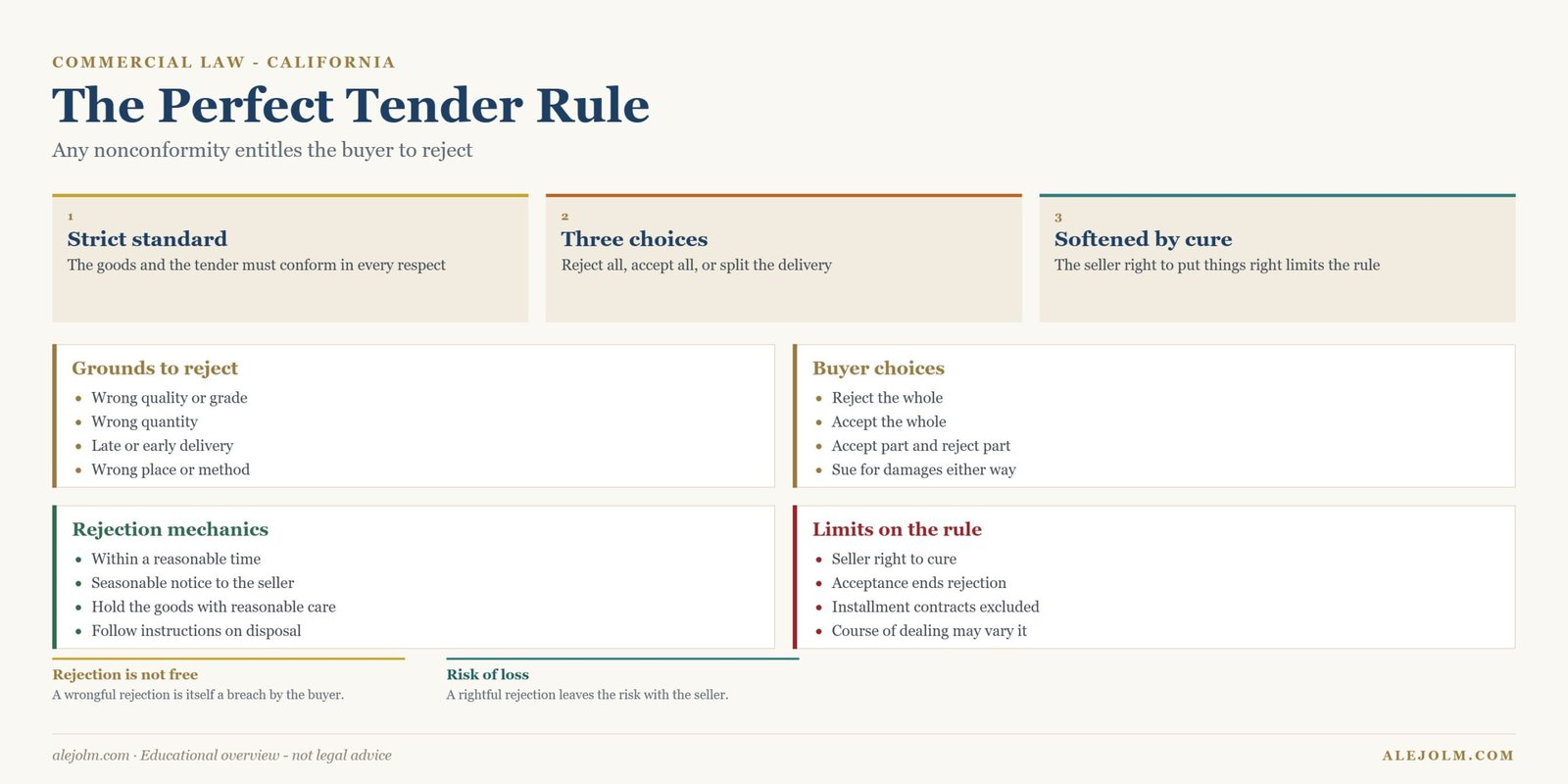
The perfect tender rule is the sale of goods principle that if the goods or the tender of delivery fail to conform to the contract in any respect, the buyer may reject the whole, accept the whole, or accept any commercial unit and reject the rest. California states it in the Commercial Code, and it is markedly stricter than the substantial performance standard that governs services.
Read alone the rule looks brutal, since even a trivial deviation appears to entitle a buyer to walk away. In practice it is heavily qualified by the seller right to cure, by the rules on acceptance, and by the separate regime for goods delivered in instalments. This guide sets out the rule, the qualifications, and the mechanics of a valid rejection.
What the rule permits
Nonconformity is judged against the contract, not against a standard of reasonableness. Wrong grade, short quantity, late arrival, delivery to the wrong place or shipment by the wrong method can all engage the rule. The buyer then has three options, and may reject the entire consignment even where only part of it is defective.
How to reject properly
Rejection must occur within a reasonable time after delivery, and the buyer must give seasonable notice to the seller. A buyer in possession of rejected goods must hold them with reasonable care for long enough to allow the seller to remove them, and a merchant buyer must follow reasonable instructions about their disposal. Failure to follow the mechanics can turn a valid rejection into an acceptance.
The qualifications that matter
- The right to cure. Where time remains, or where the seller reasonably believed the tender would be acceptable, it may put matters right.
- Acceptance. Once the goods are accepted the buyer can no longer reject and must rely on revocation or damages.
- Instalment contracts. Deliveries in separate lots are governed by a substantial impairment standard instead.
- Course of dealing. Prior practice and trade usage can qualify what conformity means.
- Good faith. A rejection engineered to escape a bad bargain sits uncomfortably with the duty of good faith.
- Risk of loss. A rightful rejection leaves the risk on the seller.
| Buyer action | Effect | Remaining remedy |
|---|---|---|
| Rightful rejection of all | Contract goods returned | Damages for non delivery |
| Rejection of part | Split delivery | Damages for the rejected part |
| Acceptance despite defect | Rejection barred | Damages for breach of warranty |
| Silence beyond a reasonable time | Acceptance | Damages only |
| Use inconsistent with the seller ownership | Acceptance | Damages only |
A worked example
A restaurant group in Los Angeles orders a fixed quantity of a specified grade of produce. The delivery arrives on time and in the right quantity but a small proportion is of a lower grade. Strictly, the tender does not conform and the buyer may reject the whole consignment. Whether that rejection sticks depends on whether the supplier can cure.
Change the calendar. If the delivery date has not yet passed, the supplier can simply notify the buyer and deliver conforming produce within the contract period, and the rejection fails. If the date has passed and the supplier had no reasonable grounds to think the lower grade would be accepted, the rejection stands and the buyer may buy elsewhere and claim the difference.
The perfect tender rule in California and Los Angeles County in 2026
The rule is a live commercial issue throughout the import, distribution and food supply businesses concentrated in Los Angeles County. Buyers use it to reject shipments when the market has moved against them, and sellers respond by pointing to cure rights, course of dealing and the good faith obligation. The outcome usually turns on how promptly and how clearly the buyer acted.
Contracts frequently modify the position. Terms allowing a defined tolerance on quantity or grade, or requiring the buyer to give the seller an opportunity to replace defective goods, are enforceable and remove much of the uncertainty. Buyers who want the full protection of the rule should avoid agreeing to such tolerances without thought.
- Inspect immediately. The right to reject expires within a reasonable time.
- Give written notice. State the nonconformity specifically, since unstated defects may be waived.
- Do not use the goods. Use inconsistent with the seller ownership is acceptance.
- Store carefully. A rejecting buyer must hold the goods with reasonable care.
- Expect a cure attempt. Especially where the delivery date has not passed.
- Check whether it is an instalment contract. A different and gentler standard applies.
For 2026, confirm the current California authority on rejection, cure and acceptance of goods directly with current authority, since these continue to develop.
Common mistakes to avoid
- Rejecting without notice. A rejection is ineffective unless the seller is told.
- Waiting too long. Delay converts rejection into acceptance.
- Applying the rule to instalments. Separate lots follow the substantial impairment test.
- Forgetting the cure right. It defeats many rejections outright.
- Using the goods after rejecting. That conduct amounts to acceptance.
- Failing to particularise the defect. Unstated grounds may not be available later.
Frequently asked questions
Can I reject a delivery for a small defect?
In principle yes, because the tender must conform in every respect. In practice the seller right to cure often removes the benefit of doing so.
How long do I have to reject?
A reasonable time after delivery and after a reasonable opportunity to inspect. What is reasonable depends on the goods and the trade.
What if I have already used the goods?
Using goods in a way inconsistent with the seller ownership is an acceptance, and rejection is no longer available. You may still have a damages claim.
Does the rule apply to services?
No. Services and other non goods contracts are judged by substantial performance, which is far more forgiving of minor deviations.
Who bears the loss if rejected goods are destroyed?
The seller. A rightful rejection means the risk of loss did not pass, subject to the buyer duty to hold the goods with reasonable care.
Related guides
- The right to cure
- Revocation of acceptance
- Installment contracts
- Risk of loss and delivery terms
- Implied warranties
- Express warranties
- Substantial performance
- Damages for breach of contract
Next steps
If a shipment has arrived in the wrong condition, act on the same day and put the objection in writing. Our guides to the right to cure and revocation of acceptance explain what the seller can do next and what happens if you have already accepted.
For primary sources, read California Commercial Code section 2601 and the civil jury instructions published by the Judicial Council of California.