
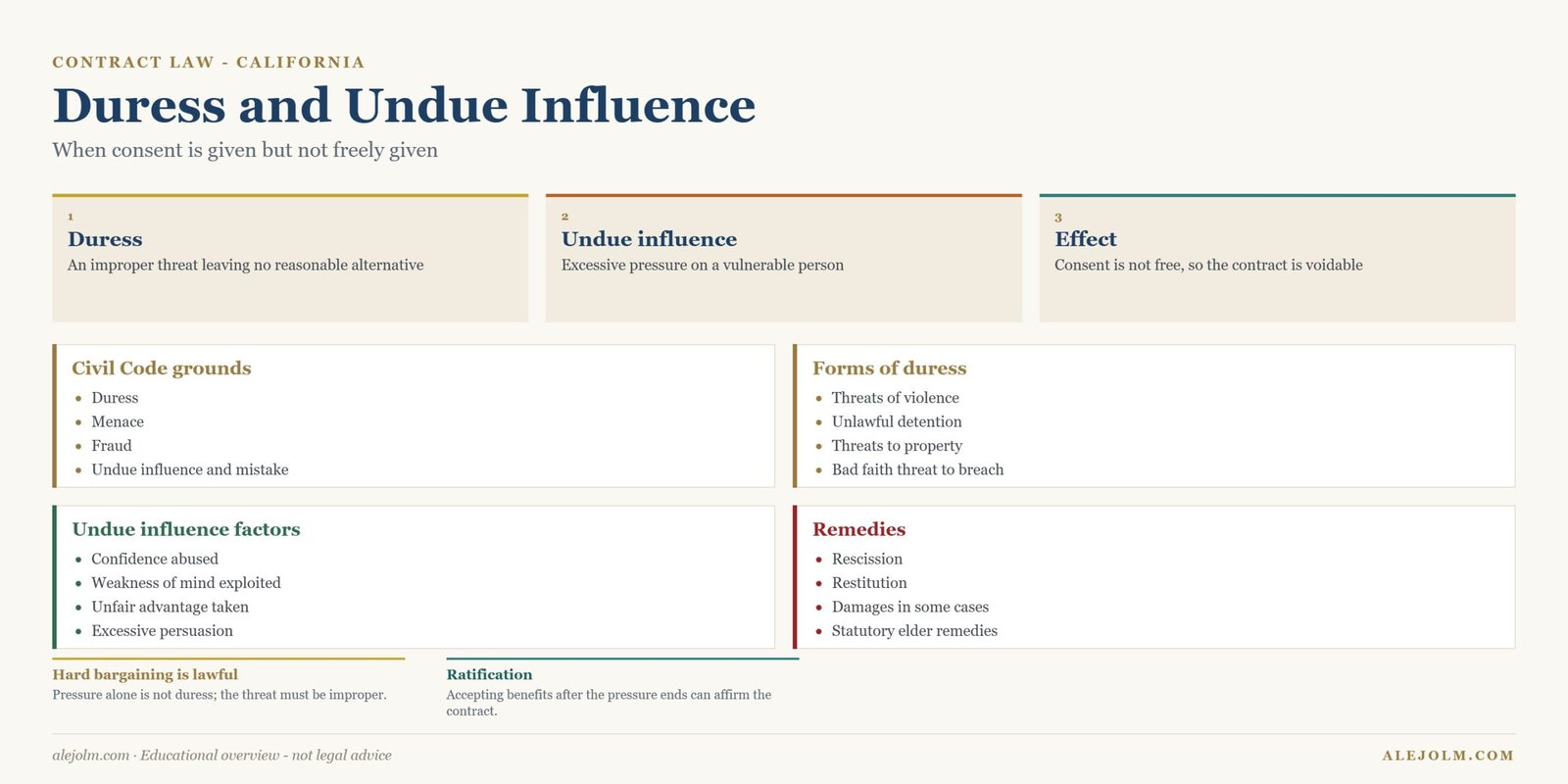
California requires consent to a contract to be free as well as mutual. Duress and undue influence are two of the ways in which apparently valid assent turns out not to be free at all. The Civil Code lists them alongside menace, fraud and mistake as circumstances that make consent something less than genuine, and the consequence is that the agreement is voidable at the election of the injured party.
The two doctrines are frequently confused. Duress rests on an improper threat that leaves the victim no reasonable alternative. Undue influence rests on the exploitation of a vulnerable person through excessive persuasion, with no threat at all. This guide explains each, sets out how California defines undue influence by statute, and works through the commercial and elder abuse settings where they matter most.
Duress
Duress in the classical sense involves unlawful confinement or a threat of violence to a person or their property. Modern practice is more often concerned with economic duress, where one party threatens to break an existing contract unless the other agrees to new terms, and the victim has no realistic alternative because litigation would be too slow and substitute performance unavailable.
What is not duress
Hard bargaining is not duress. A refusal to deal, an aggressive negotiating position, a demand for payment of a genuine debt or a threat to take lawful legal action are all permissible. The threat must be improper, which usually means unlawful, made in bad faith or amounting to an abuse of a right.
Undue influence
California defines undue influence in the Civil Code as the use, by one in whom confidence is reposed by another or who holds real or apparent authority over them, of that confidence or authority to obtain an unfair advantage; the taking of unfair advantage of another weakness of mind; or the taking of a grossly oppressive advantage of another necessities or distress.
- A relationship of trust. Caregiver, adviser, family member, fiduciary or someone with apparent authority.
- Vulnerability. Age, illness, isolation, dependency, grief or cognitive decline.
- Excessive persuasion. Pressure disproportionate to the relationship, often sustained over time.
- Unusual timing or place. Documents produced late at night, in hospital or away from advisers.
- Absence of independent advice. The vulnerable party had no one to consult.
- An unnatural transaction. The deal makes no commercial sense for the person who signed it.
| Feature | Duress | Undue influence |
|---|---|---|
| Threat required | Yes, an improper one | No |
| Focus | The coercive act | The relationship and pressure |
| Typical setting | Commercial renegotiation | Care and family relationships |
| Key vulnerability | Absence of alternatives | Weakness or dependency |
| Remedy | Rescission | Rescission |
A worked example
A supplier halfway through a critical delivery programme for a Los Angeles manufacturer announces that it will stop shipments unless the price rises sharply. The manufacturer has no alternative source in time to avoid a plant shutdown and agrees. That is the classic shape of economic duress: an improper threat to breach, a victim with no reasonable alternative, and a resulting agreement that may be set aside despite looking consensual.
Change the relationship. An elderly widow in Pasadena, recovering from illness and dependent on a live in carer, is repeatedly told over several weeks that her family has abandoned her, and eventually signs a deed transferring her home to the carer for nothing. There is no threat, so duress does not fit. The combination of dependency, isolation and sustained pressure is undue influence, and the transfer may be rescinded.
Duress and undue influence in California and Los Angeles County in 2026
Undue influence claims involving older adults are among the most common civil filings of this type in Los Angeles County, often combined with allegations of financial elder abuse, which carry enhanced statutory remedies. California has also refined the statutory definition of undue influence in the Welfare and Institutions Code, adding factors about the vulnerability of the victim, the authority of the influencer, the tactics used and the equity of the result.
On the commercial side, economic duress arises most often in construction and supply chains under stress. The safest protective step for a party facing a mid contract demand is to agree under written protest and to document the absence of alternatives at the time, so that the position can be revisited afterwards.
- Protest in writing. A contemporaneous objection preserves the argument.
- Record the lack of alternatives. Duress turns on whether any reasonable option existed.
- Insist on independent advice. It is the strongest protection against later undue influence claims.
- Watch for isolation. Separating a vulnerable person from family is a recognised warning sign.
- Act promptly. Delay after the pressure ends can amount to affirmation.
- Consider the statutory elder remedies. They go beyond ordinary rescission.
For 2026, confirm the current California authority on duress, undue influence and financial elder abuse directly with current authority, since these continue to develop.
Common mistakes to avoid
- Calling hard bargaining duress. The threat must be improper, not merely unwelcome.
- Requiring a threat for undue influence. The doctrine works without one.
- Overlooking the alternatives question. Duress fails where a reasonable option existed.
- Ignoring the relationship. Undue influence depends on trust, authority or dependency.
- Delaying the challenge. Continued performance after the pressure ends can ratify the deal.
- Treating good faith as a complete answer. A modification extracted under duress is vulnerable even in a sale of goods.
Frequently asked questions
Is a threat to sue duress?
Generally no. Threatening to pursue a genuine legal claim is lawful. A threat to bring a claim known to be baseless, or to use proceedings for an improper purpose, is different.
Can economic pressure alone void a contract?
Not by itself. There must be an improper threat, usually a bad faith threat to breach, together with the absence of any reasonable alternative for the victim.
How does California define undue influence?
The Civil Code describes it as abusing confidence or authority to gain an unfair advantage, exploiting weakness of mind, or taking grossly oppressive advantage of another necessities or distress.
What is the remedy?
Rescission, with restitution of what each side received. In elder abuse cases California provides additional statutory remedies that can exceed ordinary contract relief.
Does independent legal advice prevent a claim?
It does not make one impossible, but genuine independent advice is one of the strongest indicators that the consent was free.
Related guides
- Rescission of a contract
- Misrepresentation and fraud
- Unconscionability
- Capacity and legality
- Modification of a contract
- Good faith and fair dealing
- Mistake of fact
- Contract formation in California
Next steps
If you signed something under pressure, act quickly and keep every message that shows what you were told at the time. Our guides to rescission and unconscionability explain the alternative routes to setting an agreement aside.
For primary sources, read California Civil Code section 1575 and the civil jury instructions published by the Judicial Council of California.