
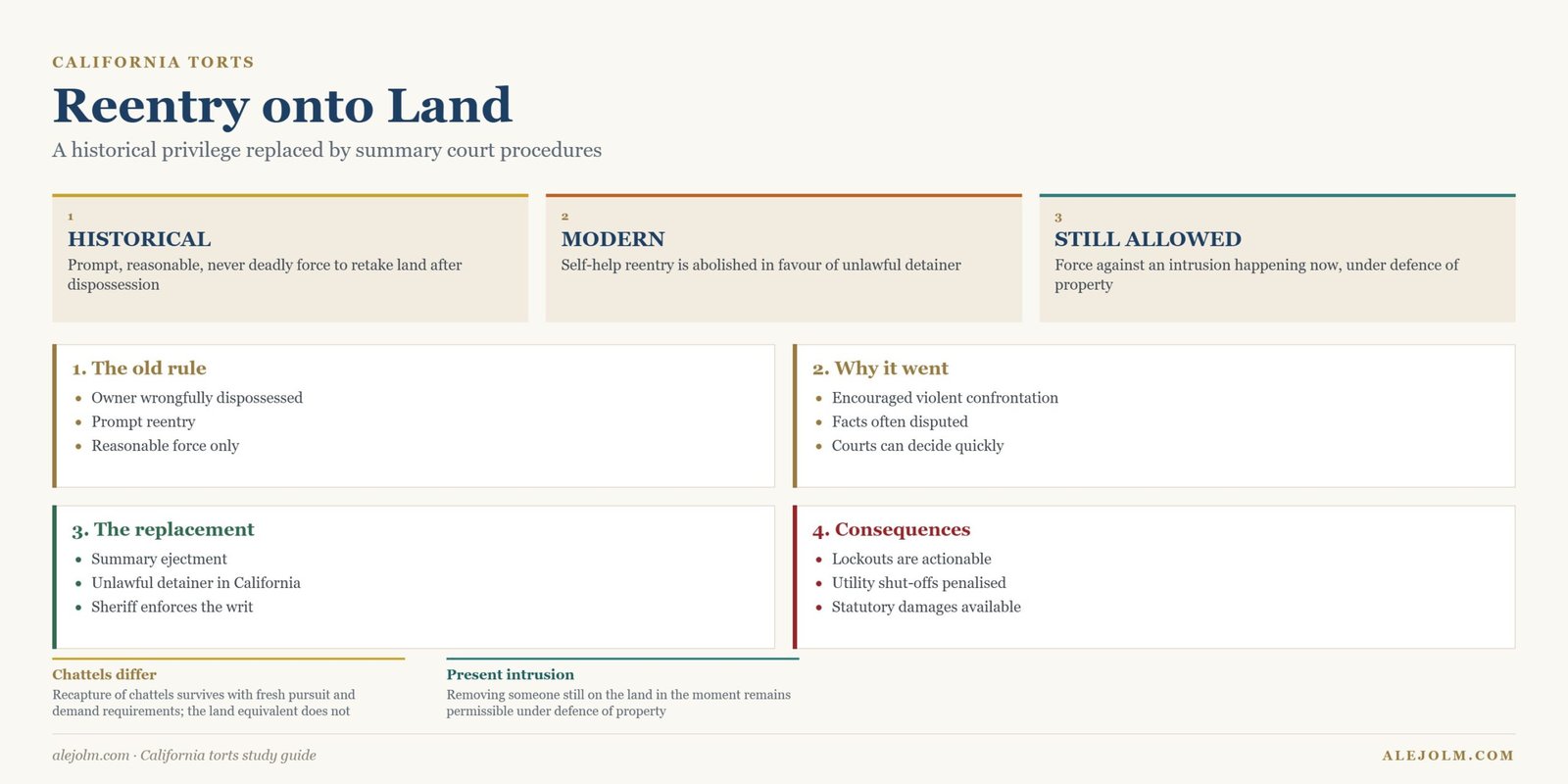
Reentry onto land was the real property counterpart to recapture of chattels. An owner wrongfully dispossessed could use prompt and reasonable force to retake possession. That privilege has been abolished in modern law and replaced by summary court procedures, and in California the point is reinforced by statutes that make self-help lockouts expensive.
The doctrine still matters, but mainly as a boundary marker. It shows where the law is willing to tolerate self-help and where it is not, and it must be kept apart from defence of property, which continues to allow reasonable force against an intrusion that is happening now. This guide explains the historical rule, the modern replacement and the practical consequences in California.
The historical privilege
At common law an owner tortiously dispossessed of land could reenter and use reasonable, never deadly, force to regain it. The privilege required promptness, in much the same way that recapture of chattels requires fresh pursuit, and it was limited to the amount of force reasonably necessary.
Why it was abolished
Two problems proved decisive. The first is that land disputes are rarely one sided and are almost never resolved by whoever is physically stronger. Allowing force invited escalation between people with genuinely competing claims to occupy the same place. The second is that courts developed fast procedures to answer the possession question, so the practical justification for self-help disappeared.
Modern law therefore channels the dispute into a summary proceeding. In California that is the unlawful detainer action, which is designed to determine the right to possession quickly and which ends, if the owner succeeds, in a writ enforced by the sheriff rather than by the owner personally.
What replaced it
- Summary proceedings — unlawful detainer determines possession on an expedited timetable.
- Notice requirements — statutory notices must precede the action.
- Judicial determination — a court decides the competing claims to possession.
- Official enforcement — a writ is executed by the sheriff, not by the owner.
- Statutory penalties — self-help conduct carries defined financial consequences.
- Damages claims — the occupant can sue for trespass and related wrongs.
| Situation | Self-help available | Correct route |
|---|---|---|
| Trespasser currently on the land | Yes, reasonable force to remove | Defence of property |
| Licensee refuses to leave now | Yes, reasonable force to exclude | Defence of property |
| Holdover tenant in possession | No | Unlawful detainer |
| Occupant who has established possession | No | Unlawful detainer |
The line with defence of property
The abolition of reentry does not mean force is never available in relation to land. Defence of property still permits reasonable, non-deadly force to exclude or remove someone who is intruding at that moment, including a licensee who refuses to leave once permission has been withdrawn.
What has gone is the retaking of possession after the other person has already established it. Once someone is in possession, however wrongfully, the dispute has become a question of competing claims that only a court can resolve.
Consequences of self-help in California
California treats self-help eviction seriously. Statutory provisions prohibit a landlord from using lockouts, removing doors or windows, seizing the belongings of an occupant or cutting off utilities in order to force someone out, and they attach financial penalties to doing so in addition to actual damages. A landlord who changes the locks on a holdover tenant is committing a tort rather than exercising a privilege.
The exposure is not limited to statute. The occupant may have claims in trespass, conversion of belongings, intentional infliction of emotional distress in an extreme case, and wrongful eviction, and the conduct can also undermine the position of the owner in the unlawful detainer proceeding itself.
A worked example
An owner in Los Angeles has a tenant who has stopped paying rent and has ignored a notice to quit. The owner changes the locks while the tenant is at work and leaves the belongings on the pavement. There is no privilege of reentry, so the owner is liable for a wrongful eviction and faces statutory penalties as well as claims relating to the property left outside.
Change the situation. Suppose instead a former guest who never established possession is standing in the doorway refusing to leave after being asked. Defence of property allows reasonable, non-deadly force to remove that person in the moment, because this is an intrusion in progress rather than a dispossession already completed.
Reentry onto land in California and Los Angeles County in 2026
California prohibits self-help removal and provides statutory remedies where a landlord uses lockouts, utility interruption or removal of belongings to force an occupant out. The unlawful detainer procedure supplies the lawful route, with defined notice periods depending on the ground and with enforcement carried out by the sheriff after judgment.
Los Angeles County and the City of Los Angeles add further layers, including local rules on grounds for eviction, relocation obligations in certain circumstances and registration requirements for particular categories of property. Those local rules can change both the notice required and whether possession can lawfully be recovered at all.
- No self-help — reentry by force is not a privilege in California.
- Statutory penalties — lockouts and utility interruption carry defined financial consequences.
- Unlawful detainer — the summary procedure for determining possession.
- Notice periods — statutory notices vary with the ground relied upon.
- Sheriff enforcement — a writ of possession is executed by the sheriff.
- Local rules — city and county measures can add grounds, notice and relocation requirements.
For 2026, confirm the current California authority on unlawful detainer procedure, self-help penalties and local eviction rules directly with current authority, since these continue to develop.
Common mistakes to avoid
- Assuming the old privilege survives — self-help reentry is abolished in modern law.
- Confusing it with defence of property — present intrusions may still be met with reasonable force.
- Equating land with chattels — recapture of chattels survives while reentry does not.
- Treating a lockout as neutral — it is a tort and attracts statutory penalties in California.
- Ignoring local rules — municipal measures can alter grounds, notice and relocation duties.
- Overlooking belongings — removing possessions can generate a separate conversion claim.
Frequently asked questions
Can a landlord change the locks in California?
No, not to force an occupant out. California prohibits lockouts and similar self-help measures and attaches statutory penalties as well as ordinary damages. Possession must be recovered through unlawful detainer and enforced by the sheriff.
Is any force allowed in relation to land?
Yes, but only against an intrusion happening at that moment. Defence of property permits reasonable, non-deadly force to exclude or remove someone who is trespassing now. It does not permit retaking possession from a person already in occupation.
Why does recapture of chattels still exist?
Because the risks are different. Retaking a movable item in fresh pursuit is a brief and usually clear cut act, whereas retaking land involves ejecting a person from a place they occupy, with a high risk of confrontation and disputed facts.
What is unlawful detainer?
The California summary procedure for determining the right to possession of real property. It runs on an expedited timetable, requires statutory notice before filing, and ends in a writ of possession executed by the sheriff where the owner succeeds.
What claims can an occupant bring after a lockout?
Typically wrongful eviction with statutory penalties, trespass, and conversion in relation to belongings that were removed. Severe conduct can also support a claim for intentional infliction of emotional distress.
Related guides
- Trespass to Land
- Defence of Property
- Recapture of Chattels
- Conversion
- Nuisance
- Premises Liability
- Lateral and Subjacent Support
- Necessity
Next steps
Read this with defence of property to keep the line between present intrusion and completed dispossession clear, and then recapture of chattels for the movable property rule that survives.
For primary sources, read California Civil Code section 789.3 and the civil jury instructions published by the Judicial Council of California.