
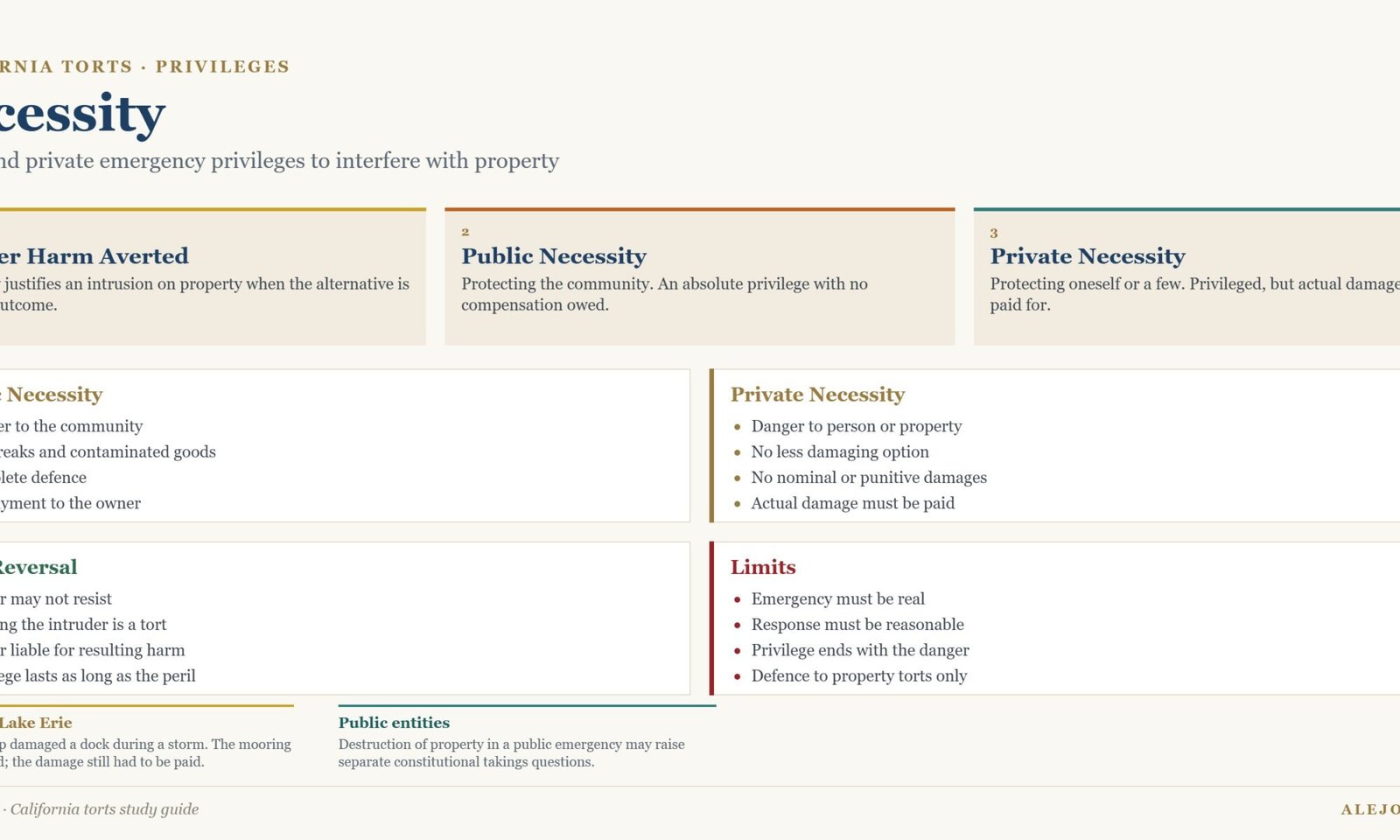
Necessity is the privilege to interfere with someone else property in order to avert a greater harm. It is a defence to the property torts, so it answers trespass to land, trespass to chattels and conversion, and it rests on an openly utilitarian idea: where a loss is unavoidable, the law prefers the smaller one.
The doctrine splits in two, and the split decides who pays. Public necessity protects the community and costs the actor nothing. Private necessity protects the actor or a few others and leaves them liable for the damage they cause. Almost every problem in this area is really a question about which branch applies.
Public necessity
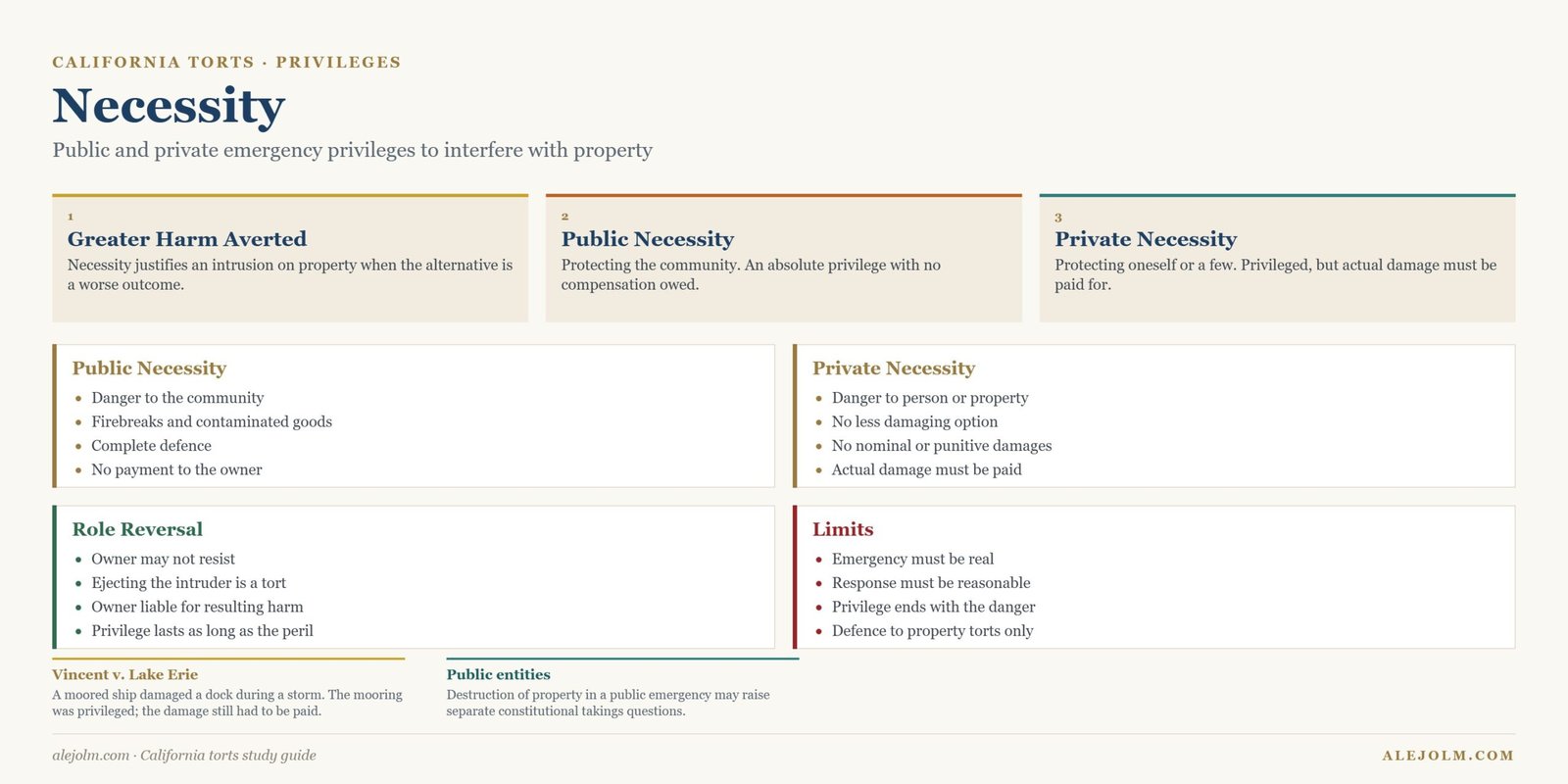
Public necessity privileges an interference undertaken to prevent a disaster affecting the community or a substantial number of people. Burning a row of houses to create a firebreak, destroying contaminated food during an outbreak, or forcing entry to reach a store of medicine are the standard illustrations. The privilege is absolute. The property owner receives nothing, even though the property was deliberately destroyed and the owner was entirely innocent.
The result looks harsh, and it is defended on the ground that the actor was serving everyone, often as a public official or at official direction. Where a public entity destroys property, a separate constitutional question about compensation may arise, but that is a takings analysis rather than a tort one.
Private necessity
Private necessity privileges an intrusion undertaken to protect the actor, the actor property, or a third party, from an emergency where no less damaging option was available. The classic case is the ship that ties up at a private dock to ride out a storm. The privilege is real: the mooring is not a trespass, and the shipowner owes no nominal or punitive damages.
What the shipowner does owe is compensation for actual physical damage caused during the intrusion. In Vincent v. Lake Erie Transportation Co. the vessel battered the dock while safely moored, and the owner had to pay for the repairs even though the decision to stay was privileged. The obligation is best understood as a narrow duty layered on top of a lawful act, not as proof that the act was wrongful.
| Branch | Interest protected | Nominal and punitive damages | Actual damage |
|---|---|---|---|
| Public necessity | The community at large | Not recoverable | Not recoverable |
| Private necessity | The actor or a few others | Not recoverable | Must be paid |
The role reversal rule
While a private necessity emergency is running, the property owner may not resist. An owner who unties the ship, forces the vessel back into the storm, or physically ejects the intruder becomes the wrongdoer and is liable for the harm that follows. The rule surprises people because it inverts the usual instinct that a possessor may always repel an intruder, and it is the single most frequently tested feature of the doctrine.
The explanation is that the intruder is exercising a privilege, so there is no tort to defend against. The owner remedy is money afterwards, not force at the time. Our guide to defence of property explains why the possessor privilege drops away whenever the entrant has a legal right to be there.
A worked example
A hiker caught in a sudden blizzard breaks a window and shelters in a locked mountain cabin, burning firewood and eating tinned food. The entry is privileged by private necessity, so there is no liability in trespass as such and no punitive award. The hiker must nonetheless pay for the window, the wood and the food. If the cabin owner had arrived during the storm and forced the hiker back outside, the owner would be liable for the consequences.
Change the scale and the branch changes. If a fire authority demolishes the same cabin to stop a wildfire reaching a town, that is public necessity, the privilege is complete, and the owner recovers nothing in tort.
Necessity in California and Los Angeles County in 2026
California recognises both branches on the conventional lines. The state also gives statutory force to emergency powers, so much of the practical work in this area happens through the Emergency Services Act and local emergency declarations rather than through common law argument. Where a public entity destroys or damages property in an emergency, the analysis usually moves to the Government Claims Act and to inverse condemnation, which asks whether compensation is constitutionally required rather than whether a tort was committed.
Wildfire is the dominant Los Angeles County context. Firebreaks, backburns, forced evacuations and the destruction of structures to protect a wider area all raise necessity questions, alongside claims about how the emergency response itself was conducted. Coastal and marine incidents produce the classic private necessity fact pattern, and utility shutoff and access disputes generate a steady stream of smaller cases.
- Public necessity. A complete privilege where the interference protects the community, with no tort compensation owed.
- Private necessity. Privileged intrusion, but the actor pays for actual damage caused.
- No resistance. A possessor who forcibly resists a privileged entrant becomes the tortfeasor.
- Inverse condemnation. Destruction by a public entity may require constitutional compensation even where tort liability is barred.
- Government Claims Act. Claims against public entities run through statutory presentation requirements and short deadlines.
- Reasonableness. The privilege covers a reasonable response to a genuine emergency, not an overreaction to a manageable risk.
For 2026, confirm the current California authority on emergency powers, inverse condemnation in wildfire cases, and public entity immunities directly with current authority, since these continue to develop.
Common mistakes to avoid
- Treating private necessity as a complete answer. It defeats nominal and punitive damages only. Actual damage is still payable.
- Making the public necessity actor pay. That privilege carries no compensation obligation in tort.
- Skipping the threshold question. Whether the community or a private interest was being protected decides everything.
- Letting the owner resist. Interfering with a privileged entrant flips liability onto the owner.
- Confusing necessity with self-defence. Necessity responds to circumstances; self-defence responds to a person.
- Ignoring proportion. The intrusion must be a reasonable response to a real and immediate peril.
Frequently asked questions
What is the difference between public and private necessity?
Public necessity protects the community and is an absolute privilege with no compensation owed. Private necessity protects the actor or a small group and requires payment for actual damage caused.
Do you have to pay for damage caused under private necessity?
Yes. The intrusion itself is privileged, so no nominal or punitive damages are available, but the actor must compensate the owner for physical damage done during the emergency.
Can a property owner throw out someone claiming necessity?
No, not during the emergency. An owner who resists or ejects a person lawfully exercising private necessity becomes liable for the harm that results.
Is necessity a defence to personal injury claims?
It is a privilege against the property torts. Emergency justifications for force against a person run through self-defence, defence of others or defence of property instead.
Does necessity apply if the danger turns out not to be real?
The privilege depends on a reasonable belief in an immediate peril and a reasonable response to it. A belief that no sensible person could have held will not support it.
Related guides
- Trespass to Land in California: Elements and Remedies
- Trespass to Chattels: Elements, Damages and Conversion
- Conversion in Tort Law: California Elements and Remedies
- Defense of Property: Reasonable Force and Katko v. Briney
- Self-Defense in Tort Law: Reasonable and Deadly Force
- Defense of Others: Reasonable Belief and Force Limits
- The Takings Clause: Regulatory and Physical Takings
- Premises Liability in California and Los Angeles County
Next steps
Read our guide to trespass to land for the tort necessity answers, then the Takings Clause, which decides when a public authority must pay for property destroyed in an emergency.
For primary sources, read California Government Code section 8655 and the property tort instructions published by the Judicial Council of California.