
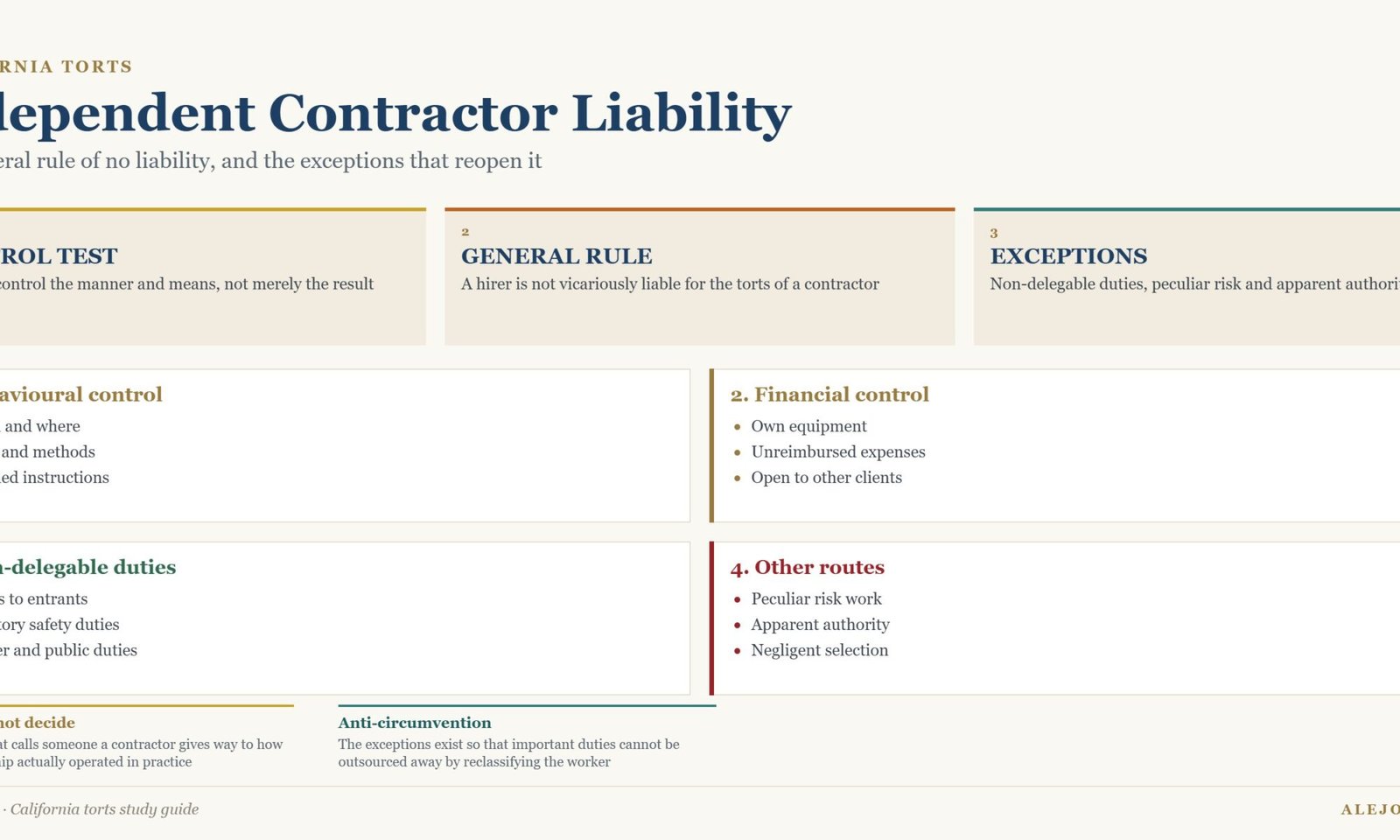
Independent contractor liability begins with a rule of no liability. A person who hires an independent contractor is generally not answerable for the torts that contractor commits, in contrast with an employer, who answers for employee torts within the scope of employment. The contractor is running their own operation and bears their own risks.
That general rule is riddled with exceptions, and in practice the exceptions decide most cases. This guide sets out the control test that separates employees from contractors, explains the California statutory framework that now shapes classification, and works through the non-delegable duty, peculiar risk and apparent authority routes that reopen the exposure of the hirer.
The control test
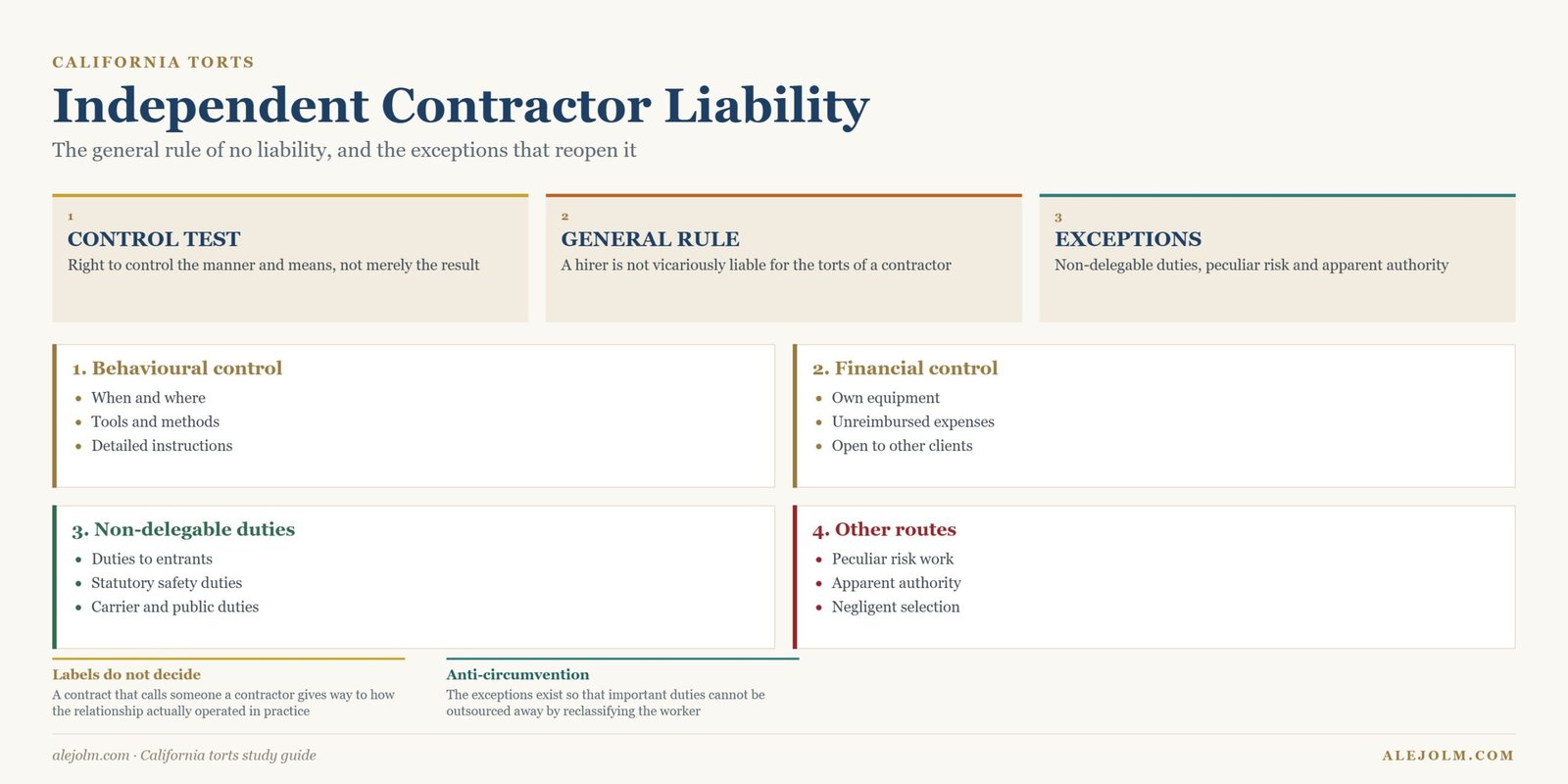
A worker is an independent contractor where the hirer has the right to control only the result of the work, not the manner and means by which it is achieved. Two clusters of factors are weighed. Behavioural control looks at who decides when, where and by what methods and tools the work is done. Financial control looks at who invests in equipment, who bears unreimbursed expenses, whether the worker is available to the wider market and how payment is structured.
Most real relationships give signals in both directions, and the label used in the contract carries some weight without being decisive. A written designation as a contractor gives way where the day to day working relationship shows the control associated with employment.
Why the exceptions exist
If the general rule stood alone, it would invite reclassification. Any business could avoid responsibility by describing its workforce as contractors, and duties the law regards as important would evaporate. The exceptions exist to prevent that, and they cluster around duties too significant to be delegated away.
Non-delegable duties
Certain duties remain with the person on whom the law places them, regardless of who performs the work. Duties owed by an occupier to those who come onto the premises are the leading example: a landowner who engages a contractor to carry out repairs remains answerable if the contractor is careless and a visitor is injured. Statutory safety duties, the obligations of public authorities to maintain streets and pavements, and the safety duties of carriers operate in the same way.
| Route to liability | Vicarious or direct | What must be shown | Typical setting |
|---|---|---|---|
| Respondeat superior | Vicarious | Employee acting within scope | Employment relationship |
| Non-delegable duty | Vicarious in effect | Duty fixed on the hirer by law | Premises and statutory duties |
| Peculiar risk work | Vicarious in effect | Work needing special precautions | Excavation, high voltage, spraying |
| Negligent selection | Direct | Carelessness in choosing or overseeing | Unfit contractor engaged |
Inherently dangerous or peculiar risk work
Where the work is of a kind the hirer should recognise as creating a peculiar and unreasonable risk of harm unless special precautions are taken, the hirer can be liable for the negligence of the contractor in carrying it out. Blasting, work on high voltage systems and spraying near occupied buildings are typical examples.
This is not the same as the strict liability doctrine for abnormally dangerous activities. The peculiar risk exception concerns responsibility for the carelessness of the contractor in performing risky work, not liability without fault imposed on whoever conducts the activity.
Apparent authority
Where a hirer holds a contractor out as its own and third parties reasonably rely on that appearance, liability can follow. The paradigm is the hospital that presents an emergency physician as part of its own staff, with shared branding, no visible indication of independent status and no meaningful choice of clinician for the patient. Reasonable reliance on that appearance can defeat the contractor defence.
Negligent selection and supervision
This route is often described as an exception, but it is really direct liability. The hirer is answerable for its own carelessness in choosing an unfit contractor or in failing to supervise where supervision was required. It does not depend on the status of the worker at all, and it survives even where contractor status is clearly established.
A worked example
A shopping centre in Los Angeles engages a specialist firm to resurface a walkway. The firm leaves an unmarked lip in the surface and a visitor trips and is injured. The firm is a genuine contractor, but the duty of an occupier to keep the premises reasonably safe for those invited onto them is non-delegable, so the centre remains liable alongside the contractor.
Change the setting. Suppose the same firm had been engaged to resurface a private yard closed to the public, and a worker employed by the firm was injured by its own poor practice. No duty to visitors is engaged, no peculiar risk arises and no appearance of agency was created, so the general rule applies and the hirer is not liable.
Independent contractor liability in California and Los Angeles County in 2026
California has reshaped worker classification by statute. The Labor Code now applies a three part test for many purposes, under which a worker is presumed an employee unless the hiring entity establishes that the worker is free from control and direction, performs work outside the usual course of the business, and is customarily engaged in an independently established trade of the same nature. A series of statutory exemptions returns particular occupations to the older multi factor analysis.
California courts have also refined the peculiar risk doctrine, limiting the ability of employees of a contractor to recover from the hirer where the hirer delegated the relevant safety responsibility and did not retain control that affirmatively contributed to the injury.
- Statutory classification — the Labor Code sets a three part test with defined exemptions.
- Retained control — a hirer who keeps control and exercises it carelessly can be directly liable.
- Contractor employees — recovery against the hirer is restricted where safety responsibility was delegated.
- Premises duties — occupier obligations to entrants remain non-delegable.
- Public entities — street and pavement duties cannot be outsourced away.
- Apparent agency — commonly raised in healthcare and franchise settings.
For 2026, confirm the current California authority on worker classification, retained control and the peculiar risk doctrine directly with current authority, since these continue to develop.
Common mistakes to avoid
- Trusting the contract label — actual behavioural and financial control decides the classification.
- Stopping at contractor status — the exceptions reopen liability in a large share of cases.
- Confusing peculiar risk with abnormally dangerous activity — one concerns contractor negligence, the other strict liability.
- Treating negligent selection as vicarious — it is direct liability for the carelessness of the hirer.
- Missing apparent authority — appearance and reasonable reliance can override formal status.
- Overlooking statutory tests — California classification rules differ from the common law control test.
Frequently asked questions
How does California decide whether someone is a contractor?
For many purposes the Labor Code applies a three part test presuming employee status unless the hiring entity shows freedom from control, work outside the usual course of the business and an independently established trade. Statutory exemptions restore the older multi factor analysis for certain occupations.
Can a landowner avoid liability by hiring a contractor?
Not for duties owed to people who come onto the property. Those duties are non-delegable, so an occupier remains answerable to an injured visitor even where the work was carried out by an independent firm.
What is a non-delegable duty?
An obligation that the law fixes on a particular person and that cannot be transferred by engaging someone else to do the work. Occupier duties, statutory safety obligations, carrier duties and public authority duties over roads are common examples.
Does apparent authority apply outside hospitals?
Yes. It applies wherever a hirer presents a contractor as its own and a third party reasonably relies on that appearance. Franchise arrangements and branded service networks raise the same question.
Is negligent hiring a form of vicarious liability?
No. It is direct liability for the fault of the hirer in selecting or supervising, and it does not depend on the classification of the worker or on the doctrine of imputed responsibility.
Related guides
 Joint Enterprise
 Joint Tortfeasors
- Vicarious Liability
- Elements of Negligence
- Premises Liability
- Abnormally Dangerous Activities
- Negligent Entrustment
- Respondeat Superior
Next steps
Read this with respondeat superior for the employee side of the line, and then premises liability for the non-delegable duty that reopens liability most often.
For primary sources, read California Labor Code section 2775 and the civil jury instructions published by the Judicial Council of California.