
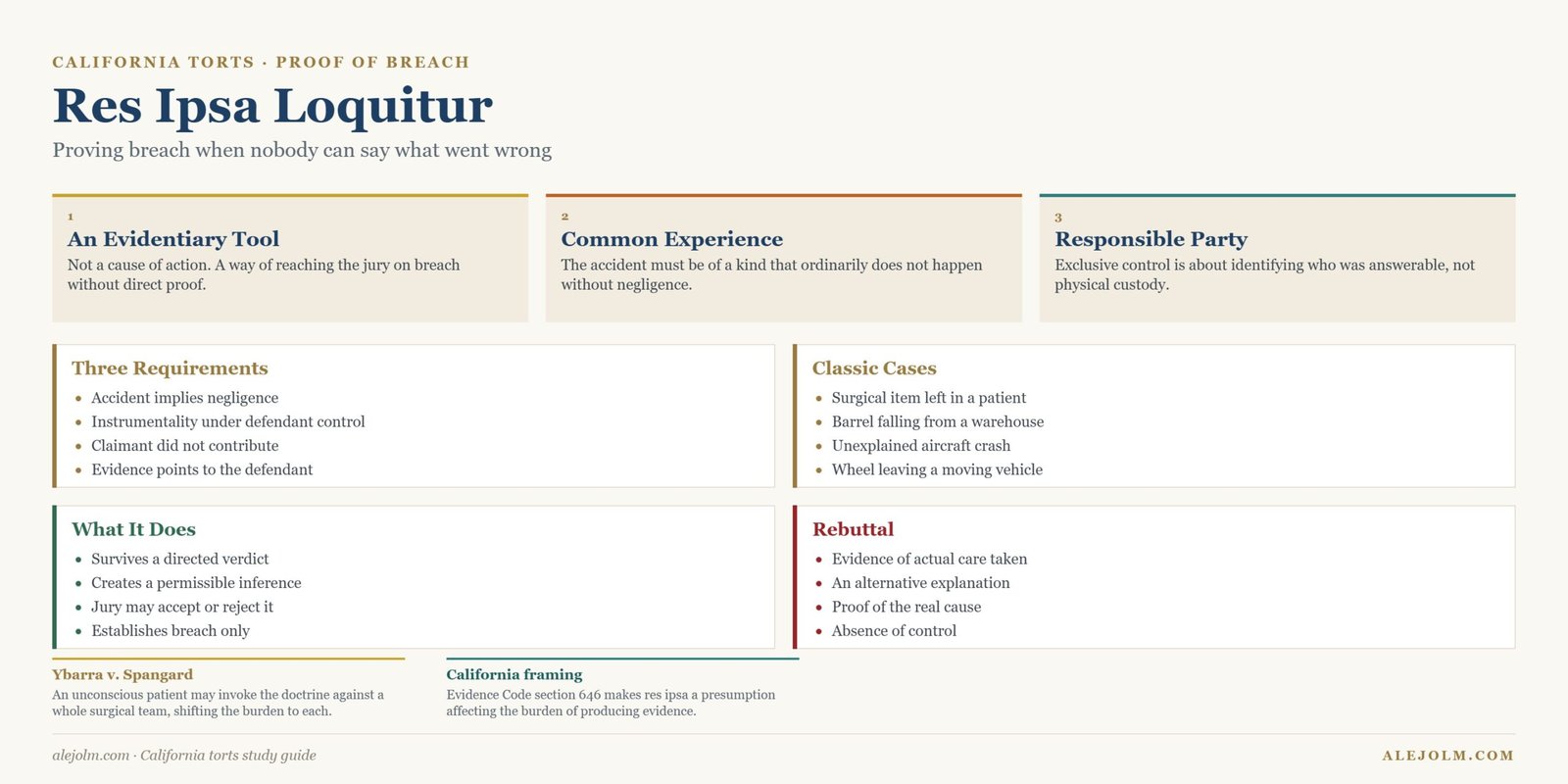
Res ipsa loquitur means that the thing speaks for itself. It is not a cause of action and it is not a theory of liability. It is an evidentiary device that lets a claimant reach the jury on breach in the one situation the ordinary rules handle badly: where something has plainly gone very wrong and nobody can say exactly how.
The doctrine exists because the alternative is unacceptable. A patient under anaesthetic cannot testify to what happened in theatre. A pedestrian struck by a falling barrel cannot describe the warehouse procedures. Requiring direct proof in those cases would hand a complete defence to the party with all the information.
The three requirements
The accident must be of a kind that ordinarily does not occur in the absence of negligence by someone in the defendant position. The instrumentality that caused the harm must have been within the defendant control. And in traditional formulations, the claimant must not have contributed to the injury. Each element is doing something specific, and the second is the one most often misunderstood.
Ordinary experience
The first requirement is a claim about how the world usually works. Surgical items do not remain inside patients unless someone was careless. Barrels do not fall out of upper floor windows by themselves. Aircraft in good repair, flown competently, do not usually descend into hillsides. Where the accident has an obvious innocent explanation, the doctrine has nothing to say.
Exclusive control
Control is not about physical possession at the instant of the injury. It is about whether the evidence points to this defendant, or to a defined group of defendants, as the party responsible for whatever went wrong. California pushed the idea furthest in Ybarra v. Spangard, allowing an unconscious surgical patient to invoke the doctrine against the entire operating team and requiring each of them to account for their own conduct.
Contribution by the claimant
The third element is a survival from the era of contributory negligence, and in comparative fault jurisdictions it has softened considerably. Rather than treating any contribution by the claimant as an absolute bar, most modern courts treat it as an apportionment question for the jury under comparative negligence.
What the doctrine actually does
This is where most errors occur. Res ipsa gets the claimant past a directed verdict on breach. It creates an inference the jury is permitted, but never required, to draw. The defendant may still win by persuading the jury that reasonable care was taken, by offering an alternative explanation, or by proving what actually caused the accident. Surviving the motion and winning the case are different things.
It is also limited to breach. Duty, causation and damages remain the claimant burden in full, and a claimant who reaches the jury on breach and then cannot prove causation loses anyway.
| Question | Answer |
|---|---|
| Is it a cause of action? | No. It is an evidentiary doctrine within negligence |
| Which element does it address? | Breach only |
| What is the effect? | A permissible inference sufficient to reach the jury |
| Can the defendant still win? | Yes, by rebutting the inference |
| Is it available with direct evidence? | Generally no. It fills a gap in proof |
Res ipsa and negligence per se
The two doctrines are alternative routes to the same element. Negligence per se borrows a standard of care from a statute; res ipsa infers a departure from the ordinary standard out of common experience. Satisfying one does not satisfy the other, and a fact pattern rarely needs both. Where a statute is quoted, per se is usually the intended route. Where the facts describe a mystery, res ipsa is.
A worked example
A patient undergoes abdominal surgery and develops an infection months later. Imaging reveals a surgical sponge left inside. No witness can say who left it or when. The accident is one that does not ordinarily happen without negligence, the operating team had control of the instruments and the patient, and the patient, unconscious throughout, contributed nothing. The inference is available and the case reaches the jury.
Suppose instead the record shows a clear count discrepancy that the circulating nurse documented and the surgeon overrode. Now there is direct evidence of the specific negligent act, and res ipsa is unnecessary. The claimant proves breach in the ordinary way.
Res Ipsa Loquitur in California and Los Angeles County in 2026
California treats res ipsa as more than a permissible inference. Evidence Code section 646 makes it a presumption affecting the burden of producing evidence, so once the conditions are met the jury is instructed to find negligence unless the defendant produces evidence that would support a contrary finding. That is a stronger position for the claimant than the pure inference model used in many states, and it changes how these cases are tried.
The state is also the home of the most aggressive application of the control element. Ybarra v. Spangard allows a claimant injured while unconscious to proceed against multiple healthcare defendants who had custody of the patient or the instruments, effectively requiring each of them to explain. In Los Angeles County the doctrine appears most often in medical negligence, elevator and escalator incidents, falling objects in commercial premises, and product failures where the item was destroyed in the event.
- Evidence Code section 646. Res ipsa operates as a presumption affecting the burden of producing evidence, not merely as an inference.
- Ybarra v. Spangard. Multiple defendants with control over an unconscious patient may each be required to account for their conduct.
- Instruction practice. Whether the conditions are satisfied is often decided as a preliminary matter before the jury is instructed.
- Comparative fault. Claimant contribution is an apportionment question rather than an automatic bar.
- Medical negligence. Expert evidence is frequently needed to establish that the event does not ordinarily occur without negligence.
- Spoliation. Where the defendant destroyed the instrumentality, separate evidentiary consequences may reinforce the inference.
For 2026, confirm the current California authority on the operation of Evidence Code section 646, the reach of Ybarra in modern healthcare settings, and instruction practice in Los Angeles Superior Court directly with current authority, since these continue to develop.
Common mistakes to avoid
- Treating it as a win. It defeats a directed verdict. The jury may still find for the defendant.
- Using it where the cause is known. The doctrine fills a gap in proof and is not a supplement to direct evidence.
- Reading control literally. The question is whether the evidence identifies the responsible party.
- Extending it beyond breach. Duty, causation and damages must still be proved.
- Assuming claimant fault is fatal. In comparative jurisdictions it usually goes to apportionment.
- Confusing it with negligence per se. One borrows a statute, the other borrows common experience.
Frequently asked questions
What does res ipsa loquitur mean?
The thing speaks for itself. It allows a claimant to establish breach circumstantially where the accident is of a kind that ordinarily does not happen without negligence and the defendant was responsible for the instrumentality.
What are the elements of res ipsa loquitur?
An accident that ordinarily implies negligence, an instrumentality within the defendant control, and, in traditional formulations, no contribution by the claimant, an element now usually treated as a comparative fault question.
Does res ipsa mean the plaintiff automatically wins?
No. It permits an inference of negligence sufficient to reach the jury. The defendant may rebut it with evidence of due care or an alternative explanation.
How does California treat res ipsa loquitur?
Evidence Code section 646 makes it a presumption affecting the burden of producing evidence, which is a stronger position for the claimant than the permissible inference approach used elsewhere.
Can it be used against several defendants at once?
Yes in California. Ybarra v. Spangard permits an unconscious patient to invoke the doctrine against a group of healthcare defendants, each of whom must then explain their own conduct.
Related guides
- The Four Elements of Negligence: Bar Exam Breakdown
- Negligence Per Se: Using a Statute to Prove Breach
- Duty of Care in Negligence: California Rules Explained
- Actual Cause in Negligence: But-For and Substantial Factor
- Comparative Negligence in California: How Fault Is Split
- Premises Liability in California and Los Angeles County
- Products Liability: The Three Defect Theories Explained
- Joint Tortfeasors: Joint and Several Liability Explained
Next steps
Read our guide to negligence per se for the other shortcut to breach, then actual cause, the element res ipsa never touches and claimants most often lose on.
For primary sources, read California Evidence Code section 646 and the res ipsa instructions published by the Judicial Council of California.