
Premises liability asks a narrow question with unusually wide consequences: what does the person who controls a piece of land owe to the people who walk onto it? For most of the history of the common law the answer depended almost entirely on why the visitor was there. In California it no longer does, and that shift is the single most important thing to understand about the doctrine.
The traditional scheme sorted entrants into trespassers, licensees and invitees, and gave each a different bundle of protections. Most states still run it. California replaced it in 1968 with one standard of ordinary care owed to everyone, and a growing minority of states have followed. Both frameworks are worth knowing, because the old categories did not disappear so much as dissolve into factors.
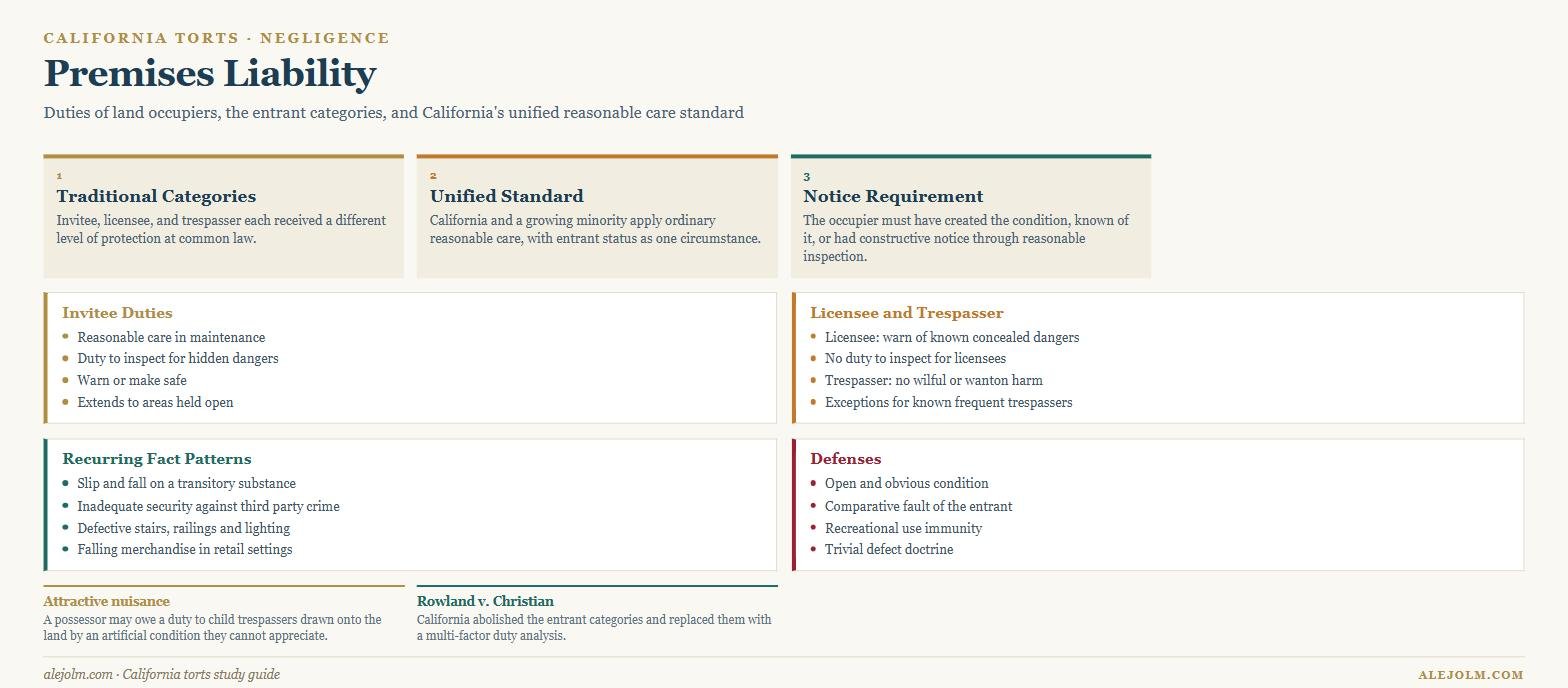
The traditional entrant categories
The categorical scheme rests on a simple intuition: a shopkeeper who invites the public in for profit should owe more than a homeowner who tolerates a neighbour cutting across the lawn. Whatever duty applies, the occupier can discharge it in either of two ways, by making the dangerous condition safe or by giving a warning adequate to let the entrant avoid it. The choice belongs to the occupier, which is why a bright orange cone beside a wet floor usually ends the argument.
Invitees
An invitee enters for a purpose connected to the occupier business, or enters land held open to the public generally. Customers, hotel guests, contractors, and people using a public library all qualify. Invitees receive the full package: reasonable care in the occupier ongoing activities, a warning of concealed dangers the occupier knows about, and, decisively, an affirmative duty to inspect the premises to discover hazards the occupier does not yet know about. That inspection duty is the distinguishing feature of the class and the point most cases turn on.
Licensees
A licensee enters with permission but for their own purposes. The social guest is the archetype, and it surprises people that a dinner guest is protected less than a shopper. The occupier owes reasonable care in activities and a duty to warn of concealed dangers actually known, but no duty to inspect. A host who has never noticed the rotten step is not liable to the guest who falls through it.
Trespassers
An undiscovered trespasser is owed nothing at all, the clearest no-duty rule in the law of negligence. Once the occupier knows of the intruder, or should anticipate intrusion from a pattern of prior trespassing across a worn path, the position changes: reasonable care is owed in ongoing activities, and there is a duty to warn of conditions that are artificial, highly dangerous, hidden, and actually known to the occupier. There is still no duty to inspect.
| Entrant | Duty owed |
|---|---|
| Undiscovered trespasser | None |
| Discovered or anticipated trespasser | Care in activities; warn of known artificial hidden dangers |
| Licensee | Care in activities; warn of known concealed dangers |
| Invitee | Care in activities; warn; and inspect for unknown dangers |
Status can change during a single visit
Entrant status is tied to the scope of the invitation, not to the front door. A customer who pushes through a door marked employees only becomes a trespasser in that room, and a social guest who wanders into the private garage loses licensee protection there. The reverse also happens: a shopper who has finished buying and stays to use a public restroom is still an invitee, because the facility is part of what the store holds open. Examiners like the mid-visit switch because it rewards reading the facts rather than the label.
People injured outside the premises
Occupiers owe duties beyond the boundary line as well. There is generally no duty as to purely natural conditions, although an occupier who negligently maintains one is liable when it causes harm next door, the rotten branch falling onto a neighbour car being the standard illustration. Unreasonably dangerous artificial conditions, such as a crumbling wall abutting a pavement, attract ordinary reasonable care. So do activities carried on the property, from target shooting to roof work that sends debris into the street.
A worked example
A shopper slips on spilled detergent in a supermarket aisle. The spill had been on the floor for forty-five minutes, and two employees walked past the aisle in that window without looking. Under the traditional scheme the shopper is an invitee, so the store owed not merely a duty to warn of hazards it knew about but a duty to inspect for hazards it did not. Forty-five minutes and two missed walk-throughs is comfortably enough for a jury to find the inspection unreasonable. Had the same person been a social guest in a private home, the claim would fail, because the host never knew about the spill and owed no duty to look.
Move the same store to California and the reasoning changes even though the result does not. The court does not begin by classifying the shopper. It asks whether the occupier used reasonable care in the management of the property, treating the shopper status, the foreseeability of a spill in a grocery aisle, the modest burden of a walk-through schedule, and the store constructive knowledge as factors in a single inquiry. Bar questions test which path a jurisdiction takes even where the destination is identical.
Premises Liability in California and Los Angeles County in 2026
California abolished the entrant categories in Rowland v. Christian and returned to the general duty stated in Civil Code section 1714, under which everyone is responsible for injury caused by a want of ordinary care in the management of their property. Duty is decided by weighing foreseeability of harm, the certainty that the plaintiff suffered injury, the closeness of the connection between the conduct and the injury, moral blame, the policy of preventing future harm, the burden on the defendant and the community, and the availability of insurance. Entrant status did not become irrelevant; it became one input into foreseeability and burden rather than an on or off switch.
The practical battleground in California is notice. A plaintiff must show the occupier created the condition, knew of it, or would have discovered it through reasonable inspection, which is why slip and fall litigation turns on sweep logs, inspection intervals and surveillance footage more than on doctrine. Around that core sit a series of limiting rules that decide a large share of Los Angeles County cases before trial.
- Unified standard. Reasonable care is owed to every foreseeable entrant, with status one factor rather than a threshold classification.
- Notice. Actual or constructive notice of the dangerous condition is required, and the length of time the hazard existed is usually the decisive fact.
- Trivial defect. Minor pavement and walkway irregularities may be held non-actionable as a matter of law, a frequent basis for summary judgment in sidewalk cases.
- Recreational use immunity. Civil Code section 846 limits the liability of landowners who allow recreational entry without charge, subject to statutory exceptions.
- Third party crime. Duties to provide security against criminal acts are calibrated to the burden of the precaution sought, with heightened foreseeability required before costly measures such as guards are imposed.
- Public property. Claims against public entities run through the Government Claims Act, require a dangerous condition of public property, and are governed by short claim presentation deadlines rather than the ordinary limitation period.
- Landlords and tenants. Liability generally follows control, so a landlord out of possession answers for common areas and for conditions it had the right and opportunity to repair.
For 2026, confirm the current California authority on the trivial defect doctrine, the scope of the recreational use exceptions, and the Los Angeles Superior Court approach to summary judgment in slip and fall cases directly with current authority and the court, since these continue to develop. For the surrounding doctrine, see our guides to duty of care, negligence per se and comparative negligence.
Common mistakes to avoid
- Applying reasonable care everywhere. Outside California and the minority that followed it, the entrant must be classified before any duty can be stated.
- Blurring warning and inspection. Licensees get a warning of known dangers. Only invitees get an inspection for unknown ones, and that is the distinction most questions are built around.
- Forgetting activities. Even a discovered trespasser is owed reasonable care in what the occupier is actively doing, however little is owed as to static conditions.
- Ignoring the scope of the invitation. An invitee who walks into a restricted area is a trespasser there, and the duty drops accordingly.
- Treating notice as automatic. In California the plaintiff still has to prove the occupier created the hazard, knew of it, or should have found it.
- Delegating the undelegable. Hiring a contractor to inspect or repair does not transfer a non-delegable duty owed to entrants.
Frequently asked questions
Does California still use invitee, licensee and trespasser categories?
No. Rowland v. Christian replaced the categories with a single duty of ordinary care owed to all foreseeable entrants. Entrant status survives only as one factor bearing on foreseeability and the burden of precautions.
What is the difference between a licensee and an invitee?
An invitee enters for a purpose connected to the occupier business or on land held open to the public and is owed an affirmative duty of inspection. A licensee enters for their own purposes with permission and is owed only a warning of concealed dangers the occupier actually knows about.
How long does a hazard have to be present before a store is liable?
There is no fixed period. Courts ask whether the occupier inspection regime was reasonable given the risk, so a few minutes may suffice in a high risk area while an hour may not in a quiet one.
Can a landowner be liable to a trespasser?
Yes, in limited circumstances. A discovered or anticipated trespasser is owed reasonable care in the occupier activities and a warning of artificial, highly dangerous, hidden conditions actually known. Child trespassers are protected more broadly under the attractive nuisance doctrine.
Who is responsible when a tenant guest is injured, the landlord or the tenant?
Responsibility generally follows control. The tenant answers for the leased space it controls, while the landlord answers for common areas and for conditions it retained the right and opportunity to repair.
Related guides
- Duty of Care in Negligence: California Rules Explained
- Negligence Per Se: Using a Statute to Prove Breach
- The Four Elements of Negligence: Bar Exam Breakdown
- Comparative Negligence in California: How Fault Is Split
- Assumption of Risk in California: Primary and Secondary
- Actual Cause in Negligence: But-For and Substantial Factor
- Proximate Cause: Foreseeability and Superseding Causes
- Trespass to Land in California: Elements and Remedies
- Products Liability: The Three Defect Theories Explained
Next steps
Read our guide to duty of care for the framework California uses to decide whether a duty exists at all, then comparative negligence, which determines how much a careless entrant recovers once liability is established.
For primary sources, read California Civil Code section 1714 and the premises liability instructions published by the Judicial Council of California.