
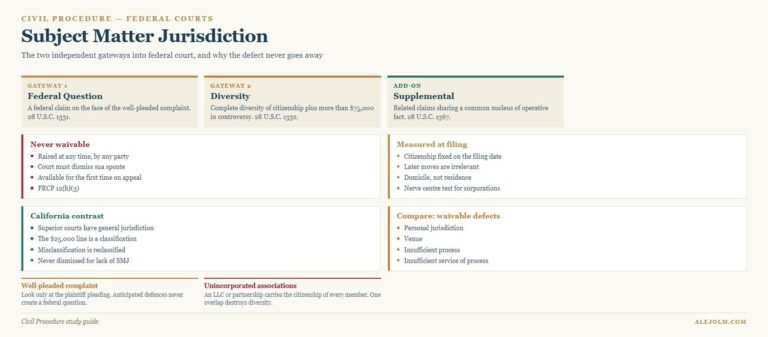
Diversity jurisdiction exists so that an out-of-state litigant is not tried in a courthouse where the other side has a home-field advantage. Two conditions must be satisfied at the moment the complaint is filed: complete diversity of citizenship, and an amount in controversy exceeding $75,000. Both are simple to state and surprisingly easy to get wrong.
This guide covers the citizenship rules for individuals, corporations and unincorporated entities, the amount in controversy and aggregation, the exceptions that keep certain cases out of federal court, and how the analysis works for the Los Angeles businesses that so often sit on both sides of the caption.
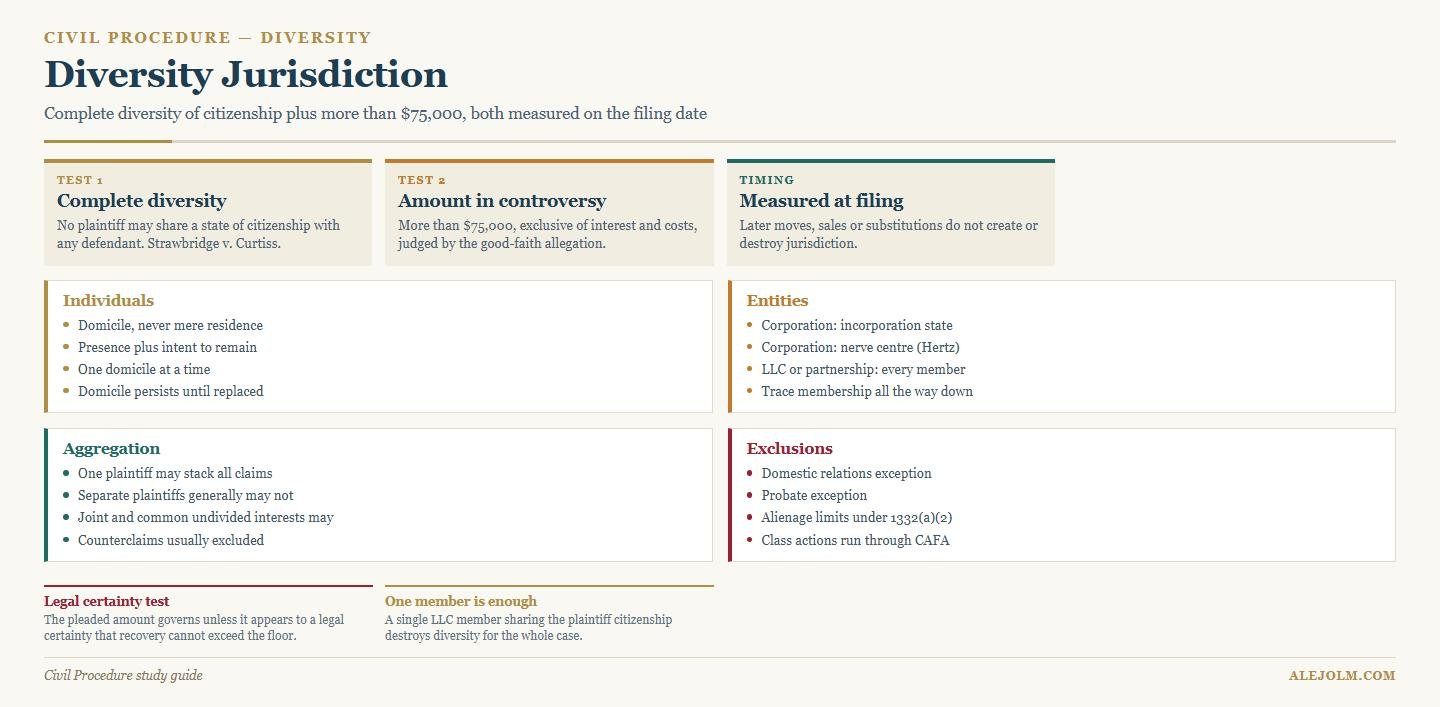
Complete diversity
Strawbridge v. Curtiss (1806) reads section 1332 to require that no plaintiff share a state of citizenship with any defendant. This is a statutory construction, not a constitutional command — Article III would tolerate minimal diversity, which is why Congress can and does authorise minimal-diversity jurisdiction in interpleader and in the Class Action Fairness Act.
Diversity is measured once, on the filing date. A defendant who relocates the following month changes nothing. Conversely a plaintiff who moves to the defendant’s state a week before filing has destroyed jurisdiction, and courts scrutinise such moves for the genuine intent that domicile requires.
How citizenship is calculated
Individuals
Citizenship means domicile: physical presence in a state combined with the intent to remain there indefinitely. Everyone has exactly one domicile, and an existing domicile persists until a new one is actually established. Courts weigh voter registration, driver’s licence, tax filings, property ownership, family location and where the person keeps the things they care about. A student, a service member or a consultant on a long assignment may well remain domiciled where they came from.
Corporations
A corporation is a citizen of both its state of incorporation and the state of its principal place of business. Hertz Corp. v. Friend (2010) settled the second half with the nerve centre test: the single place where the officers direct, control and coordinate the corporation’s activities, normally the headquarters, and not the state with the most stores, employees or revenue.
Unincorporated entities
A limited liability company, general or limited partnership, joint venture or unincorporated association carries the citizenship of every one of its members. Where a member is itself an entity, the trace continues downward until only human beings and corporations remain. In practice this defeats diversity far more often than anything else, because a single member in the wrong state is enough.
Amount in controversy
The sum must exceed $75,000, exclusive of interest and costs. The plaintiff’s good-faith allegation controls unless it appears to a legal certainty that recovery cannot reach the threshold, a standard traced to St. Paul Mercury Indemnity v. Red Cab (1938). Punitive damages count where they are recoverable; attorney fees count where a statute or contract makes them part of the claim. In injunction cases courts look to the value of the right protected or the cost of compliance.
- One plaintiff against one defendant. All claims, related or not, may be aggregated.
- Multiple plaintiffs. Separate and distinct claims may not be aggregated, but a common and undivided interest may be.
- Multiple defendants. Claims may be aggregated only where the defendants are jointly liable.
- Counterclaims. A compulsory counterclaim generally does not count toward the plaintiff’s threshold; the majority view excludes permissive counterclaims as well.
- Supplemental parties. Under section 1367 additional plaintiffs in a diversity case may sometimes ride along below the threshold, provided complete diversity is intact.
Cases diversity cannot reach
| Exception | Scope |
|---|---|
| Domestic relations | Divorce, alimony, child custody decrees |
| Probate | Administration of an estate, probate of a will |
| Alienage limits | Aliens on both sides with no citizen |
| Permanent residents | § 1332(a)(2) proviso |
| Collusive joinder | 28 U.S.C. § 1359 |
| Forum defendant rule | 28 U.S.C. § 1441(b)(2) |
A worked example
A Nevada resident is injured in a collision on the 405 freeway and wants to sue in federal court. The defendants are a delivery company organised as a Delaware LLC with its headquarters in Phoenix, and the driver, who lives in Van Nuys. Damages are pleaded at $400,000.
The amount is fine. Diversity is not, but not for the obvious reason. The driver is a California citizen and the plaintiff is a Nevadan, so that pairing is diverse. The trap is the LLC: its citizenship is that of its members, and if any member is domiciled in Nevada, complete diversity fails no matter where the company is organised or headquartered. Counsel must obtain the membership roster before filing, not after a motion to dismiss.
Diversity jurisdiction in California and Los Angeles County in 2026
Los Angeles County produces an unusual concentration of diversity problems because of how business is organised there. Entertainment production companies, real estate syndications, restaurant groups and medical practices are overwhelmingly limited liability companies and limited partnerships, often with dozens of passive members spread across several states. Every one of those members is a citizen for section 1332 purposes, and the citizenship of a single silent investor can decide whether a case is heard at the Roybal Federal Building or the Stanley Mosk Courthouse.
California also generates a disproportionate share of the nerve centre case law. Hertz Corp. v. Friend itself began as a California wage suit against a company with more business in California than anywhere else; the Supreme Court held that the New Jersey headquarters controlled. The lesson for Los Angeles litigants is that a household-name company with hundreds of California locations may still be a foreign citizen, and a small firm with one office in Century City is very much a Californian one.
Layered on top is removal practice in the Central District of California, one of the busiest districts in the country. Points to keep in mind for a 2026 Los Angeles filing:
- Get the membership chart first. Ask for the operating agreement or check the Secretary of State business filings before you decide where to file; an LLC roster cannot be guessed from the entity name.
- Plead damages deliberately. California pleading rules bar stating a specific personal injury amount, so a removing defendant must prove the threshold by a preponderance; a plaintiff who wants to stay in Los Angeles should avoid volunteering a number in discovery responses.
- Remember the forum defendant rule. Section 1441(b)(2) bars removal where any properly joined and served defendant is a California citizen, which is the single most common ground for remand out of the Central District.
- Watch fraudulent joinder arguments. Defendants often claim a local supervisor or manager was joined only to defeat diversity; the standard is demanding, but the motion is routine.
- Check CAFA separately for class actions. Minimal diversity plus $5 million in the aggregate opens federal court even where section 1332 would not, subject to the local controversy and home state exceptions that Los Angeles-only classes frequently satisfy.
- Diarise the one-year outer limit. A diversity case generally cannot be removed more than one year after commencement unless the plaintiff acted in bad faith to prevent removal.
For 2026, treat the citizenship investigation as part of case intake rather than motion practice. In a county where most defendants are entities and most entities are pass-throughs, the answer is almost never on the face of the caption. Continue with subject matter jurisdiction, the Erie doctrine and personal jurisdiction.
Common mistakes to avoid
- Using residence instead of domicile. A complaint alleging that a party “resides in” a state does not allege citizenship, and courts dismiss on that basis.
- Treating an LLC like a corporation. There is no nerve centre test for an LLC. Every member counts.
- Letting later events matter. Post-filing changes in citizenship or in the value of the claim are irrelevant.
- Aggregating across unrelated plaintiffs. Distinct claims by separate plaintiffs stand or fall on their own.
- Forgetting the forum defendant rule. It has no bearing on an original filing but is fatal to removal.
Frequently asked questions
Does a corporation have two citizenships?
Yes. It is a citizen of the state where it is incorporated and of the state containing its principal place of business, which after Hertz means the nerve centre where the company is directed and controlled.
Can jurisdiction be cured after filing?
Generally no, because diversity is measured at filing. A limited exception under 28 U.S.C. § 1653 allows defective allegations to be amended, and a dispensable non-diverse party may sometimes be dismissed to preserve jurisdiction.
Do attorney fees count toward the amount in controversy?
They count where a statute or contract makes fees part of the recovery. Fees available only as costs in the ordinary sense do not count.
What is the forum defendant rule?
A case otherwise removable on diversity may not be removed if any properly joined and served defendant is a citizen of the forum state. It applies only to removal, never to an original federal filing.
How does the Class Action Fairness Act change the analysis?
CAFA requires only minimal diversity and an aggregate amount exceeding $5 million for classes of at least 100 members, with exceptions returning genuinely local controversies to state court.
Related guides
 The Erie Doctrine Explained: A 4-Step Bar Exam Guide
 Piercing the Corporate Veil: A Two-Prong Alter Ego Test
 Abstention Doctrine: 4 Ways Federal Courts Step Aside
 Full Faith and Credit: Recognising Sister-State Judgments
 Partner Liability and Authority Under RUPA Explained
 Personal Jurisdiction: The 3-Step Bar Exam Framework
 Federal Question Jurisdiction and the Well-Pleaded Rule
 Subject Matter Jurisdiction in Federal Court Explained
- The IRAC Method: How to Structure a Bar Exam Answer
- Res Judicata vs Collateral Estoppel: Bar Exam Guide
- Standing in Federal Court: The 3-Part Article III Test
Next steps
With both gateways mapped, the next question is what happens to claims that have no independent basis of their own. Read subject matter jurisdiction for the supplemental jurisdiction overview, then turn to the Erie doctrine for the law a federal court applies once a diversity case is properly before it.