
Everyone can recite the warnings, which is precisely why Miranda rights questions separate candidates so effectively. The doctrine turns on two threshold conditions that must coincide, a waiver standard the state has to satisfy, and an invocation rule that behaves differently depending on which right the suspect asserts.
This guide takes those pieces in order: what counts as custody, what counts as interrogation, when a waiver is valid, how the right to silence and the right to counsel diverge, and what actually happens to a statement obtained in breach.
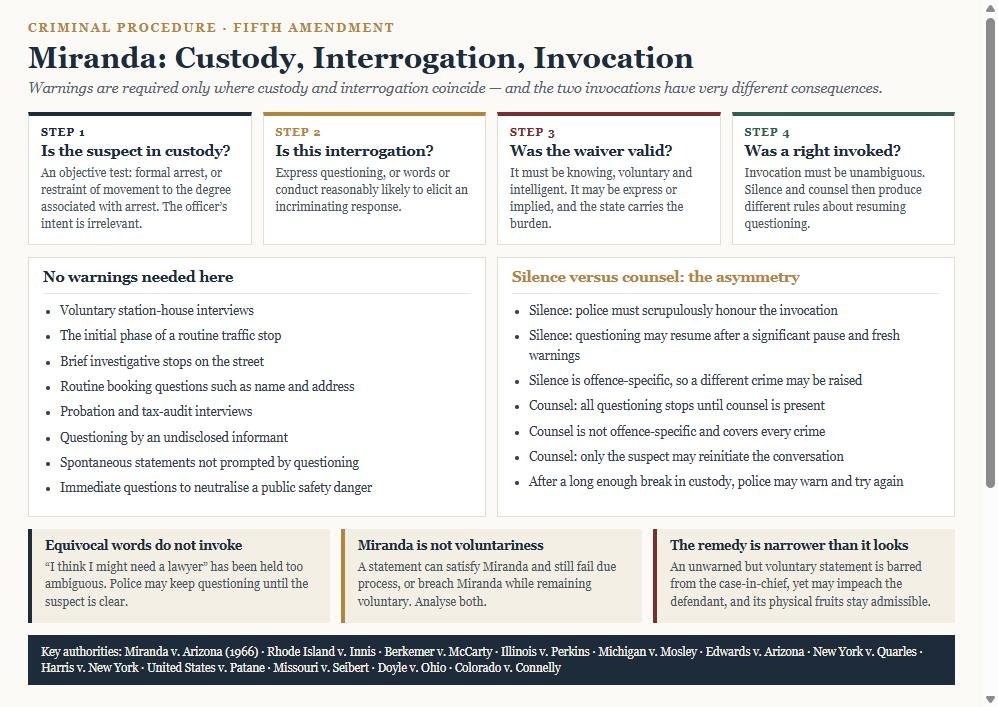
The four warnings and what triggers them
Miranda v. Arizona requires four warnings before custodial interrogation by a government agent: the right to remain silent, that anything said may be used against the suspect, the right to have an attorney present during questioning, and the right to appointed counsel for a suspect who cannot afford one.
The trigger is conjunctive. Custody alone does not require warnings, and questioning alone does not either. Only the combination does. Nearly every wrong answer in this area comes from finding one condition and assuming the other.
Custody is an objective question
Custody means formal arrest, or a restraint on freedom of movement of the degree associated with formal arrest. The officer’s private intention to arrest is irrelevant; the question is whether a reasonable person in the suspect’s position would feel free to end the encounter and leave.
- A voluntary interview at the station, where the suspect came in and could leave, is not custody.
- The initial phase of a routine traffic stop is not custody, as Berkemer v. McCarty holds, though it can escalate.
- A brief investigative detention on the street is not custody.
- Probation interviews and tax-audit interviews are not custody.
- Routine booking questions such as name and address are exempt from Miranda altogether.
Interrogation includes its functional equivalent
Interrogation means express questioning, or any words or conduct by the police that they should know are reasonably likely to elicit an incriminating response. That formulation, from Rhode Island v. Innis, is why a staged conversation between officers in a suspect’s hearing can be interrogation while an unprompted outburst is not.
One further condition is easy to miss: the suspect must know they are dealing with a government agent. Questions from an undercover officer or a cellmate informant whose role is concealed do not trigger Miranda, because the coercive atmosphere the doctrine addresses is absent.
Waiver
A waiver must be knowing, voluntary and intelligent. It may be express, or implied from a suspect who answers questions after receiving and understanding the warnings. The government bears the burden of proving that a valid waiver occurred, which is why the presence or absence of a signed form matters so much in practice.
Invocation must be unambiguous
A suspect who wants the protection has to ask for it clearly. Equivocal statements such as “I think I might need a lawyer” or “maybe I should talk to an attorney” have been held insufficient, and officers are not required to clarify or to stop questioning. This is one of the least intuitive features of the doctrine and a favourite of examiners.
Invoking the right to silence
Police must scrupulously honour the invocation. Under Michigan v. Mosley, questioning may resume after a significant pause and fresh warnings. Crucially, the right to silence is offence-specific, so officers may return and ask about a different crime.
Invoking the right to counsel
All questioning must cease until counsel is present, and only the suspect may reinitiate the conversation. Edwards v. Arizona supplies that rule. Unlike silence, the counsel invocation is not offence-specific: once asserted, no interrogation on any crime is permitted. The obligation does lapse after the suspect has enjoyed a sufficient break in custody, after which police may warn again and try once more.
| Question | Right to silence | Right to counsel |
|---|---|---|
| Must questioning stop immediately? | Yes | Yes |
| May police resume on the same crime? | Yes, after a pause and fresh warnings | Only if the suspect reinitiates |
| May police ask about a different crime? | Yes | No |
| Who may reopen the conversation? | Police, after honouring the invocation | The suspect |
| Does the protection ever lapse? | Effectively, after a genuine pause | Yes, after a long enough break in custody |
Exam tip: write custody and interrogation as two separate findings before you reach the warnings. If either is missing, say so and stop. Candidates who blend the threshold questions into one sentence almost always lose the point that was actually being tested.
Exceptions to the warning requirement
Four situations recur. Under New York v. Quarles, unwarned questioning is permitted where it is needed to neutralise an immediate danger, such as locating a discarded weapon. Spontaneous statements that are not responses to interrogation are admissible. Brief investigative stops do not require warnings. And grand jury witnesses are not entitled to them.
What a violation actually costs the prosecution
Less than students assume. An unwarned but otherwise voluntary statement is inadmissible in the case-in-chief, yet it may be used to impeach the defendant’s inconsistent trial testimony. Physical evidence derived from such a statement remains admissible. A properly warned second statement is generally admissible, unless the police deliberately used a two-step technique designed to circumvent the doctrine.
Silence receives asymmetric treatment as well. Pre-warning silence may be used for impeachment and, in some circumstances, as an adoptive admission. Post-warning silence may not be used to impeach, because doing so would penalise the exercise of a right the state has just promised.
Voluntariness is a separate question
Independently of Miranda, a confession violates due process if it was involuntary under the totality of the circumstances. Only official coercion can produce that result: mental impairment on its own is not enough, which is the holding of Colorado v. Connelly. The remedy differs too. A genuinely coerced confession is inadmissible for every purpose, including impeachment, which makes it a stronger argument than a Miranda breach whenever the facts support it.
Common mistakes that cost points
- Finding custody and treating warnings as required without asking whether interrogation occurred.
- Applying the officer’s subjective intent instead of the objective reasonable-person test.
- Treating an equivocal reference to a lawyer as an invocation.
- Giving the silence invocation the same offence-blind protection as the counsel invocation.
- Assuming an unwarned statement is worthless to the prosecution when it can still impeach.
- Suppressing physical fruits of a voluntary but unwarned statement.
- Merging the Miranda analysis with the due process voluntariness analysis instead of running both.
- Applying Miranda to questioning by someone whose government role the suspect did not know.
Frequently asked questions
Do the warnings have to use the exact words?
No. The substance is what matters, and a warning that conveys all four elements in different language is sufficient. A warning that omits the right to appointed counsel for an indigent suspect, however, is defective.
Does a traffic stop require warnings?
Not at the outset. The temporary detention involved in a routine stop is not custody, so ordinary roadside questioning needs no warnings. Once the encounter becomes the functional equivalent of an arrest, the analysis changes.
Is the right to counsel here the same as the Sixth Amendment right?
No, and conflating them is a classic error. The Miranda right to counsel is a Fifth Amendment prophylactic tied to custodial interrogation. The Sixth Amendment right attaches at the initiation of formal proceedings, is offence-specific, and protects against deliberate elicitation even outside custody.
Miranda in Los Angeles County: Vega v. Tekoh and youth waivers, 2026
The most consequential recent Miranda decision came out of Los Angeles County. Terence Tekoh, a hospital employee, was questioned by a Sheriff’s Department deputy without warnings, and after acquittal he sued under the federal civil rights statute. In Vega v. Tekoh (2022) the Supreme Court held that a Miranda violation is not itself a deprivation of a constitutional right actionable in damages, because the warnings are a prophylactic rule rather than a right. The remedy for a violation remains suppression, not compensation.
California adds a protection with no federal counterpart, and it is one of the most practically important rules in county juvenile practice. Under the Welfare and Institutions Code, a youth aged seventeen or younger must consult with legal counsel before a custodial interrogation and before waiving Miranda rights, and the consultation cannot be waived by the young person. Statements obtained without it face exclusion, and separate provisions require electronic recording of custodial interrogations of minors in serious cases.
The framework as applied here:
- Custody plus interrogation triggers warnings. Both elements are required, and roadside questioning during an ordinary traffic stop generally is not custodial.
- Invocation must be unambiguous. An equivocal reference to a lawyer does not require questioning to stop, and silence alone is not invocation.
- Suppression is the remedy. Motions proceed under the California Penal Code in the Los Angeles Superior Court, and California cannot exclude beyond what federal law requires because of its Truth in Evidence provision.
- Physical evidence is treated differently. Fruits of an unwarned statement are not automatically excluded, unlike statements themselves.
- Public safety questioning is permitted. Immediate questions about weapons or ongoing danger fall outside the rule.
- Voluntariness is a separate enquiry. A coerced statement is inadmissible for all purposes even where warnings were given.
For 2026, check the suspect’s age first, because the California consultation requirement may resolve the motion by itself. Read with the incorporation doctrine, habeas corpus and official immunity.
Next steps
Confession problems rarely arrive alone. A statement obtained in breach of Miranda usually leads into a substantive criminal law question, so pair this guide with the homicide ladder to see how the admissible evidence maps onto the elements the prosecution must actually prove. If the statement is being offered against a co-defendant or through a third party, the hearsay rule controls whether it can come in at all.
For drilling, take one arrest scenario and vary a single fact each time: move the interview to the suspect’s home, make the questioner an undercover officer, insert an ambiguous reference to a lawyer, then a clear one. Reading the Miranda overview at Cornell’s Legal Information Institute afterwards is a good way to confirm you drew the lines where the case law does.
Related guides
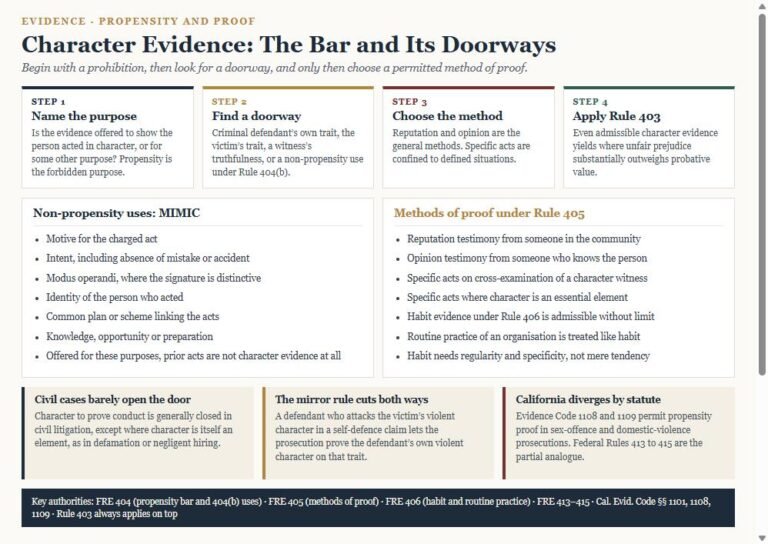 The Character Evidence Rules: Propensity Bar and Doorways
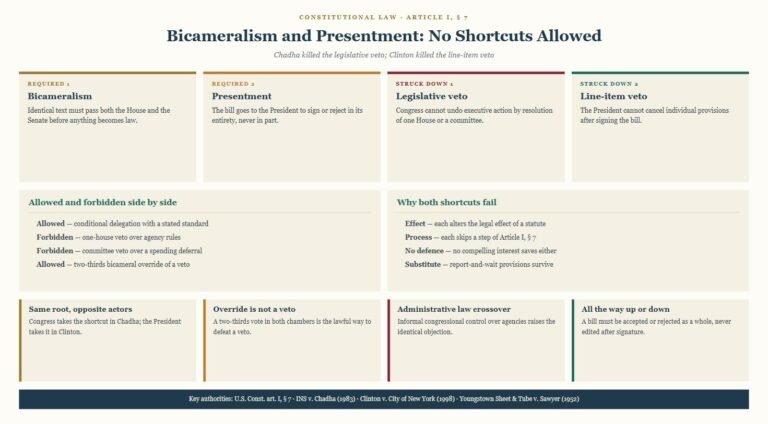 Bicameralism and Presentment: Two Vetoes Struck Down
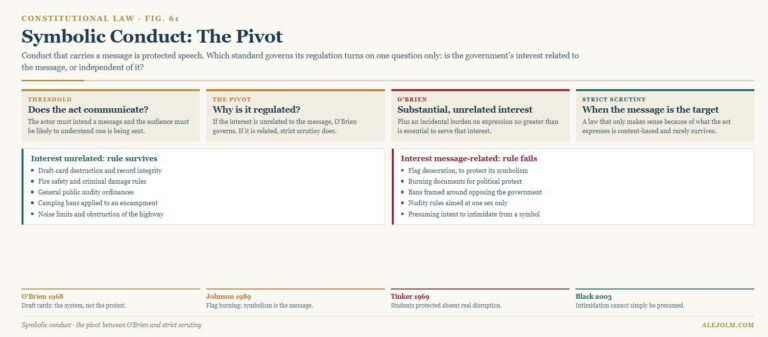 Symbolic Conduct and the O’Brien Test: The Pivot Question
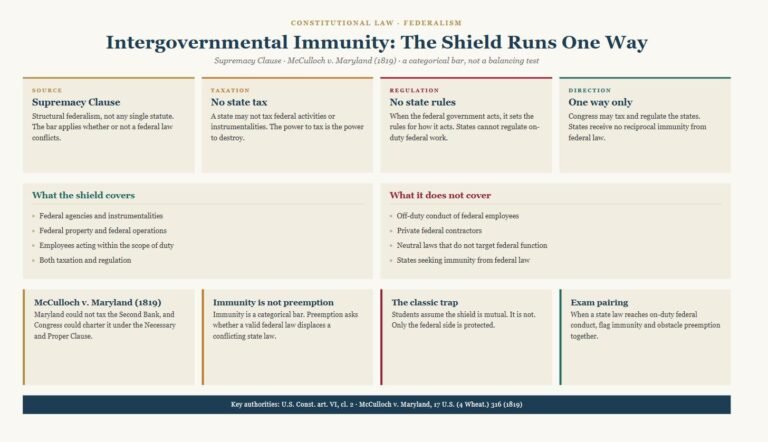 Intergovernmental Immunity: The Shield Runs One Way
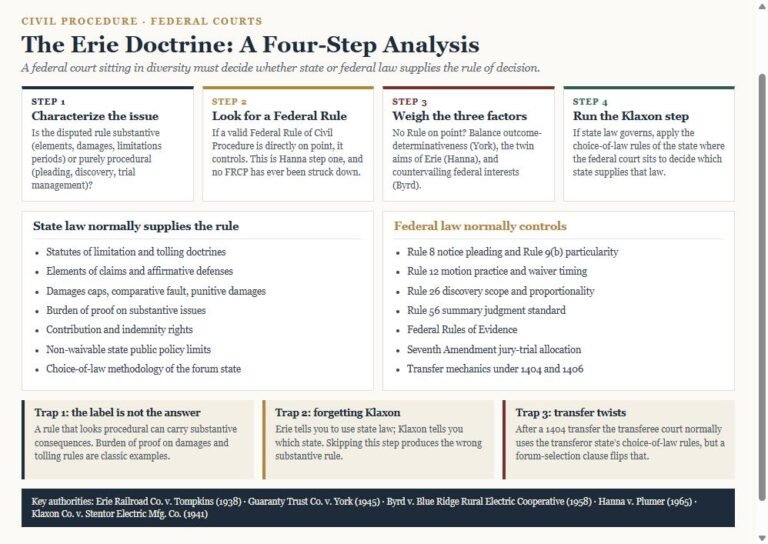 The Erie Doctrine Explained: A 4-Step Bar Exam Guide
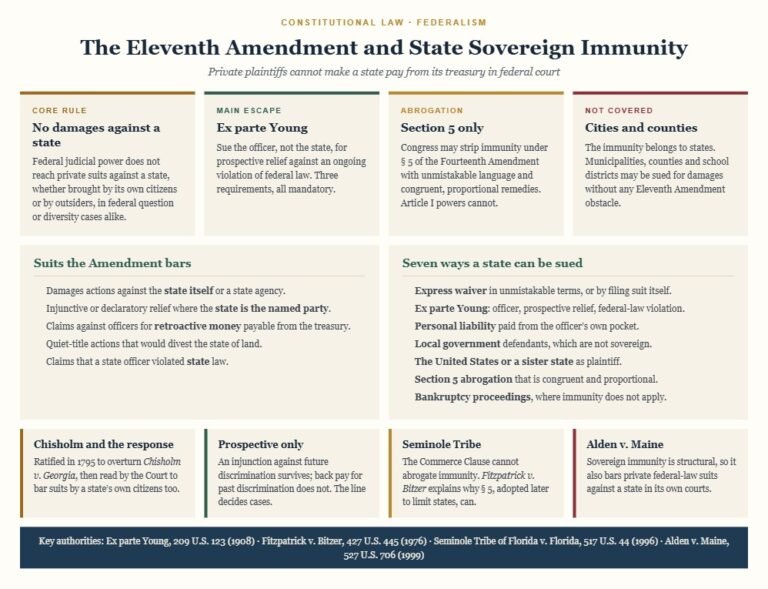 The Eleventh Amendment and State Sovereign Immunity
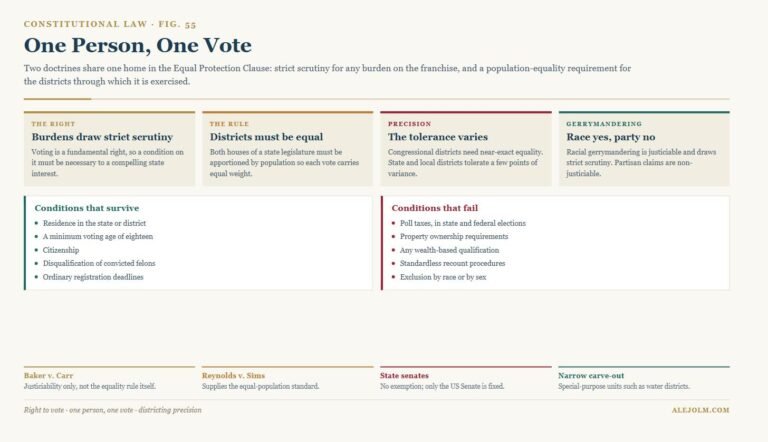 One Person, One Vote: Voting Rights Under Equal Protection
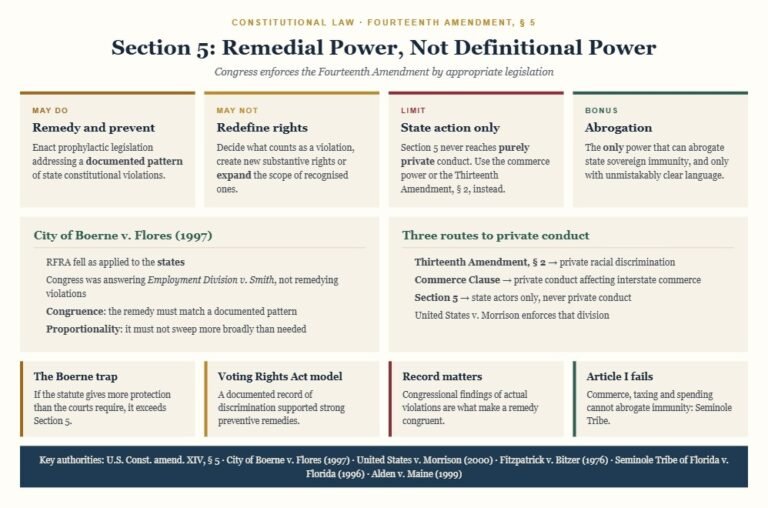 Section 5 Enforcement Power: Remedy, Do Not Redefine
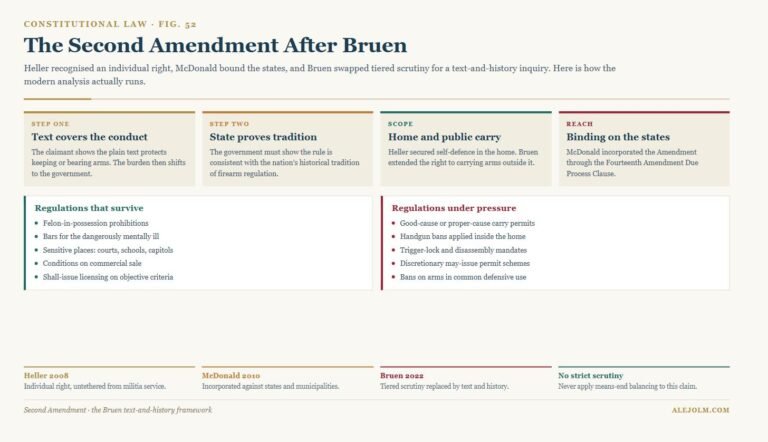 Second Amendment: The Bruen Text-and-History Standard
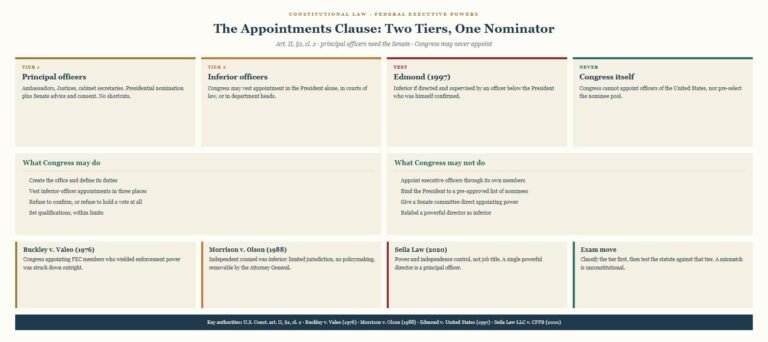 The Appointment Power: Principal and Inferior Officers
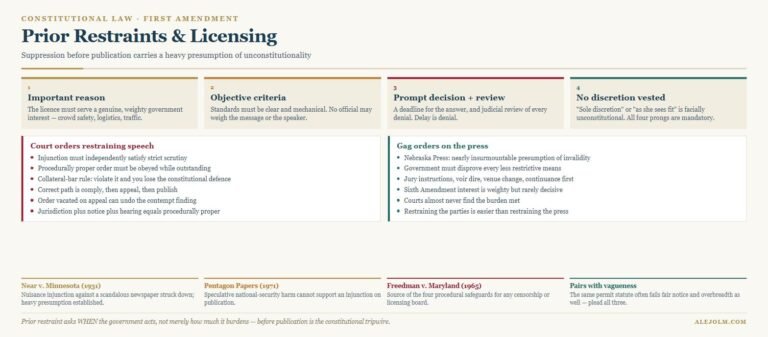 Prior Restraint and Licensing: The Freedman Safeguards
 Executive Privilege: A Qualified Right That Must Yield