
Campaign finance looks intimidating because it is politically charged, but doctrinally it runs on two axes and almost nothing else. The first axis asks what kind of money is being regulated: a contribution handed to a candidate, or an expenditure made independently. The second asks what the money is about: electing a person, or passing a ballot measure. Place a restriction on that grid and the answer usually falls out.
Sitting alongside it is a related but separate protection: the right to speak without identifying yourself. Anonymous political speech has independent First Amendment value, and compelling a speaker or donor to be named is a real burden requiring serious justification. This guide sets out both, works through Buckley, Citizens United, McCutcheon and Bonta, and applies them to a hypothetical.
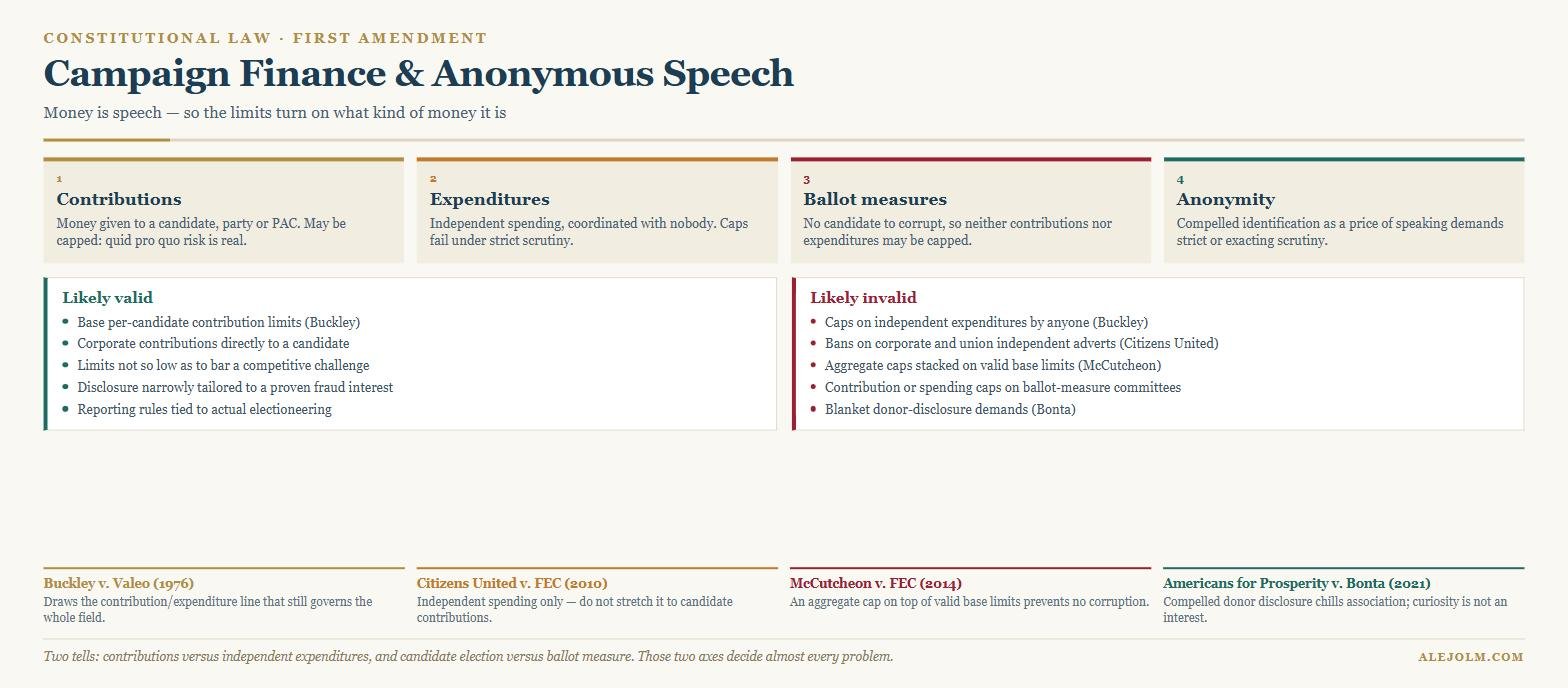
Buckley and the contribution–expenditure line
Buckley v. Valeo (1976) began from a premise that still governs everything: spending money to communicate a political message is a form of protected speech, because in a mass democracy speech costs money. Having said that, the Court refused to treat all political money identically, and the distinction it drew has survived half a century of pressure.
Contributions — money given to a candidate, a party or a political committee — may be capped. The reasoning is that a contribution is a fairly blunt expression of support; the donor’s message is conveyed by the act of giving, and its content does not become richer as the sum increases. Meanwhile a large direct payment to someone seeking office creates a genuine risk of quid pro quo corruption, and of the appearance of it. So the speech burden is marginal and the government interest is real and specific.
Independent expenditures — money spent by a person, group, union or corporation on its own political advocacy, uncoordinated with any candidate — may not be capped. Here the speech burden is direct and severe, since a cap simply limits how much a speaker may say. And the anti-corruption rationale collapses: nobody is handing money to a candidate, so there is no exchange to be bought. Independent spending fails strict scrutiny when limited, and the limits have consistently been struck down.
One qualification on the contribution side is worth carrying. Limits are valid only if they are not set so low as to prevent challengers from mounting a competitive campaign. A cap that in practice entrenches incumbents stops serving the anti-corruption interest and starts distorting the very competition it purports to protect.
Citizens United, and the mistake almost everyone makes
Citizens United v. FEC (2010) applied Buckley’s expenditure holding to corporate and union speakers: Congress may not prohibit them from using their own funds for independent political advertising. The First Amendment does not permit a speaker to be disfavoured because of its corporate form, provided the spending genuinely remains independent of any candidate’s campaign.
The recurring error is to read the case as abolishing campaign finance regulation. It did not. Citizens United is about independent spending only. Limits on contributions made directly to candidates, including limits on corporate contributions, were untouched and remain valid. If a problem describes a corporation writing a cheque to a candidate’s committee, Citizens United is the wrong authority; the answer comes from Buckley.
The independence requirement also does real work. Once spending is coordinated with a campaign it functions as a contribution, whatever it is called, and may be regulated accordingly. That is why the coordination question is where the modern litigation actually happens, rather than in the tidy categories themselves.
McCutcheon and the limits of the corruption rationale
McCutcheon v. FEC (2014) shows that even on the contribution side the anti-corruption interest is not open-ended. Federal law had imposed base limits per candidate and an aggregate cap on the total a donor could give across all candidates and committees in a cycle. The Court struck down the aggregate cap while leaving the base limits standing.
The logic is arithmetical. If a contribution at the base limit does not corrupt candidate A, it does not become corrupting because the donor has already given the same lawful amount to candidates B and C. The aggregate cap therefore prevented no quid pro quo corruption; it simply restricted how many candidates and causes a donor could support at levels already deemed safe. That is a limit on the breadth of political participation rather than on the intensity of any single relationship, and the anti-corruption interest cannot carry it.
Ballot measures: the broader rule
Where voters decide a measure directly, the entire corruption framework loses its object. There is no officeholder who might trade favours, because there is no officeholder at all — the electorate is the decision-maker. The consequence is a rule considerably more protective than the one governing candidate elections: for ballot initiatives and referendums, both expenditure limits and contribution limits are unconstitutional.
This is the trap most frequently laid in problems. A candidate contribution cap is presumptively fine, so a reader on autopilot will approve a contribution cap on a ballot-measure committee too. It fails. A donor may give any amount to a committee campaigning for or against a measure, and may spend any amount advocating independently, because the justification that supports candidate contribution limits simply has no application.
Exam tip: read the facts twice for the words “ballot measure”, “initiative” or “referendum”. If they appear, contribution limits fall along with expenditure limits — the one situation where the familiar contribution rule reverses.
Anonymous speech and compelled disclosure
Anonymity has a long and honourable pedigree in political argument, from pseudonymous pamphlets onward, and the First Amendment protects it independently. The government may not require a speaker to identify themselves as the price of speaking unless it can satisfy strict scrutiny — a compelling interest, narrowly served. The rule reaches leaflets, pamphlets, signage and online expression alike.
Compelled disclosure of donors and members is a related but distinct question, analysed under exacting scrutiny. In Americans for Prosperity Foundation v. Bonta (2021) a requirement that charities report their major donors to the state was held to burden associational freedom, because donors who fear harassment or retaliation withdraw from participation altogether. The state must show a sufficiently important interest that the disclosure regime actually and directly furthers; administrative convenience, or a generalised suspicion that some organisations might misbehave, will not do.
None of this means disclosure is always unconstitutional. Reporting rules tightly tied to identified electioneering, or narrowly framed to a demonstrated fraud problem, can survive. The failures tend to be broad, prophylactic collection regimes that gather far more than any proven need requires.
| Restriction | Context |
|---|---|
| Base contribution limit per candidate | Candidate election |
| Aggregate cap across all candidates | Candidate election |
| Cap on independent expenditures | Any |
| Ban on corporate independent advertising | Candidate election |
| Corporate contribution direct to a candidate | Candidate election |
| Contribution cap on a ballot-measure committee | Ballot measure |
| Expenditure cap on ballot-measure advocacy | Ballot measure |
| Compelled identification of the speaker | Any political speech |
| Compelled disclosure of major donors | Association |
Worked example
Federal law caps individual contributions to candidate campaigns at $3,300 per candidate per election. State Y separately caps individual contributions to ballot-measure committees at $1,000 per measure. A donor wishes to give $5,000 to a committee supporting a state ballot measure. State Y moves to enforce its cap and the donor argues it violates the First Amendment.
The instinct to uphold the cap by analogy to the federal limit is exactly wrong, and identifying why is the whole answer. The federal $3,300 limit is valid because money flowing to a candidate creates a quid pro quo risk: an officeholder can later repay the favour. State Y’s cap applies to a committee supporting a measure that voters will decide directly. There is no candidate, no officeholder and therefore no exchange available to be bought. Strip away the anti-corruption interest and nothing remains to justify limiting a citizen’s financial support for a political cause, which is core protected expression. The cap is unconstitutional and the donor may give $5,000, or any sum.
Change one fact. Suppose instead the $1,000 cap applied to contributions to candidates for the State Assembly. Now it is squarely within Buckley and presumptively valid, with only one live question: is $1,000 so low that a challenger cannot realistically fund a competitive campaign against an incumbent? If the evidence showed that, the limit would fail even in the candidate context — not because contributions are immune from regulation, but because a cap that suppresses competition no longer serves the interest invoked to defend it.
Common mistakes that cost points
- Treating contributions and expenditures alike. Contribution limits are generally valid; expenditure limits generally are not.
- Applying the candidate contribution rule to ballot measures. There both contribution and expenditure limits fall.
- Reading Citizens United as covering contributions. It concerns independent spending only, and corporate contributions to candidates may still be limited.
- Forgetting the independence requirement. Coordinated spending is treated as a contribution however it is labelled.
- Assuming McCutcheon invalidated base contribution limits. It struck only the aggregate cap layered on top of them.
- Applying rational basis to compelled disclosure. Bonta applies exacting scrutiny to donor-disclosure regimes.
- Overlooking the competitiveness caveat. A contribution limit set so low that challengers cannot compete is vulnerable even in candidate races.
- Merging anonymous speech with associational disclosure. They are related doctrines with different standards; address each on its own terms.
Frequently asked questions
Why can contributions be limited when expenditures cannot?
A contribution communicates support largely through the act of giving, so a cap restricts speech only marginally, and money passing directly to a candidate creates a genuine risk of a corrupt exchange. An independent expenditure is the speech itself, so a cap directly reduces how much a speaker may say, and with no payment to any candidate there is no exchange to prevent.
Are contribution limits on ballot-measure committees really unconstitutional?
Yes, and it is the single most counter-intuitive rule in the area. The only accepted justification for capping contributions is preventing corruption of a candidate. Where voters decide a measure themselves there is no candidate, so the justification disappears and both contribution and expenditure caps fail.
Can the government ever require political speakers to identify themselves?
Only on a strong showing. Compelling a speaker to be named as a condition of speaking must satisfy strict scrutiny, and compelled disclosure of donors or members faces exacting scrutiny under Bonta. Narrow rules tied to identified electioneering or a proven fraud problem can survive; broad prophylactic collection generally cannot.
Campaign finance in California and Los Angeles County, 2026
California layers a detailed state regime on top of the federal constitutional framework, and one of the most important recent decisions on disclosure came out of California. In Americans for Prosperity Foundation v. Bonta (2021) the Supreme Court invalidated the California Attorney General‘s blanket requirement that charities disclose major donors, holding that the demand was not narrowly tailored to the state’s interest in policing charitable fraud and burdened associational freedom.
The state’s own rules come from the Political Reform Act, adopted by initiative in 1974 and enforced by the Fair Political Practices Commission. It sets contribution limits for state offices, imposes detailed reporting duties, and since 2021 supplies default limits for local offices in jurisdictions that have not adopted their own. Los Angeles City has gone considerably further, operating a public matching funds programme administered by its Ethics Commission, and Los Angeles County maintains its own contribution rules for county offices.
The constitutional structure underneath:
- Contributions and expenditures are treated differently. Limits on contributions survive intermediate-style review; limits on independent expenditures generally do not.
- Independent spending cannot be capped. Citizens United (2010) protects corporate and union independent expenditures, so state law regulates disclosure instead.
- Disclosure is usually valid but must be tailored. Election-related reporting is routinely upheld; compelled donor lists untethered to elections are not.
- Public financing may be offered, not conditioned coercively. Voluntary matching programmes are constitutional; triggered matching that penalises non-participants is not.
- Coordination collapses the distinction. Spending coordinated with a campaign is treated as a contribution and becomes subject to limits.
- Deadlines and forms are enforced strictly. Most local exposure arises from late reporting rather than substantive violations.
For 2026, confirm the applicable limits with the county and city directly, since they are adjusted periodically. Read with freedom of association, the First Amendment framework and the franchise amendments.
Next steps
This area rewards being read against its foundations rather than in isolation. Work outward from the First Amendment analysis to see why political spending sits at the core of protected expression, and revisit the levels of scrutiny, since the whole contribution–expenditure divide is really a dispute about which tier applies. For the structural side of elections, the one person, one vote principle covers how districts and votes are weighed, and equal protection supplies the framework for challenges to ballot access and voter classifications.
The opinions in Buckley and Citizens United are long but foundational, and both are freely available through Justia’s First Amendment collection. Cornell’s Legal Information Institute keeps a concise entry with current citations, and candidates should confirm the tested scope against the outlines published by the State Bar of California.
Related guides
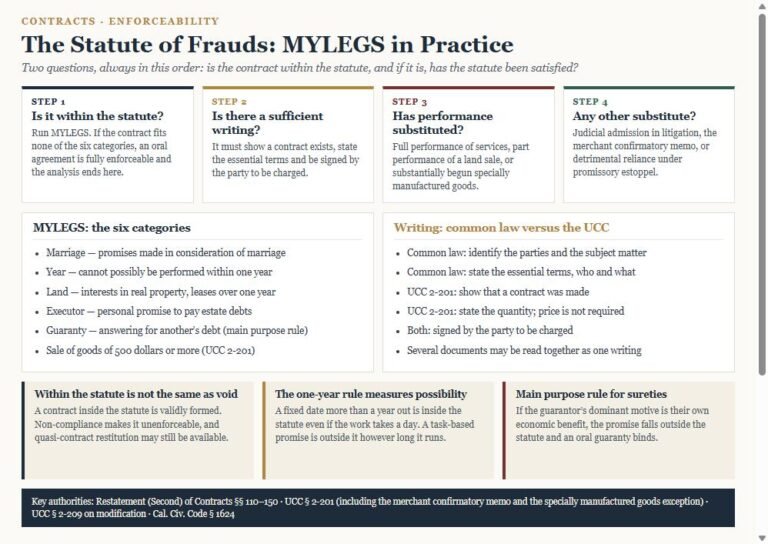 The Statute of Frauds: MYLEGS and How to Satisfy It
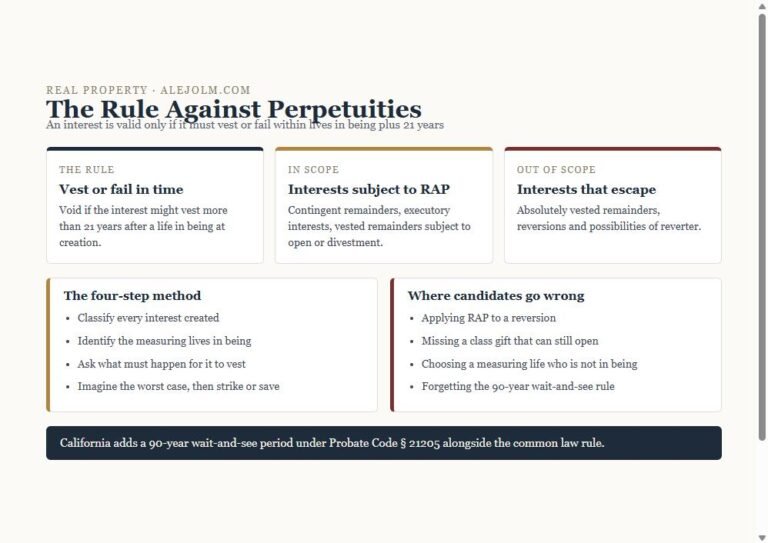 The Rule Against Perpetuities Explained Step by Step
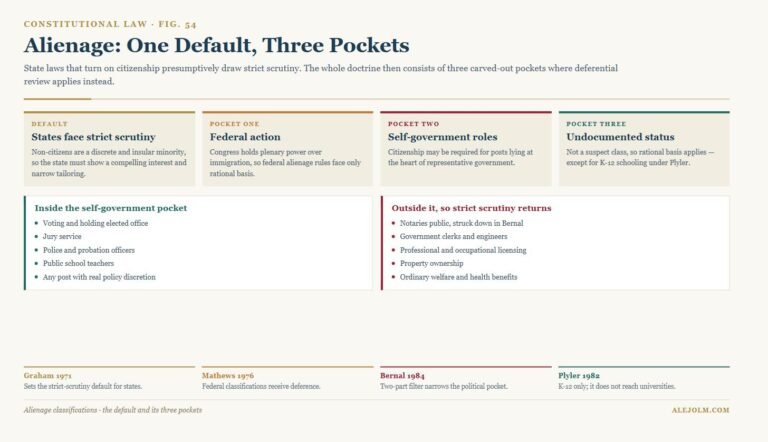 Alienage Classifications: Strict Scrutiny and Its Pockets
 Advisory Opinions: Article III and Declaratory Relief
 Political Question Doctrine: What Courts Will Not Decide
 Congress’s Naturalization Power and Citizenship Limits
 The Supremacy Clause: Floors, Ceilings and Preemption
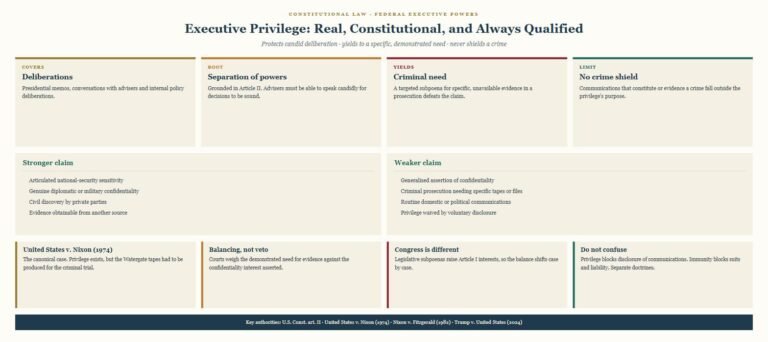 Executive Privilege: A Qualified Right That Must Yield
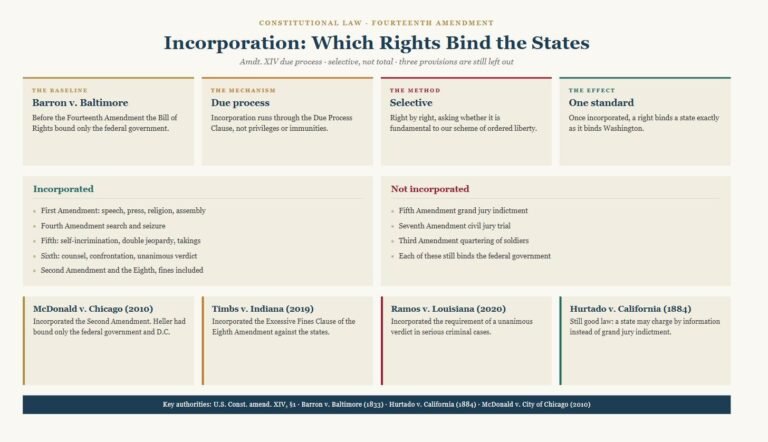 Incorporation Doctrine: Which Rights Bind the States
 3 Levels of Scrutiny in Constitutional Law Explained
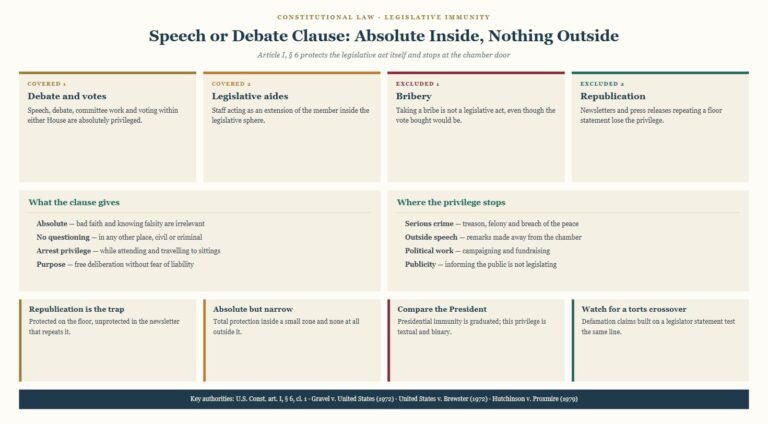 Speech or Debate Clause: Absolute but Narrow Immunity
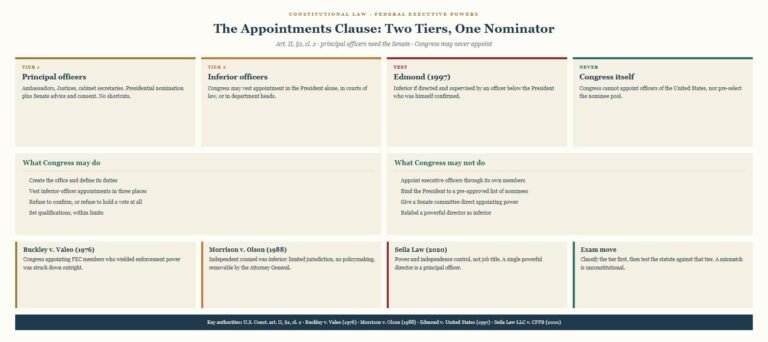 The Appointment Power: Principal and Inferior Officers