
What Is Witness Impeachment?
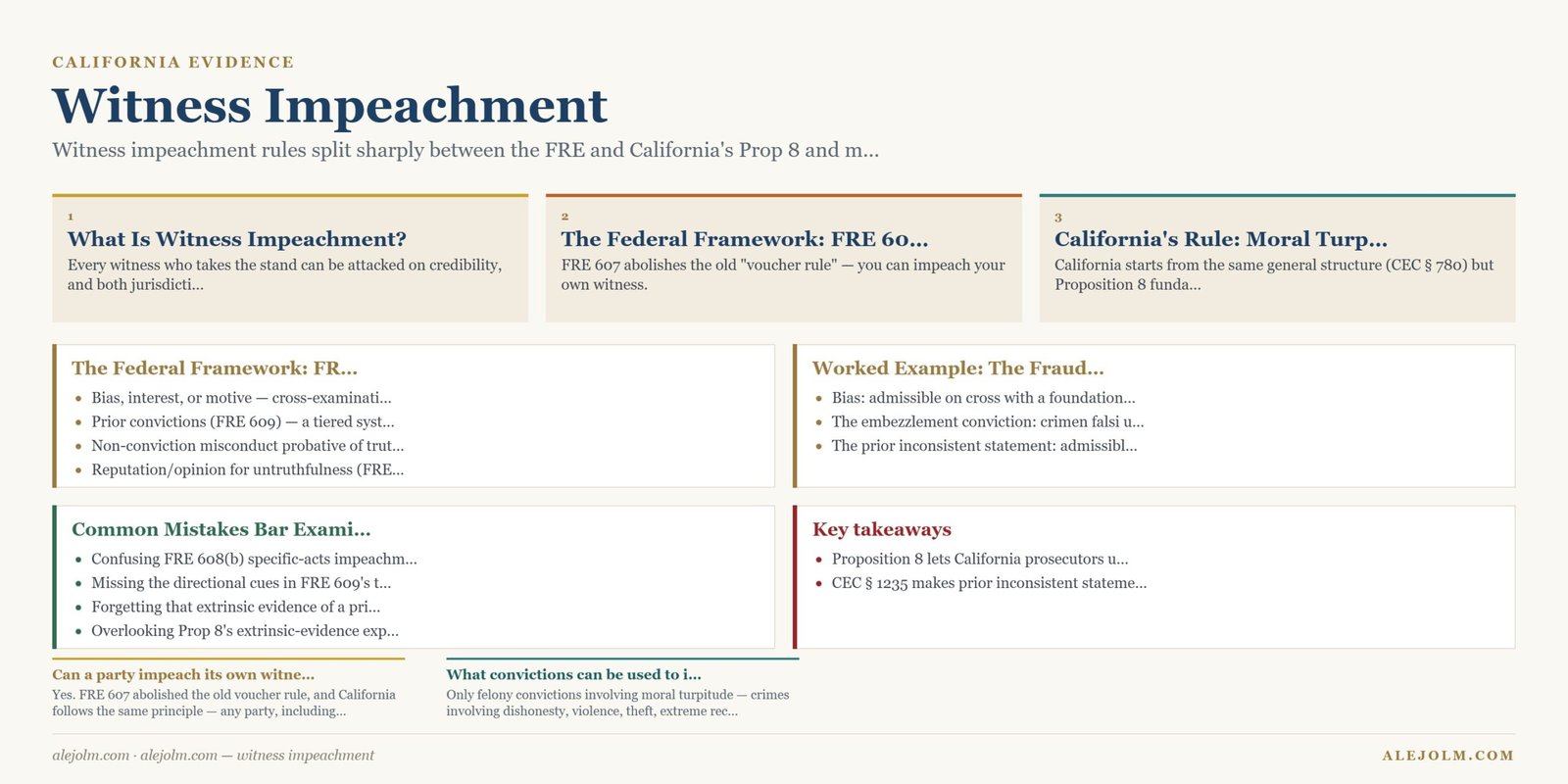
Every witness who takes the stand can be attacked on credibility, and both jurisdictions start from the same premise: any party — even the party who called the witness — may impeach. Witness impeachment means attacking a witness’s credibility through cross-examination or other evidence, and it’s one of the highest-yield evidence topics on the California Bar Exam because California’s Proposition 8 rewrote the rules for criminal cases.
Witness impeachment, defined: the process of attacking a witness’s credibility using methods like bias, prior convictions, prior inconsistent statements, or specific instances of untruthful conduct, governed federally by FRE 607–613 and in California by Evidence Code § 780 as modified by Proposition 8.
The Federal Framework: FRE 607–613
FRE 607 abolishes the old “voucher rule” — you can impeach your own witness. From there, federal law recognizes several distinct methods, each with its own evidentiary rules:
- Bias, interest, or motive — cross-examination or extrinsic evidence, with a foundation requirement.
- Prior convictions (FRE 609) — a tiered system described below.
- Non-conviction misconduct probative of truthfulness (FRE 608(b)) — cross-examination ONLY; no extrinsic evidence allowed.
- Reputation/opinion for untruthfulness (FRE 608(a)) — cross-examination or extrinsic evidence.
- Prior inconsistent statements (FRE 613) — requires laying a foundation.
- Contradiction — extrinsic evidence allowed only if the fact contradicted is not collateral.
FRE 609 has directional balancing tests that examiners test relentlessly: crimen falsi convictions (any crime involving dishonesty or a false statement) come in automatically, no balancing required. Other felonies against an ordinary witness are admissible unless prejudice substantially outweighs probative value. The same felonies against a criminal defendant require probative value to simply outweigh prejudice — a more protective, neutral standard. Convictions over ten years old flip the test again: probative value must substantially outweigh prejudice.
California’s Rule: Moral Turpitude and Proposition 8
California starts from the same general structure (CEC § 780) but Proposition 8 fundamentally reshapes impeachment in criminal cases. Under CEC § 788 and Prop 8, only felonies involving moral turpitude — crimes involving dishonesty, violence, theft, extreme recklessness, or sexual misconduct — are usable to impeach, and every conviction remains subject to CEC § 352 balancing. Non-moral-turpitude felonies are excluded entirely.
Prop 8 also expands the scope of non-conviction misconduct: unlike FRE 608(b)’s cross-examination-only rule, California prosecutors in criminal cases may introduce extrinsic evidence of non-conviction moral-turpitude misconduct. And under CEC § 1235, prior inconsistent statements come in for their substantive truth as well as impeachment — not just credibility, as under the federal rule.
FRE vs. CEC on Impeachment: Side-by-Side
| Issue | Federal Rule (FRE 607–613) | California (CEC § 780, Prop 8) |
|---|---|---|
| Crimen falsi convictions | Automatic, no balancing | Subject to CEC § 352 balancing regardless |
| Other felony convictions | Admissible unless prejudice substantially outweighs (ordinary witness) | Only if felony involves moral turpitude |
| Non-conviction misconduct | Cross-examination only (FRE 608(b)) | Extrinsic evidence allowed in criminal cases (Prop 8) |
| Prior inconsistent statements | Impeachment purposes only | Admissible for impeachment AND substantive truth (CEC § 1235) |
| Convictions 10+ years old | Reverse balancing test (favors exclusion) | Subject to ordinary CEC § 352 balancing |
The bottom line for bar prep: California is often more permissive for prosecutors than the FRE, thanks to Prop 8’s extrinsic-evidence rule and CEC § 1235’s substantive-truth admission of prior inconsistent statements — even though it’s simultaneously more restrictive on which felony convictions qualify (moral turpitude only).
Worked Example: The Fraud Witness
Anthony testifies that he saw the defendant, Renata, at the scene of a burglary. On cross-examination, defense counsel wants to: (1) show Anthony has a financial stake in Renata’s conviction, (2) bring up Anthony’s five-year-old felony conviction for embezzlement, and (3) confront Anthony with a statement he gave police saying Renata was not at the scene.
- Bias: admissible on cross with a foundation, under both federal and California law.
- The embezzlement conviction: crimen falsi under FRE 609 — automatically admissible in federal court, no balancing. In California, embezzlement is a crime of moral turpitude (theft/dishonesty), so it’s usable too, but still subject to CEC § 352 balancing.
- The prior inconsistent statement: admissible for impeachment in both systems once foundation is laid. In California, it can also be used for its substantive truth under CEC § 1235 — meaning the jury could actually believe Renata wasn’t at the scene, not just doubt Anthony’s credibility.
Common Mistakes Bar Examiners Test
- Confusing FRE 608(b) specific-acts impeachment with FRE 404 character-propensity evidence — they’re separate rules with separate purposes.
- Missing the directional cues in FRE 609’s tiered balancing tests (automatic vs. FRE-403-style vs. neutral vs. reverse).
- Forgetting that extrinsic evidence of a prior inconsistent statement requires foundation first — confronting the witness and giving them a chance to explain.
- Overlooking Prop 8’s extrinsic-evidence expansion for non-conviction moral-turpitude misconduct in California criminal cases.
Frequently Asked Questions
Can a party impeach its own witness?
Yes. FRE 607 abolished the old voucher rule, and California follows the same principle — any party, including the one who called the witness, may impeach.
What convictions can be used to impeach in California?
Only felony convictions involving moral turpitude — crimes involving dishonesty, violence, theft, extreme recklessness, or sexual misconduct — and even those remain subject to CEC § 352 balancing.
Are prior inconsistent statements only useful for impeachment?
Under federal law, generally yes. Under California’s CEC § 1235, a prior inconsistent statement is admissible for both impeachment and as substantive proof of the fact asserted.
Key Takeaways
- FRE 607 and California both abolish the voucher rule, letting any party impeach any witness.
- FRE 609’s conviction rules use four distinct balancing tests depending on the crime and the witness’s role.
- California limits impeachment convictions to moral-turpitude felonies, but subjects every conviction to CEC § 352 balancing.
- Proposition 8 lets California prosecutors use extrinsic evidence of non-conviction moral-turpitude misconduct — broader than FRE 608(b).
- CEC § 1235 makes prior inconsistent statements substantively admissible, not just useful for impeachment.
This article is educational and is not legal advice. Consult a licensed California attorney about your situation.
Related guides
- rehabilitating an impeached witness
- character evidence rules
- non-hearsay statements not offered for truth
- hearsay exceptions under FRE 803