
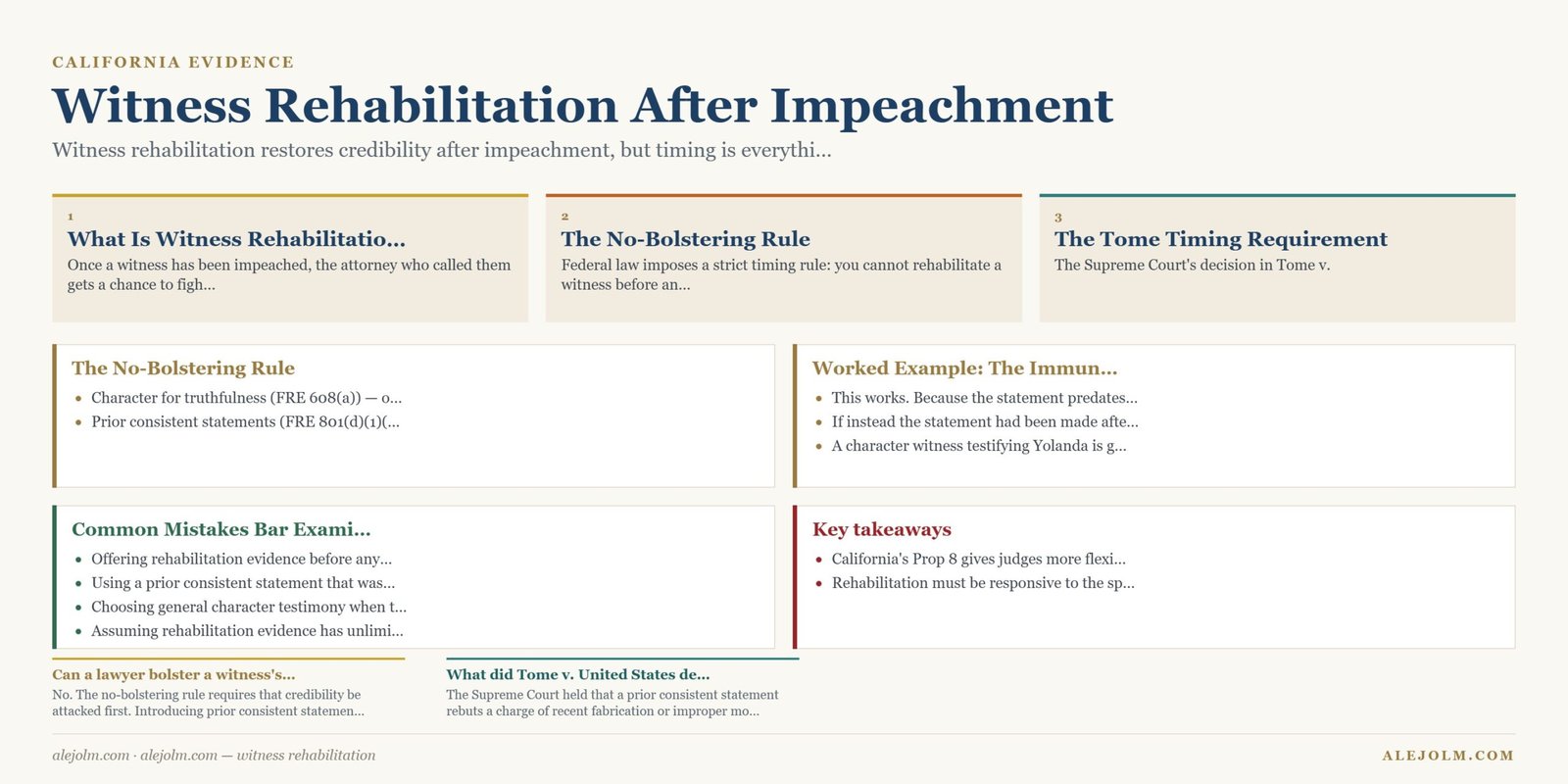
What Is Witness Rehabilitation?
Once a witness has been impeached, the attorney who called them gets a chance to fight back. Witness rehabilitation restores credibility after a witness has been attacked, most commonly through prior consistent statements or character evidence for truthfulness — but only after the attack, and only when the fix actually answers the specific charge.
Witness rehabilitation, defined: evidence offered on redirect examination — such as a prior consistent statement or reputation for truthfulness — to restore a witness’s credibility after impeachment, governed by FRE 608(a) and FRE 801(d)(1)(B).
The No-Bolstering Rule
Federal law imposes a strict timing rule: you cannot rehabilitate a witness before an attack happens. Offering a prior consistent statement or character testimony before anyone has questioned the witness’s credibility is “bolstering,” and it’s improper. Only after impeachment can rehabilitation evidence come in — and even then, a judge can limit it to the actual scope of the attack.
Two rehabilitation tools dominate:
- Character for truthfulness (FRE 608(a)) — opinion or reputation evidence supporting the witness’s honesty, admissible on cross or extrinsically.
- Prior consistent statements (FRE 801(d)(1)(B)) — statements matching the witness’s trial testimony, useful to rebut a charge of recent fabrication, bias, or improper motive.
The Tome Timing Requirement
The Supreme Court’s decision in Tome v. United States (1995) added a critical limitation: a prior consistent statement only rebuts a fabrication or bias charge if it was made before the alleged motive to fabricate arose. A consistent statement made after the motive existed doesn’t logically rebut the charge — the witness could have already been lying by then — so it fails FRE 801(d)(1)(B), even though it might still be usable for other, non-hearsay purposes.
This timing rule is the single most tested nuance in rehabilitation questions. Students who correctly identify the impeachment (bias, fabrication) but forget to check when the consistent statement was made routinely lose points.
California’s More Flexible Approach
California’s CEC §§ 787–788 permit the same core tools — reputation/opinion evidence and prior consistent statements — but Proposition 8 loosens the strict federal timing rule. Under Prop 8, a prior consistent statement could in theory be introduced even before any attack on credibility, subject to the trial judge’s CEC § 352 discretion to exclude it if its prejudicial or time-wasting effect outweighs its value.
| Issue | Federal Rule (FRE 608, 801(d)(1)(B)) | California (CEC §§ 787–788, Prop 8) |
|---|---|---|
| Rehabilitation timing | Strict no-bolstering — only after impeachment | More flexible — Prop 8 allows earlier use, subject to CEC § 352 |
| Prior consistent statement pre-motive requirement | Required (Tome v. United States) | Same general principle applies |
| Character evidence for truthfulness | FRE 608(a), opinion/reputation | CEC §§ 787–788, similar |
| Judicial discretion to limit scope | Yes | Yes, via CEC § 352 balancing |
Worked Example: The Immunity Deal
A prosecution witness, Yolanda, testifies that the defendant sold drugs. On cross-examination, defense counsel establishes that Yolanda received immunity from prosecution in exchange for her testimony — a classic bias/motive-to-fabricate attack.
On redirect, the prosecution offers a statement Yolanda gave to DEA agents six months before the immunity deal was ever discussed, describing the same facts.
- This works. Because the statement predates the alleged motive to fabricate, it satisfies Tome‘s pre-motive requirement and directly rebuts the bias charge under FRE 801(d)(1)(B).
- If instead the statement had been made after Yolanda started negotiating immunity, it would fail the pre-motive test — even though it’s word-for-word consistent with her trial testimony — because she already had the motive to shade her account by then.
- A character witness testifying Yolanda is generally honest would also be admissible but far less persuasive, since it doesn’t specifically address the bias allegation.
Common Mistakes Bar Examiners Test
- Offering rehabilitation evidence before any impeachment has occurred — a clear no-bolstering violation.
- Using a prior consistent statement that was made after the alleged motive to fabricate arose, ignoring the Tome timing rule.
- Choosing general character testimony when the impeachment was specific (like bias), rather than a more targeted, responsive statement.
- Assuming rehabilitation evidence has unlimited scope — judges can restrict it to match the actual impeachment.
Frequently Asked Questions
Can a lawyer bolster a witness’s credibility before cross-examination?
No. The no-bolstering rule requires that credibility be attacked first. Introducing prior consistent statements or character evidence before any impeachment is improper.
What did Tome v. United States decide?
The Supreme Court held that a prior consistent statement rebuts a charge of recent fabrication or improper motive under FRE 801(d)(1)(B) only if it was made before the alleged motive arose — not after.
Is California’s rehabilitation rule different from federal law?
Somewhat. Proposition 8 gives California more flexibility to admit prior consistent statements earlier than federal law would allow, subject to the trial judge’s discretion under CEC § 352.
Key Takeaways
- Rehabilitation is only proper after a witness’s credibility has been attacked — offering it earlier is improper bolstering.
- Prior consistent statements under FRE 801(d)(1)(B) must predate the alleged motive to fabricate, per Tome v. United States.
- Character evidence for truthfulness (FRE 608(a)) is admissible but less targeted than a well-timed prior consistent statement.
- California’s Prop 8 gives judges more flexibility to admit rehabilitation evidence earlier, subject to CEC § 352 balancing.
- Rehabilitation must be responsive to the specific impeachment — mismatched evidence risks exclusion or wasted effort.
ns).
This article is educational and is not legal advice. Consult a licensed California attorney about your situation.
Related guides
- witness impeachment methods
- character evidence rules
- non-hearsay statements not offered for truth
- hearsay rule basics