
What Are the FRE 803 Hearsay Exceptions?
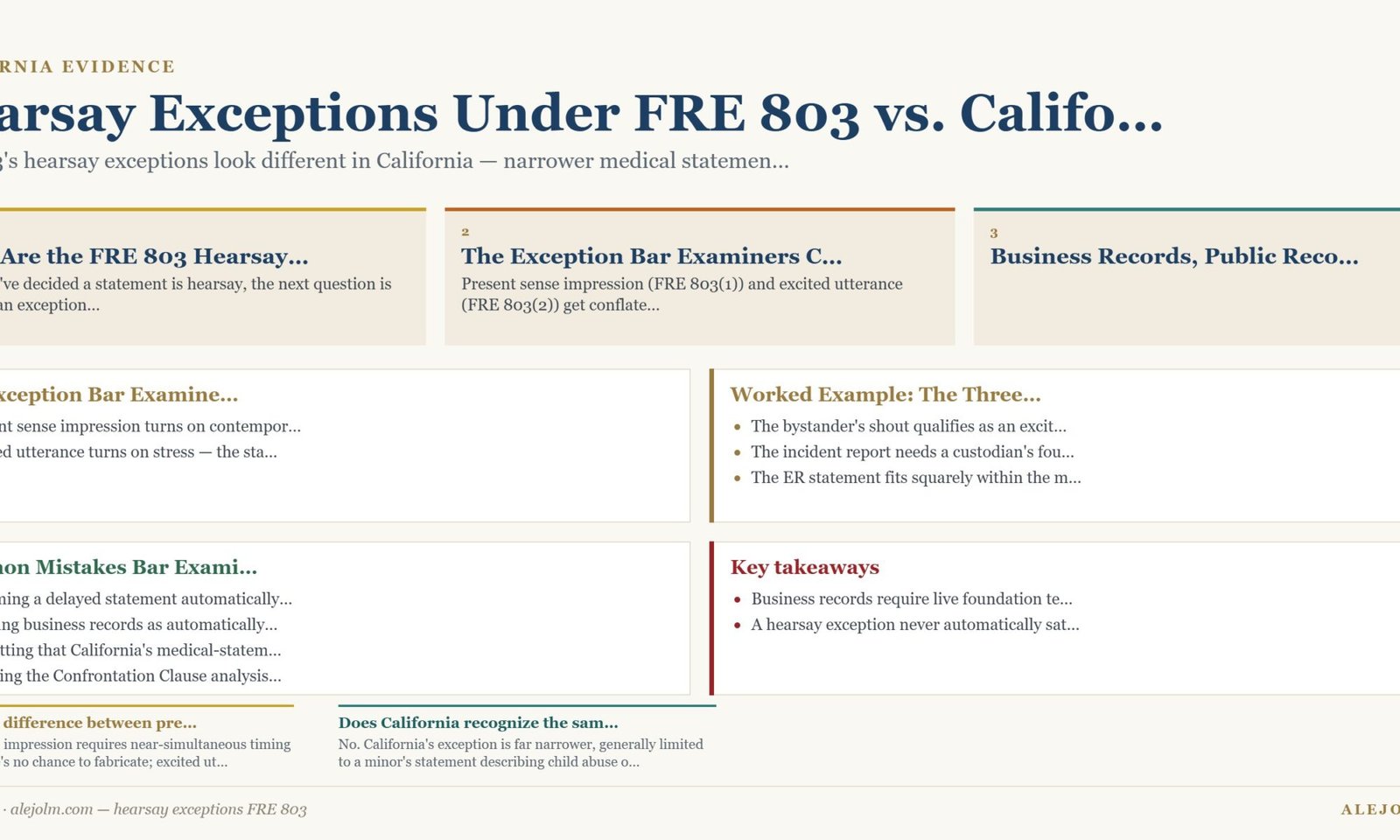
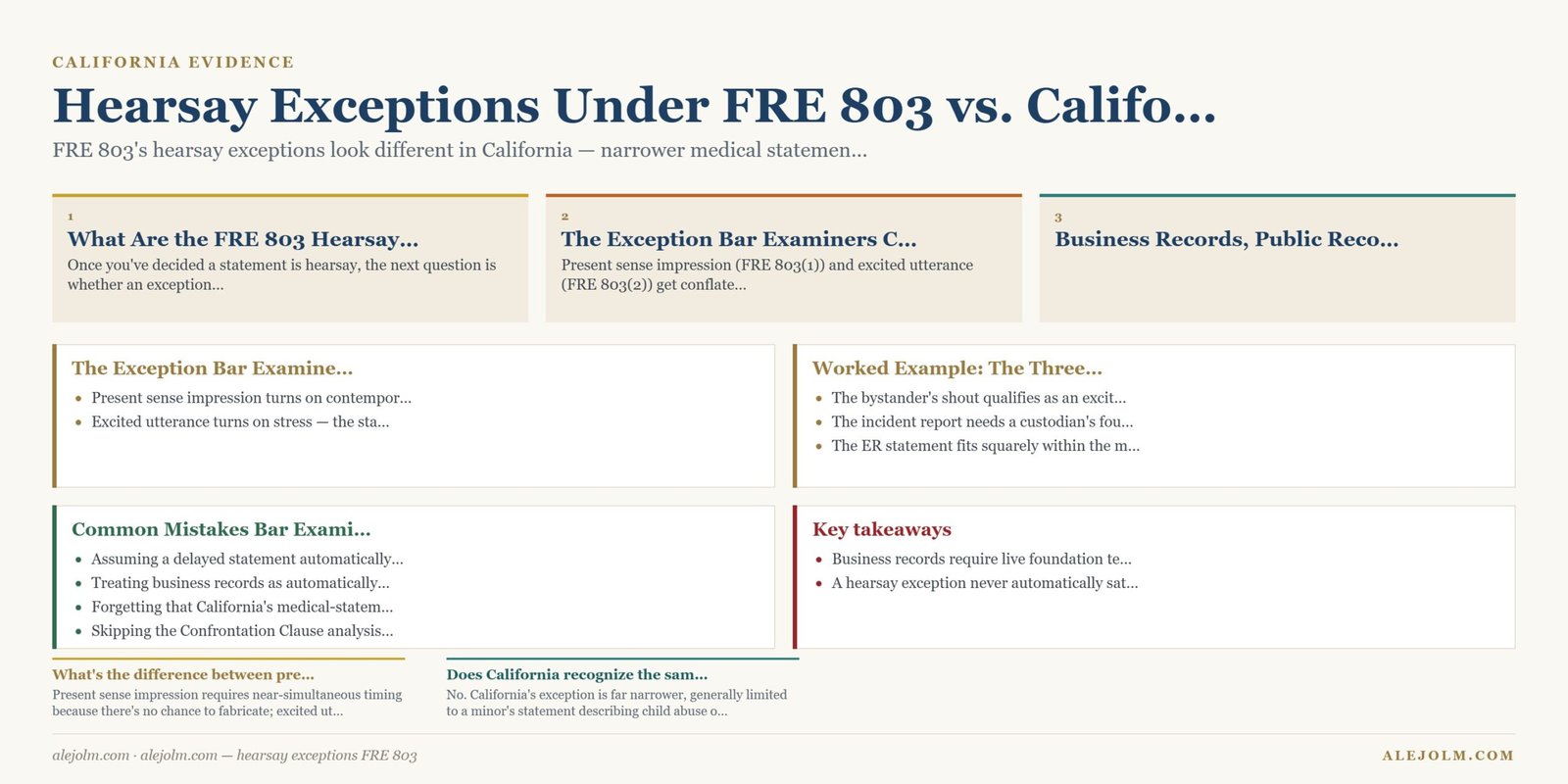
Once you’ve decided a statement is hearsay, the next question is whether an exception saves it. FRE 803 contains the exceptions that apply regardless of whether the declarant is available to testify — the theory being that the circumstances of the statement itself, not the chance to cross-examine, make it reliable. California tracks this framework but reshapes several exceptions in ways the bar exam tests constantly.
FRE 803 hearsay exceptions, defined: a set of categories — including excited utterance, present sense impression, business records, and statements for medical diagnosis — that admit out-of-court statements for their truth without regard to whether the declarant could testify, because the circumstances of the statement supply their own guarantee of trustworthiness.
The Exception Bar Examiners Confuse Most: PSI vs. Excited Utterance
Present sense impression (FRE 803(1)) and excited utterance (FRE 803(2)) get conflated constantly, but they rest on opposite rationales:
- Present sense impression turns on contemporaneity — the statement must be made while perceiving an event, or immediately after. The time window is narrow because the theory is there’s no time to fabricate.
- Excited utterance turns on stress — the statement must be made while the declarant is under the stress of a startling event. Because stress (not timing) is doing the work, the permissible gap can be much longer, as long as the stress persists.
A delayed statement doesn’t automatically fail as an excited utterance just because it wasn’t immediate — the real question is whether the declarant was still under the stress of the event.
Business Records, Public Records, and Medical Statements
Business records (FRE 803(6)) require a witness to establish that the record was made near the time of the event, by someone with knowledge, and kept in the regular course of business. The Supreme Court’s warning in Palmer v. Hoffman still matters: self-serving incident reports, even if technically qualifying, risk exclusion under FRE 403 because juries may give them undue weight.
Public records (FRE 803(8)) admit government records of activities and legally required investigations — but records observed by police are not admissible against a criminal defendant under this exception.
Medical statements (FRE 803(4)) cover statements made for diagnosis or treatment to any medical personnel, describing symptoms, history, or cause. Statements attributing fault (“the other driver ran the light”) are usually excluded, while statements of cause pertinent to treatment (“I was hit by a car”) come in.
California’s Version: Narrower in Places, Broader in Others
This is where FRE 803 diverges sharply from California’s Evidence Code, and it’s the single most exam-relevant comparison in this area.
| Issue | FRE 803 (Federal) | CEC (California) |
|---|---|---|
| Contemporaneous/present sense statement | Covers statements describing any event or condition perceived (803(1)) | Narrower — CEC § 1241 covers only statements explaining the declarant’s OWN conduct while doing it |
| Statements about physical harm/threats | No direct federal parallel | Broader — CEC § 1370, the “O.J. exception,” admits an unavailable declarant’s statement describing physical harm or threats if written, recorded, or made to police/medical staff |
| Medical diagnosis/treatment statements | Broad — any statement pertinent to diagnosis/treatment (803(4)) | Narrower — generally limited to a minor describing child abuse/neglect, or a statement of past condition if the declarant is unavailable |
| Business records | Admits opinions/diagnoses in records | CEC § 1271 omits “opinions or diagnoses,” though courts admit simple ones |
| Public records against criminal defendants | Police-observed matters excluded (803(8)) | No criminal-case exclusion — police reports can theoretically be admitted |
| Felony judgment exception | Available in civil and criminal cases | CEC limits it to civil cases only |
| Ancient documents | 20+ years old | 30+ years under California’s authentication rule |
The “O.J. exception” (CEC § 1370) gets its nickname from the famous case that inspired it, and it’s a favorite bar exam topic precisely because it has no clean federal counterpart — while raising Confrontation Clause questions whenever the statement was made to police.
The Confrontation Clause Overlay
Satisfying a hearsay exception is never the end of the analysis in a criminal case. Under Crawford v. Washington, a “testimonial” statement — even one that fits neatly within FRE 803 — can still violate the Sixth Amendment if the declarant is unavailable and was never cross-examined. Davis v. Washington clarified that statements made during an ongoing emergency (like a 911 call) are typically non-testimonial and survive confrontation scrutiny, while statements to police investigating a completed crime often do not.
Worked Example: The Three Witnesses
A defendant is on trial for assault. The prosecution offers: (1) a bystander’s shout immediately after the attack, “He hit him with a bat!”; (2) a store manager’s written incident report from the next day; (3) the victim’s statement to an ER doctor, “My ribs are broken from blunt-force trauma.”
- The bystander’s shout qualifies as an excited utterance — startling event, statement made under its stress.
- The incident report needs a custodian’s foundation for business records, and even then risks FRE 403 exclusion as self-serving under the Palmer warning.
- The ER statement fits squarely within the medical-diagnosis exception; under California law, it would need the narrower child-abuse or unavailability pathway instead, since the FRE 803(4) medical exception doesn’t map directly onto the CEC.
Common Mistakes Bar Examiners Test
- Assuming a delayed statement automatically fails as an excited utterance — the test is stress, not timing.
- Treating business records as automatically admissible without laying the required foundation.
- Forgetting that California’s medical-statement exception is far narrower than FRE 803(4) outside the child-abuse context.
- Skipping the Confrontation Clause analysis in criminal cases just because a hearsay exception technically applies.
Frequently Asked Questions
What’s the difference between present sense impression and excited utterance?
Present sense impression requires near-simultaneous timing because there’s no chance to fabricate; excited utterance requires that the declarant remain under the stress of a startling event, which can allow a longer time gap.
Does California recognize the same medical-statement exception as FRE 803(4)?
No. California’s exception is far narrower, generally limited to a minor’s statement describing child abuse or neglect, or a statement of past physical condition when the declarant is unavailable.
Can a hearsay exception override the Confrontation Clause?
No. Even if a statement fits within FRE 803, it can still be excluded against a criminal defendant if it’s “testimonial” under Crawford v. Washington and the declarant was never subject to cross-examination.
Key Takeaways
- FRE 803 exceptions apply regardless of the declarant’s availability, based on the trustworthiness of the circumstances.
- Present sense impression turns on contemporaneity; excited utterance turns on stress — the bar exam’s most commonly confused pair.
- California narrows the medical-diagnosis and present-sense exceptions but broadens statements about physical harm through the “O.J. exception” (CEC § 1370).
- Business records require live foundation testimony and remain subject to FRE 403 exclusion for self-serving content.
- A hearsay exception never automatically satisfies the Confrontation Clause in a criminal case — that’s always a separate analysis.
This article is educational and is not legal advice. Consult a licensed California attorney about your situation.
Related guides
- hearsay rule basics
- non-hearsay statements not offered for truth
- hearsay exceptions for unavailable declarants under FRE 804
- witness impeachment methods