
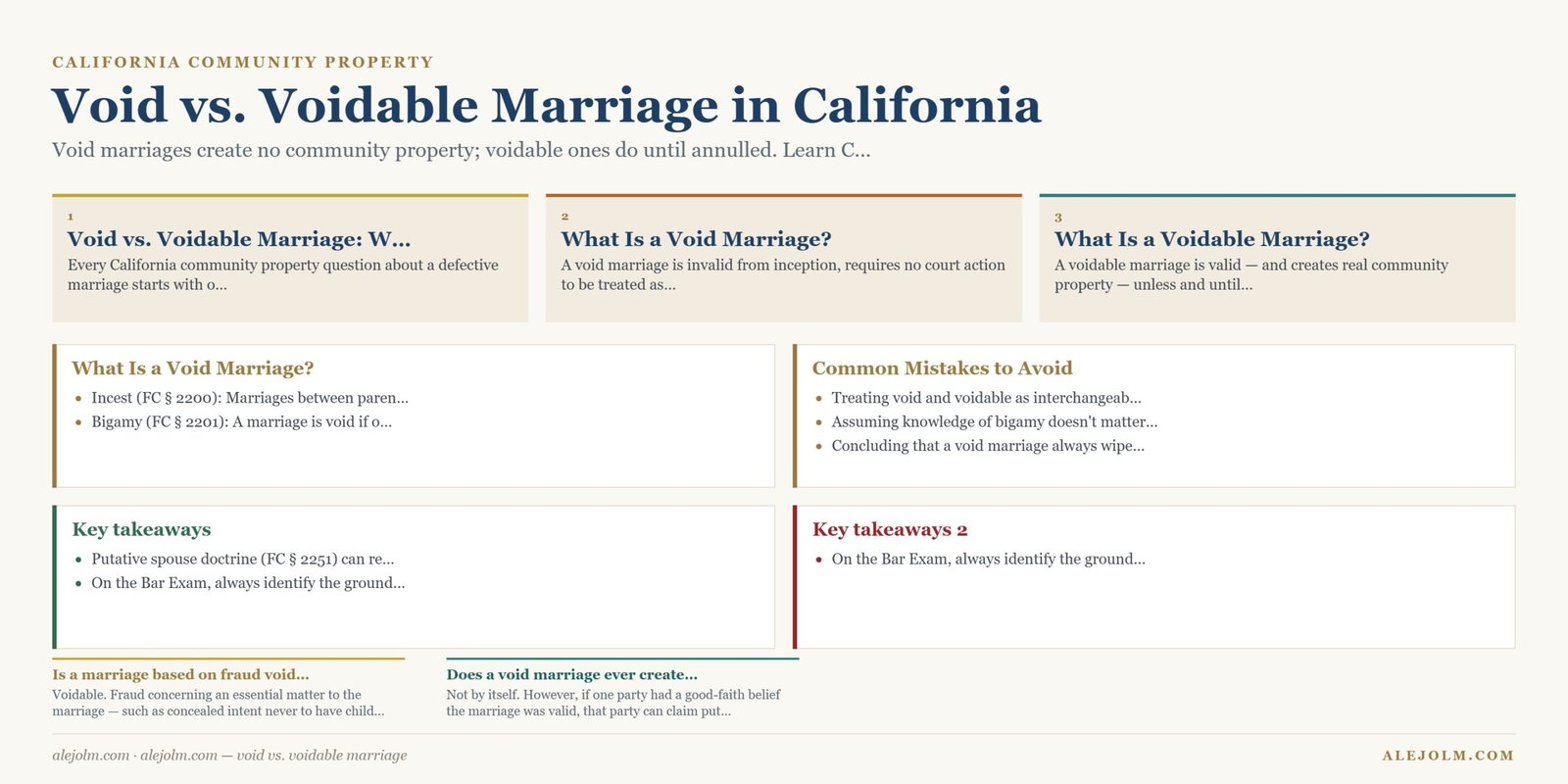
Void vs. Voidable Marriage: Why the Label Controls Your Property
Every California community property question about a defective marriage starts with one label: void or voidable. Get the label wrong and you’ll get the property division wrong, because the two categories produce completely different outcomes for the couple’s earnings, real estate, and retirement accounts.
A void marriage is a nullity from the moment it happened — the law treats it as if it never existed, and by default it creates no community property at all. A voidable marriage, by contrast, is fully valid — including for community property purposes — until a court annuls it. This distinction is one of the most heavily tested traps on the California Bar Exam’s community property essays.
What Is a Void Marriage?
A void marriage is invalid from inception, requires no court action to be treated as a nullity, and — absent putative spouse protection — never generates community property rights for either party. California recognizes only two categories of void marriage under Family Code sections 2200–2201: incest and bigamy.
- Incest (FC § 2200): Marriages between parents and children, siblings (including half-siblings), and other close relatives listed in the statute are void regardless of whether the parties knew of the relationship.
- Bigamy (FC § 2201): A marriage is void if one party was already validly married to someone else at the time. There’s a narrow exception: if the prior spouse has been absent and unheard of for five years, or is generally believed dead, the later marriage is valid unless and until a court declares it a nullity.
Because a void marriage is void ab initio, either party — or even a third party with a legal interest — can raise its invalidity at any time, in any proceeding. No annulment action is technically required, though parties often obtain one anyway for record-keeping clarity.
What Is a Voidable Marriage?
A voidable marriage is valid — and creates real community property — unless and until a party who has grounds obtains a judgment of nullity. Only that party can attack it; third parties cannot. California recognizes five voidable grounds under Family Code sections 2210–2212:
- Underage marriage without required parental or court consent (ratified if the underage spouse keeps cohabiting after reaching the age of consent).
- Unsound mind — lack of mental capacity to consent. This is voidable, not void, and it’s a favorite bar-exam trap.
- Fraud going to an essential element of the marriage (concealed intent never to have children, misrepresented intent or ability to consummate). Fraud about a collateral matter doesn’t qualify.
- Force or duress.
- Physical incapacity — incurable impotence existing at the time of marriage and continuing.
The Bar Exam Trap: Only Two Grounds Are Void
Examiners love to test whether you can keep these two lists separate. The trap sentence usually reads something like “the marriage is invalid because of fraud” or “because Husband lacked capacity.” Both are voidable, not void — and students who reflexively write “void” lose points fast.
| Ground | Category | Requires annulment action? | CP created before annulment? |
|---|---|---|---|
| Incest | Void | No | No (absent putative spouse) |
| Bigamy | Void | No | No (absent putative spouse) |
| Underage (no consent) | Voidable | Yes | Yes, until annulled |
| Unsound mind | Voidable | Yes | Yes, until annulled |
| Fraud (essential matter) | Voidable | Yes | Yes, until annulled |
| Force or duress | Voidable | Yes | Yes, until annulled |
| Physical incapacity | Voidable | Yes | Yes, until annulled |
How Each Category Affects Community Property
The practical stakes of this distinction are entirely about money.
Void marriage: No community property is created, full stop — unless the putative spouse doctrine rescues an innocent party. If one spouse had a good-faith belief the marriage was valid, that spouse can claim quasi-marital property rights under Family Code § 2251, and property acquired during the “marriage” is treated as if it were community property for that innocent spouse’s benefit. A spouse who knew of the bigamy or incest gets no such protection.
Voidable marriage: Community property exists and accumulates normally from the date of marriage through the date of annulment, because the marriage is valid until a court says otherwise. Upon annulment, the parties divide that property much like they would in a divorce, and an innocent party can still invoke putative spouse doctrine if it adds protection.
Worked Example: Applying the Void/Voidable Distinction
Facts: Husband is validly married to Fiona. Without divorcing her, he marries Wanda in a ceremony where Wanda has no idea Husband is already married. Over three years, Husband and Wanda together earn $180,000 and buy a car titled in both names.
Analysis: The marriage to Wanda is void ab initio under FC § 2201 — bigamy is one of the two void categories, and it requires no judicial action to be a nullity. Ordinarily that means no community property was ever created between Husband and Wanda. But because Wanda had a good-faith, reasonable belief the marriage was valid, she qualifies as a putative spouse under FC § 2251. The $180,000 in earnings and the car are treated as quasi-marital property, divided between Wanda and Husband roughly as community property would be. Husband, who knew about the bigamy, gets no innocent-party protection of his own — only Wanda’s good faith matters here.
Now compare a voidable case: Husband conceals from Wife that he is sterile because he knows she wants children; they marry, and Wife later discovers the deception. This is fraud on an essential matter — voidable, not void. Every dollar the couple earns before Wife obtains an annulment is genuine community property. If she annuls the marriage, she can still assert putative spouse rights as an innocent party, but she didn’t need to — the CP already existed by operation of the marriage being valid until annulled.
Common Mistakes to Avoid
- Treating void and voidable as interchangeable. They produce opposite default outcomes for CP: none versus full accumulation until annulment.
- Assuming knowledge of bigamy doesn’t matter for putative spouse status. It does — good faith belief in the marriage’s validity is required, and a knowing party in a bigamous marriage cannot claim putative spouse status.
- Concluding that a void marriage always wipes out all property claims. If the innocent party can show good-faith belief, putative spouse doctrine preserves community-like treatment for that party’s share.
FAQ
Is a marriage based on fraud void or voidable in California?
Voidable. Fraud concerning an essential matter to the marriage — such as concealed intent never to have children — is a voidable ground under Family Code § 2210, requiring an affirmative annulment action. It is not automatically void.
Does a void marriage ever create community property?
Not by itself. However, if one party had a good-faith belief the marriage was valid, that party can claim putative spouse status under FC § 2251 and receive quasi-marital property treatment for property acquired during the invalid marriage.
Do I need a court order to end a void marriage?
No. A void marriage is a nullity from the start and requires no judicial action, though a party may still seek a judgment of nullity for clarity and to formally resolve any property or status disputes.
Key Takeaways
- Only incest and bigamy make a California marriage void; everything else — underage marriage, unsound mind, fraud, force, and physical incapacity — is merely voidable.
- Void marriages create no community property by default; voidable marriages create real community property until a court grants an annulment.
- Putative spouse doctrine (FC § 2251) can rescue an innocent party’s property rights even inside a void marriage, but only with a good-faith belief the marriage was valid.
- On the Bar Exam, always identify the ground first, place it in the correct void/voidable column, then apply the corresponding CP consequence.
This article is educational and is not legal advice. Consult a licensed California attorney about your situation.
Related guides
- community property presumptions
- registered domestic partners and community property
- Marvin contracts for unmarried couples
- will execution requirements