
What Registered Domestic Partnership Means for Property
Registered domestic partners in California get community property treatment that is, for nearly every practical purpose, identical to marriage. If you’re studying for the California Bar Exam or advising a client, the key is knowing exactly when that treatment starts and where it still diverges from marital law.
A registered domestic partnership (RDP) exists when two unrelated adults file a Declaration of Domestic Partnership with the California Secretary of State. Under Family Code § 297.5, RDPs are treated as spouses for community property purposes, with the community property system applying retroactively to the date of original registration — not to whenever the couple actually started living together.
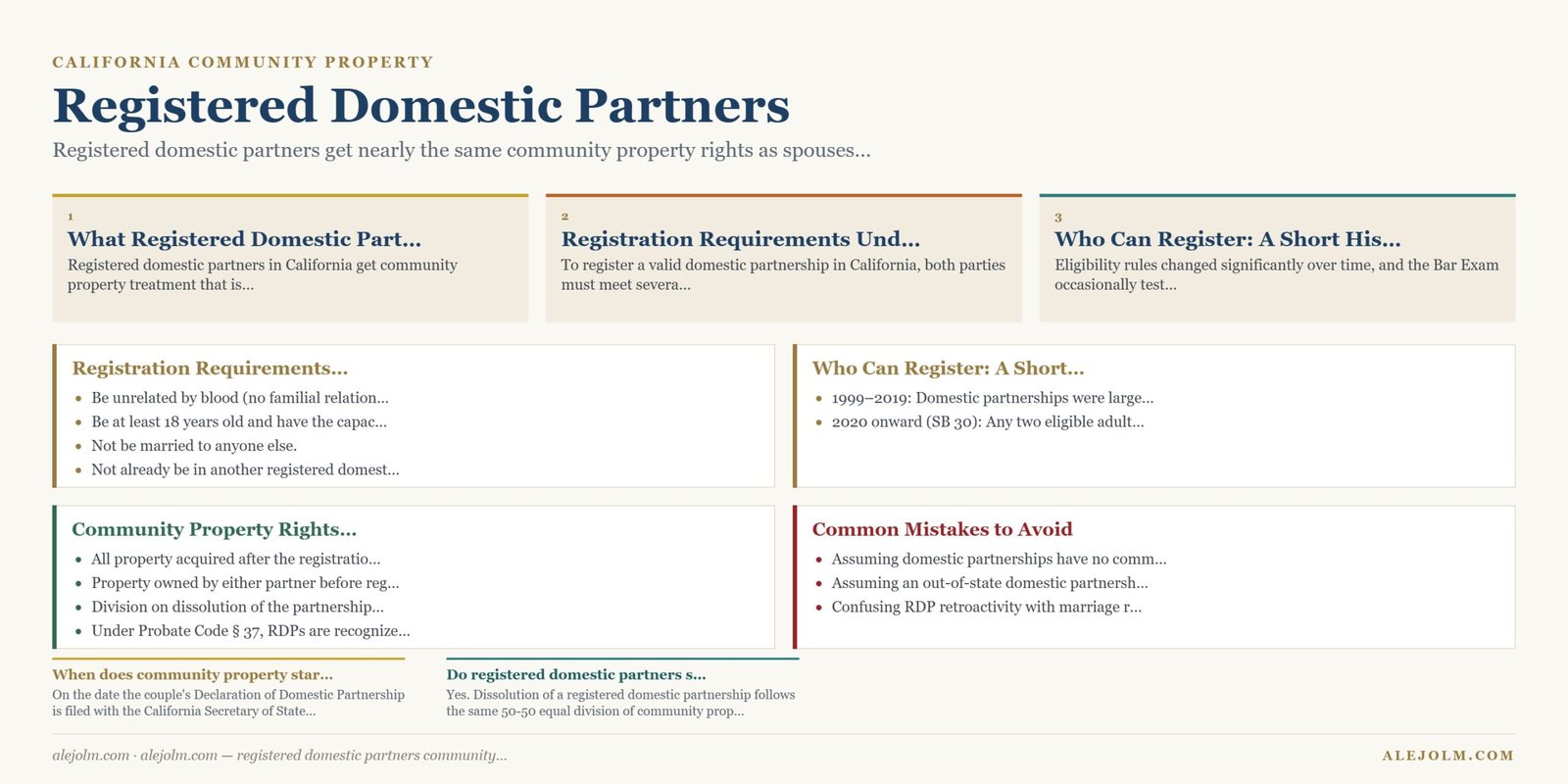
Registration Requirements Under FC § 297.5
To register a valid domestic partnership in California, both parties must meet several conditions:
- Be unrelated by blood (no familial relationship that would bar marriage).
- Be at least 18 years old and have the capacity to consent.
- Not be married to anyone else.
- Not already be in another registered domestic partnership.
- Since 2020, there is no cohabitation requirement — prior law required the couple to share a residence, but that requirement has been eliminated.
Who Can Register: A Short History
Eligibility rules changed significantly over time, and the Bar Exam occasionally tests the timeline:
- 1999–2019: Domestic partnerships were largely limited to same-sex couples, plus opposite-sex couples where at least one partner was 62 or older and receiving Social Security retirement or disability benefits.
- 2020 onward (SB 30): Any two eligible adults, regardless of sex or gender, may register as domestic partners — the age-62 restriction for opposite-sex couples was eliminated entirely.
Community Property Rights of RDPs
Once registered, an RDP couple’s property is characterized almost exactly like a married couple’s:
- All property acquired after the registration date is presumed community property.
- Property owned by either partner before registration remains that partner’s separate property.
- Division on dissolution of the partnership follows the same 50-50 equal division rule that applies in divorce.
- Under Probate Code § 37, RDPs are recognized as spouses for intestate succession and have the same testamentary power as a surviving spouse.
| Feature | Marriage | Registered Domestic Partnership |
|---|---|---|
| CP starts | Date of marriage | Date of registration |
| Division on dissolution | 50-50 equal division | 50-50 equal division |
| Intestate succession | Spouse status | Spouse status (Prob. Code § 37) |
| Pre-relationship property | Separate property | Separate property |
| Management & control rules | FC §§ 1100–1103 | Same rules apply |
The Retroactivity Rule — And Its Limit
One of the most tested points in this area is that RDP community property rights are retroactive to the registration date, not the date the couple began living together. A couple who cohabited for a decade before registering gets no CP credit for those pre-registration years — property acquired during that earlier period stays separate property unless a Marvin-style contract or other agreement says otherwise.
Worked Example
Facts: Alex and Blake began living together in 2003 but didn’t register their domestic partnership with the Secretary of State until June 1, 2010. By the time they dissolve the partnership, they’ve accumulated $200,000 in savings, all earned after 2003.
Analysis: Only the savings earned on or after June 1, 2010 — the registration date — are community property subject to equal division. Any savings accumulated between 2003 and 2010, before registration, remain each partner’s separate property, even though the couple was cohabiting the entire time. If Alex owned a house before registration and continued making mortgage payments from post-registration community income, that raises separate commingling and reimbursement issues, analyzed the same way they would be for a married couple’s separate-property home.
Common Mistakes to Avoid
- Assuming domestic partnerships have no community property rights. Wrong since 1999 — RDPs have substantially all the legal rights and responsibilities of marriage, including CP characterization.
- Assuming an out-of-state domestic partnership is automatically recognized in California. California recognizes partnerships formed under California law, or those that would have qualified under California law during the relevant period. Out-of-state partnerships are analyzed under conflict-of-law principles, not automatically imported.
- Confusing RDP retroactivity with marriage retroactivity. Marriage-based CP runs from the marriage date; RDP-based CP runs from the registration date, which can be much later than when the couple actually moved in together.
FAQ
When does community property start for registered domestic partners in California?
On the date the couple’s Declaration of Domestic Partnership is filed with the California Secretary of State — not the date they began cohabiting, even if that was years earlier.
Do registered domestic partners split property the same way as divorcing spouses?
Yes. Dissolution of a registered domestic partnership follows the same 50-50 equal division of community property that applies in a California divorce, and separate property stays with its owner.
Is a domestic partnership registered in another state recognized in California?
Only if it was formed under California law, or would have qualified under California law during the period it was created. Otherwise, California applies conflict-of-law principles rather than automatic recognition.
Key Takeaways
- Registered domestic partnerships give partners essentially the same community property rights as marriage, under Family Code § 297.5.
- CP treatment is retroactive to the registration date, not the start of cohabitation — a critical distinction from marriage.
- Since 2020 (SB 30), any two eligible adults can register regardless of sex or gender; the prior age-62 restriction for opposite-sex couples is gone.
- RDPs are treated as spouses for intestate succession under Probate Code § 37 and follow the same management-and-control rules as marriage.
- Distinguish RDPs (statutory spouse-equivalent status) from unmarried cohabitants, who must rely on contract-based Marvin claims instead.
This article is educational and is not legal advice. Consult a licensed California attorney about your situation.