
Why Valid Marriage Requirements Matter for Property Rights
Valid marriage requirements are the prerequisite for every community property right in California. Before a court divides a single dollar as community property, it must first confirm the parties were actually, legally married.
This foundational issue shows up constantly on the California Bar Exam, usually disguised inside a fact pattern that looks like a straightforward property question. If one of the three required elements is missing, the entire community property analysis can collapse into a putative spouse or Marvin contract problem instead.
What Makes a Marriage Valid in California?
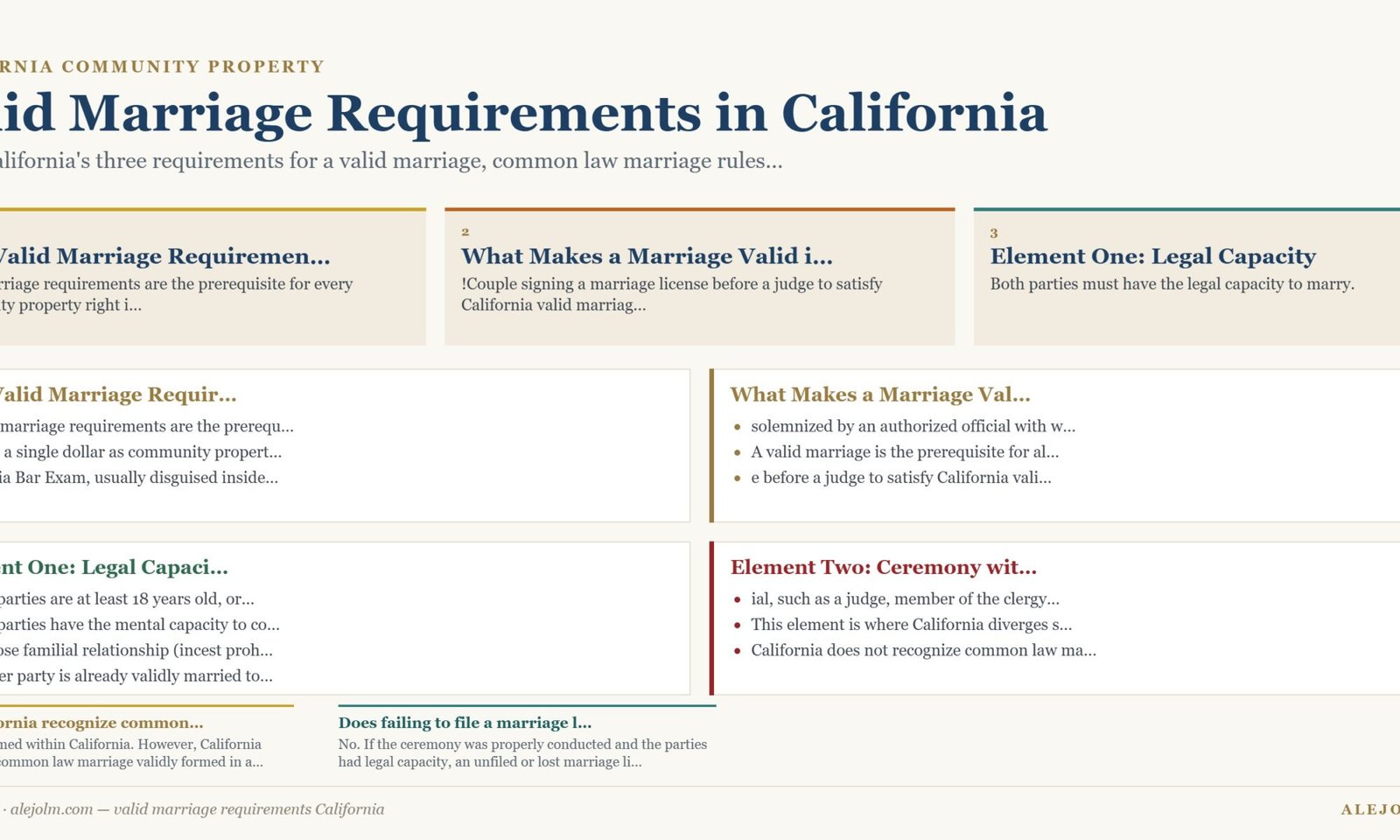
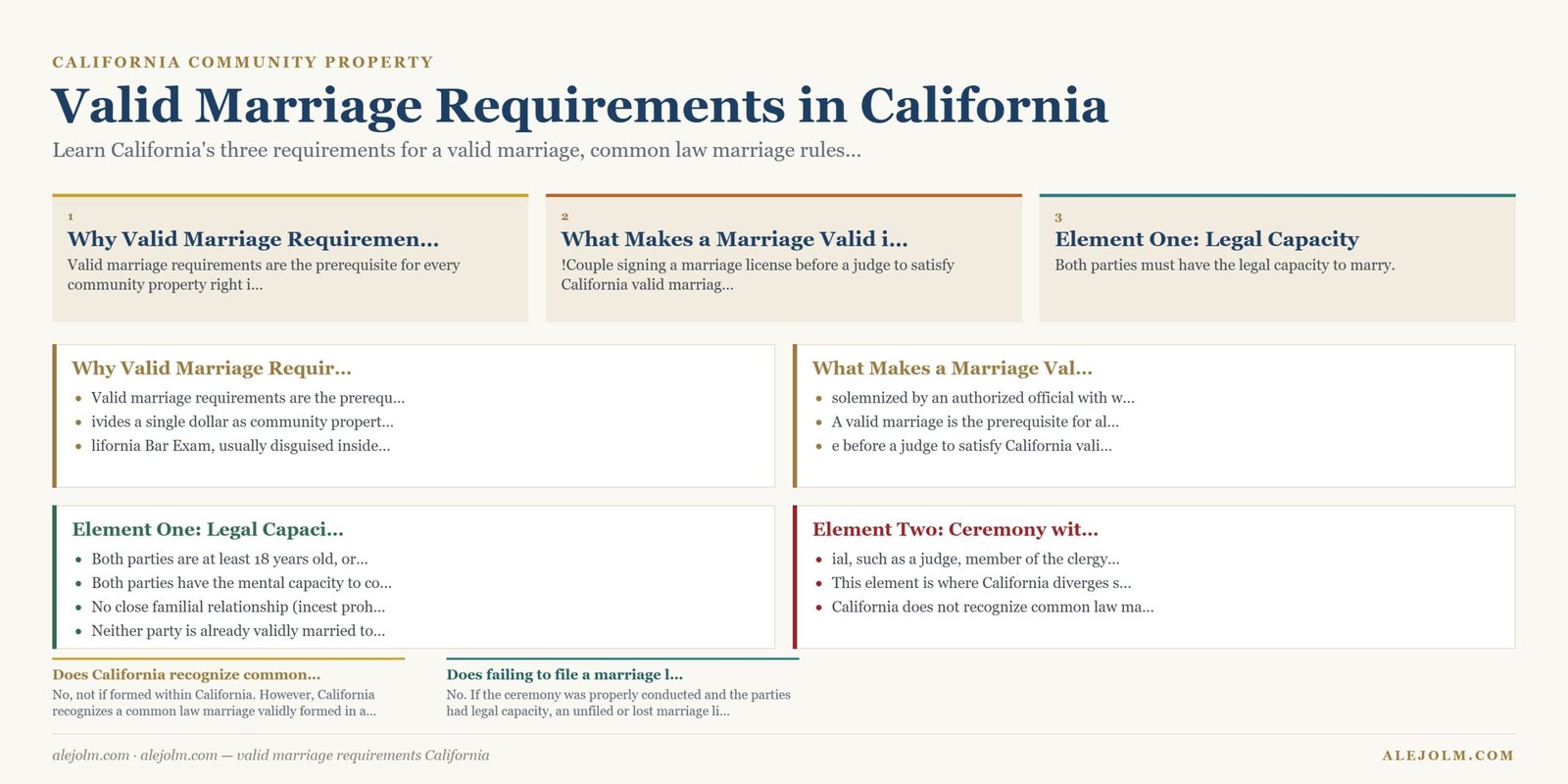
A valid marriage in California requires legal capacity of both parties, a ceremony solemnized by an authorized official with witnesses, and issuance of a marriage license from the county clerk. A valid marriage is the prerequisite for all community property rights between the spouses.
Element One: Legal Capacity
Both parties must have the legal capacity to marry. California requires:
- Both parties are at least 18 years old, or younger with parental or judicial consent
- Both parties have the mental capacity to consent, free of duress
- No close familial relationship (incest prohibition)
- Neither party is already validly married to someone else (no bigamy)
Missing any of these elements can render the marriage void or voidable, which shifts the analysis toward putative spouse doctrine if one party had a good-faith belief in the marriage’s validity.
Element Two: Ceremony with Witnesses
The marriage must be solemnized by an authorized official, such as a judge, member of the clergy, or authorized notary, in front of the required number of witnesses. This element is where California diverges sharply from many other states.
California does not recognize common law marriage formed within its own borders. Living together for years, even while holding yourselves out as married, does not create a valid marriage under California law without an actual ceremony.
Element Three: The Marriage License
A license must be obtained from the county clerk before the ceremony, and the officiant is responsible for completing and returning it for recording afterward. This is the element with the most forgiving exception.
Failure to file the license does not invalidate an otherwise valid marriage. As long as the ceremony was properly conducted and the other two elements were satisfied, an unfiled or lost license is a clerical problem, not a fatal defect.
The Three Elements at a Glance
| Element | Requirement | Consequence if Missing |
|---|---|---|
| Legal capacity | Age, consent, no bigamy, no incest | Marriage void or voidable |
| Ceremony | Solemnized by authorized official with witnesses | No valid marriage without it |
| Marriage license | Issued before ceremony, filed by officiant | Filing failure alone does not invalidate |
Out-of-State Common Law Marriages
California does not create common law marriages internally, but it does recognize ones validly formed elsewhere. If a couple validly forms a common law marriage in a state that permits it, such as Texas, and that marriage was valid under that state’s law at the time and place it was formed, California will honor it as a valid marriage once the couple relocates here.
This distinction trips up a lot of test-takers: the prohibition is on forming a common law marriage inside California, not on recognizing one lawfully created somewhere else.
Worked Example: Two Couples, Two Outcomes
Couple A: Diego and Camila, both 25, obtain a marriage license, marry before a judge with two witnesses present, and the license is properly filed. This is a straightforward valid marriage; full community property rights attach from the wedding date.
Couple B: Beto and Sofia meet and live together in California for twenty years, presenting themselves as married to friends and family, but they never had a ceremony or obtained a license. Because California abolished common law marriage, no valid marriage exists here, regardless of how long they lived together or how they presented themselves. Their property rights, if any, must be analyzed under Marvin contract principles rather than community property law, unless one of them can show they moved to California from a common-law state after validly marrying there.
Common Mistakes to Avoid
Watch for these frequent examiner traps:
- Assuming marriage must occur in California for California law to apply. If the couple is domiciled in California, California community property law applies regardless of where the marriage occurred, as long as it was valid where formed.
- Confusing an unfiled license with an invalid marriage. A completed ceremony survives a filing failure; the marriage remains valid.
- Overlooking the putative spouse doctrine. If a marriage turns out to be invalid but one party had a sincere good-faith belief it was valid, that party may still obtain community-property-style rights.
- Treating long-term cohabitation as marriage. No matter how long a California couple lives together or how they present themselves publicly, cohabitation alone never creates a valid marriage in this state.
California Bar Exam Strategy
When a fact pattern describes an unconventional wedding, or a couple who never formally married, methodically check all three elements: capacity, ceremony, and license. Identify precisely which element is missing, then pivot to the correct secondary doctrine — putative spouse if there was good-faith belief, or Marvin contract principles if not.
FAQ
Does California recognize common law marriage?
No, not if formed within California. However, California recognizes a common law marriage validly formed in another state that permits it, as long as the marriage was valid there when created.
Does failing to file a marriage license invalidate the marriage?
No. If the ceremony was properly conducted and the parties had legal capacity, an unfiled or lost marriage license does not invalidate an otherwise valid marriage.
What happens if a marriage turns out to be invalid?
The couple’s property rights depend on whether the putative spouse doctrine applies. If one party had a sincere, good-faith belief the marriage was valid, that party may still receive community-property-style treatment for quasi-marital property.
Key Takeaways
- A valid California marriage requires legal capacity, a solemnized ceremony with witnesses, and a marriage license.
- California does not recognize common law marriage formed within the state, but it recognizes valid common law marriages formed elsewhere.
- Failing to file the marriage license does not invalidate an otherwise properly conducted marriage.
- A valid marriage is the prerequisite for all community property rights between spouses.
- If a marriage is invalid, the putative spouse doctrine may still provide community-property-style protection for an innocent, good-faith party.
- Long-term cohabitation without a ceremony and license never creates a valid marriage in California.
Related guides
- putative spouse doctrine
- community property definition
- date of separation rules
- will execution requirements
Sources and further reading
This article is educational and is not legal advice. Consult a licensed California attorney about your situation.