
The Date That Stops the Community Property Clock
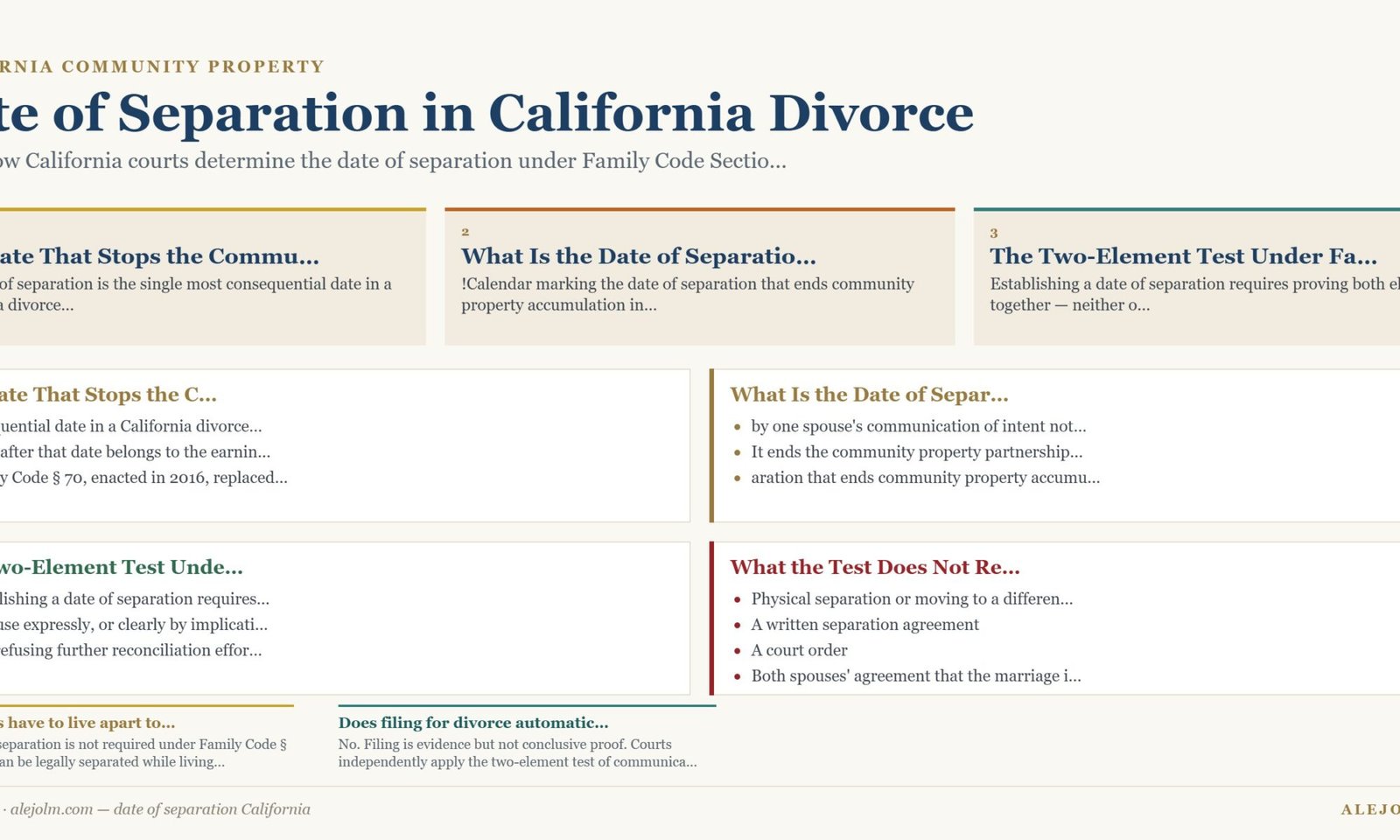
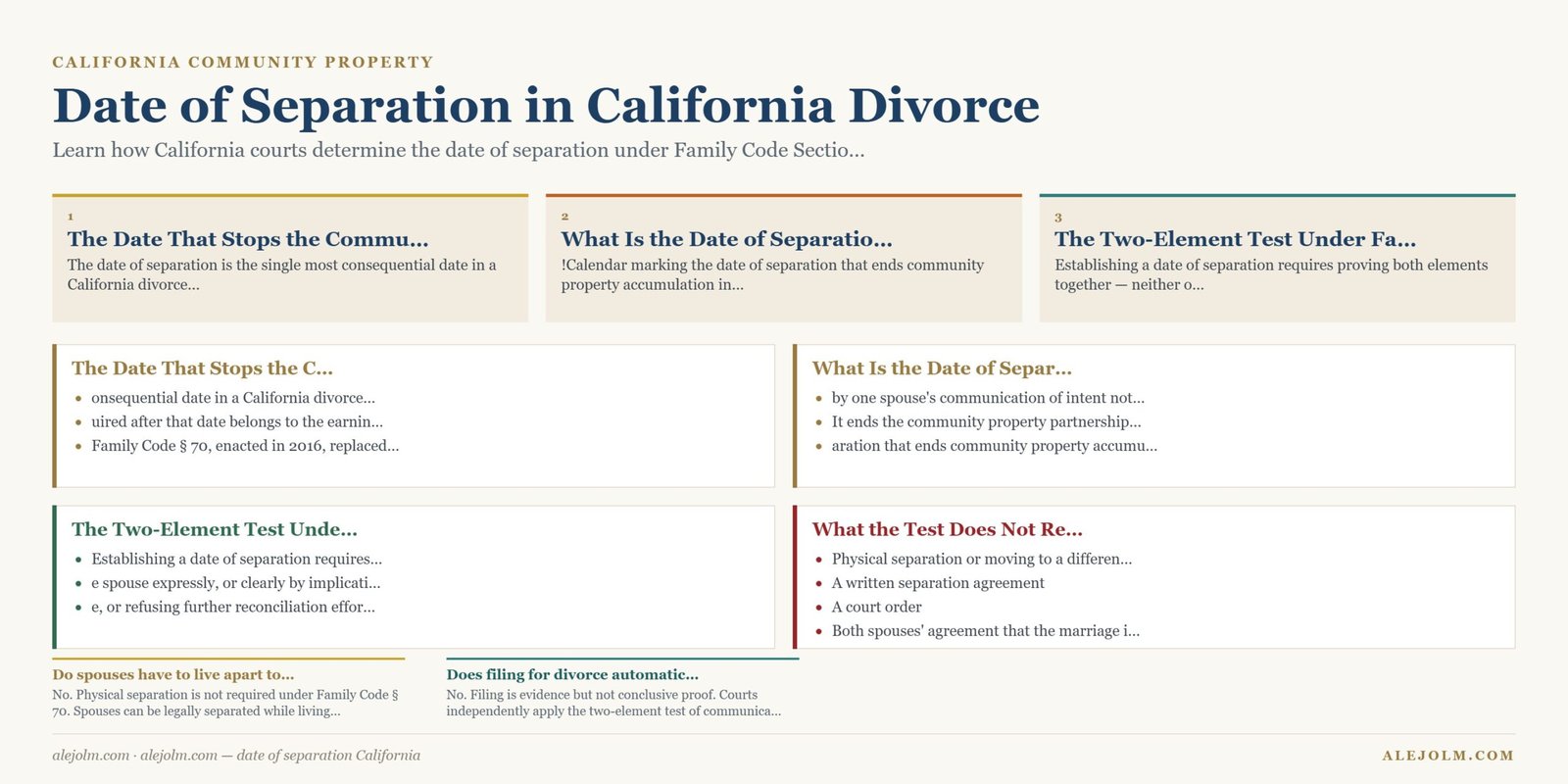
The date of separation is the single most consequential date in a California divorce, because it marks the moment the community economic partnership ends. Everything earned or acquired after that date belongs to the earning spouse alone, no matter how the marriage formally concludes later.
Family Code § 70, enacted in 2016, replaced older, murkier case law with a concrete two-element test. The California Bar Exam tests this section constantly, usually by burying a subtle timing detail inside a longer family law fact pattern.
What Is the Date of Separation?
The date of separation is the date of a complete and definite rupture of the marital relationship, shown by one spouse’s communication of intent not to resume the marriage and by conduct consistent with that intent. It ends the community property partnership and starts the separate-property clock for future earnings.
The Two-Element Test Under Family Code § 70
Establishing a date of separation requires proving both elements together — neither one alone is enough:
- Communication of intent — at least one spouse expressly, or clearly by implication, communicates an intent not to resume the marital relationship
- Corroborating conduct — that spouse’s actual behavior is consistent with the stated intent, such as moving out, filing for divorce, or refusing further reconciliation efforts
Courts reject a date of separation supported by only one element. A spouse who says “I want a divorce” but keeps attending couples counseling has not established the corroborating conduct half of the test.
What the Test Does Not Require
Several common assumptions about separation are simply wrong under California law. None of the following are required:
- Physical separation or moving to a different residence
- A written separation agreement
- A court order
- Both spouses’ agreement that the marriage is over
A couple can legally separate while still living under the same roof, as long as both statutory elements are satisfied. Filing for divorce, by itself, does not automatically establish the date of separation either; the court still applies the two-element test independently.
Reconciliation Resets the Clock
A temporary reconciliation attempt nullifies any earlier date of separation. If the spouses genuinely try to repair the marriage, a new date of separation must be established from scratch once that attempt fails.
| Scenario | Effect on Date of Separation |
|---|---|
| Spouse states intent to divorce and moves out | Date of separation established immediately |
| Spouse states intent but continues counseling | Date delayed until intent and conduct align |
| Spouses attempt reconciliation after separating | Earlier date nullified; new date required later |
| Divorce petition filed with no other evidence | Filing alone is not sufficient by itself |
Worked Example: Determining the Exact Day
Renata files for divorce on June 1. At the first hearing, she testifies that she actually decided to leave the marriage on May 15, the day her husband, Marco, refused to attend any more marriage counseling and she moved into the guest bedroom permanently.
Analysis: June 1 is only the filing date, not necessarily the date of separation. If Renata can prove that on May 15 she communicated her intent not to resume the marriage (perhaps by telling Marco directly, or through unambiguous conduct) and that her conduct from that point forward was consistent with that intent, May 15 becomes the operative date of separation under Family Code § 70. Any income Marco earns after May 15 is his separate property under Family Code § 771, even though the couple did not formally file for divorce until June 1.
Why the Exact Date Matters So Much
In high-earning cases, the precise day of separation can move six or seven figures from the community estate to one spouse’s separate estate. Income earned on the last day of the marriage, before separation, is still community property; income earned the day after belongs entirely to the earning spouse.
This also affects property purchased right around the separation date. A spouse cannot unilaterally convert community funds into separate property simply by buying an asset the day after claiming separation; if the purchase money came from community sources, or the purchase was arranged before separation, the asset may still be characterized as community property.
Common Mistakes to Avoid
Watch for these frequent examiner traps:
- Treating the filing date as automatic. Filing for divorce is evidence, not proof, of the date of separation; the court still runs the two-element test.
- Assuming physical separation is required. Spouses can separate under the statute while living together, if both elements are proven.
- Ignoring reconciliation attempts. Any genuine reconciliation nullifies an earlier separation date and forces a new determination later.
- Assuming continued bill-paying revives the marriage. Continuing to pay shared expenses after expressing separation intent may just be practical, not a legal reconciliation.
California Bar Exam Strategy
Always analyze both elements of Family Code § 70 separately and explicitly: state the evidence of communicated intent, then state the evidence of corroborating conduct. If a fact pattern gives you ambiguous conduct (like continued counseling), flag the ambiguity rather than picking a firm date — that tension is usually the point of the question.
FAQ
Do spouses have to live apart to establish a date of separation?
No. Physical separation is not required under Family Code § 70. Spouses can be legally separated while living in the same home, as long as both the communication and conduct elements are satisfied.
Does filing for divorce automatically set the date of separation?
No. Filing is evidence but not conclusive proof. Courts independently apply the two-element test of communicated intent plus corroborating conduct to determine the actual date.
What happens if spouses try to reconcile after separating?
A genuine reconciliation attempt nullifies the earlier date of separation. If the reconciliation later fails, a new date of separation must be established based on fresh evidence.
Key Takeaways
- Family Code § 70 requires both communicated intent and corroborating conduct to establish a date of separation.
- Physical separation, a written agreement, and a court order are not required.
- Filing for divorce alone does not establish the date of separation.
- Reconciliation attempts nullify an earlier separation date and require a new determination.
- Earnings and acquisitions after the date of separation are separate property under Family Code § 771.
- The exact day of separation can significantly affect the size of the community estate in high-income cases.
This article is educational and is not legal advice. Consult a licensed California attorney about your situation.
Related guides
- separate property definition
- timing and source in characterization
- community property definition
- putative spouse doctrine