
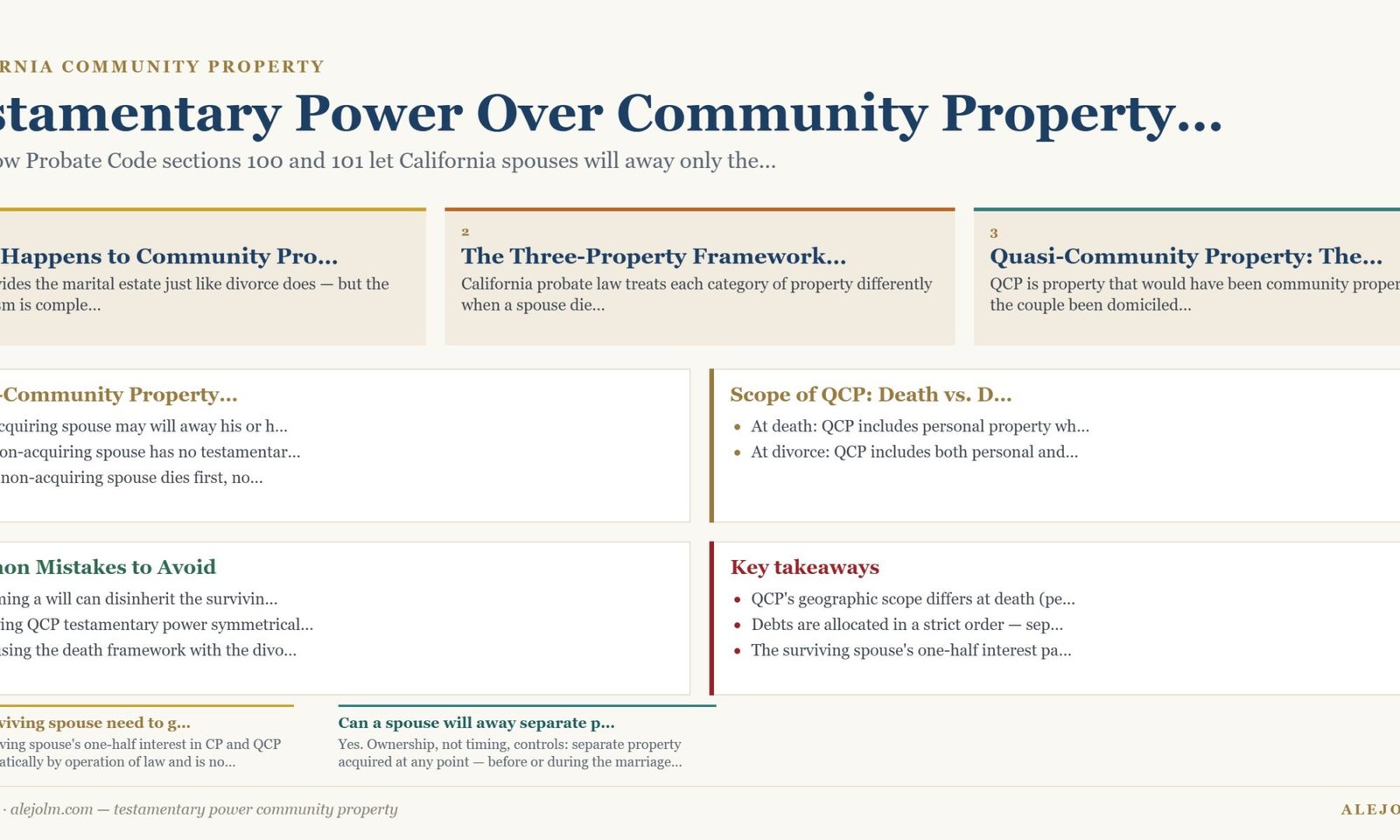
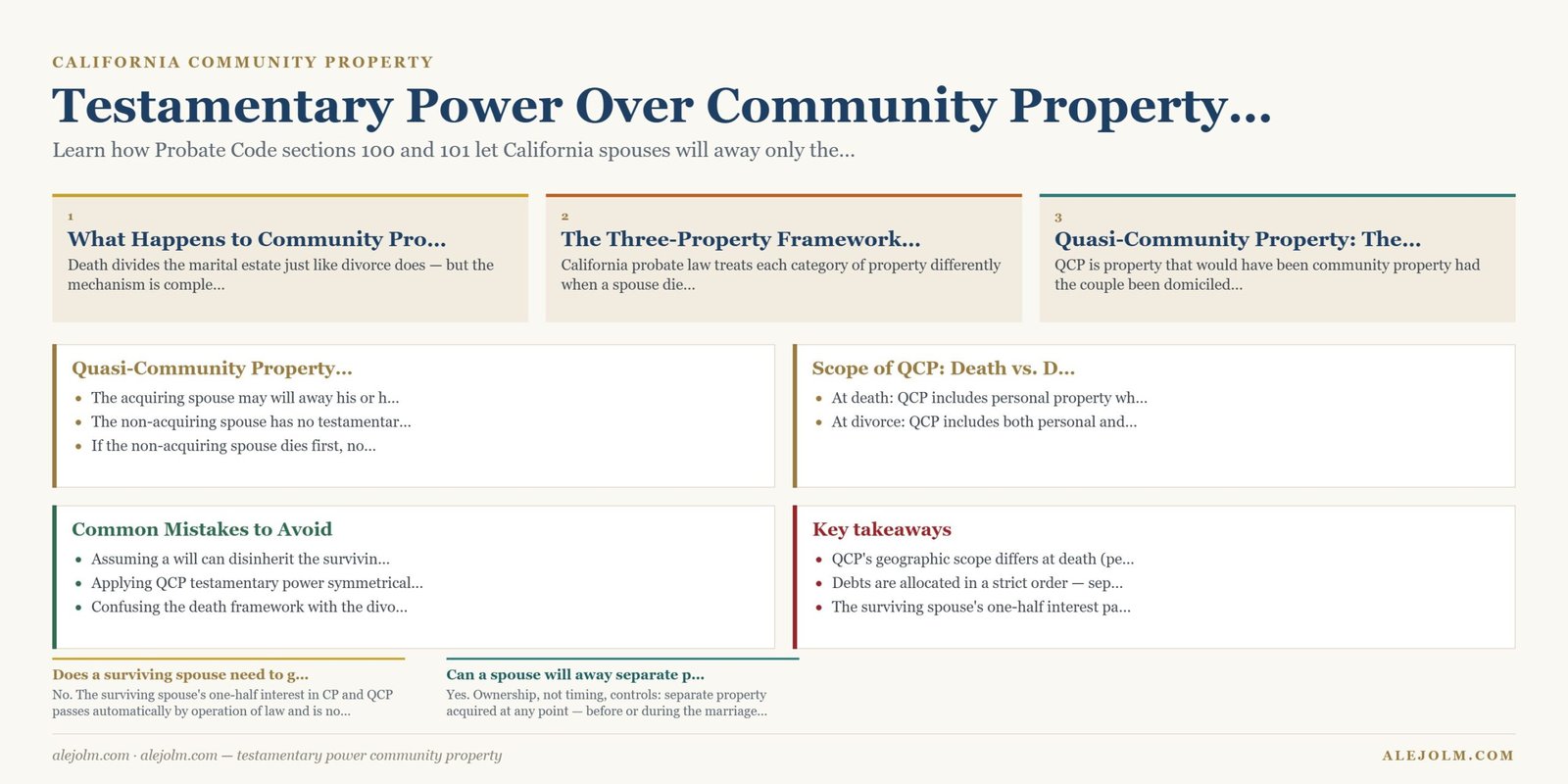
What Happens to Community Property When a Spouse Dies?
Death divides the marital estate just like divorce does — but the mechanism is completely different. On divorce, a court splits community property equally. At death, the law gives each spouse testamentary power: the legal authority to dispose of assets by will. Understanding exactly how much testamentary power each spouse has over community property (CP), separate property (SP), and quasi-community property (QCP) is one of the most heavily tested topics on the California Bar Exam.
Testamentary power over community property means each spouse may will away only their own one-half interest. The surviving spouse’s other half never enters probate — it belongs to the survivor automatically, by operation of law, the instant the first spouse dies.
The Three-Property Framework: SP, CP, and QCP
California probate law treats each category of property differently when a spouse dies. Get comfortable distinguishing them before you touch a fact pattern.
| Property Type | Who Can Will It Away | Statute |
|---|---|---|
| Separate Property (SP) | Owning spouse — 100% | General probate rules |
| Community Property (CP) | Each spouse — own 1/2 only | Probate Code § 100 |
| Quasi-Community Property (QCP) | Acquiring spouse — own 1/2 only | Probate Code § 101 |
Separate Property: Full Freedom
There’s no complexity here. A spouse who owns separate property — earned before marriage, or received by gift or inheritance — can dispose of all of it by will. The other spouse has no claim to it under community property law.
Community Property: Each Spouse Controls Only Half
Probate Code § 100 caps a spouse’s testamentary power at one-half of the community estate. If a will purports to give away more than that, the excess simply fails as to the surviving spouse’s share (this triggers a separate doctrine called the widow’s election, covered below).
Example: Husband’s will leaves “all my interest in the family restaurant” — a CP asset — to his brother. Because the restaurant is community property, Husband’s will can only reach his own one-half interest. The surviving spouse automatically keeps the other half, regardless of how the will is phrased.
Quasi-Community Property: The Asymmetric Rule
QCP is property that would have been community property had the couple been domiciled in California when it was acquired, but was actually acquired while domiciled in a common-law state. California treats it as CP for most purposes at divorce, but at death, Probate Code § 101 applies an asymmetric rule that trips up a lot of bar candidates.
- The acquiring spouse may will away his or her own one-half of QCP.
- The non-acquiring spouse has no testamentary power over the acquiring spouse’s QCP while the acquiring spouse is alive.
- If the non-acquiring spouse dies first, no QCP rights ever arise for that spouse’s estate.
Worked example: While living in a common-law state, Husband bought stock in his own name with his earnings. The couple later moved to California, making that stock QCP. Husband dies first: he can will away his own half of the QCP stock, and the surviving Wife keeps the other half automatically. But if Wife had died first, she would have had no testamentary power over that QCP at all — the rule only protects a spouse who survives the acquiring spouse.
Scope of QCP: Death vs. Divorce
The geographic scope of QCP actually shifts depending on whether the couple is dividing property at death or divorce, and this distinction shows up on exam questions designed to catch students who assume the rules are identical.
- At death: QCP includes personal property wherever located, plus real property located in California only.
- At divorce: QCP includes both personal and real property, wherever located.
California has also adopted the Uniform Disposition of Community Property Rights at Death Act, which applies California community property principles to real property acquired by a California-domiciled spouse, even when that realty sits in one of the roughly 16 common-law states that have adopted the uniform act. If a transferee received QCP for inadequate consideration and the non-consenting survivor objects, the survivor can compel that transferee to restore one-half of the property to the estate.
How Debts Are Allocated Against the Estate
A frequently missed point: debt allocation at death is not a proportional split across SP and CP. Probate Code §§ 11440–11446 set a specific order of priority.
- The decedent’s separate debts are charged first against the decedent’s own separate property.
- Only if separate property is insufficient does the unpaid balance spill over — first to the decedent’s own one-half of CP, then to the surviving spouse’s one-half of CP if still unsatisfied.
- Community debts are charged against community property assets.
- Funeral expenses and expenses of the last illness are charged to the decedent’s estate — never against the surviving spouse’s community share.
Numbers example: A decedent’s estate has $200,000 in SP and $200,000 in CP (so the decedent’s own CP share is $100,000). The decedent owed a $40,000 premarital, separate debt. That $40,000 comes entirely out of the $200,000 SP first. It is not divided proportionally between the SP and CP estates unless the SP proves insufficient to cover it.
Common Mistakes to Avoid
Bar graders see the same errors repeatedly on this topic.
- Assuming a will can disinherit the surviving spouse entirely. It can’t — a spouse can only dispose of their own one-half of CP and QCP. The survivor’s half is untouchable by the decedent’s will.
- Applying QCP testamentary power symmetrically. Only the acquiring spouse has power over QCP during their lifetime. Always identify which spouse actually acquired the out-of-state property before applying § 101.
- Confusing the death framework with the divorce framework. Family Code § 2550’s equal-division rule governs divorce. Probate Code §§ 100 and 101 govern death. They use different mechanisms even though both aim at an equal split of the community estate.
Frequently Asked Questions
Does a surviving spouse need to go through probate to get their half of CP?
No. The surviving spouse’s one-half interest in CP and QCP passes automatically by operation of law and is not part of the decedent’s probate estate.
Can a spouse will away separate property acquired during the marriage?
Yes. Ownership, not timing, controls: separate property acquired at any point — before or during the marriage, by gift or inheritance — belongs entirely to the owning spouse, who may dispose of all of it by will.
What happens to QCP if the acquiring spouse dies without a will?
Intestate succession rules apply instead of testamentary power — the surviving spouse takes the entire QCP estate, both halves, because there’s no will to displace the default statutory scheme.
Key Takeaways
- Each spouse can will away only their own one-half of CP (Probate Code § 100) and QCP (Probate Code § 101).
- A spouse has unlimited testamentary power over their own separate property.
- QCP testamentary power is asymmetric: only the acquiring spouse controls it, and only during their lifetime.
- QCP’s geographic scope differs at death (personal property anywhere, California realty only) versus divorce (everywhere).
- Debts are allocated in a strict order — separate debts hit SP first, not proportionally across SP and CP.
- The surviving spouse’s one-half interest passes automatically, without probate.
This article is educational and is not legal advice. Consult a licensed California attorney about your situation.
Related guides
- community property presumptions
- will execution requirements
- widow’s election
- intestate succession and community property