
What Is the Widow’s Election in California Community Property Law?
Picture a will that tries to give away more than the testator legally owns. That single fact pattern generates one of the trickiest doctrines on the California Bar Exam: the widow’s election. It only comes up after you’ve already worked through testamentary power over community property (CP) and quasi-community property (QCP) — so make sure you have that foundation first.
The widow’s election is a doctrine requiring a surviving spouse to choose between accepting gifts under a will that purports to dispose of the survivor’s own community property share (“taking under” the will) or rejecting those gifts to keep that share outright (“taking against” the will). The two options are mutually exclusive.
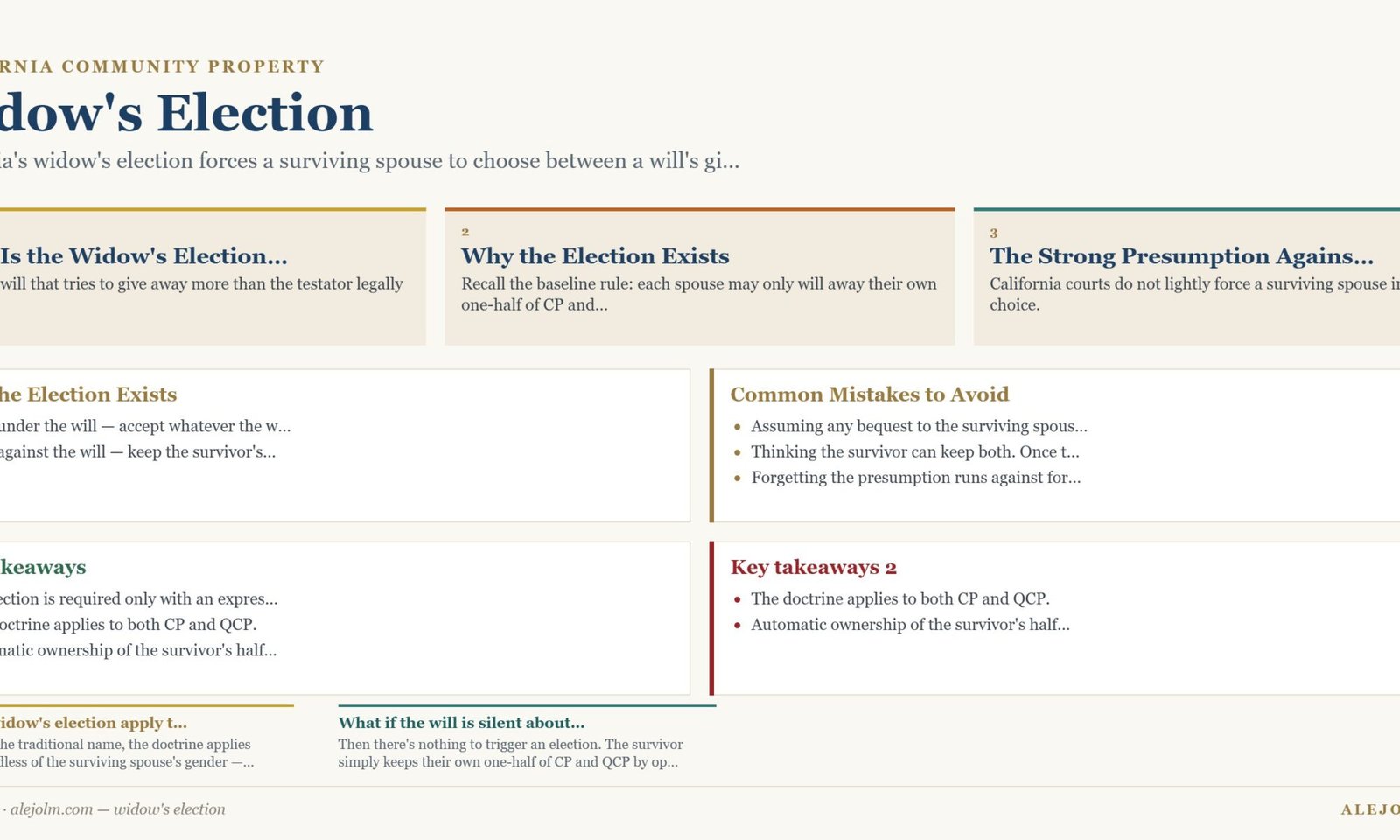
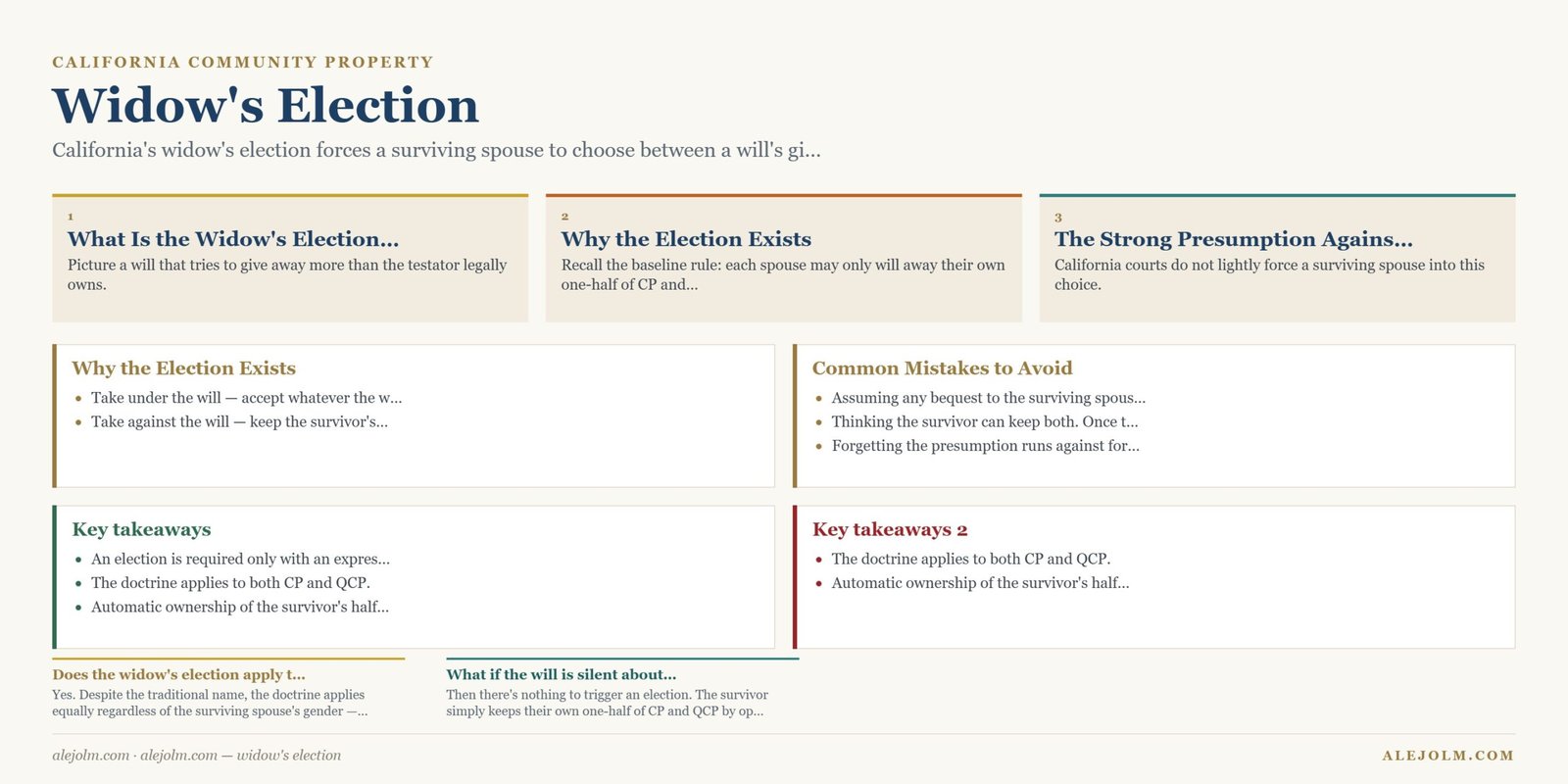
Why the Election Exists
Recall the baseline rule: each spouse may only will away their own one-half of CP and QCP. A testator’s half is theirs to give; the survivor’s half is not. Problems arise when a testator’s will is worded broadly enough that it appears to reach beyond the testator’s own interest and into the surviving spouse’s share too.
When that happens, the survivor can’t have it both ways. Either:
- Take under the will — accept whatever the will offers, but give up the survivor’s own CP/QCP share to satisfy the will’s over-broad gift, or
- Take against the will — keep the survivor’s own legal one-half of CP plus one-half of QCP, but forfeit whatever the will tried to give in exchange.
The Strong Presumption Against Forcing an Election
California courts do not lightly force a surviving spouse into this choice. Rules of testamentary construction start from the presumption that a testator understood the character of the property and intended to dispose of only their own interest.
That means ambiguous language — even language that sounds broad on its face — is read narrowly, as reaching only the testator’s own half. No election is required unless the will’s language clearly says otherwise.
When an Election Is Actually Required
Only two circumstances force the choice:
- The will contains an express election clause — language explicitly stating that the surviving spouse must elect, or
- The will’s language clearly and unambiguously shows the testator intended to give away the surviving spouse’s own share to a third party.
Short of one of these two triggers, the default presumption controls, and the survivor keeps their own half automatically — no strings attached.
Worked Examples: Spot the Difference
These two hypotheticals differ by a single phrase, and that phrase is the whole ballgame.
No election required. A married couple owns a blueberry farm as community property. The husband’s will states: “All my interest in the Blueberry Farm to my cousin John.” Courts read “my interest” as referring only to the testator’s own one-half. The surviving spouse keeps her own CP half of the farm and is free to accept any other gifts the will makes her — no election required.
Election required. Same farm, different will language: “My interest AND my wife’s interest in the Blueberry Farm to my cousin John.” This unambiguously reaches beyond the testator’s own share into the surviving spouse’s half, so the doctrine kicks in. The wife must choose:
| Option | What She Keeps | What She Gives Up |
|---|---|---|
| Take under the will | Any other gifts the will makes her | Her own CP half of the farm |
| Take against the will | Her own CP half of the farm | Any other gifts the will offered her |
The same result follows if a will mistakenly characterizes community property as the testator’s separate property and purports to give away “all my interest” — the mischaracterization doesn’t save the gift from triggering an election if it unambiguously covers the whole asset.
Distinguishing Automatic Ownership From the Election
Don’t confuse two related but distinct ideas. The surviving spouse’s own one-half of CP and QCP already belongs to the survivor automatically, by operation of law — it doesn’t pass through probate and needs no election to vest. The widow’s election is a narrower, separate doctrine that arises only when the decedent’s will also attempts to dispose of that already-owned half. In that specific scenario — and only that scenario — courts force the binary choice.
The Election Also Applies to Quasi-Community Property
The same logic extends to QCP. If a will purports to dispose of the non-acquiring, surviving spouse’s one-half interest in quasi-community property — not just ordinary CP — the same take-under-or-take-against framework applies.
Common Mistakes to Avoid
- Assuming any bequest to the surviving spouse triggers an election. Being named a beneficiary under the will doesn’t, by itself, force a choice. The election is triggered only by will language that unambiguously reaches the survivor’s own CP/QCP share.
- Thinking the survivor can keep both. Once triggered, the election is strictly either/or. The survivor cannot accept the will’s substitute gift and simultaneously retain the CP/QCP share the will purported to give away.
- Forgetting the presumption runs against forcing the election. Default to “no election required” on ambiguous facts; only clear, unambiguous language or an express election clause changes that.
Frequently Asked Questions
Does the widow’s election apply to a surviving husband too?
Yes. Despite the traditional name, the doctrine applies equally regardless of the surviving spouse’s gender — any surviving spouse can be put to the election.
What if the will is silent about the surviving spouse’s share entirely?
Then there’s nothing to trigger an election. The survivor simply keeps their own one-half of CP and QCP by operation of law and can separately accept whatever the will gives them.
Can a surviving spouse change their mind after electing?
Once made, an election is generally treated as final and binding, since third parties rely on it in administering the estate — always check the specific facts and any applicable statute or case law before assuming flexibility.
Key Takeaways
- The widow’s election forces a surviving spouse to choose between taking under a will (accepting its gifts) or taking against it (keeping their own CP/QCP share).
- California strongly presumes against forcing an election; ambiguous language is read as reaching only the testator’s own share.
- An election is required only with an express election clause or clear, unambiguous intent to dispose of the survivor’s share.
- The doctrine applies to both CP and QCP.
- Automatic ownership of the survivor’s half is distinct from — and unaffected by — the election doctrine, unless the will overreaches.
This article is educational and is not legal advice. Consult a licensed California attorney about your situation.
Related guides
- testamentary power over community property
- intestate succession and community property
- will execution requirements
- community property presumptions