
What Is a Family Law Attorney’s Real Property Lien (FLARPL)?
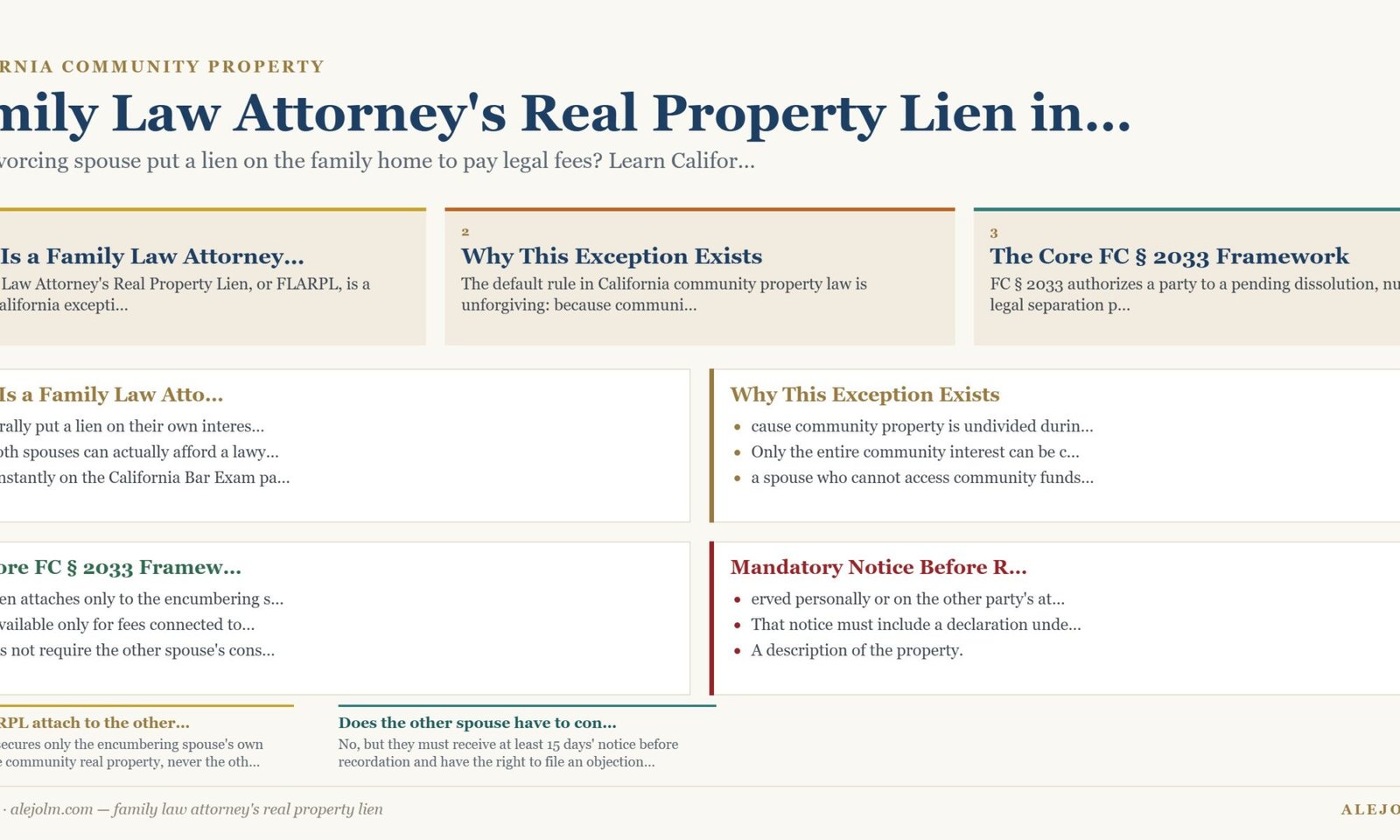
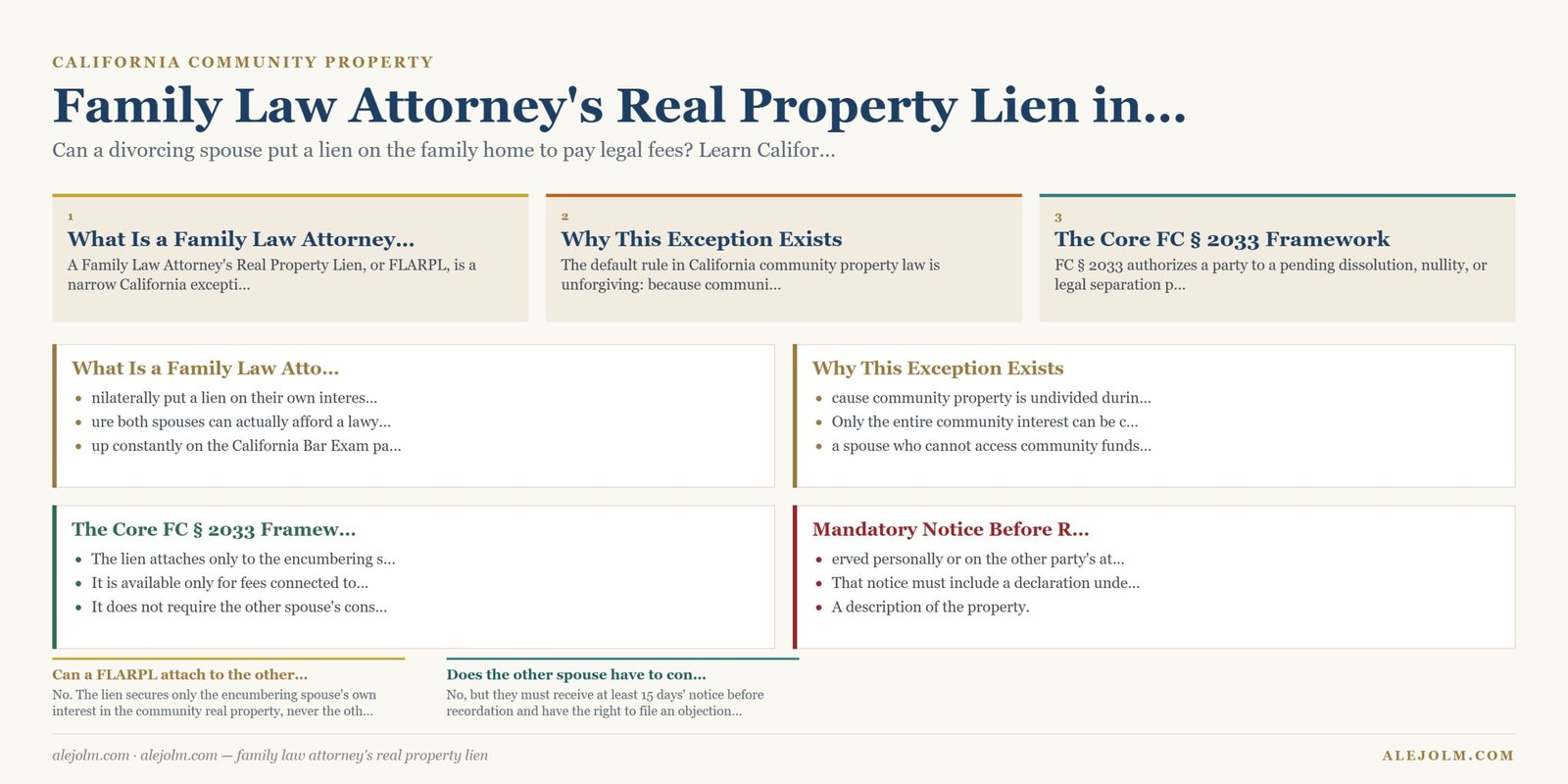
A Family Law Attorney’s Real Property Lien, or FLARPL, is a narrow California exception under Family Code section 2033 that lets a spouse in a pending divorce, nullity, or legal separation case unilaterally put a lien on their own interest in community real property to secure reasonable attorney’s fees. It exists for one purpose: making sure both spouses can actually afford a lawyer during a divorce, even when one spouse controls most of the cash.
This is one of the few genuine exceptions to the general community property joinder rule, so it comes up constantly on the California Bar Exam paired with — and contrasted against — the ordinary conveyance rules.
Why This Exception Exists
The default rule in California community property law is unforgiving: because community property is undivided during marriage, neither spouse can unilaterally transfer or encumber it. Only the entire community interest can be conveyed, and that requires both spouses to join in signing. FC § 2033 breaks from that default in a deliberately narrow way, recognizing that a spouse who cannot access community funds during a bitter divorce still needs a way to retain and pay counsel.
The Core FC § 2033 Framework
FC § 2033 authorizes a party to a pending dissolution, nullity, or legal separation proceeding to encumber their own interest in community real property to secure reasonable fees for retaining or maintaining an attorney in that same proceeding. Three features define its scope:
- The lien attaches only to the encumbering spouse’s own interest — never the other spouse’s interest, and never the whole community estate outright.
- It is available only for fees connected to the dissolution, nullity, or legal-separation case itself.
- It does not require the other spouse’s consent, unlike an ordinary FC § 1102 conveyance.
Mandatory Notice Before Recording
FC § 2033(b) requires the encumbering spouse to give notice — served personally or on the other party’s attorney of record — at least 15 days before the lien is recorded. That notice must include a declaration under penalty of perjury covering:
- A description of the property.
- Its estimated fair market value.
- Any existing encumbrances on it.
- A list of the community’s assets and liabilities.
- The proposed lien amount.
The Non-Encumbering Spouse’s Objection Rights
FC § 2033(c) gives the other spouse a real check on this power. That spouse may file an ex parte objection, along with a request to stay recordation, arguing the lien would likely produce an unequal division of property or would otherwise be unjust. The court can deny the lien outright or, for good cause, limit its amount.
Attorney Ethics Compliance
Because a FLARPL is effectively a business transaction between attorney and client, FC § 2033(e) requires the attorney securing the lien to comply with the Rules of Professional Conduct governing business transactions with a client — currently Rule 1.8.1 (formerly Rule 3-300). That means fair and reasonable terms, full written disclosure, and a real opportunity for the client to seek independent advice before agreeing to the lien.
The Exception Is Limited to Dissolution Representation
FC § 2033 only protects liens securing fees for the dissolution, nullity, or legal-separation case itself. An attorney representing a spouse in an unrelated matter — a car-accident defense, a criminal case, ordinary business litigation — is not a “family law attorney” for purposes of this exception. A lien for that attorney’s fees falls back to the ordinary joinder rule and is an unauthorized unilateral encumbrance, voidable by the non-consenting spouse within the standard one-year window.
Worked Example: Divorce Fees vs. Car Accident Fees
Valid FLARPL. During her divorce from Owen, Ines cannot pay her divorce attorney’s retainer in cash. With proper 15-day notice, she grants her divorce attorney a lien on her own interest in the family home to secure the fees. Because the attorney is representing her in the pending dissolution, this unilateral encumbrance is valid under FC § 2033, even without Owen’s consent.
Invalid lien. Now suppose Owen, separately, is sued after a car accident and hires his own attorney to defend the lawsuit — a matter with nothing to do with the divorce. He grants that attorney a lien on his interest in the family home to secure the defense fees. Because this attorney isn’t representing Owen in the dissolution proceeding, FC § 2033 doesn’t apply. The lien is an unauthorized encumbrance of community real property, and Ines can void it within one year under the ordinary FC § 1102 rule.
Priority Against Other Liens
A FLARPL’s priority is determined the same way as any other recorded encumbrance: by its recordation date relative to other liens on the property. A previously recorded mortgage, for instance, remains senior to a later-recorded FLARPL. The attorney must satisfy the FC § 2033 notice and procedural requirements before the lien can be validly recorded at all.
Common Mistakes Bar Candidates Make
A frequent wrong answer claims the lien can attach to the entire community property, including the other spouse’s interest. It cannot — a FLARPL secures only the encumbering client’s own interest. The opposite error, assuming the lien attaches only to the client’s separate property, is equally wrong; FC § 2033 specifically authorizes reaching the client’s community property interest, which is exactly what makes it an exception worth testing.
FAQ
Can a FLARPL attach to the other spouse’s interest in the community home?
No. The lien secures only the encumbering spouse’s own interest in the community real property, never the other spouse’s interest or the whole community estate.
Does the other spouse have to consent to a FLARPL?
No, but they must receive at least 15 days’ notice before recordation and have the right to file an objection asking the court to deny or limit the lien.
Does the FC § 2033 exception apply to attorney fees in a non-divorce case?
No. It applies only to fees for retaining or maintaining counsel in the pending dissolution, nullity, or legal separation proceeding. A lien for fees in an unrelated case falls back to the ordinary joinder rule.
Key Takeaways
- FC § 2033 lets a divorcing spouse unilaterally encumber their own interest in community real property to secure attorney’s fees for that same case.
- The lien can never reach the other spouse’s interest or the whole community estate.
- At least 15 days’ notice, with a sworn declaration of specified details, is required before recording.
- The non-encumbering spouse can object on unequal-division or unjust-result grounds.
- The exception is strictly limited to dissolution, nullity, and legal-separation representation — any other purpose reverts to the ordinary FC § 1102 joinder rule.
Related guides
- community property real estate transfer
- community property creditor rights
- divorce debt allocation
- conflicts of interest
Sources and further reading
This article is educational and is not legal advice. Consult a licensed California attorney about your situation.