
A state legislature decides to tax the local branch of a federal agency, or to require federal inspectors to hold a state licence before they may do their jobs. Nothing in the constitutional text says so in as many words, yet both statutes are void. The doctrine that kills them is intergovernmental immunity, and it is among the oldest ideas in American constitutional law.
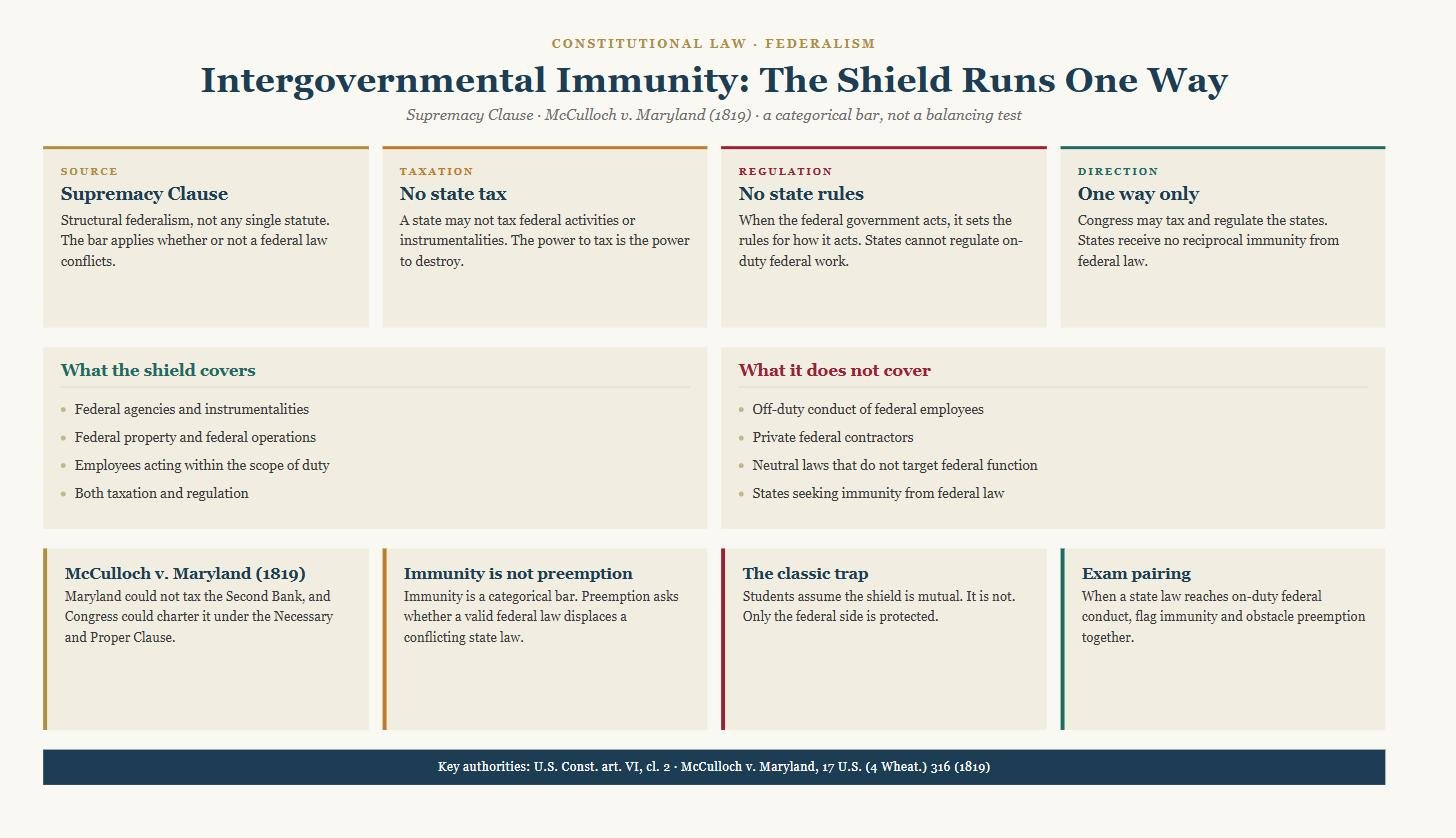
The rule is short. States may not tax or regulate the federal government, its instrumentalities, or its employees acting within the scope of their federal duties. What makes the doctrine worth a full study session is not the rule but its geometry: the shield points in one direction only. Washington is protected from the states. The states are protected from nothing.
Where the doctrine comes from
The source is the Supremacy Clause of Article VI read together with the structural logic of a federal union, and the case is McCulloch v. Maryland (1819). Maryland had imposed a stamp tax on notes issued by any bank not chartered by the state, a provision aimed squarely at the Baltimore branch of the Second Bank of the United States. Chief Justice Marshall produced two holdings that still frame the syllabus: Congress had authority to charter the bank under the Necessary and Proper Clause, and Maryland had no authority to tax it.
The reasoning behind the second holding is the part that travels. A state legislature answers only to the voters of that state, yet a tax on a federal instrumentality is ultimately paid out of a treasury filled by the whole country. Marshall’s formulation, that the power to tax involves the power to destroy, describes a structural problem rather than an economic one. If a single state may tax a federal institution at all, it may tax it out of existence, and the national government would then exist at the sufferance of whichever legislature disliked it most.
The two prongs
Taxation. A state may not levy a tax on federal activities, federal property or federal instrumentalities. The test is not whether the tax is heavy or discriminatory; a modest, evenhanded levy on a federal agency is just as void as a punitive one. What matters is who ends up paying. A state tax that would be satisfied out of the federal treasury is unconstitutional by its nature.
Regulation. The second prong is broader and appears more often in modern fact patterns. A state may not regulate federal activities, nor the conduct of federal employees acting within the course of their official duties. The principle is simple: when the federal government acts, it decides how it acts. A state cannot tell a federal agency which safety standards to follow, what insurance to carry, or what licence its officers must hold in order to perform federal work.
Exam tip: the immunity is categorical. Do not look for a compelling interest, a balancing test or a least-restrictive alternative. Once the target is federal operations, the state law simply fails.
The shield runs one way
The asymmetry is where most points are lost, so it is worth committing to memory in table form.
| Fact pattern | Result |
|---|---|
| State taxes a federal instrumentality | Invalid — McCulloch |
| State regulates a federal agency’s operations | Invalid |
| State regulates an on-duty federal employee’s federal work | Invalid |
| State applies a neutral traffic or property law to a federal employee | Valid |
| State regulates a private firm that happens to hold a federal contract | Generally valid |
| Congress taxes or regulates the states through a general law | Generally valid |
| Congress orders a state legislature to enact a federal programme | Invalid, but under anti-commandeering, not immunity |
The last two lines matter. States do enjoy constitutional protection against federal overreach, but it comes from the Tenth Amendment and the anti-commandeering rule, not from intergovernmental immunity. Invoking the immunity on behalf of a state is a doctrinal error even when the state ultimately wins.
The scope-of-duty limit
Immunity attaches to the federal function, not to the person. A federal marshal serving a warrant is shielded from state interference with that act. The same marshal who runs a red light on a Sunday afternoon is an ordinary motorist, and the state may ticket, sue or prosecute him like anyone else. Between those two poles sits the large category of generally applicable law: speed limits, building codes, contract and property rules. These reach federal employees so long as they neither single out federal activity nor interfere with the performance of a federal duty.
The contractor question follows the same logic. A private firm does not inherit federal immunity merely because its customer is a federal agency. Contractors are ordinarily subject to state tax, state licensing and state workers’ compensation law even while working on a federal project, unless a federal statute provides otherwise or the state law is applied so as to discriminate against the federal relationship.
Immunity is not preemption
Both doctrines resolve federal-state conflict and they are easy to blur. Preemption is a question of legislative intent: given a valid federal statute, did Congress mean to displace state law in this field, and does the state rule conflict with it? Intergovernmental immunity asks nothing about intent. It is a flat bar on states reaching federal operations, and it applies even where no federal statute addresses the subject at all.
In practice the two overlap. A state law that regulates on-duty federal conduct usually offends the immunity and also stands as an obstacle to federal objectives. The safe habit is to name both, lead with immunity because it is categorical, and treat preemption as the alternative ground.
Worked example
State X requires every employer operating within its borders to carry state workers’ compensation insurance, and applies the requirement to federal agencies and federal contractors alike. A federal military installation refuses to enrol, is fined, and sues.
The installation wins. The statute is facially neutral and generally applicable, which would matter under a balancing doctrine but is beside the point here. The law directs a federal instrumentality to buy insurance on state terms, imposes a financial burden payable out of federal funds, and dictates how the federal government must treat its own personnel. That is regulation of federal operations, and the immunity bars it categorically. Obstacle preemption supplies a second, independent ground.
Change one fact. Suppose the fine falls not on the base but on a private construction firm building a hangar under federal contract. Now the state usually wins. The firm is a private employer, not a federal instrumentality, and the immunity does not travel down the contract chain.
Common mistakes that cost points
- Treating the immunity as reciprocal. Only the federal side is shielded; a state seeking protection must argue the Tenth Amendment.
- Applying the immunity to off-duty conduct. It covers the federal function, not the employee’s private life.
- Forgetting the taxation prong. McCulloch was a tax case first and a structure case second.
- Extending the shield to private federal contractors, who remain subject to ordinary state law.
- Asking whether the state law discriminates. Neutrality is no defence once federal operations are the target.
- Running a preemption analysis and stopping there, when the categorical bar disposes of the question more cleanly.
Frequently asked questions
Can a state ever tax federal property?
Only with congressional consent. Congress may waive the immunity by statute and has done so in narrow areas. Absent a waiver, the answer is no.
Does the immunity protect federal employees from state income tax?
No. Congress consented long ago to nondiscriminatory state taxation of federal salaries. A state may tax federal wages on the same terms as everyone else’s; what it may not do is tax them more heavily because they are federal.
Is there any reciprocal immunity for the states?
Not under this doctrine. States are protected by the anti-commandeering rule, by the Eleventh Amendment in litigation, and by the limits of whichever enumerated power Congress is using, but not by intergovernmental immunity.
Intergovernmental immunity in California and Los Angeles County, 2026
This doctrine descends from McCulloch v. Maryland and prohibits a state from regulating or taxing the federal government directly, or from discriminating against the federal government and those who deal with it. California has generated one of the clearest modern applications, and it arose out of the same litigation that tested its sanctuary statutes.
When the United States challenged California’s legislation authorising state inspection of facilities holding immigration detainees, the Ninth Circuit concluded that provisions imposing review obligations that fell only on federal detention operations offended intergovernmental immunity, because the burden singled out the federal government and its contractors. Other portions of the state’s scheme survived on anti-commandeering grounds. The case is a useful reminder that the two doctrines answer different questions.
Where the issue surfaces locally:
- Federal property is outside county taxation. Los Angeles County may not levy property tax on land owned by the United States, though it may tax private lessees’ possessory interests.
- Federal contractors are protected only from discrimination. A neutral, generally applicable county tax or regulation applied to a defence contractor is ordinarily valid.
- Permits cannot be required of federal operations. County building and land use approvals do not bind federal construction on federal land.
- Federal employees pay ordinary state taxes. The immunity is not personal, and salaries are taxable on the same terms as anyone else’s.
- Enclaves complicate the analysis. Where the United States holds exclusive jurisdiction, state law applies only as assimilated by federal statute.
- Discrimination is judged by comparison. Identify the class the state treats better and explain why the federal party is worse off.
In 2026 the sequence is: is the federal government being regulated directly, and if not, is it being treated worse than comparable private parties. Read alongside anti-commandeering, the Supremacy Clause and the Property Clause.
Next steps
Read this alongside the Necessary and Proper Clause, which supplied the first holding in McCulloch, then the anti-commandeering doctrine for the protection states actually do enjoy, and Congress’s taxing power together with the Commerce Clause for the affirmative side of the federalism map.
For primary sources, read McCulloch v. Maryland on Justia, review the text of Article VI on Cornell Legal Information Institute, and confirm current subject coverage with the State Bar of California.
Related guides
 One Person, One Vote: Voting Rights Under Equal Protection
 The Necessary and Proper Clause: Congress’s Multiplier
 The Spending Power and the Five Dole Test Conditions
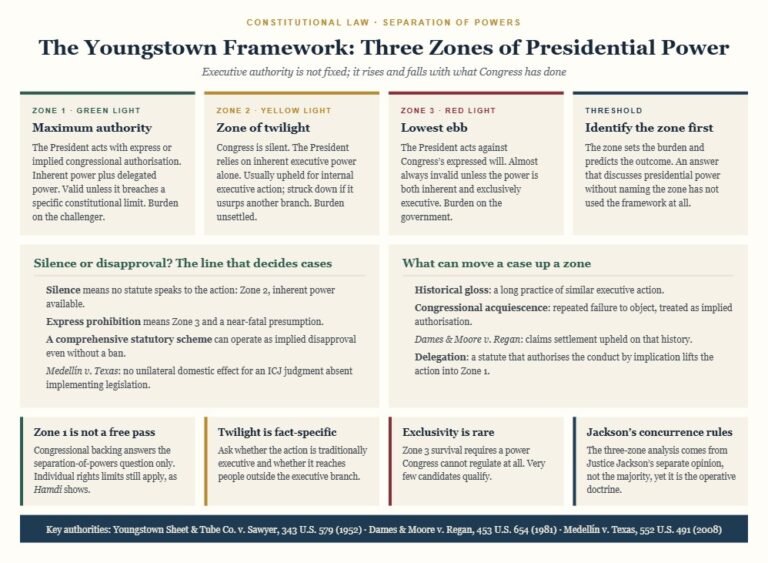 The Youngstown Framework: Presidential Power in 3 Zones
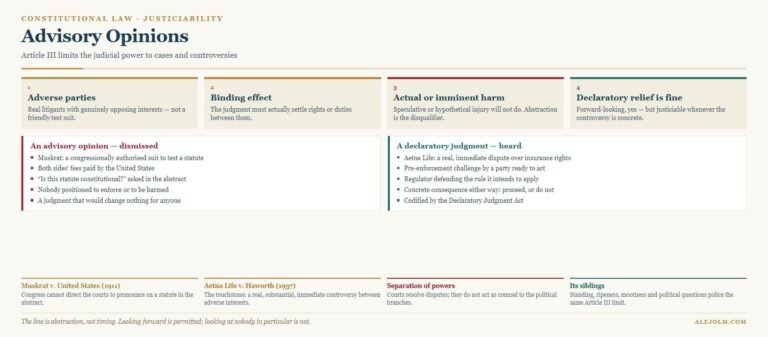 Advisory Opinions: Article III and Declaratory Relief
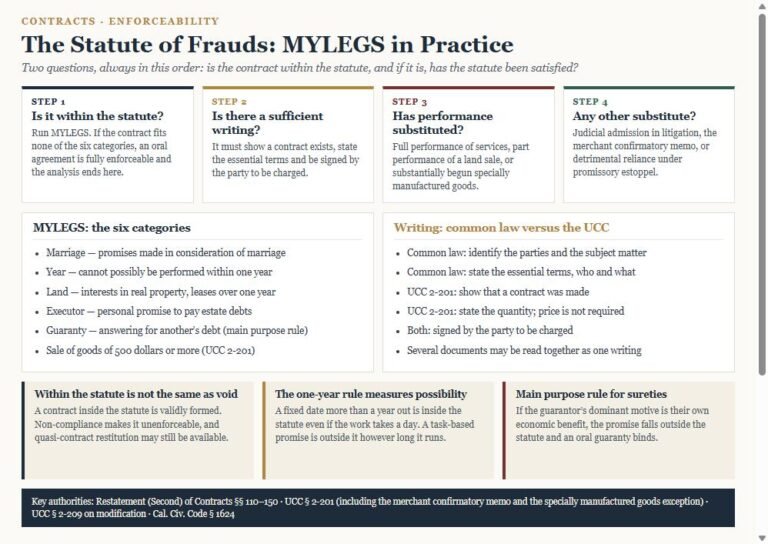 The Statute of Frauds: MYLEGS and How to Satisfy It
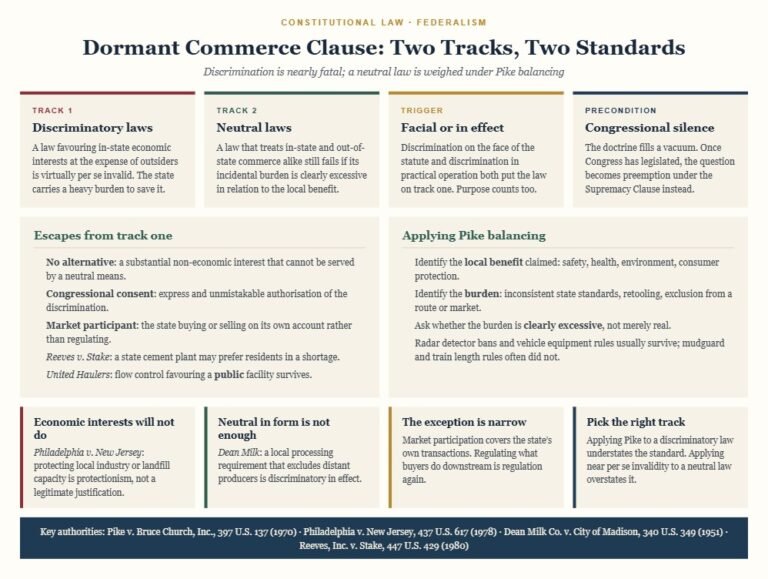 Dormant Commerce Clause: Discrimination vs Pike Balancing
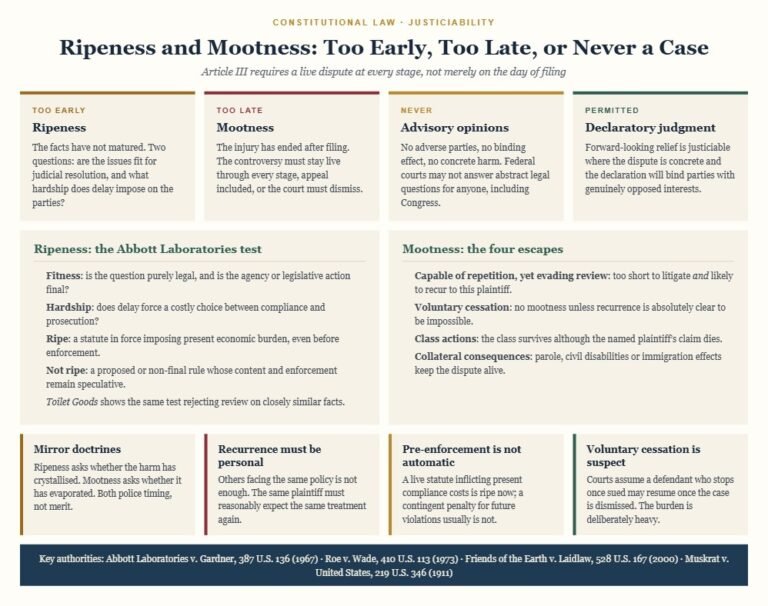 Ripeness and Mootness: Timing Rules in Federal Court
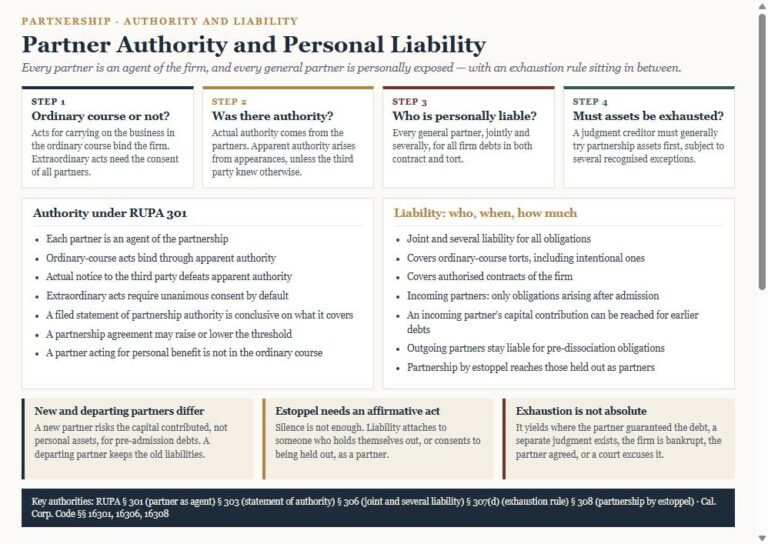 Partner Liability and Authority Under RUPA Explained
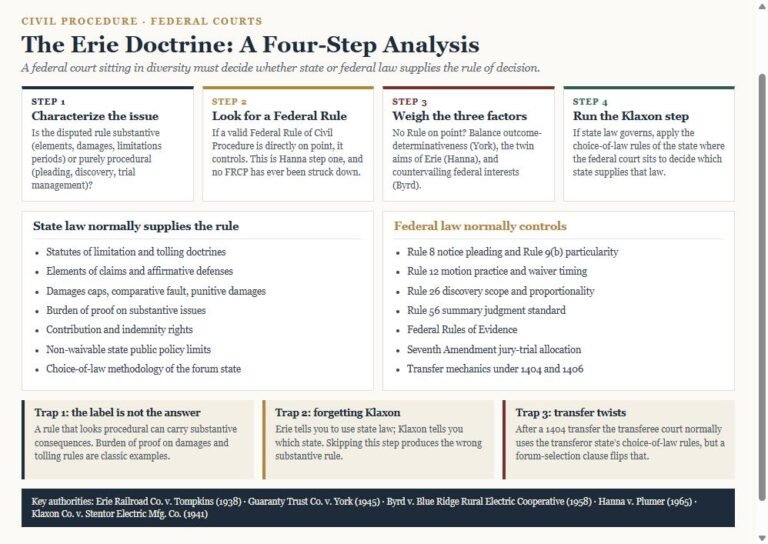 The Erie Doctrine Explained: A 4-Step Bar Exam Guide
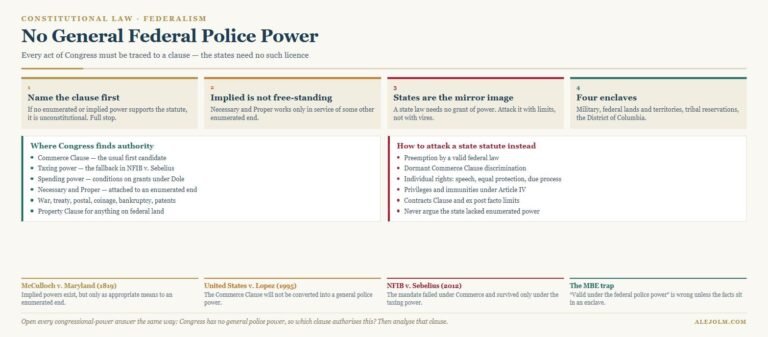 No Federal Police Power: Enumerated Powers and Enclaves
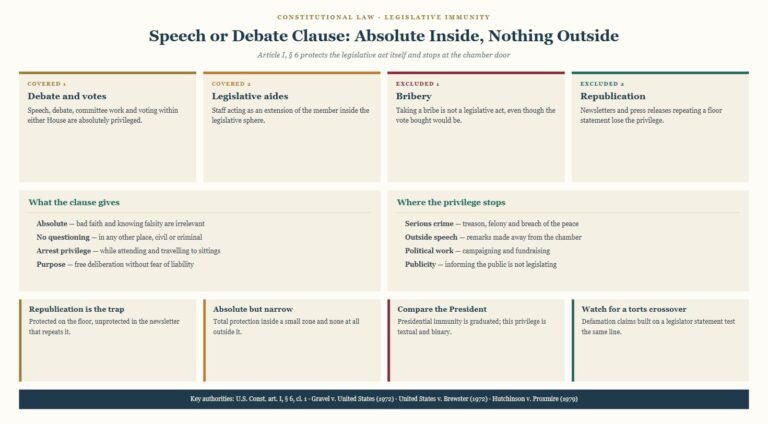 Speech or Debate Clause: Absolute but Narrow Immunity