
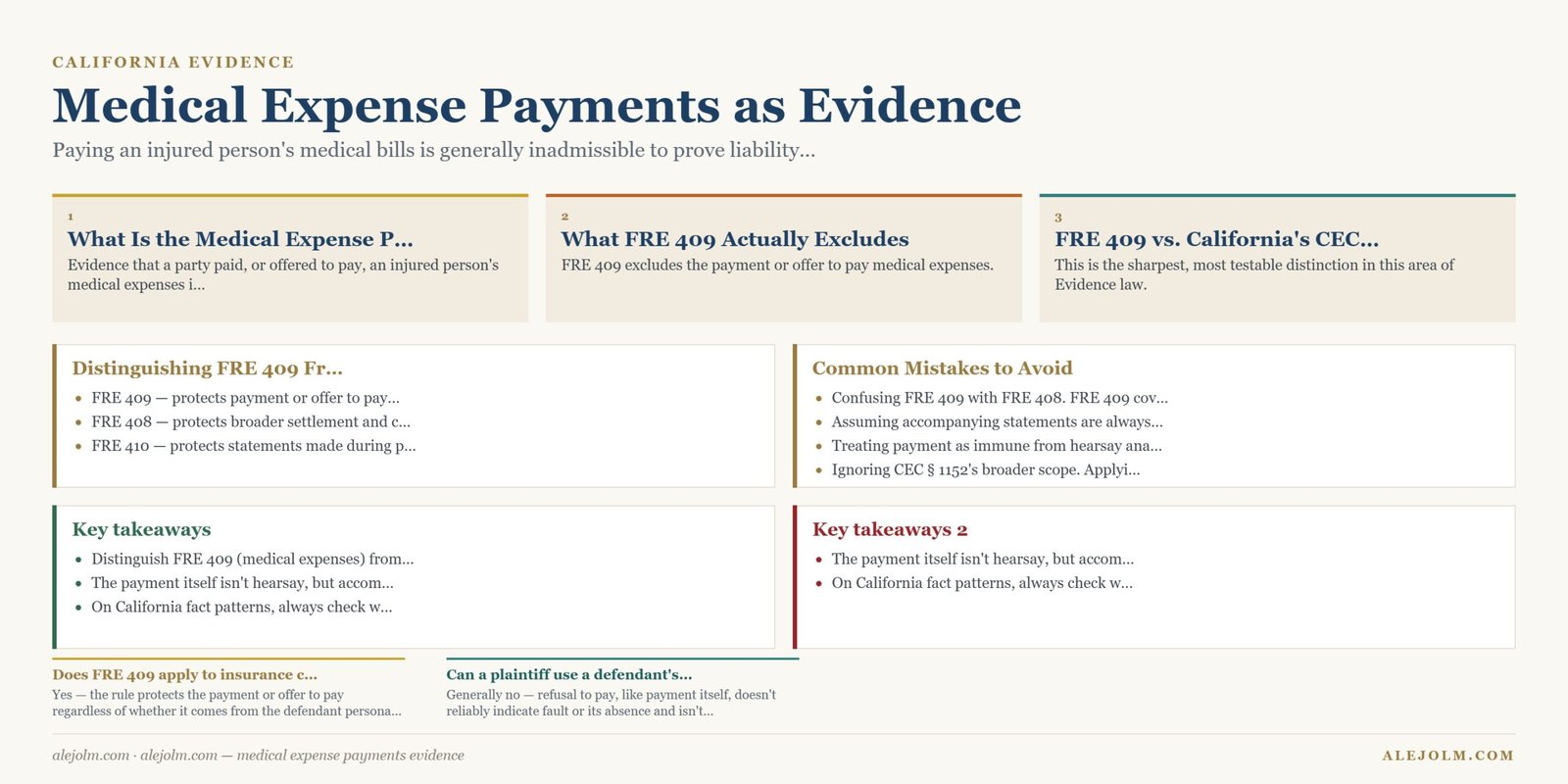
What Is the Medical Expense Payment Rule?
Evidence that a party paid, or offered to pay, an injured person’s medical expenses is generally inadmissible to prove liability for the injury. Under Federal Rule of Evidence 409, this protects benevolent conduct — someone who pays a stranger’s hospital bill out of compassion shouldn’t have that kindness weaponized as an admission of fault. California’s Evidence Code § 1152 covers the same ground but goes further than the federal rule.
The policy is simple: if payment could be used against you at trial, people would stop paying medical bills out of fear, which harms injured parties and discourages exactly the humane conduct the rule wants to encourage.
What FRE 409 Actually Excludes
FRE 409 excludes the payment or offer to pay medical expenses. That’s it — the rule is narrower than its cousin, FRE 408 (which covers full settlement negotiations). Under federal law, a factual statement made alongside the payment may still be admissible if the statement itself isn’t about the payment. For example, if a defendant pays a victim’s hospital bill and separately mentions “I was at the intersection at 3 PM,” that factual admission about location can come in even though the payment itself cannot.
FRE 409 vs. California’s CEC § 1152
This is the sharpest, most testable distinction in this area of Evidence law. California folds the medical-expense rule into its general compromise-offer statute rather than giving it a standalone provision, and the resulting protection is meaningfully broader than the federal rule.
| Feature | Federal Rule (FRE 409) | California (CEC § 1152) |
|---|---|---|
| Statutory location | Standalone rule | Combined with the general settlement/compromise rule |
| Payment or offer to pay excluded | Yes | Yes |
| Accompanying factual statements | May be admissible if unrelated to the payment itself | Generally excluded — CA bars admissions of fact made in connection with the offer to pay |
| Applies in criminal cases | N/A — evidentiary context is mostly civil | Applies broadly; Prop 8 does not override this exclusion |
| Related provision | FRE 408 (broader settlement rule) | CEC § 1153 (separate compromise-offer condemnation provision) |
In practice: a defendant in California who pays a victim’s medical bills while saying “I’m paying because the accident was my fault” gets both the payment and the accompanying fault statement excluded. The same fact pattern in federal court might see the payment excluded but the accompanying statement admitted, because FRE 409 doesn’t reach factual statements unrelated to the payment mechanics themselves.
Distinguishing FRE 409 From FRE 408 and FRE 410
Students frequently blur three related-but-distinct exclusionary rules:
- FRE 409 — protects payment or offer to pay medical expenses specifically.
- FRE 408 — protects broader settlement and compromise negotiations, including statements made during those negotiations (civil cases only).
- FRE 410 — protects statements made during plea-bargaining discussions in criminal cases.
A defendant who pays medical bills without any broader settlement language triggers FRE 409 only. A defendant who says “I’ll pay your bills if we settle the whole case right now” has arguably triggered both FRE 409 and FRE 408, since the payment is now bundled into a compromise offer — and FRE 408’s broader protection would apply to the entire exchange.
Why the Payment Itself Isn’t Hearsay — But Statements Might Be
A payment, standing alone, is conduct, not an assertion — it’s not a “statement” for hearsay purposes at all. But once a defendant pairs the payment with words (“I’m paying because it was my fault”), that verbal statement can raise a separate hearsay problem if offered for the truth of the matter (that the defendant was actually at fault). FRE 409 excludes the payment; whether the accompanying statement is independently excluded depends on whether it’s protected as part of the payment context (federal: often admissible; California: generally excluded under § 1152’s broader language).
Worked Example: The Hospital Parking Lot Statement
After a car accident, Devon visits the injured pedestrian, Wren, in the hospital and pays her $8,000 medical bill in cash. While handing over the money, Devon says, “I ran the red light — this is on me.”
Walk through the analysis:
- Is the payment itself admissible to prove liability? No — under both FRE 409 and CEC § 1152, the payment is excluded.
- Federal analysis of the accompanying statement: “I ran the red light” is a factual admission that doesn’t describe the payment itself. Under FRE 409, this statement could be admissible as a party-opponent admission, separate from the excluded payment.
- California analysis of the accompanying statement: Under CEC § 1152’s broader language, an admission of fact made in connection with the offer to pay is also excluded — so Devon’s statement, made while handing over payment for medical expenses, would likely be excluded in California, unlike in federal court.
- Exam takeaway: The same fact pattern produces different outcomes depending on jurisdiction — precisely the kind of distinction the California Bar Exam rewards spotting.
Common Mistakes to Avoid
- Confusing FRE 409 with FRE 408. FRE 409 covers only medical expense payments; FRE 408 covers the whole universe of settlement negotiations.
- Assuming accompanying statements are always excluded. Under federal law, factual statements unrelated to the payment mechanics can come in — only California’s CEC § 1152 excludes them more broadly.
- Treating payment as immune from hearsay analysis entirely. The payment itself isn’t a statement, but words spoken alongside it can be.
- Ignoring CEC § 1152’s broader scope. Applying federal FRE 409 analysis wholesale to a California fact pattern is a common and costly exam error.
FAQ
Does FRE 409 apply to insurance company payments?
Yes — the rule protects the payment or offer to pay regardless of whether it comes from the defendant personally or an insurer acting on the defendant’s behalf.
Can a plaintiff use a defendant’s refusal to pay medical bills as evidence?
Generally no — refusal to pay, like payment itself, doesn’t reliably indicate fault or its absence and isn’t treated as an admission under these rules.
Is CEC § 1152 the same statute that covers general settlement offers in California?
Yes — California combines medical expense payment protection with its general compromise-offer exclusion in CEC § 1152, unlike the federal system’s separate FRE 408/409 rules.
Key Takeaways
- FRE 409 and CEC § 1152 both exclude evidence of paying or offering to pay medical expenses to prove liability.
- California’s CEC § 1152 is broader than FRE 409 because it also excludes factual admissions made in connection with the offer to pay, not just the payment itself.
- Distinguish FRE 409 (medical expenses) from FRE 408 (broader settlement negotiations) and FRE 410 (plea discussions).
- The payment itself isn’t hearsay, but accompanying verbal statements can raise a separate hearsay issue.
- On California fact patterns, always check whether an accompanying statement would be excluded under the state’s broader rule, even when federal law would let it in.
This article is educational and is not legal advice. Consult a licensed California attorney about your situation.
Related guides
- negotiation and compromise offers in California
- relevance and probative value in California
- confrontation clause and hearsay