

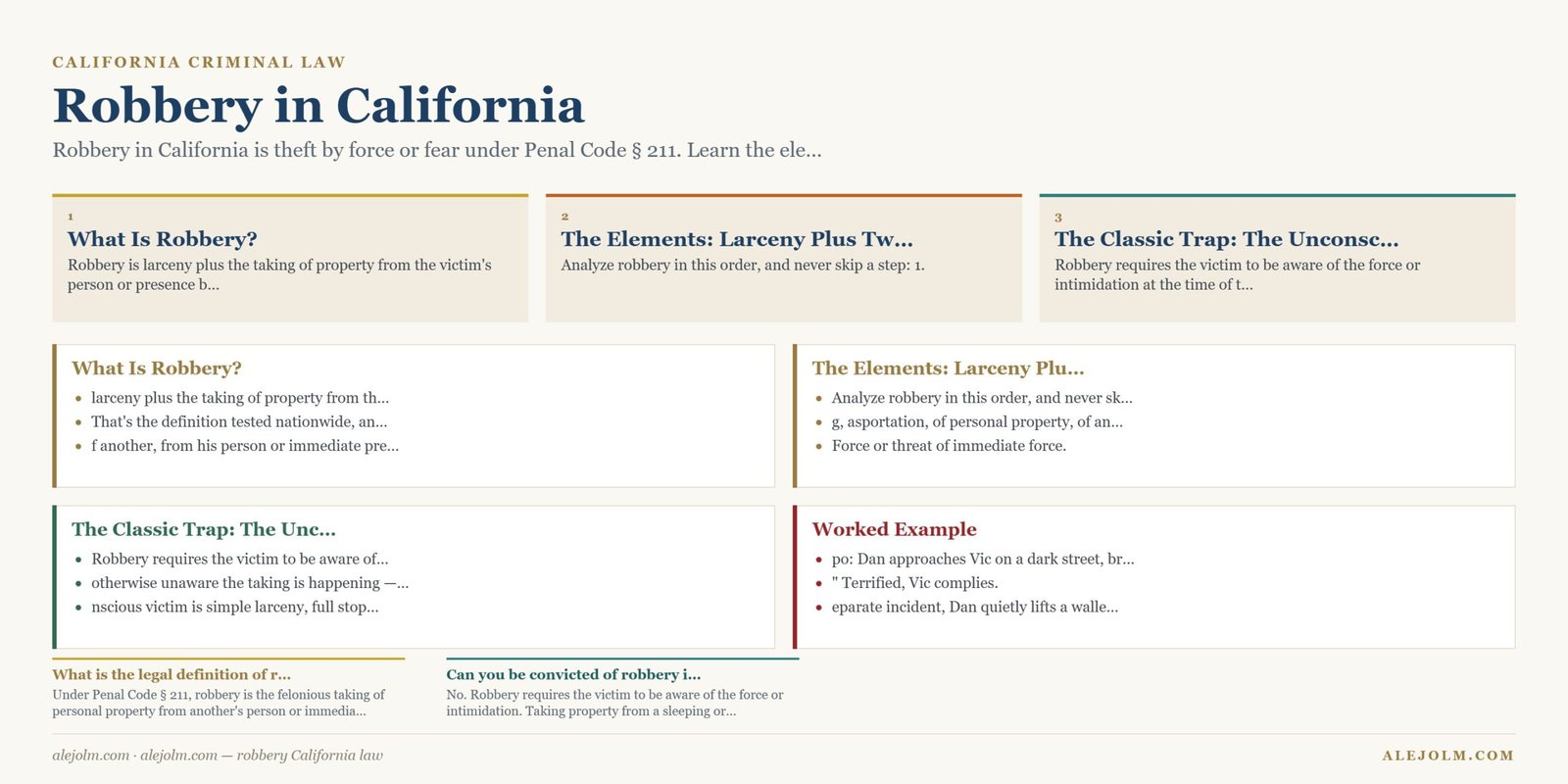
What Is Robbery?
Robbery is larceny plus the taking of property from the victim’s person or presence by force or threat of immediate force. That’s the definition tested nationwide, and California’s statute tracks it almost exactly. Penal Code § 211 defines robbery as “the felonious taking of personal property in the possession of another, from his person or immediate presence, and against his will, accomplished by means of force or fear.” If you memorize one definition for this crime, memorize that one — it’s both the MBE rule and the California rule, word for word in substance.
Because robbery necessarily includes every element of larceny plus an added force component, a defendant can’t be convicted of both robbery and larceny for the same taking — robbery is what’s called a greater offense that merges the lesser-included larceny into it.
The Elements: Larceny Plus Two Extra Requirements
Analyze robbery in this order, and never skip a step:
- All the elements of larceny — trespassory taking, asportation, of personal property, of another, from possession, with specific intent to permanently deprive.
- Force or threat of immediate force. A threat of future harm is not enough — that’s extortion, not robbery.
- Taken from the victim’s person or presence. “Presence” means reasonably near the victim and under her control or protection, not literally touching her body.
If the underlying larceny element fails — most commonly because the defendant has a claim of right to the property, or an honest mistake of fact about ownership — the robbery charge collapses along with it. Force doesn’t “upgrade” a taking to robbery if there was never a valid theft to begin with.
The Classic Trap: The Unconscious Victim
Robbery requires the victim to be aware of the force or intimidation at the time of the taking. You cannot rob someone who is asleep, unconscious, or otherwise unaware the taking is happening — there’s no operative fear or coercion to satisfy the force element. Taking property from an unconscious victim is simple larceny, full stop, no matter how much physical force was used to get at the property.
This is, by a wide margin, the single most reliable robbery trap on the bar exam. Whenever a fact pattern gives you a sleeping, drugged, or passed-out victim, the correct charge is larceny, not robbery.
Worked Example
Hypo: Dan approaches Vic on a dark street, brandishes a knife, and says “hand over your wallet or I’ll cut you.” Terrified, Vic complies. In a separate incident, Dan quietly lifts a wallet from the pocket of Wendy, who is passed out drunk on a park bench.
Analysis: Dan committed robbery against Vic — he took Vic’s property, satisfying larceny, directly from Vic’s person, accomplished by a threat of immediate force (the knife and explicit threat) that Vic was fully aware of and that overcame his will. As to Wendy, Dan committed only larceny, not robbery: because Wendy was unconscious, she experienced no fear or coercion, and robbery’s force element can’t be satisfied against a victim unaware that a taking is occurring.
How Long Does the “Robbery Transaction” Last?
Force used during the actual taking obviously supports robbery. But what about force used moments later, during the getaway? California takes an expansive view. In People v. Estes (Cal. Ct. App. 1983), force used during immediate flight — against a security guard trying to recover the stolen goods — still qualified as robbery, extending the “taking” transaction through the escape. Courts elsewhere disagree about how far this extends; some limit the robbery transaction strictly to the taking itself, while others follow California’s broader approach through immediate flight to a place of temporary safety.
Degrees of Robbery Under California Law
California divides robbery into two degrees under Penal Code § 212.5:
| Degree | When it applies | Statute |
|---|---|---|
| First degree | Robbery of a person in an inhabited dwelling, of a driver or passenger of certain vehicles for hire (taxis, buses), or from an ATM | § 212.5(a)-(c) |
| Second degree | All other robbery | § 212.5(b) |
First-degree robbery carries significantly higher sentencing exposure, which is exactly why California essays test whether a fact pattern’s location and circumstances trigger the first-degree category.
The Felony-Murder Connection
Robbery is one of the classic enumerated felonies that triggers first-degree felony murder liability when a death results during its commission. Because robbery combines a property crime with an inherently dangerous force element, courts treat it as a paradigm “dangerous felony” for felony-murder purposes — and bar examiners frequently layer a death onto a robbery fact pattern to test whether felony-murder liability extends to deaths caused by co-felons, by the victim, or even by police during the encounter.
Common Mistakes
- Applying robbery to an unconscious or unaware victim. This is larceny only — robbery’s force element requires a victim who actually perceives the coercion.
- Confusing a threat of future harm with a threat of immediate harm. “I’ll hurt you tomorrow if you don’t pay me” is extortion, not robbery.
- Missing that claim of right defeats robbery too. Because robbery includes larceny as an element, any defense that defeats the underlying larceny (like an honest claim of right) defeats robbery as well.
- Double-charging larceny and robbery for the same taking. Robbery is larceny plus force; a defendant is convicted of robbery only, not both, for a single taking.
- Assuming “presence” means literally on the victim’s body. Property nearby that the victim is protecting or controlling — a store counter, a car she’s standing next to — still counts as being in her presence.
FAQ
What is the legal definition of robbery in California?
Under Penal Code § 211, robbery is the felonious taking of personal property from another’s person or immediate presence, against their will, accomplished by force or fear. It’s larceny plus a force or threat element.
Can you be convicted of robbery if the victim was asleep?
No. Robbery requires the victim to be aware of the force or intimidation. Taking property from a sleeping or unconscious victim is larceny, not robbery, because there’s no operative fear to overcome.
What’s the difference between first- and second-degree robbery in California?
First-degree robbery under Penal Code § 212.5 applies to robbery of a person in an inhabited dwelling, certain transit vehicle occupants, or an ATM user. Every other robbery is second degree.
Key Takeaways
- Robbery equals larceny plus force or threat of immediate force, taken from the victim’s person or presence, under Penal Code § 211.
- The victim must be aware of the coercion — robbing an unconscious victim is legally impossible; that’s larceny instead.
- A threat of future harm is extortion, not robbery, which requires immediacy.
- California recognizes two degrees of robbery, with first degree covering inhabited dwellings, certain transit vehicles, and ATMs.
- Robbery is a classic felony-murder predicate, and California’s Estes rule extends the robbery transaction through immediate flight.
This article is educational and is not legal advice. Consult a licensed California attorney about your situation.
Related guides
- larceny in California
- larceny by trick vs. false pretenses
- California burglary law
- murder and manslaughter