
What Is Larceny by Trick?
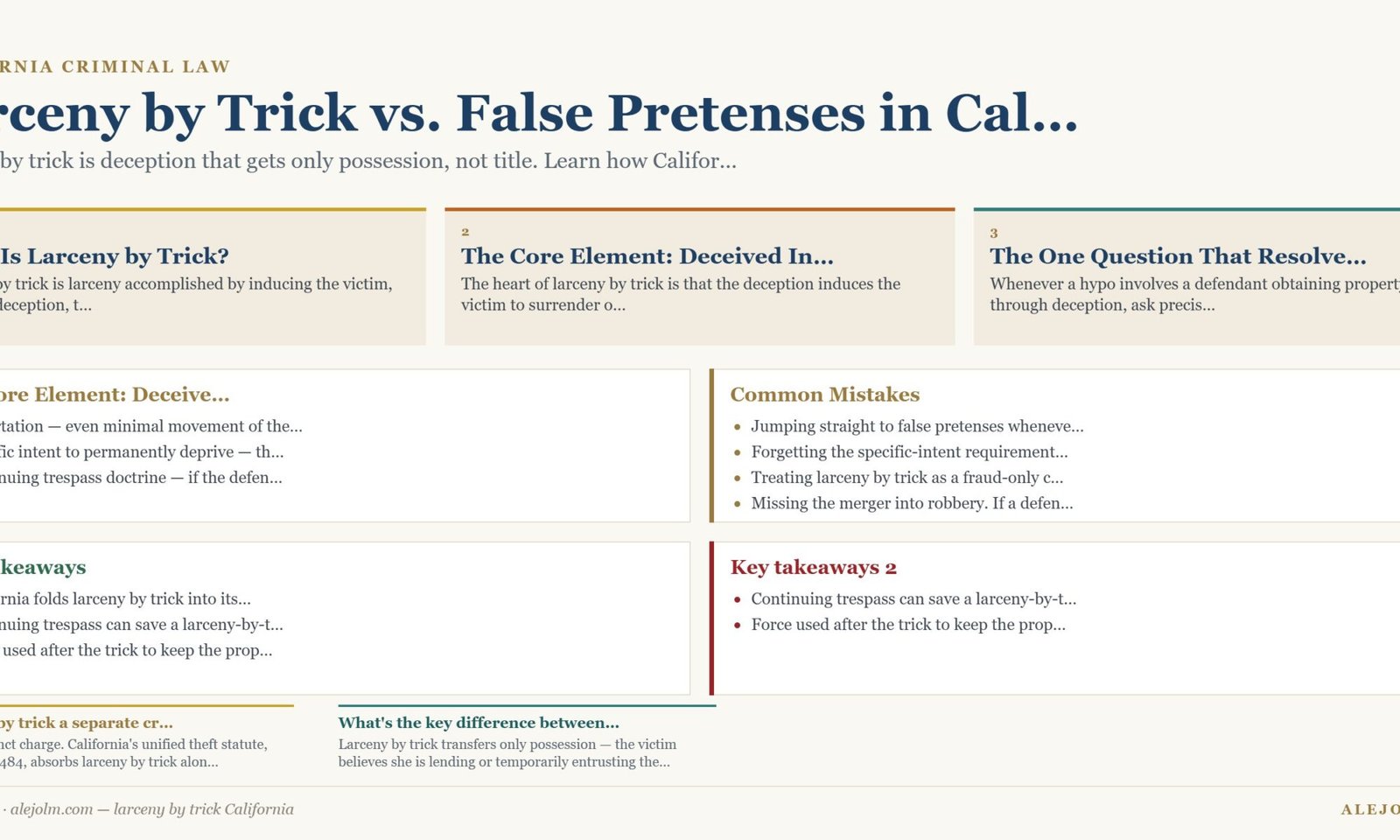
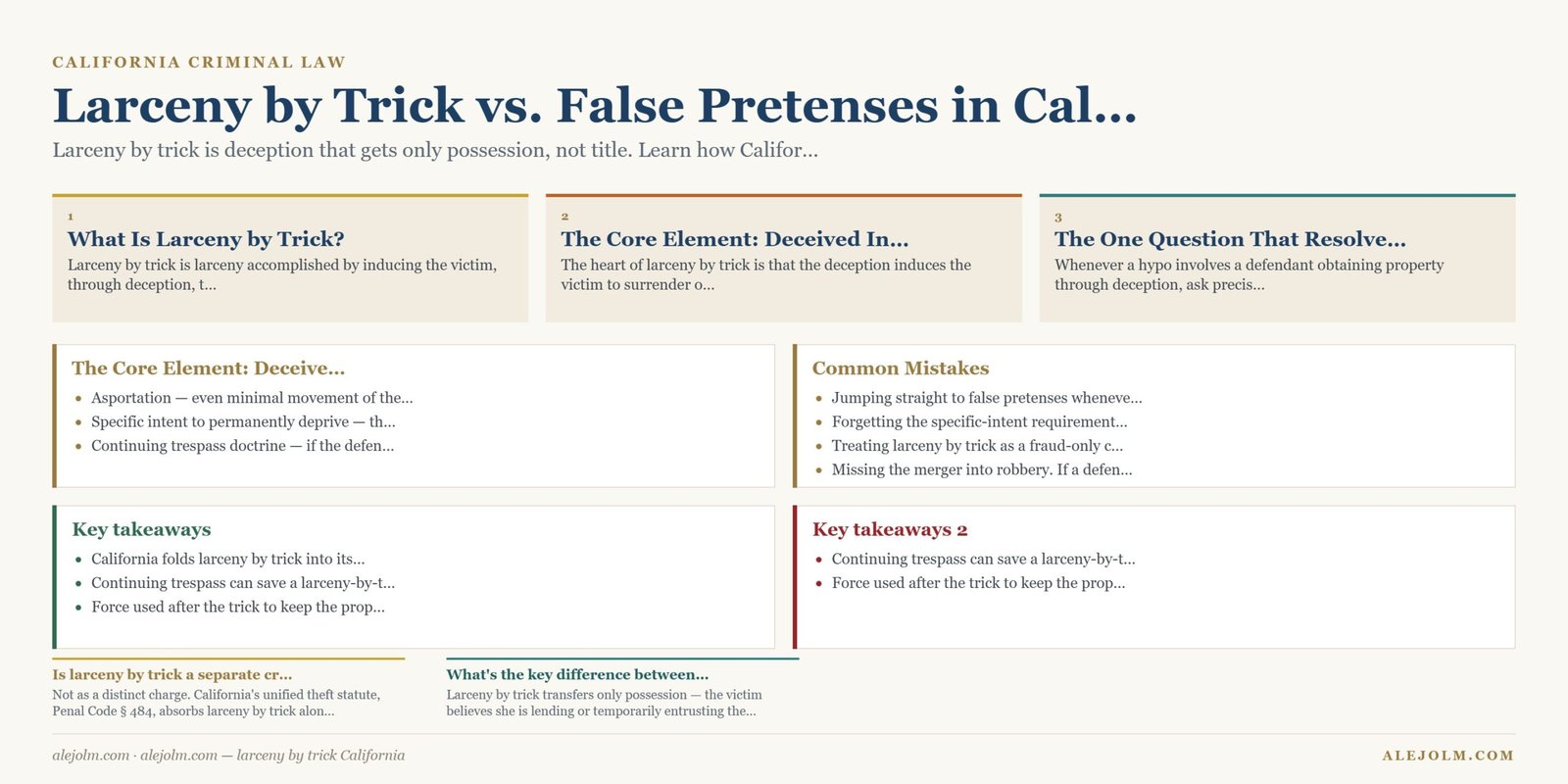
Larceny by trick is larceny accomplished by inducing the victim, through deception, to voluntarily hand over mere possession — not title — of property. It isn’t a separate crime; it’s a species of larceny, and it’s defined almost entirely by contrast with its sibling doctrine, false pretenses. If you understand one, you understand the other by process of elimination.
California doesn’t preserve this as a separately named crime — like larceny and false pretenses, it’s absorbed into the state’s unified theft statute, Penal Code § 484. But the common-law elements still govern whether the underlying conduct satisfies that statute, which is exactly why the California Bar Exam keeps testing this distinction even though a real California charging document would just say “theft.”
The Core Element: Deceived Into Giving Up Possession Only
The heart of larceny by trick is that the deception induces the victim to surrender only possession — the victim never intends to, and never does, transfer ownership. Because it’s a form of larceny, every classic larceny element still applies:
- Asportation — even minimal movement of the property satisfies this.
- Specific intent to permanently deprive — the defendant must have this intent; if he intended only temporary use at the time of the trick, larceny by trick may not be complete until he later decides to keep the property.
- Continuing trespass doctrine — if the defendant initially took possession intending to return it, but later decided to keep it, this doctrine allows liability to attach once the intent to permanently deprive forms, closing the gap between the original taking and the later decision.
The One Question That Resolves Almost Every Fact Pattern
Whenever a hypo involves a defendant obtaining property through deception, ask precisely what the owner intended to give up:
“I’ll just borrow your car for an hour” (owner intends only to lend possession), followed by the defendant driving off permanently — larceny by trick.
“I’ll buy your car,” backed by a bad check or a lie about the buyer’s ability to pay (owner intends to transfer full ownership) — false pretenses.
The inquiry focuses entirely on the victim’s subjective intent at the moment of transfer. If the victim believed she was only granting temporary possession, larceny by trick applies even if the defendant walked away with full physical control of the item.
Larceny by Trick, False Pretenses, and Robbery Compared
| Crime | What the deceived/coerced victim intended to transfer | Method |
|---|---|---|
| Larceny by trick | Possession only | Deception |
| False pretenses | Title | Deception |
| Robbery | Nothing voluntarily — taken by force or threat | Force or fear |
Because larceny by trick is a species of larceny, it merges into robbery if the defendant later uses force or a threat of force to complete or protect the taking. A defendant who tricks someone into handing over car keys, then threatens the owner when confronted, has escalated from larceny by trick to robbery.
Worked Example
Hypo: Dan asks to borrow Vic’s power drill “just for the afternoon,” intending from the outset to keep it permanently and never return it. Vic hands over the drill believing Dan will return it that evening.
Analysis: Vic intended to transfer only possession of the drill — a loan — not title; he never intended to give up ownership. Dan’s deception induced Vic to hand over possession only, and Dan’s undisclosed intent to permanently deprive Vic of the drill existed at the time of the taking. This is larceny by trick, not false pretenses, because title never passed — Vic thought he was lending the drill, not selling it.
Business Context Shapes the Analysis
Courts often look to ordinary business norms to figure out what a victim intended to transfer. In a rental transaction, the customer usually intends only to obtain possession — so a defendant who rents a car under a false name and never returns it commits larceny by trick. In a sale, even one paid by check or on credit, the customer intends to transfer title — so a defendant who buys a car with a bad check is more likely liable for false pretenses. The defendant’s deception can look identical in both scenarios (lying about identity or creditworthiness); it’s the victim’s expectation, shaped by the type of transaction, that determines the applicable theory.
Common Mistakes
- Jumping straight to false pretenses whenever deception is present. The critical question is always whether the victim intended to transfer title or only possession — not simply whether a lie was involved.
- Forgetting the specific-intent requirement. Larceny by trick inherits larceny’s mens rea requirement. A defendant who genuinely intends to return borrowed property has not committed larceny by trick, even if he used some deception to get it — though continuing trespass may apply if he later changes his mind.
- Treating larceny by trick as a fraud-only crime. It retains all of larceny’s structural elements, including asportation, not just the deception element.
- Missing the merger into robbery. If a defendant obtains property by trick and later uses force to keep it from a confronting owner, that’s robbery, not larceny by trick — charging both is a double-counting error.
FAQ
Is larceny by trick a separate crime under California law?
Not as a distinct charge. California’s unified theft statute, Penal Code § 484, absorbs larceny by trick along with larceny, embezzlement, and false pretenses. But the common-law elements still determine whether the facts support a theft conviction.
What’s the key difference between larceny by trick and false pretenses?
Larceny by trick transfers only possession — the victim believes she is lending or temporarily entrusting the property. False pretenses transfers title — the victim believes she is permanently conveying ownership.
Can larceny by trick become robbery?
Yes. If the defendant obtains property through deception and later uses force or a threat of force — for example, to stop the owner from reclaiming it — the crime escalates to robbery.
Key Takeaways
- Larceny by trick is deception that obtains possession only, never title; it’s a variant of larceny, not a standalone crime.
- The victim’s subjective intent — to lend versus to sell — is the single question that resolves nearly every fact pattern in this area.
- California folds larceny by trick into its unified theft statute (Penal Code § 484), but the common-law elements still control the analysis.
- Continuing trespass can save a larceny-by-trick charge even when intent to permanently deprive forms after the initial taking.
- Force used after the trick to keep the property merges the crime into robbery.
This article is educational and is not legal advice. Consult a licensed California attorney about your situation.