
What Is Larceny? A Working Definition
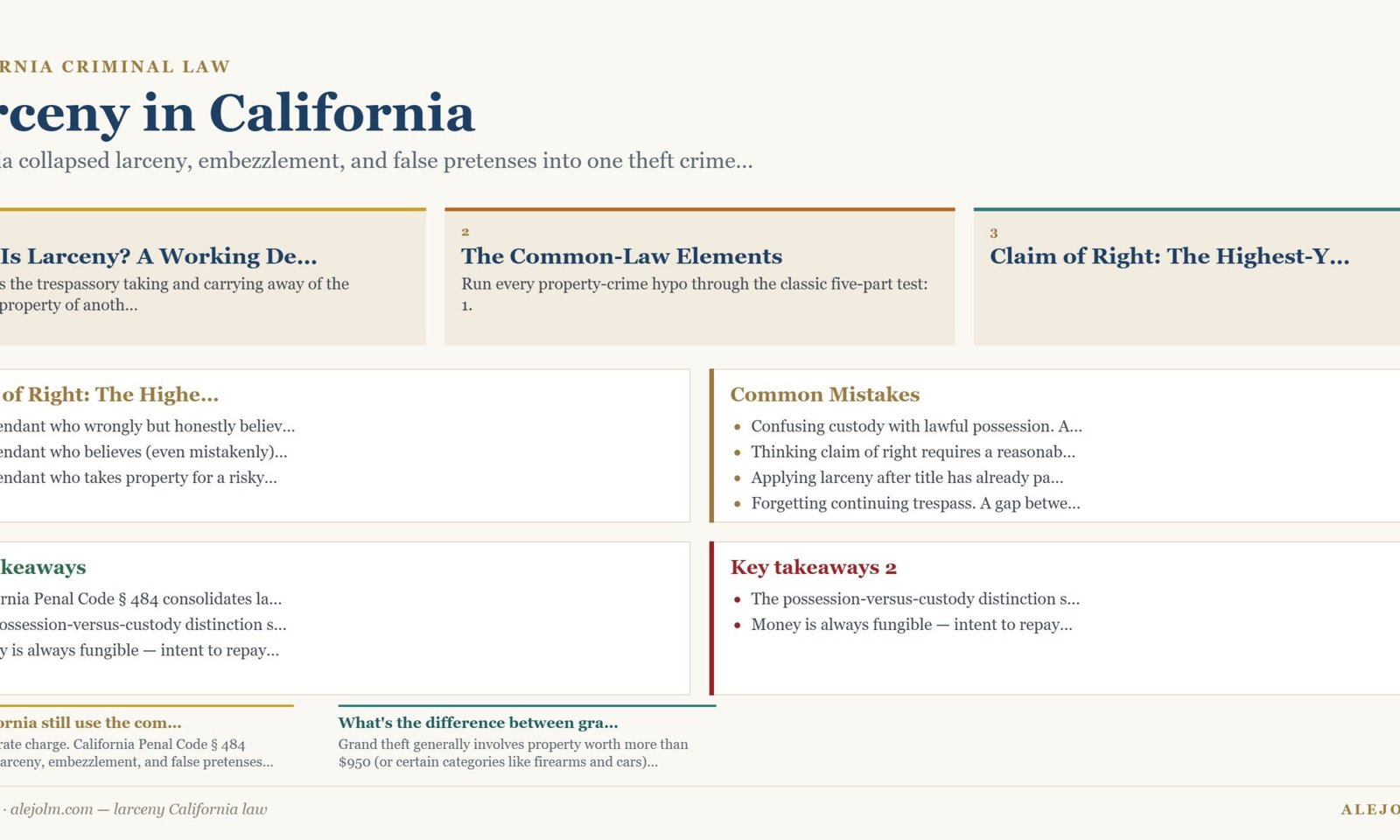
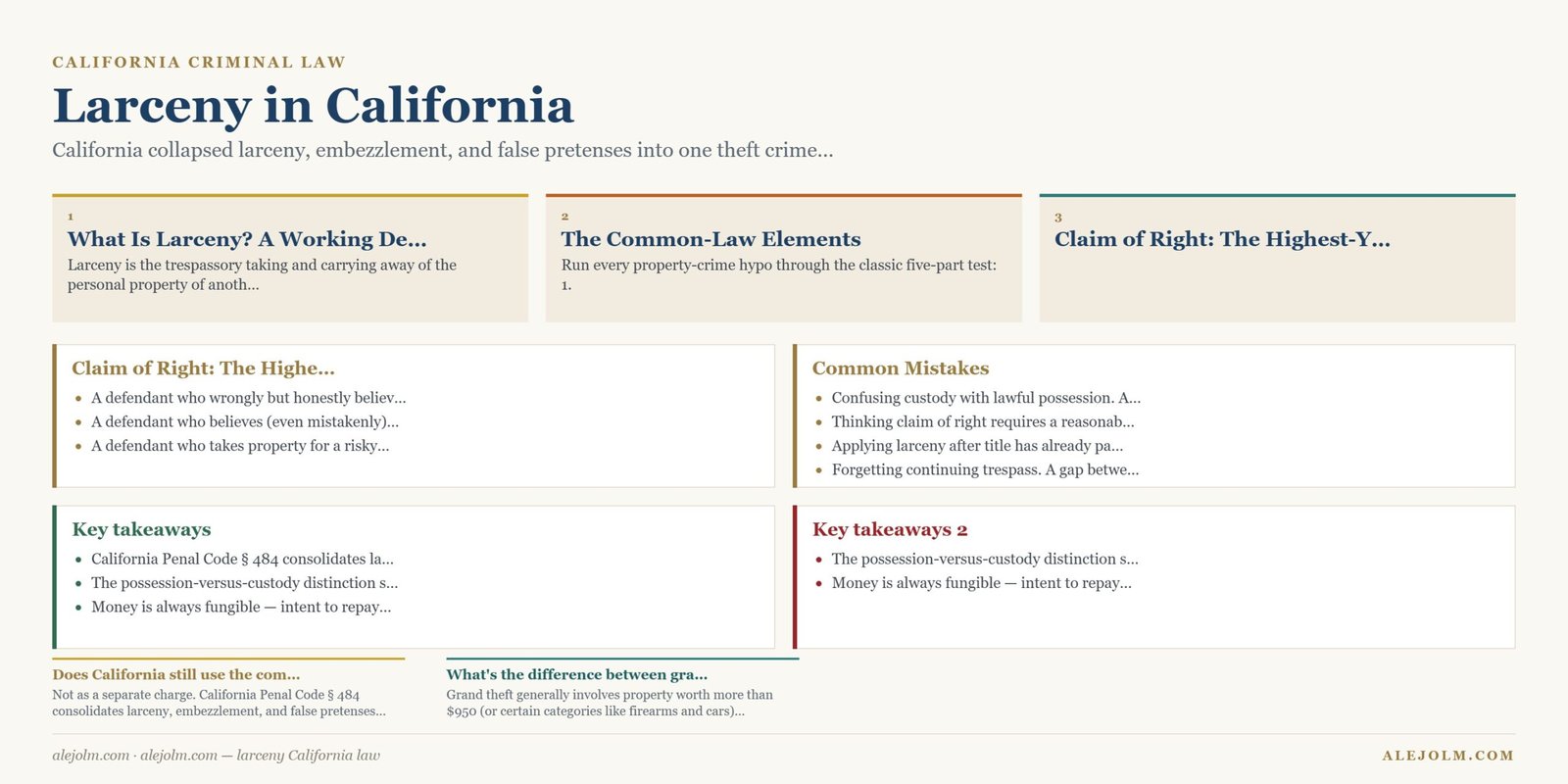
Larceny is the trespassory taking and carrying away of the personal property of another, from that person’s possession, with the specific intent to permanently deprive the possessor of it. That’s the common-law and MBE-tested definition, and it’s the backbone of every property crime question you’ll face on the exam — robbery is larceny plus force, burglary is entry plus intent to commit larceny (among other felonies), and embezzlement and false pretenses are larceny’s close cousins.
For California, though, the common-law taxonomy matters mostly for spotting issues — the state’s actual statute takes a very different approach, and understanding that gap is itself a high-yield California Bar Exam topic.
The Common-Law Elements
Run every property-crime hypo through the classic five-part test:
- Trespassory taking — without the possessor’s consent.
- Carrying away (asportation) — even the slightest movement counts.
- Of personal property — tangible, movable items.
- Of another — meaning legitimate possession, not necessarily title.
- With specific intent to permanently deprive the possessor of it, existing at the moment of the taking.
The trickiest element is usually intent. Under the continuing trespass doctrine, if a defendant initially takes property without larcenous intent but later decides to keep it, the law treats the original taking as continuously wrongful, allowing larceny liability to attach once the intent to steal forms — an exception to the usual concurrence requirement.
Claim of Right: The Highest-Yield Defense in This Area
Claim of right is an honest, good-faith belief — even an unreasonable one — that the defendant is entitled to the property. It negates the specific intent to steal and defeats larceny, robbery, and embezzlement liability alike. This defense is subjective, not objective: what matters is what this defendant believed, not what a reasonable person would have believed.
- A defendant who wrongly but honestly believes he co-owns the property has claim of right.
- A defendant who believes (even mistakenly) that he’s owed compensation in the form of the property has claim of right.
- A defendant who takes property for a risky purpose (like gambling with it), rather than under a belief of entitlement, does not get the defense — the intent to permanently deprive is still satisfied.
How California Actually Charges Theft: Penal Code § 484
Here’s the California-specific twist that trips up students who only study the common law. California Penal Code § 484 abolishes the common-law tripartite division between larceny, embezzlement, and false pretenses, folding them into a single crime called “theft” — the same consolidation the Model Penal Code § 223.1 makes at the national level.
That means a California prosecutor doesn’t have to plead the exact common-law theory (larceny vs. embezzlement vs. false pretenses) to win a conviction; proving any of the underlying conduct satisfies § 484 theft. Theft is then divided by value and type into grand theft (generally property worth more than $950, or specific categories like firearms) and petty theft (everything else), with California’s Proposition 47 reform raising many thresholds and reclassifying certain conduct as misdemeanors.
Even so, California bar examiners still test the common-law distinctions constantly, because the underlying doctrinal lines — did the defendant have possession or mere custody, did title pass, was force used — determine which statutory theory of theft the facts actually support, and they matter for related crimes like burglary and robbery that build on larceny’s structure.
Larceny vs. Embezzlement vs. False Pretenses at a Glance
| Crime | What transfers | Defendant’s status at time of taking |
|---|---|---|
| Larceny | Possession only, without consent | No lawful possession (custody at most) |
| Embezzlement | Nothing transfers — defendant already has lawful possession and converts it | Already in lawful possession (fiduciary) |
| False pretenses | Title | Obtains title through a knowing lie |
| Larceny by trick | Possession only, via deception | Obtains possession through deception |
The possession-versus-custody line is the classic bar exam illustration: a bank teller has mere custody of the till, so pocketing cash is larceny; a bank president has lawful possession through a fiduciary role, so diverting funds is embezzlement.
Worked Example
Hypo: Cara, a cashier trusted only to place customer payments into the register, pockets $200 intending to spend it, planning to replace it from her next paycheck. Separately, the branch manager, who has legal authority over the store’s entire cash reserves, transfers $5,000 from the safe to his personal account, intending to repay the exact amount within a week.
Analysis: Cara is guilty of larceny, not embezzlement — as a cashier, she has mere custody, not legal possession, so pocketing the cash is a trespassory taking. Her intent to repay is no defense, because money is fungible; replacing an equivalent amount is never the “same property.” The branch manager, by contrast, has lawful possession through his fiduciary role, so his conversion is embezzlement — and for the same fungibility reason, his promise to repay doesn’t save him either.
Common Mistakes
- Confusing custody with lawful possession. Anyone who merely handles property (a cashier, a warehouse clerk) has custody; larceny applies. Anyone with genuine fiduciary control (a manager, a trustee) has possession; embezzlement applies instead.
- Thinking claim of right requires a reasonable belief. It doesn’t. Claim of right is purely subjective — an honest but unreasonable belief in entitlement still defeats the specific intent to steal.
- Applying larceny after title has already passed. Once title passes (as in false pretenses), the defendant can’t also be convicted of larceny or embezzlement over the same property.
- Forgetting continuing trespass. A gap between the initial taking and the formation of larcenous intent doesn’t automatically defeat the charge if the continuing trespass doctrine applies.
FAQ
Does California still use the common-law crime of larceny?
Not as a separate charge. California Penal Code § 484 consolidates larceny, embezzlement, and false pretenses into a single crime of “theft,” but the common-law elements still determine whether the underlying conduct satisfies the statute.
What’s the difference between grand theft and petty theft in California?
Grand theft generally involves property worth more than $950 (or certain categories like firearms and cars), while petty theft covers lower-value property. The threshold has shifted over time through legislative reforms like Proposition 47.
Is claim of right a defense to larceny in California?
Yes. An honest, good-faith belief in entitlement to the property — even if unreasonable — negates the specific intent to steal required for theft, whether charged as common-law larceny or California’s unified theft offense.
Key Takeaways
- Larceny requires a trespassory taking, asportation, of another’s personal property, from their possession, with specific intent to permanently deprive.
- Claim of right is a subjective defense: an honest but unreasonable belief in entitlement defeats specific intent.
- California Penal Code § 484 consolidates larceny, embezzlement, and false pretenses into one theft crime, mirroring the MPC’s approach.
- The possession-versus-custody distinction still controls which common-law theory applies, even under California’s unified statute.
- Money is always fungible — intent to repay an equivalent amount is never a defense to a completed theft.
This article is educational and is not legal advice. Consult a licensed California attorney about your situation.
Related guides
- embezzlement in California
- false pretenses in California
- robbery in California
- receiving stolen property in California