
What Is a Positional Conflict? The Rule 1.7 Material-Limitation Test
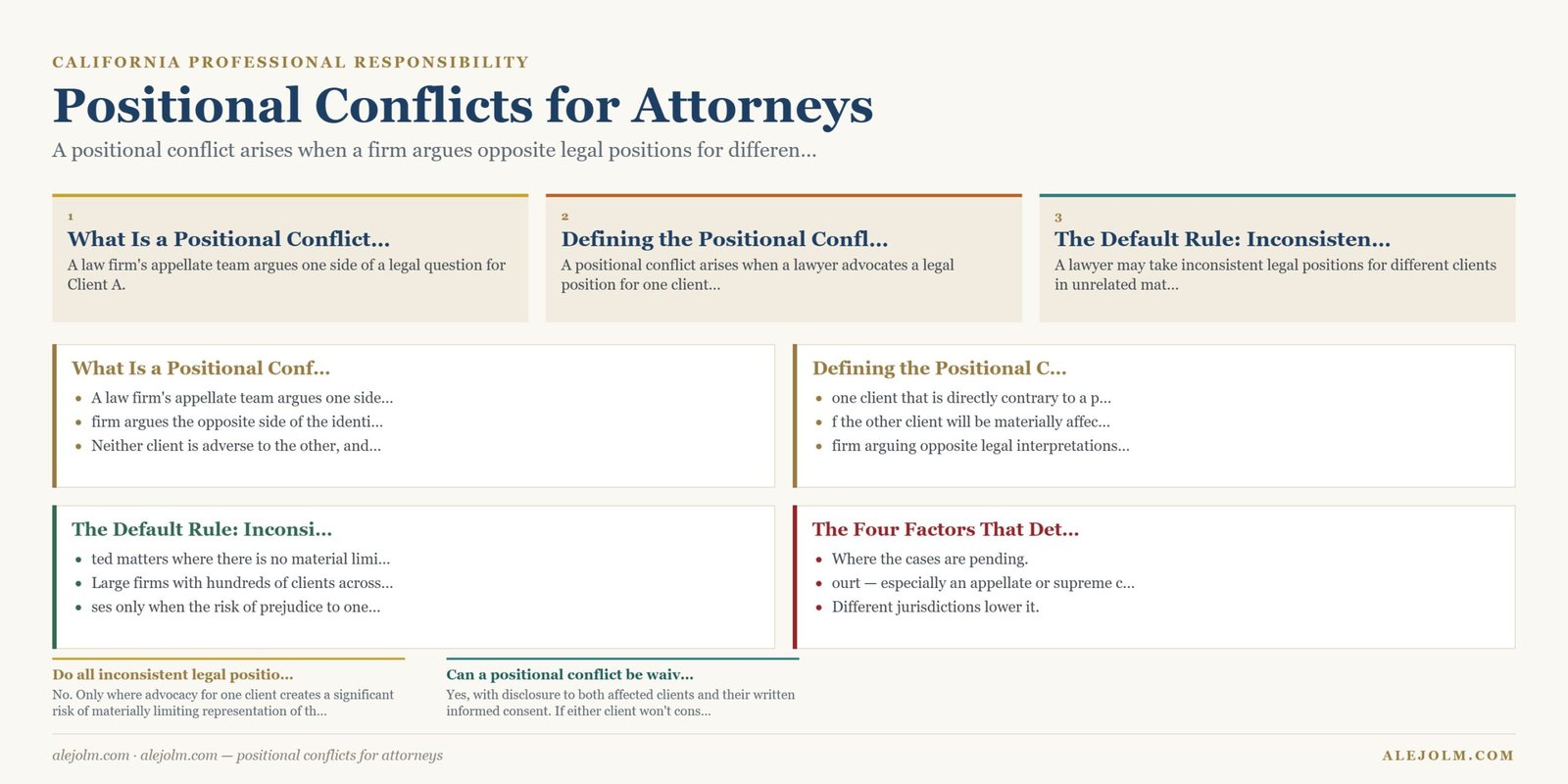
A law firm’s appellate team argues one side of a legal question for Client A. Down the hall, a different partner at the same firm argues the opposite side of the identical legal question for Client Z — in front of the very same court. Neither client is adverse to the other, and the two matters are completely unrelated. Is this a conflict of interest?
Sometimes, yes. This is a positional conflict, and it is one of the more conceptually slippery topics in California Bar Exam professional responsibility, because it doesn’t fit the intuitive picture of a conflict (one client suing another). It’s analyzed under the ordinary material-limitation branch of Rule 1.7 — not as a separate, freestanding rule.
Defining the Positional Conflict
A positional conflict arises when a lawyer advocates a legal position for one client that is directly contrary to a position the same lawyer simultaneously takes for a different client. It exists only where advocacy of one position creates a significant risk that representation of the other client will be materially affected — not merely where the positions are logically inconsistent.
The Default Rule: Inconsistent Positions Are Usually Fine
A lawyer may take inconsistent legal positions for different clients in unrelated matters where there is no material limitation — this is routine and does not, by itself, create a conflict. Large firms with hundreds of clients across every practice area could not function otherwise. The conflict arises only when the risk of prejudice to one client from the lawyer’s advocacy for the other becomes significant.
The Four Factors That Determine Materiality
- Where the cases are pending. Same court — especially an appellate or supreme court whose ruling would bind both clients — raises the risk sharply. Different jurisdictions lower it.
- Substantive vs. procedural. A purely procedural inconsistency rarely creates a material limitation; a substantive, outcome-determinative one often does.
- Timing. Is one case further along, such that a ruling in it could bind or prejudice the other?
- Significance of the issue to each client, and each client’s reasonable expectations when retaining the firm.
Worked Example: The Duty-to-Defend Precedent
A large firm’s appellate group represents Client A, urging the state supreme court to overrule decades-old precedent narrowly construing an insurer’s duty to defend — a broad ruling would help Client A. In a separate, unrelated coverage dispute pending before the same state supreme court a few months behind on an expedited track, the same firm represents Client Z, an insurer that wants the old, narrow precedent left intact, because a broad duty-to-defend rule would expose Client Z to enormous liability across its book of business.
Both cases turn on the identical legal question, before the identical court, and a ruling in Client A’s case will almost certainly control or heavily influence the outcome for Client Z. This is a textbook positional conflict. The firm’s own brief in one case becomes ammunition for the opposing side in the other. The firm must disclose the conflict to both clients and obtain written informed consent from each, or decline one of the two representations if either client won’t consent.
Worked Example: Different Courts, No Conflict
Now compare that to a lawyer arguing that California’s statute of limitations should be interpreted to extend the filing period for Client X in California state court, while arguing the identical statute (or a Texas equivalent) should be interpreted to shorten the period for Client Y in Texas federal court. Because the cases are in different jurisdictions that do not bind each other, no single court’s ruling will directly affect the other case.
The inconsistency might be logically uncomfortable, and it might trouble one of the clients if they found out, but it does not create a significant risk of material prejudice. No Rule 1.7 conflict analysis is required.
| Factor | Same-Court Duty-to-Defend Example | Different-Jurisdiction Statute Example |
|---|---|---|
| Court | Same state supreme court for both | California vs. Texas |
| Binding effect | One ruling controls or heavily influences the other | Neither binds the other |
| Materiality | Significant risk — conflict exists | No significant risk — no conflict |
| Required action | Disclosure + written informed consent from both, or decline one | None |
Distinguishing Positional Conflicts From Direct Adversity
Don’t confuse a positional conflict with direct adversity — for example, a single lawyer trying to jointly represent co-defendants whose interests actually conflict within the same matter. That is a garden-variety concurrent-client conflict, analyzed differently. A positional conflict involves unrelated clients and unrelated matters; the only link is the shared legal issue and the shared court.
Common Mistakes
- Assuming boilerplate consent-to-future-conflicts language in a retainer cures a positional conflict without specific disclosure of the actual divergent positions.
- Ignoring the same-court factor because the two matters are in different practice areas.
- Treating a positional conflict as if it were direct adversity, skipping the material-limitation analysis entirely.
- Assuming any logically inconsistent position automatically creates a conflict, regardless of jurisdiction or timing.
- Waiting until the inconsistency is discovered or exploited before disclosing it, instead of disclosing prospectively.
FAQ
Do all inconsistent legal positions between clients create a conflict?
No. Only where advocacy for one client creates a significant risk of materially limiting representation of the other — typically where both matters are before the same court on the identical legal issue.
Can a positional conflict be waived?
Yes, with disclosure to both affected clients and their written informed consent. If either client won’t consent, the lawyer must decline one of the two representations.
Is a positional conflict the same as representing opposing parties in one lawsuit?
No. That is direct adversity, analyzed as an ordinary concurrent-client conflict. A positional conflict involves unrelated clients and unrelated matters linked only by a shared legal issue.
Key Takeaways
- A positional conflict exists only when advocacy for one client creates a significant risk of materially limiting representation of another.
- Same court, substantive issue, and close timing are the strongest risk factors.
- Different jurisdictions with no binding effect on each other usually mean no conflict.
- Positional conflicts require disclosure and written informed consent from both clients, or declining one representation.
- Positional conflicts are analyzed under Rule 1.7’s material-limitation branch, distinct from direct-adversity conflicts.
Related guides
- conflicts of interest
- attorney media rights in litigation
- California attorney discipline vs. malpractice
- using client information for lawyer gain
Sources and further reading
- California Rules of Professional Conduct, Rule 1.7 (Conflict of Interest: Current Clients)
- ABA Model Rule 1.7, Comment on Positional Conflicts
This article is educational and is not legal advice. Consult a licensed California attorney about your situation.