
What Is the Hot-Potato Rule in California Legal Ethics?
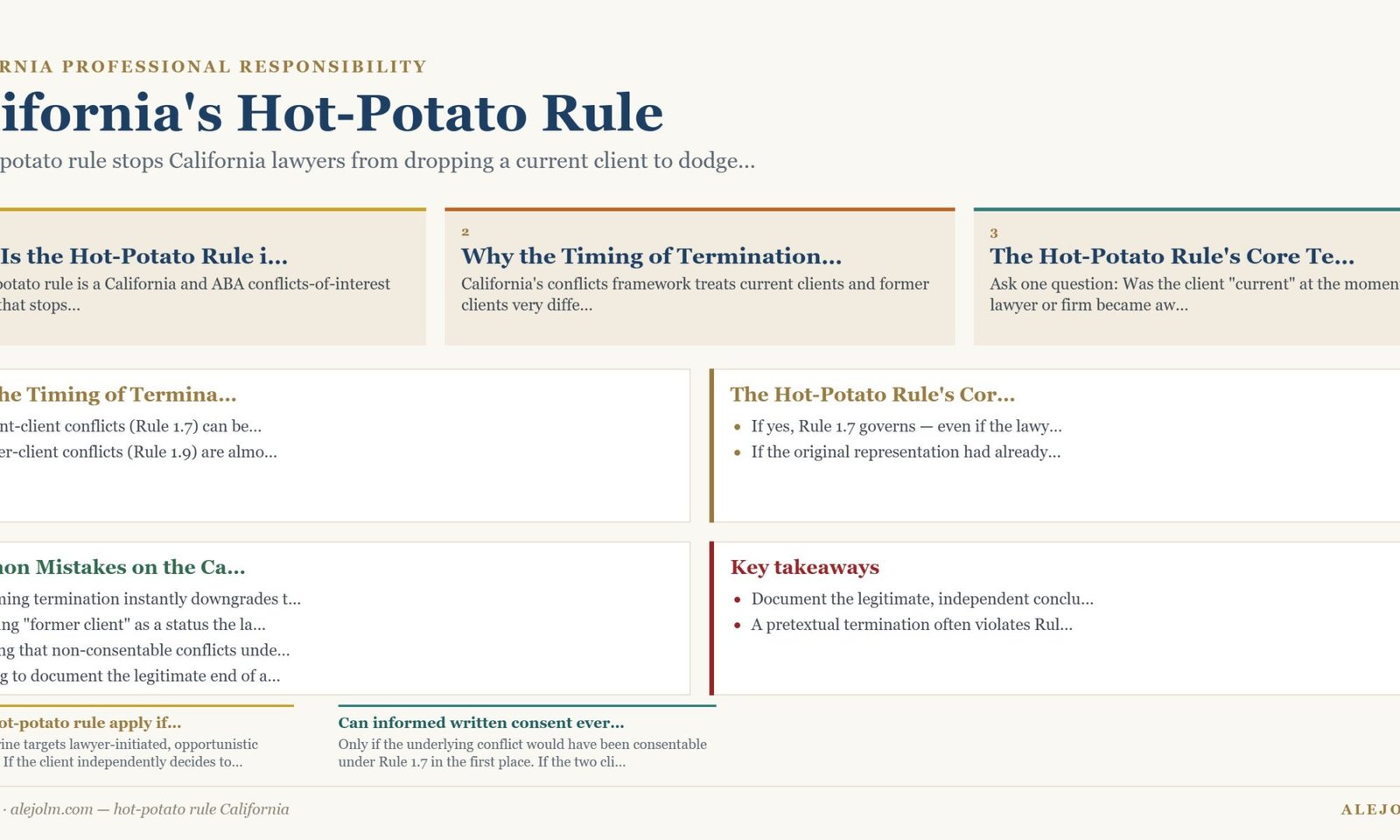
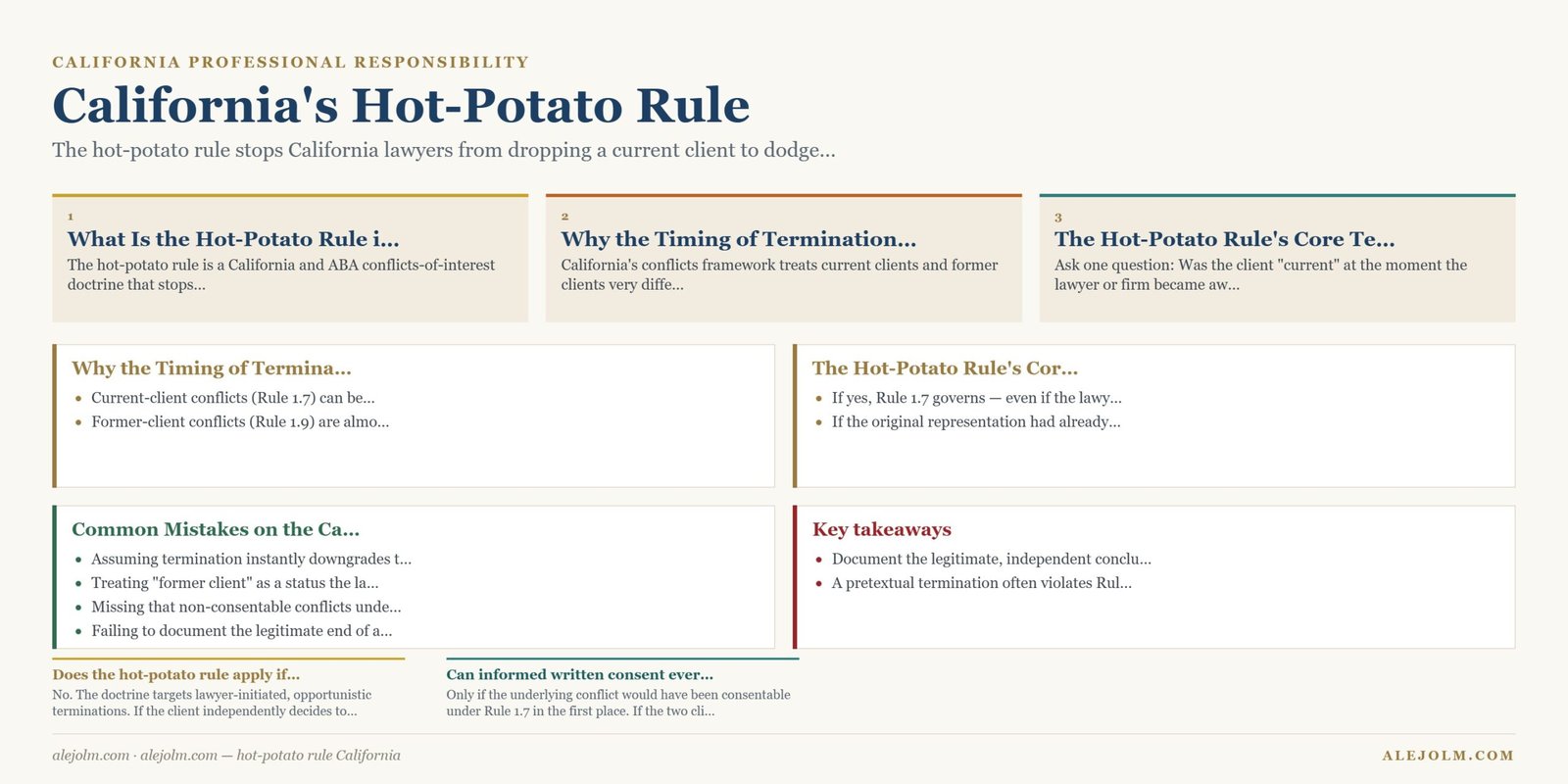
The hot-potato rule is a California and ABA conflicts-of-interest doctrine that stops a lawyer from dropping a current client — mid-representation, without a real reason — just to convert that client into a “former client” and take on a more lucrative, adverse matter. If you were representing someone when the adverse opportunity showed up, you’re stuck with the stricter current-client rules, no matter how fast you send the termination letter.
If you’re studying for the California Bar Exam or practicing in California, this rule shows up constantly in conflicts questions, because it tests whether you understand when a conflict is measured, not just whether one exists.
Why the Timing of Termination Matters So Much
California’s conflicts framework treats current clients and former clients very differently:
- Current-client conflicts (Rule 1.7) can be non-consentable — if two clients are directly adverse in the same or related litigation, no amount of consent fixes it.
- Former-client conflicts (Rule 1.9) are almost always curable with informed written consent, and only require a substantially-related-matter-plus-material-adversity showing.
That gap creates an obvious temptation: fire the inconvenient client, wait a day, and take the lucrative adverse matter under the friendlier Rule 1.9 standard. The hot-potato rule closes that loophole by locking in the analysis at the moment the adverse opportunity arises — not after a convenient, back-dated-feeling termination.
The Hot-Potato Rule’s Core Test
Ask one question: Was the client “current” at the moment the lawyer or firm became aware of the new adverse matter?
- If yes, Rule 1.7 governs — even if the lawyer terminates the original client the next day.
- If the original representation had already, genuinely concluded before the adverse matter was ever discussed, Rule 1.9 governs the new engagement.
The rule doesn’t punish lawyers for having former clients. It punishes lawyers for manufacturing former-client status through timing.
Worked Example: The Textbook Violation
A firm represents Client A in an ongoing commercial lease negotiation — modest hourly fees, no litigation in sight, and monthly check-ins with A. One afternoon, Client B, a major corporation, calls wanting representation in litigation directly adverse to A. The B matter could generate hundreds of thousands of dollars in fees.
The partners want the B engagement. So the firm sends A a termination letter effective the next day, with no legitimate reason — the lease matter isn’t even resolved. The day after termination, the firm signs on with B.
This is a hot-potato violation. The conflict is measured as of the moment B approached the firm, and at that moment A was a current client. The overnight termination doesn’t rewrite that fact. If A and B are directly adverse, the conflict may be non-consentable even if A is asked to sign a waiver.
Worked Example: The Legitimate Former-Client Scenario
Compare that to a firm representing Client A in a lease negotiation that actually finishes. The lease closes, all obligations are fulfilled, and the firm and A mutually agree the representation is over. Six months later — with no adverse matter anywhere on the horizon when A’s matter ended — Client B approaches the firm about an unrelated commercial dispute adverse to A.
Because A’s matter concluded on its own timeline, with no manipulation, this is a genuine former-client scenario. Rule 1.9 applies, and the firm can take B’s matter with A’s informed written consent, provided the matters aren’t substantially related.
How to Tell the Two Scenarios Apart
| Factor | Hot-Potato Violation | Legitimate Former Client |
|---|---|---|
| Timing of termination | Sudden, right after adverse opportunity appears | Independent of any adverse opportunity |
| Reason for ending representation | None — matter still open | Matter genuinely concluded |
| Contemporaneous documentation | Missing or thin | Clear record the engagement ended |
| Governing rule | Rule 1.7 (possibly non-consentable) | Rule 1.9 (curable with consent) |
The Withdrawal Trap
A pretextual termination isn’t just a hot-potato problem — it’s also a Rule 1.16 withdrawal problem. Rule 1.16 permits withdrawal only for specified grounds (nonpayment, irreconcilable conflict, client fraud, and similar reasons), not mere convenience. A lawyer who fires a client purely to chase a bigger fee is essentially confessing, through the withdrawal itself, that the termination was opportunistic.
Common Mistakes on the California Bar Exam
- Assuming termination instantly downgrades the analysis. It doesn’t — the conflict is locked in at the moment the new matter arises.
- Treating “former client” as a status the lawyer controls. A lawyer cannot self-declare former-client status through paperwork alone.
- Missing that non-consentable conflicts under Rule 1.7 can survive a fake termination. Consent from the fired client won’t cure a conflict that was never curable in the first place.
- Failing to document the legitimate end of a matter. Lawyers who close matters cleanly, with a closing letter and no lingering contact, are protected; lawyers who keep discussing “future work” with a “former” client are not.
FAQ
Does the hot-potato rule apply if the client fires the lawyer instead?
No. The doctrine targets lawyer-initiated, opportunistic terminations. If the client independently decides to leave, that’s an ordinary end of representation, and Rule 1.9’s former-client framework applies once the engagement genuinely ends.
Can informed written consent ever fix a hot-potato problem?
Only if the underlying conflict would have been consentable under Rule 1.7 in the first place. If the two clients are directly adverse in the same litigation, the conflict may be non-consentable regardless of any waiver signed after a rushed termination.
How is the hot-potato rule different from a positional conflict?
A positional conflict involves taking inconsistent legal positions for two clients in different, unrelated cases. The hot-potato rule is about the timing used to relabel a current client as a former client. They’re related conflicts issues but test different facts.
Key Takeaways
- The hot-potato rule bars lawyers from dropping a current client to reclassify a conflict under the more permissive Rule 1.9.
- The conflict is evaluated at the moment the adverse opportunity arises — not after termination.
- Current-client conflicts under Rule 1.7 can be non-consentable; former-client conflicts under Rule 1.9 are usually curable with written consent.
- Document the legitimate, independent conclusion of every matter to avoid a hot-potato challenge later.
- A pretextual termination often violates Rule 1.16’s withdrawal standards too.
This article is educational and is not legal advice. Consult a licensed California attorney about your situation.
Related guides
- California conflicts of interest rules explained
- California fee splitting rules for lawyers
- California lawyer withdrawal rules