
When Can a Lawyer Profit From a Client’s Story? Media Rights and Proprietary Interests
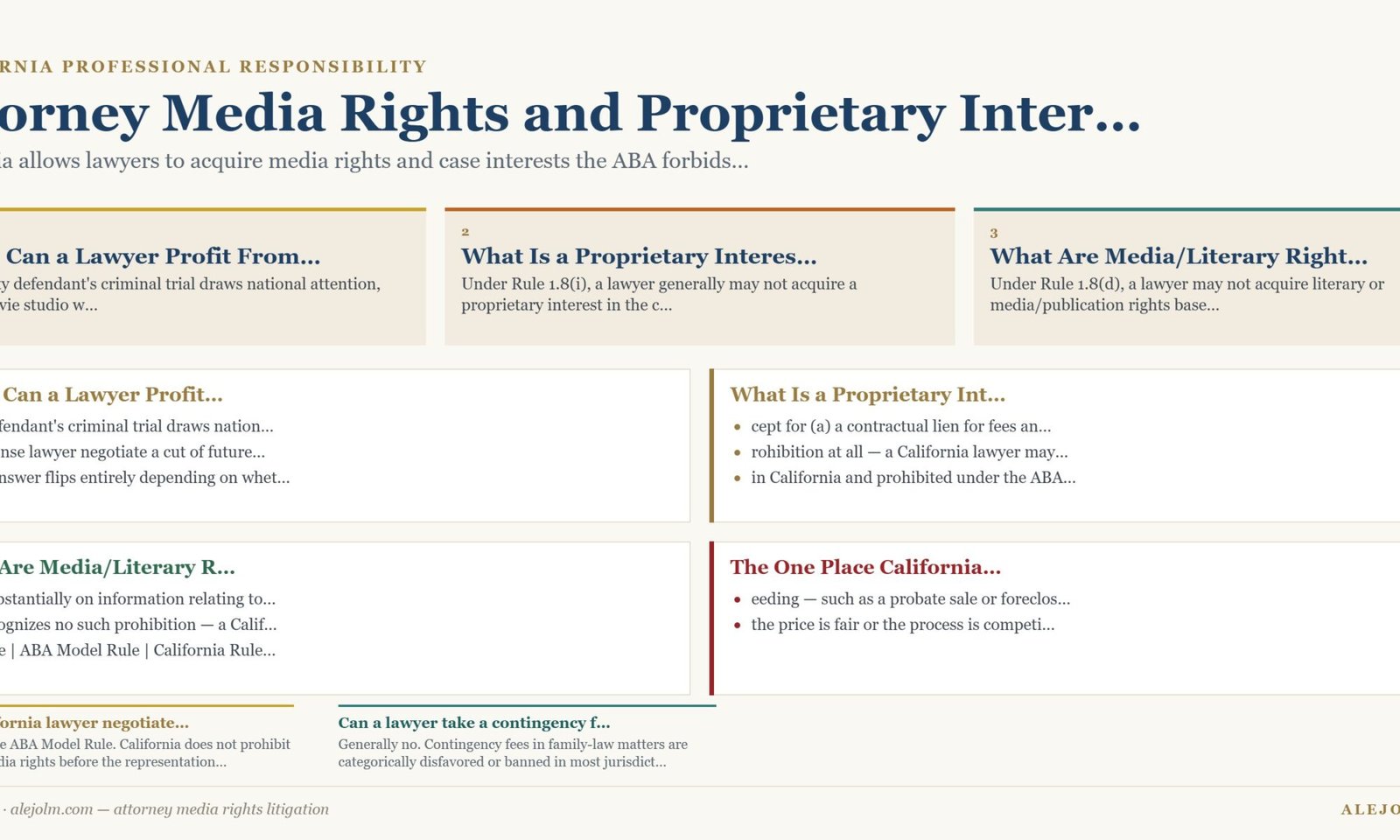
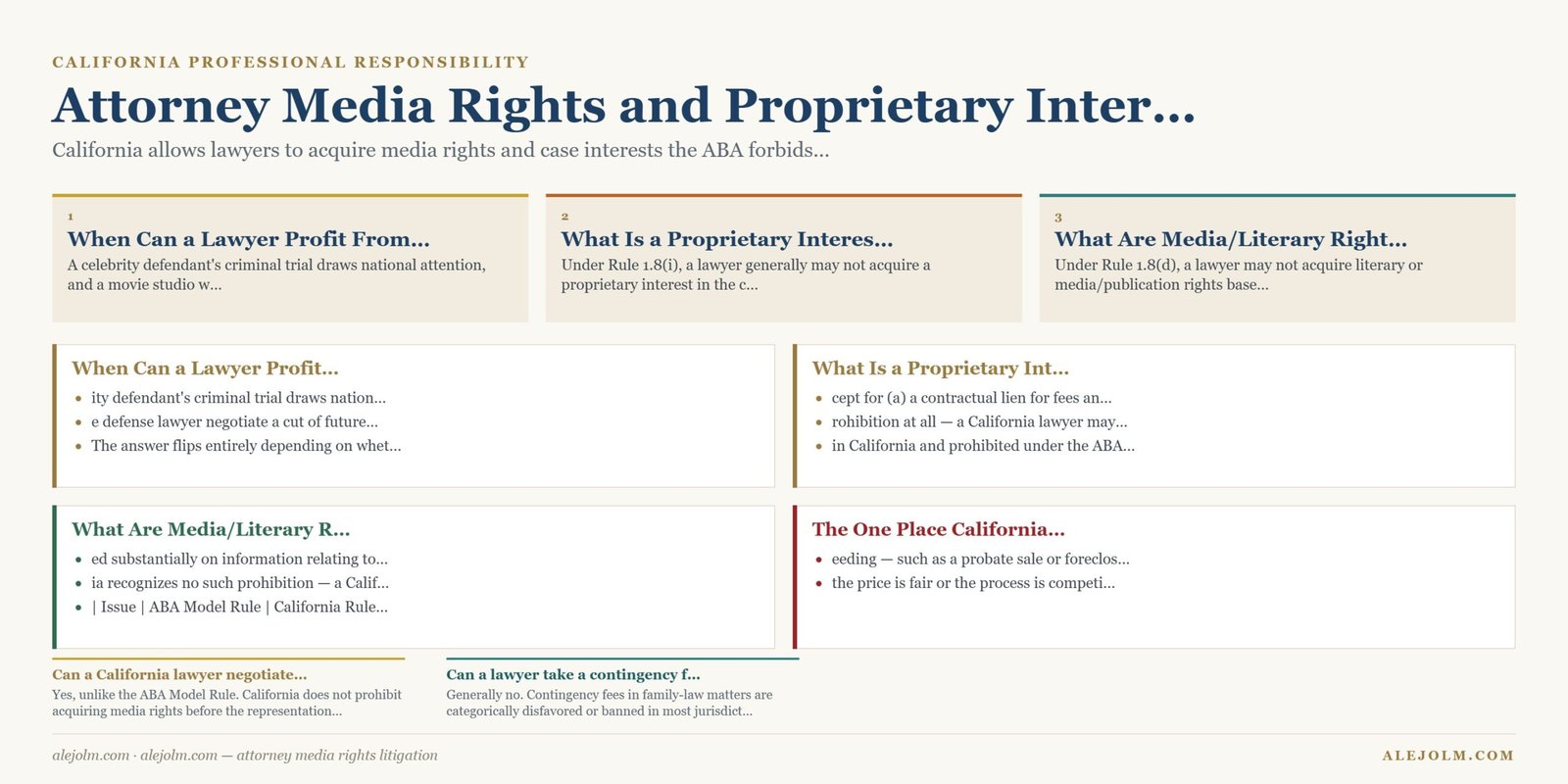
A celebrity defendant’s criminal trial draws national attention, and a movie studio wants the rights to tell the story. Can the defense lawyer negotiate a cut of future movie revenue as part of the fee — while the trial is still ongoing? The answer flips entirely depending on whether you’re in an ABA jurisdiction or California.
Two related Rule 1.8 prohibitions bar a lawyer from acquiring a stake in the subject matter of the representation: a proprietary interest in the cause of action and literary or media rights based on the representation. The concern is the same in both cases — a personal financial stake in the story or the outcome can distort professional judgment. California takes a notably different approach than the ABA on both.
What Is a Proprietary Interest in Litigation?
Under Rule 1.8(i), a lawyer generally may not acquire a proprietary interest in the cause of action or subject matter of the litigation she’s conducting, except for (a) a contractual lien for fees and expenses, and (b) a reasonable contingent fee in a civil case. California recognizes no such prohibition at all — a California lawyer may acquire a proprietary interest before the representation concludes.
What Are Media/Literary Rights, and Who Bans Them?
Under Rule 1.8(d), a lawyer may not acquire literary or media/publication rights based substantially on information relating to the representation, prior to the conclusion of that representation. Again, California recognizes no such prohibition — a California lawyer may negotiate media rights before the case concludes.
| Issue | ABA Model Rule | California Rule |
|---|---|---|
| Proprietary interest in cause of action (1.8(i)) | Prohibited except contingent fee (civil) / fee lien | No prohibition |
| Media/literary rights (1.8(d)) | Prohibited before conclusion of representation | No prohibition |
| Purchasing property in a proceeding the lawyer is affiliated with | Not separately codified | Prohibited |
The One Place California Is Stricter: Buying Property in a Proceeding
California adds a restriction with no direct ABA counterpart: a California lawyer may not purchase property in a proceeding — such as a probate sale or foreclosure — if the lawyer is affiliated with a party to that proceeding. This applies regardless of whether the price is fair or the process is competitive; the rule exists to avoid even the appearance of self-dealing.
Worked Example: The Movie Rights Deal
A high-profile criminal-defense lawyer represents a client whose case draws a major studio’s interest. Rather than a full cash fee, the lawyer and client negotiate a reduced cash fee plus a percentage of future movie revenue — a deal partially executed before the trial concludes.
Under the ABA Model Rule, acquiring media rights before the conclusion of representation is prohibited outright, because it creates a financial interest in how the story unfolds and can distort trial strategy or settlement decisions. Under California law, there is no such prohibition. The deal is still subject to Rule 1.8(a)/CRPC 1.8.1 business-transaction safeguards — fair terms, written disclosure, advice to seek independent counsel, and written informed consent — because it is, in substance, a business deal between lawyer and client.
Worked Example: The Probate Beachfront Property
A California lawyer represents a beneficiary in a probate proceeding involving a valuable beachfront parcel that is being sold as part of estate administration. The lawyer, personally interested in the property, submits a winning bid through the lawyer’s own company at a fair market price.
This is prohibited in California, regardless of the fair price or competitive process, because a lawyer affiliated with a party to a proceeding may not purchase property being sold as part of that same proceeding. The rule targets the risk that the lawyer’s personal interest could distort the estate’s administration or sale process — not just actual harm.
The Contingent-Fee Exception and Its Family-Law Trap
A reasonable contingent fee in a civil case is the standard, permitted exception to the proprietary-interest prohibition — uncontroversial in a personal-injury case, for example. But a contingent fee in a divorce or family-law matter is treated very differently: most jurisdictions categorically ban contingency fees in family-law cases, both as an impermissible proprietary interest and because it creates perverse incentives to prolong litigation or maximize conflict.
Common Mistakes
- Acquiring media rights before the representation concludes in an ABA jurisdiction, forgetting Rule 1.8(d) bars this.
- Assuming California’s lack of a media-rights prohibition means no safeguards apply at all — the Rule 1.8(a) business-transaction requirements still apply.
- Purchasing probate or foreclosure property without recognizing California’s affiliated-party prohibition, even at a fair price.
- Taking a contingency fee in a family-law matter, assuming the civil-case exception extends to divorce.
- Failing to separately analyze whether a proprietary interest also creates a Rule 1.7 material-limitation conflict requiring disclosure and consent.
FAQ
Can a California lawyer negotiate movie rights while a client’s trial is ongoing?
Yes, unlike the ABA Model Rule. California does not prohibit acquiring media rights before the representation concludes, though Rule 1.8(a) business-transaction safeguards still apply.
Can a lawyer take a contingency fee in a divorce case?
Generally no. Contingency fees in family-law matters are categorically disfavored or banned in most jurisdictions, distinct from the standard civil-case contingent-fee exception.
Can a California lawyer buy property from an estate they’re helping administer?
No, if the lawyer is affiliated with a party to that probate proceeding — California prohibits this regardless of whether the purchase price is fair.
Key Takeaways
- California permits both proprietary interests in litigation and pre-conclusion media rights deals; the ABA prohibits both, subject to narrow exceptions.
- The ABA’s proprietary-interest exception covers fee liens and reasonable contingent fees in civil cases only.
- California uniquely bars a lawyer affiliated with a party from purchasing property sold in that same proceeding.
- Contingency fees in family-law matters are a recurring trap distinct from the ordinary civil-case exception.
- Even where California imposes no prohibition, Rule 1.8(a) business-transaction safeguards still apply to the underlying deal.
This article is educational and is not legal advice. Consult a licensed California attorney about your situation.
Related guides
- conflicts of interest
- using client information for lawyer gain
- positional conflicts for attorneys
- California client trust accounts