
California Attorney Discipline vs. Malpractice: Why Bar Candidates Must Keep Them Separate
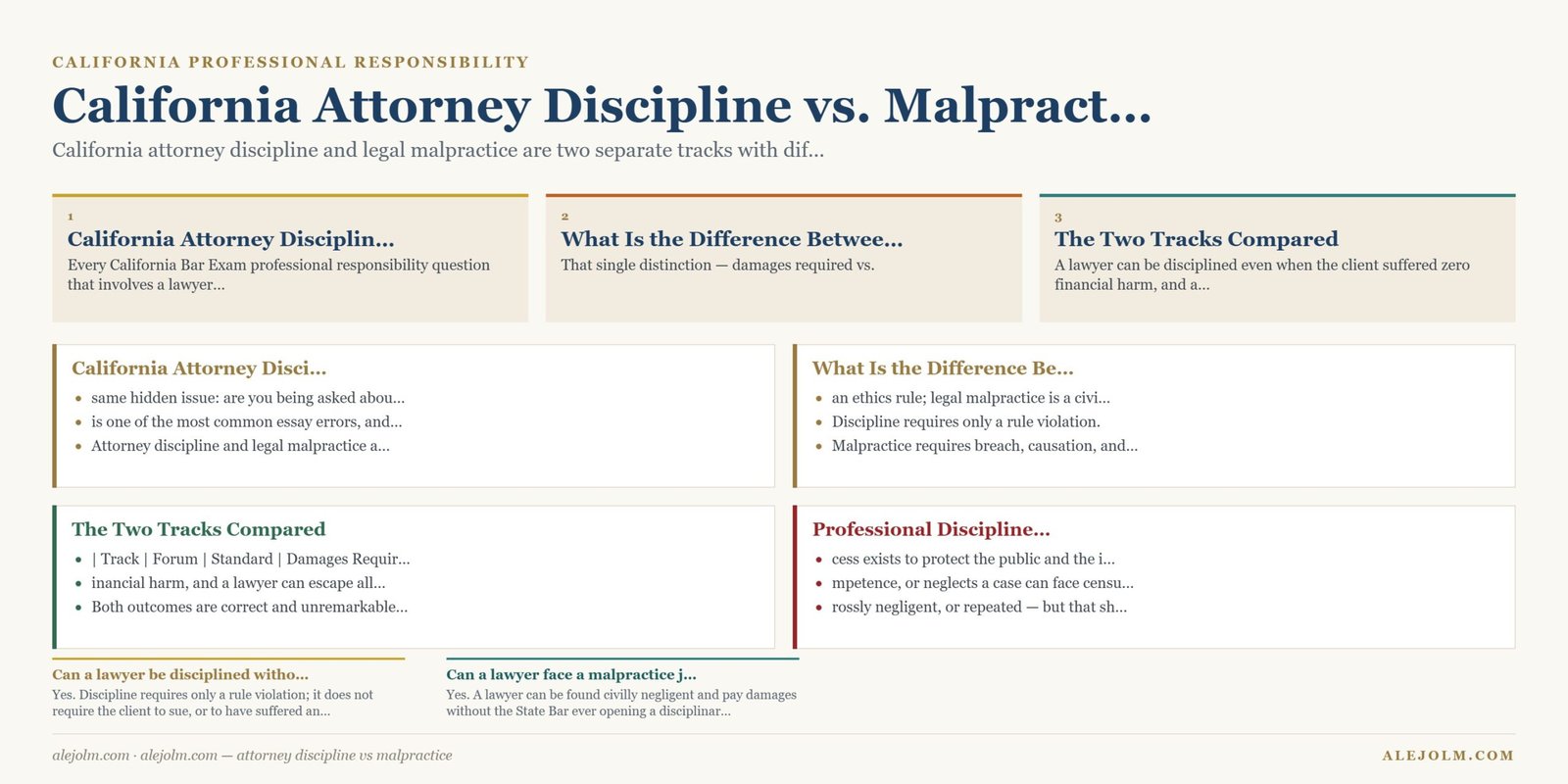
Every California Bar Exam professional responsibility question that involves a lawyer’s mistake tests the same hidden issue: are you being asked about State Bar discipline, a civil malpractice claim, or both? Mixing them up is one of the most common essay errors, and it costs points even when your rule statement is otherwise correct.
Attorney discipline and legal malpractice are two independent consequence streams. A single act of lawyer misconduct can trigger one, the other, both, or — surprisingly often — neither, depending on whether the client actually suffered a provable loss.
What Is the Difference Between Discipline and Malpractice?
Attorney discipline is an administrative penalty the State Bar imposes for violating an ethics rule; legal malpractice is a civil lawsuit for money damages caused by a lawyer’s breach of duty. Discipline requires only a rule violation. Malpractice requires breach, causation, and actual damages.
That single distinction — damages required vs. not required — drives almost every fact pattern you will see on this topic.
The Two Tracks Compared
| Track | Forum | Standard | Damages Required? | Remedy |
|---|---|---|---|---|
| Professional discipline | State Bar, administrative proceeding | Rule violation (in California, competence/diligence lapses require intentional, reckless, grossly negligent, or repeated conduct) | No — the rule violation alone suffices | Censure, suspension, disbarment |
| Legal malpractice | Civil court | Breach of duty + causation + damages | Yes | Money damages |
A lawyer can be disciplined even when the client suffered zero financial harm, and a lawyer can escape all malpractice liability even after admittedly breaking an ethics rule. Both outcomes are correct and unremarkable once you separate the two frameworks.
Professional Discipline: Rule Violation Is Enough
The State Bar’s disciplinary process exists to protect the public and the integrity of the profession, not to compensate any individual client. A lawyer who misses a filing deadline, takes on a matter outside her competence, or neglects a case can face censure, suspension, or disbarment even if the client never loses a dime.
In California, competence and diligence violations require a heightened showing — the conduct must be intentional, reckless, grossly negligent, or repeated — but that showing has nothing to do with whether the client was actually harmed. It is entirely about the lawyer’s state of mind and conduct.
Legal Malpractice: You Must Prove Causation and Damages
A malpractice plaintiff sues under one of three theories:
- Breach of contract — failing to deliver the competent services promised.
- Breach of fiduciary duty — for example, an undisclosed conflict of interest or misuse of confidences.
- Negligence — failing to exercise the skill and care an ordinary lawyer would exercise in similar circumstances.
Under every theory, the client must prove causation: that the lawyer’s breach actually caused the loss, not merely that the lawyer did something wrong. This is where many malpractice claims collapse. A missed deadline is not malpractice if the underlying case was going to lose anyway.
Worked Example: Same Mistake, Different Outcomes
Consider three California lawyers, each of whom breaches a duty.
Lawyer A misses a deadline to file a dispositive motion in a civil case. The motion was negligently overlooked — it sat on the calendar in plain view. But the underlying claim was destined to lose on the merits regardless. Lawyer A faces likely State Bar discipline for the Rule 1.1 diligence lapse (the rule violation exists independent of harm), but the client’s malpractice suit fails: there is no causation, because better lawyering would not have changed the result.
Lawyer B takes a complex securities fraud case with zero relevant experience, violating the competence rule outright. Through pure luck — a key witness disappears, the other side settles generously — the client ends up better off than expected. Lawyer B faces discipline because the rule violation occurred regardless of outcome, but there is no malpractice claim because there are no damages.
Lawyer C negligently fails to relay a $500,000 settlement offer. The client, unaware, proceeds to trial and wins only $300,000. Here, both tracks apply: discipline for the Rule 1.4 communication violation, and a viable malpractice claim for the $200,000 difference, because the client can prove breach, causation, and damages.
Common Mistakes on the Bar Exam
- Assuming a rule violation automatically creates malpractice liability — it does not, without causation and damages.
- Assuming the State Bar needs proof of client harm to discipline a lawyer — it does not.
- Skipping the causation analysis in a malpractice essay and jumping straight to damages.
- Analyzing only one track when the facts plainly support both.
- Confusing the evidentiary standards: California discipline for competence lapses looks for intentional, reckless, or grossly negligent conduct, while malpractice uses an ordinary negligence standard.
How to Structure Your Essay Answer
When an essay presents a lawyer’s mistake, always ask two separate questions in this order:
- Was a rule violated? If yes, discipline is available regardless of harm.
- Did the client suffer provable damages caused by that violation? If yes, add a malpractice analysis; if no, say so explicitly and explain why the malpractice claim fails.
Explicitly labeling both tracks — even to conclude one of them does not apply — signals to the grader that you understand the doctrinal structure, not just the rule text.
FAQ
Can a lawyer be disciplined without ever being sued for malpractice?
Yes. Discipline requires only a rule violation; it does not require the client to sue, or to have suffered any loss at all. Many disciplined lawyers are never sued civilly.
Can a lawyer face a malpractice judgment without any State Bar discipline?
Yes. A lawyer can be found civilly negligent and pay damages without the State Bar ever opening a disciplinary file, particularly for garden-variety negligence that does not rise to the intentional, reckless, or grossly negligent standard discipline requires in California.
Does winning a malpractice case require proving the lawyer broke an ethics rule?
No. Malpractice is typically pleaded as ordinary negligence, breach of contract, or breach of fiduciary duty — a violation of the Rules of Professional Conduct can be evidence of the standard of care, but it is not a required element.
Key Takeaways
- Discipline and malpractice are separate consequence streams with different forums, standards, and remedies.
- Discipline requires only a rule violation; California adds an intentional/reckless/grossly negligent standard for competence and diligence lapses.
- Malpractice always requires breach, causation, and actual damages.
- A single act of misconduct can trigger both tracks, one track, or neither — always analyze them separately on an exam.
- Causation is the element that most often defeats an otherwise-valid malpractice claim.
This article is educational and is not legal advice. Consult a licensed California attorney about your situation.
Related guides
- client trust accounts and IOLTA rules
- malpractice liability waivers in California
- attorney liens in California
- conflicts of interest