
What Is Embezzlement?
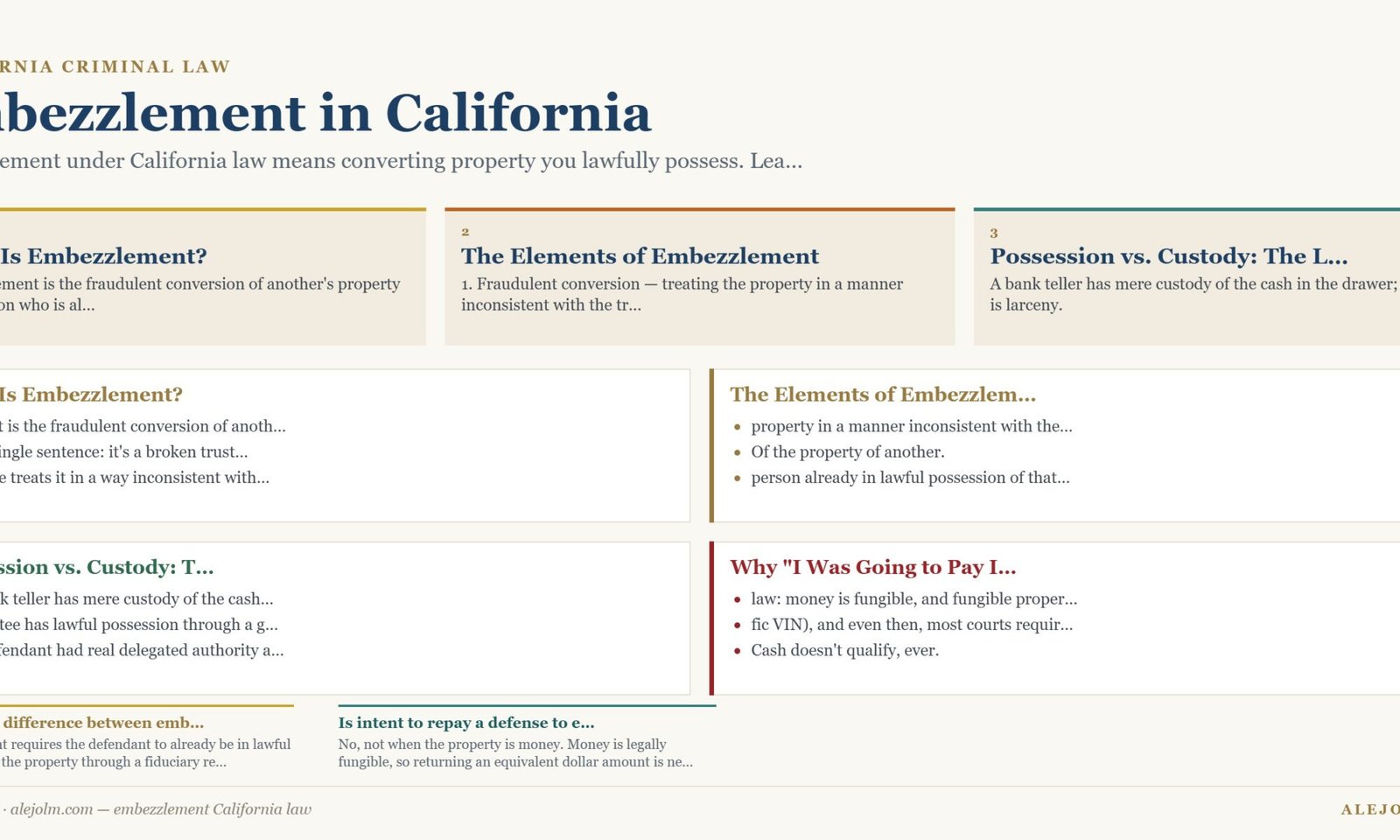
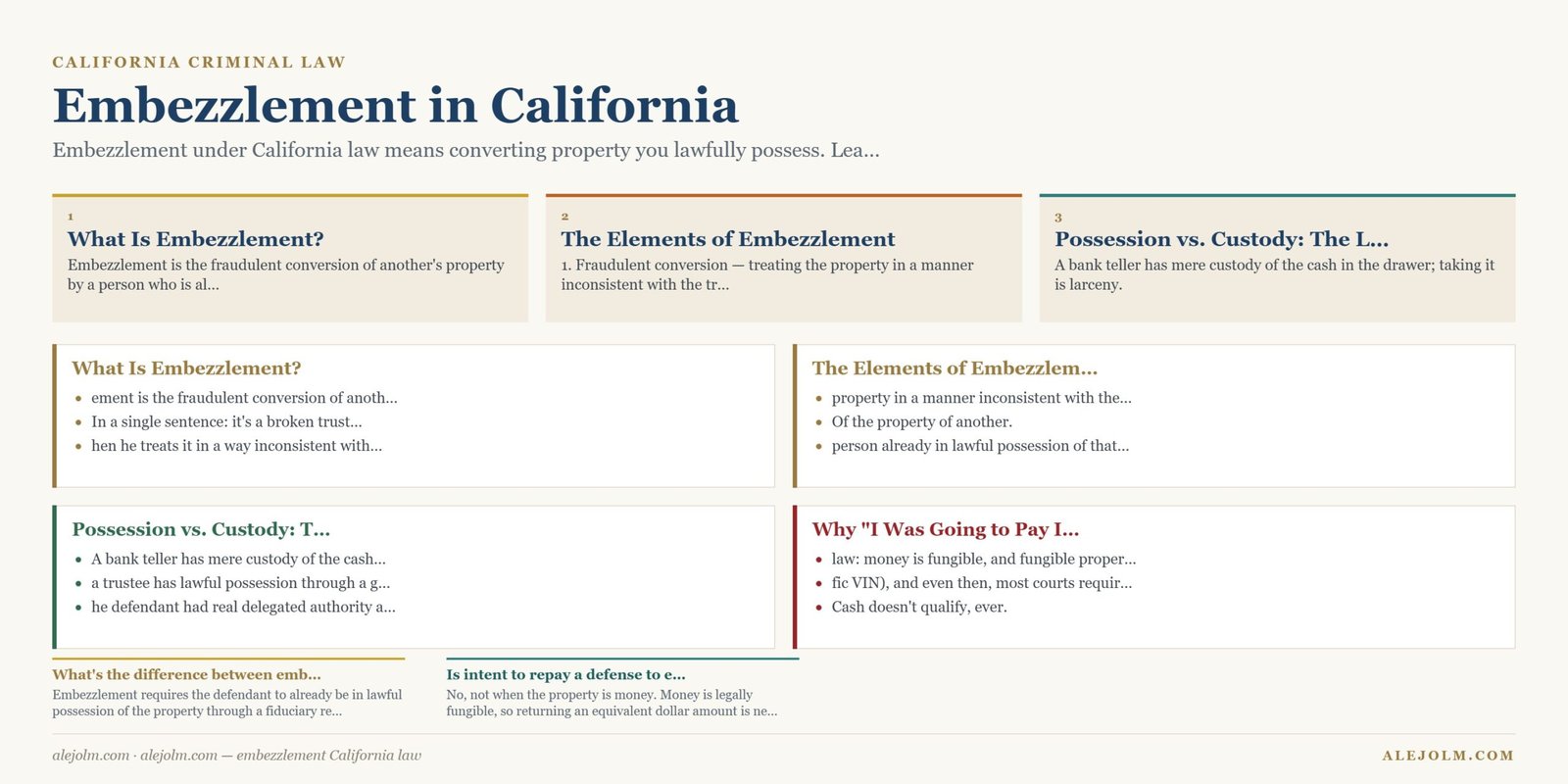
Embezzlement is the fraudulent conversion of another’s property by a person who is already in lawful possession of it. In a single sentence: it’s a broken trust, not a broken lock. There’s no trespassory taking, because the defendant already had the property lawfully — the crime happens when he treats it in a way inconsistent with the trust relationship that gave him possession in the first place.
California defines it in almost identical terms. Penal Code § 503 states that “embezzlement is the fraudulent appropriation of property by a person to whom it has been entrusted,” codifying the same core idea tested at common law and under Model Penal Code § 223.2, which folds embezzlement into a unified theft offense. On the California Bar Exam, you need both the common-law elements and the California-specific applications.
The Elements of Embezzlement
- Fraudulent conversion — treating the property in a manner inconsistent with the trust relationship, excluding the owner from its use and enjoyment.
- Of the property of another.
- By a person already in lawful possession of that property, entrusted through a fiduciary or similar relationship.
The entire crime turns on element three. Embezzlement requires lawful possession, not mere custody — and that distinction is the doctrinal core of this whole area of criminal law.
Possession vs. Custody: The Line That Decides Everything
A bank teller has mere custody of the cash in the drawer; taking it is larceny. A bank president or a trustee has lawful possession through a genuine fiduciary relationship; converting funds is embezzlement. The touchstone is whether the defendant had real delegated authority and responsibility over the property, not just physical access to it.
| Role | Legal status | Crime if property is misappropriated |
|---|---|---|
| Cashier ringing up sales | Custody only | Larceny |
| Store manager with account authority | Lawful possession | Embezzlement |
| Trustee managing a trust estate | Lawful possession | Embezzlement |
| Friend asked to hold valuables temporarily | Lawful possession (informal) | Embezzlement |
| Warehouse worker moving inventory | Custody only | Larceny |
Fiduciary relationships giving rise to lawful possession can arise through explicit trust arrangements, employment, statute (a guardian managing a ward’s property), or even an informal arrangement like a friend holding valuables for safekeeping. The prosecution has to prove the nature and scope of that relationship beyond a reasonable doubt.
Why “I Was Going to Pay It Back” Never Works
This is the single most heavily tested trap in embezzlement law: money is fungible, and fungible property is never “the same property” for restitution-defense purposes. Intent to return the exact same property taken can be a defense — but only for a specific, identifiable item (a particular necklace, a car with a specific VIN), and even then, most courts require the return to actually happen or be imminent, not merely promised.
Cash doesn’t qualify, ever. If a defendant diverts $10,000 and plans to replace it dollar-for-dollar next month, that plan is legally irrelevant. He isn’t returning “the exact property” — he’s returning different currency units that happen to add up to the same number.
Worked Example
Hypo: Fran, the treasurer of a nonprofit with signing authority over its bank accounts, transfers $10,000 of the nonprofit’s funds into her personal account, intending to replace the exact dollar amount before the next audit.
Analysis: Fran had lawful possession of the funds through her fiduciary role as treasurer — not mere custody — so her conversion of the money for personal use is embezzlement, not larceny. Her intent to repay is no defense, because money is fungible: replacing the same dollar amount is never treated as returning “the exact property” she took.
Restitution and the Intent Element
Restitution doesn’t erase completed embezzlement, but the timing of restitution can be relevant evidence of mens rea. If a defendant repays quickly and completely, that fact may support an inference that she never intended to permanently deprive the owner in the first place — potentially negating the intent-to-defraud element rather than serving as an independent defense. A long delay before any attempt at repayment, by contrast, tends to support an inference of persistent fraudulent intent. Either way, this is evidence about intent, not a freestanding defense once conversion with fraudulent intent is proven.
How This Differs From Larceny by Trick and False Pretenses
If a defendant obtains property through deception at the outset — before he ever has lawful possession — that’s not embezzlement. It’s larceny by trick (if only possession transfers) or false pretenses (if title transfers). Embezzlement only kicks in when the defendant was already lawfully entrusted with the property and later converts it. The fraud in embezzlement is in the conversion, not in how the defendant originally got the property.
Common Mistakes
- Mischaracterizing possession as custody (or vice versa). Mid-level employees with genuine account authority often have lawful possession even if they aren’t the highest officer in the company — mislabeling this as custody wrongly converts embezzlement into larceny.
- Assuming repayment defeats the charge. It doesn’t, once conversion with fraudulent intent is complete. Repayment is, at most, evidence relevant to the mens rea element.
- Treating any fiduciary misuse as embezzlement. A fiduciary who takes a risky but disclosed action with property, without excluding the owner from it, may not have “converted” it in the legal sense required.
- Skipping the fiduciary-relationship proof requirement. The prosecution must actually establish the relationship and its scope — it isn’t assumed just because the defendant had access to the property.
FAQ
What’s the difference between embezzlement and larceny in California?
Embezzlement requires the defendant to already be in lawful possession of the property through a fiduciary relationship at the time of the conversion. Larceny applies when the defendant has, at most, mere custody and takes the property without lawful authority to control it.
Is intent to repay a defense to embezzlement?
No, not when the property is money. Money is legally fungible, so returning an equivalent dollar amount is never treated as returning “the exact property” taken. Only specific, identifiable non-monetary property can sometimes support this narrow defense.
What is California Penal Code § 503?
Penal Code § 503 is California’s statutory definition of embezzlement: the fraudulent appropriation of property by a person to whom it has been entrusted. It mirrors the common-law elements tested nationally on the bar exam.
Key Takeaways
- Embezzlement is the fraudulent conversion of property by someone already in lawful possession of it — no trespassory taking is required.
- The possession-versus-custody line, not job title alone, determines whether misappropriated property yields larceny or embezzlement liability.
- California Penal Code § 503 codifies the common-law definition of embezzlement almost verbatim.
- Money is always fungible; intent or even actual repayment of an equivalent sum is never a complete defense to completed embezzlement.
- Restitution timing can be circumstantial evidence bearing on intent to defraud, even though it’s not a standalone defense.
This article is educational and is not legal advice. Consult a licensed California attorney about your situation.