
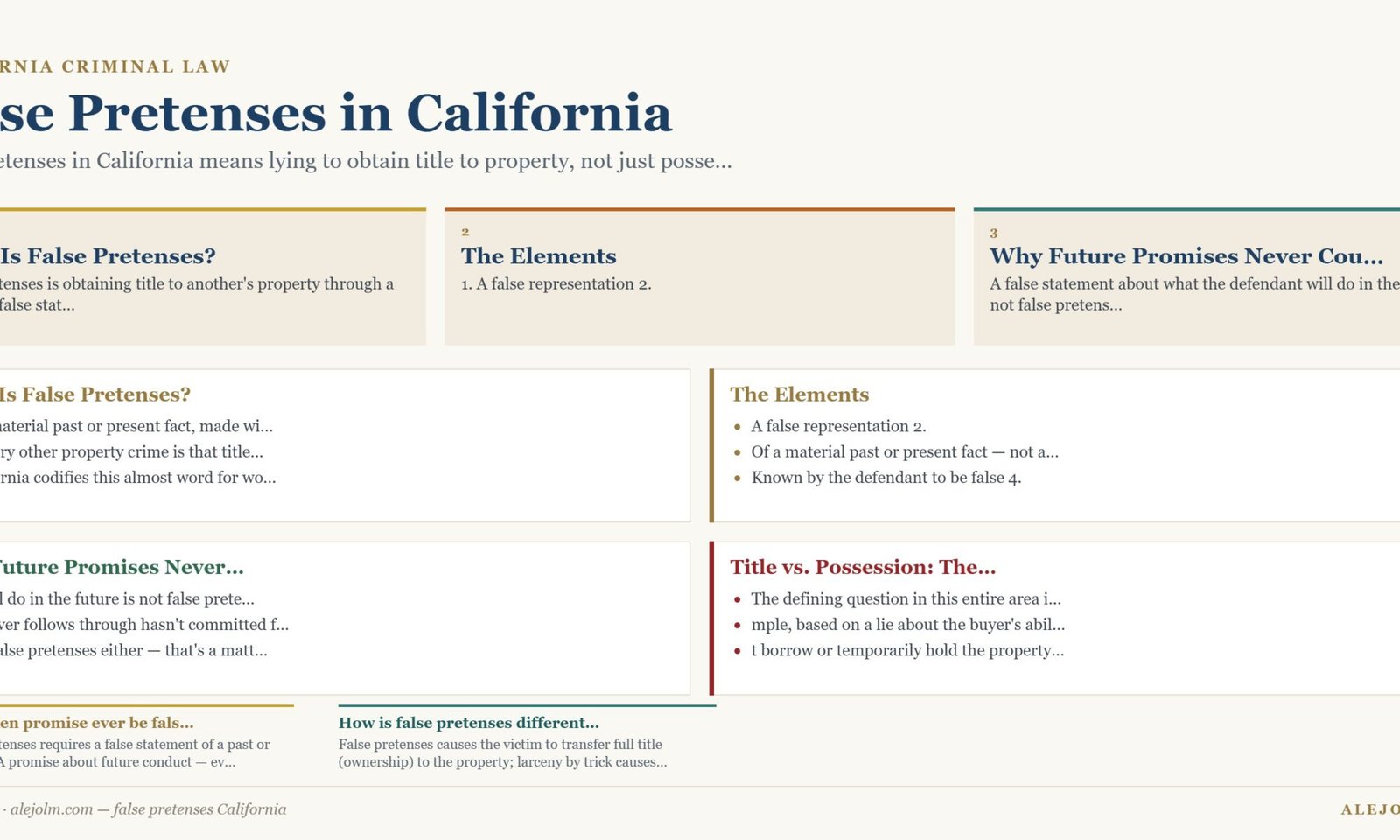
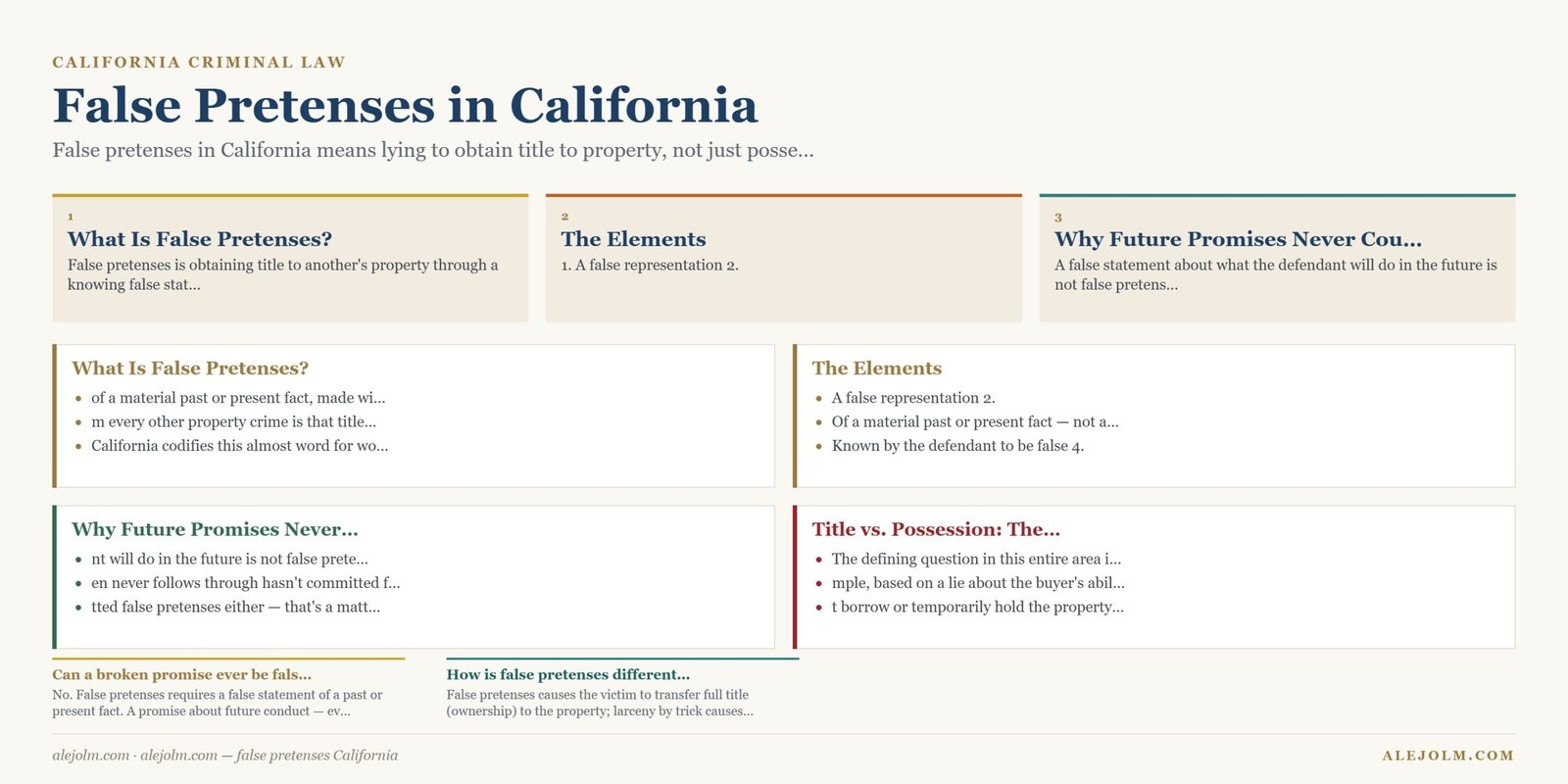
What Is False Pretenses?
False pretenses is obtaining title to another’s property through a knowing false statement of a material past or present fact, made with intent to defraud, that causes the owner to convey the property. It’s a specific-intent crime, and the single feature that separates it from every other property crime is that title — full ownership, not just possession — passes to the defendant.
California codifies this almost word for word. Penal Code § 532 punishes anyone who “knowingly and designedly, by any false or fraudulent representation or pretense, defrauds any other person of money, labor, or real or personal property” — and the statute expressly punishes it the same as larceny of equivalent value. On the California Bar Exam, false pretenses is tested constantly because it’s the crime students most often confuse with its close cousin, larceny by trick.
The Elements
- A false representation
- Of a material past or present fact — not a future promise, not an opinion
- Known by the defendant to be false
- Made with intent to defraud
- That causes the victim to pass title to the property
The past-or-present-fact requirement is rigid, and it’s the single biggest trap on this topic.
Why Future Promises Never Count
A false statement about what the defendant will do in the future is not false pretenses — even if the defendant never intended to keep the promise. A defendant who promises to marry someone and then never follows through hasn’t committed false pretenses, no matter how insincere the promise was at the time. A borrower who promises to repay a loan with no intention of doing so hasn’t committed false pretenses either — that’s a matter for civil fraud or breach of contract, not this criminal statute.
Examiners plant unkept future promises as distractors constantly. Train yourself to ask: is the lie about a fact that already existed, or about something the defendant said he’d do later? Only the former supports false pretenses.
Title vs. Possession: The Line That Separates False Pretenses From Larceny by Trick
The defining question in this entire area is what the victim believed she was giving up. If she intended to transfer full ownership — selling her car, for example, based on a lie about the buyer’s ability to pay — and was deceived into doing so, that’s false pretenses. If she only intended to let the defendant borrow or temporarily hold the property, and he took it via a lie, that’s larceny by trick instead.
| Factor | False pretenses | Larceny by trick |
|---|---|---|
| What transfers | Title (full ownership) | Possession only |
| Victim’s intent | To sell or permanently convey | To lend or temporarily entrust |
| Classic fact pattern | Selling property based on a lie about payment ability | Lending property based on a lie about intended use |
Look for concrete facts that reveal the victim’s subjective intent: was a receipt given, was consideration exchanged, did the victim relinquish all control? Business context matters too — a rental transaction usually contemplates possession only, while a sale (even on credit or by check) contemplates title transfer.
Knowledge of Falsity: Actual Knowledge vs. Willful Blindness
The defendant must know the statement is false, either through actual knowledge or, in many jurisdictions, willful blindness. Willful blindness requires the defendant to be aware of a high probability that the statement is false and to deliberately avoid confirming the truth. Mere negligence or a failure to investigate isn’t enough — the defendant has to have consciously dodged the truth.
Statements of opinion and ordinary sales puffery (“this car is great,” “you’ll love this outfit”) don’t satisfy the knowing-falsity element at all, because they aren’t statements of fact to begin with.
Worked Example
Hypo: Sam tells Old Man Perkins that Sam’s ring is a genuine two-carat diamond, knowing it’s actually cubic zirconia, and sells it to Perkins for $8,000, intending to keep the money and never disclose the truth.
Analysis: Sam made a knowing false statement of a present, material fact (the ring’s authenticity) with intent to defraud, and that lie caused Perkins to hand over $8,000 in reliance on it. Perkins intended to transfer full ownership of his $8,000 to Sam in a completed sale, and Sam obtained title to that money through the misrepresentation. Sam is guilty of false pretenses — the victim is Perkins, and the property Sam fraudulently obtained is the $8,000 purchase price, not the ring (which Sam already owned and validly conveyed). Perkins may separately have civil fraud or rescission remedies against Sam, but the criminal false-pretenses analysis focuses on what Sam obtained by lying.
The Merger Rule: No Double-Charging
Once false pretenses is established and title has passed, the defendant can’t also be convicted of larceny or embezzlement over the same property. This prevents double-counting for what is really one theory of liability. If the defendant later does something beyond the original deception — say, sells property obtained through false pretenses and then converts the sale proceeds in a new act — additional charges might attach for that separate conduct.
Common Mistakes
- Applying false pretenses to broken promises. A defendant who never intends to keep a future promise has not committed false pretenses; the statement has to concern a past or present fact.
- Confusing false pretenses with larceny by trick. The dispositive question is whether the victim intended to transfer title (false pretenses) or only possession (larceny by trick) — not simply whether a lie induced the transfer.
- Treating mere negligence as willful blindness. Willful blindness requires conscious awareness of a high probability of falsity, not just a failure to investigate.
- Charging both false pretenses and larceny for the same property. Once title passes under a false-pretenses theory, larceny and embezzlement drop out of the case entirely.
FAQ
Can a broken promise ever be false pretenses in California?
No. False pretenses requires a false statement of a past or present fact. A promise about future conduct — even one made with no intention of keeping it — isn’t a false statement of fact and can’t support a false pretenses charge under Penal Code § 532.
How is false pretenses different from larceny by trick?
False pretenses causes the victim to transfer full title (ownership) to the property; larceny by trick causes the victim to transfer only possession, while she still believes she retains ownership.
Does willful blindness satisfy the knowledge element in California?
In many jurisdictions, yes — if the defendant was aware of a high probability that a statement was false and deliberately avoided confirming the truth. This is a higher bar than mere negligence or failure to investigate.
Key Takeaways
- False pretenses requires a knowing false statement of a past or present fact that causes the victim to pass title to property.
- California Penal Code § 532 punishes false pretenses the same way it punishes larceny of equivalent value.
- Future promises, opinions, and puffery never satisfy the false-statement element.
- The title-versus-possession question is the entire test for distinguishing false pretenses from larceny by trick.
- Once title passes, the defendant can’t also be charged with larceny or embezzlement over the same property.
This article is educational and is not legal advice. Consult a licensed California attorney about your situation.