
The dormant Commerce Clause is not written anywhere in the Constitution. It is inferred from the grant of commerce power to Congress: if the national legislature holds authority over interstate trade, states cannot legislate in ways that fragment the national market. When Congress has said nothing, states may still regulate local matters, but not by discriminating against outsiders and not by imposing burdens out of proportion to what they gain.
This guide explains the two analytical tracks, how to tell discrimination in effect from mere neutrality, the three escapes available to a discriminatory law, and why the doctrine disappears the moment Congress acts.
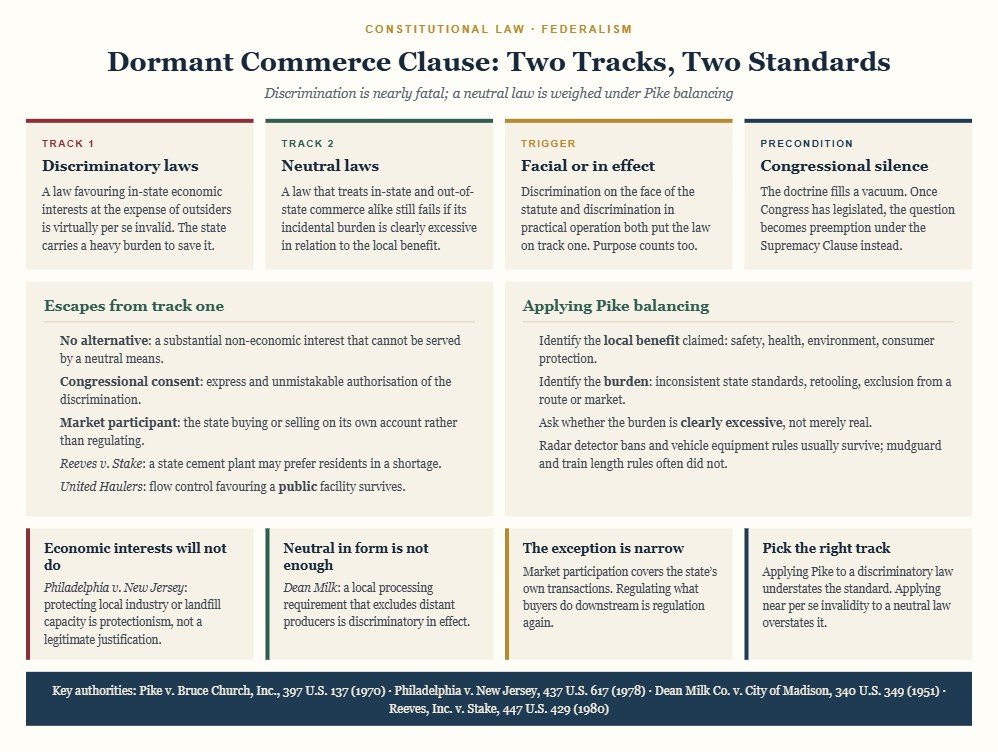
The precondition: congressional silence
Begin by confirming that Congress has not spoken. If a federal statute addresses the subject and the state law conflicts with it, the case is a preemption case governed by the Supremacy Clause, not a dormant Commerce Clause case. The two doctrines answer different questions, and merging them is one of the most common errors in this area.
Congress can also go the other way and expressly authorise state discrimination. Insurance regulation and certain waste and alcohol schemes have been immunised in exactly that way. Where the authorisation is express and unmistakable, the challenge fails without any balancing at all.
Track one: discriminatory laws
A state law that benefits in-state economic interests at the expense of out-of-state interests is treated as virtually per se invalid. The state must then show a substantial local interest that is not economic in character and that cannot be served by any reasonable non-discriminatory alternative. That burden is rarely carried.
Philadelphia v. New Jersey shows how the argument collapses. New Jersey banned the importation of out-of-state waste and defended the ban as environmental protection. The Court found protectionism, because the state’s own waste created the same problems and was not banned. When a justification does not fit the pattern of the discrimination, the justification is not the real reason.
Discrimination in effect
Facial neutrality is not a safe harbour. In Dean Milk Co. v. City of Madison an ordinance required milk to be pasteurised within five miles of the city centre. On its face it applied to everyone; in operation it excluded producers from further afield, including out-of-state dairies, and reasonable alternatives such as inspection fees were available. The ordinance fell on track one despite its neutral wording.
Purpose matters as well. A statute whose stated aim is protecting a local industry has announced its own discrimination, and no drafting can rescue it.
The three escapes
- No reasonable alternative. A genuine health, safety or environmental interest that cannot be protected by even-handed means can justify discrimination. Quarantine laws against genuinely infected goods are the classic example.
- Congressional consent. Express federal authorisation removes the constitutional objection entirely, because the doctrine only fills the gap left by congressional silence.
- Market participation. When a state buys or sells on its own account, it is a trader rather than a regulator and may prefer its own citizens. Reeves, Inc. v. Stake upheld a state-owned cement plant selling only to residents during a shortage, and United Haulers upheld flow control directing waste to a publicly owned facility.
The market participant exception is narrower than candidates expect. It covers the state’s own transactions. Once the state attaches conditions regulating what its buyers subsequently do with the goods, it has resumed the regulatory role and the exception no longer applies.
Track two: Pike balancing
A genuinely even-handed law is assessed by weighing its incidental burden on interstate commerce against the local benefit it produces. The law fails only if the burden is clearly excessive in relation to that benefit, which gives states real room to legislate.
The analysis is concrete rather than abstract. Identify what the state gains, then identify what interstate actors must do differently: retool vehicles at the border, comply with a standard inconsistent with neighbouring states, or abandon a route. Highway safety rules of general application typically survive, while requirements that force operators to reconfigure equipment at state lines have often failed.
| State law | Track | Likely outcome |
|---|---|---|
| Ban on importing out-of-state waste | Discriminatory | Invalid; economic protectionism (Philadelphia) |
| Local pasteurisation radius | Discriminatory in effect | Invalid; alternatives available (Dean Milk) |
| State-owned plant selling only to residents | Market participant | Valid (Reeves) |
| Radar detector ban applying to all vehicles | Neutral | Valid under Pike; safety benefit outweighs inconvenience |
| Unique mudguard or truck configuration requirement | Neutral | Often invalid; burden clearly excessive |
Exam tip: never apply Pike balancing to a discriminatory law. Doing so understates the standard and signals that the discrimination was never identified.
A worked example
A grain-producing state bans the importation of ethanol-blended petrol from other states, declaring that the purpose is to support its own corn-derived biofuel industry. Out-of-state distributors sue.
- Track: the statute discriminates against out-of-state product and announces a protectionist purpose. Track one applies.
- Justification: the asserted interest is economic, which is precisely what the doctrine forbids.
- Recharacterisation: if the state reframes the aim as reducing emissions, the argument still fails, because in-state ethanol blends remain permitted and the rule therefore does not match the environmental rationale.
- Alternative: a uniform ethanol content standard applied to all fuel would serve any genuine environmental goal without discriminating.
- Conclusion: the ban is unconstitutional.
Common mistakes that cost points
- Analysing a preemption problem as a dormant Commerce Clause problem, or the reverse.
- Missing discrimination in effect because the statute reads neutrally.
- Applying Pike balancing to a discriminatory law.
- Accepting an economic justification for discrimination.
- Treating the market participant exception as covering downstream conditions.
- Forgetting that express congressional consent ends the inquiry.
- Failing to identify the specific burden on interstate actors in a Pike analysis.
- Confusing general dormant Commerce Clause analysis with the four-part test applied to state taxation of interstate commerce.
Frequently asked questions
How does this differ from the Privileges and Immunities Clause of Article IV?
Article IV protects individuals, not goods or corporations, and it has no market participant exception. Where a state disadvantages out-of-state citizens in a fundamental economic activity such as earning a living, both doctrines may apply, and a good answer runs them separately.
Does the doctrine apply to state taxes?
It does, but through a specialised four-part framework asking about substantial nexus, fair apportionment, non-discrimination and a fair relation to services provided. Recite that test rather than general balancing when a tax is at issue.
Can a city ordinance violate the dormant Commerce Clause?
Yes. Local governments are treated as state actors for this purpose, and Dean Milk concerned a municipal ordinance. The analysis does not change because the regulator is smaller.
The dormant Commerce Clause and California regulation in 2026
California is the state that tests this doctrine hardest, because the size of its market means a California rule often becomes the national rule. That practical reality is now reflected in the case law. In National Pork Producers Council v. Ross (2023) the Supreme Court upheld Proposition 12, California’s ban on selling pork from breeding pigs confined below specified standards, even though almost all affected producers operate in other states. The Court declined to read the doctrine as containing a broad prohibition on state laws with extraterritorial economic effects.
The surviving core is therefore narrower than students often assume: facial discrimination against interstate commerce is close to fatal, and the balancing enquiry associated with Pike remains available but is difficult to win where a law is evenhanded. California’s low carbon fuel standard survived challenge on essentially those grounds, and its vehicle emissions programme occupies a special statutory position because the Clean Air Act expressly permits California to seek a waiver to set stricter standards.
What this looks like at county level:
- Local procurement preferences are the usual flashpoint. Ordinances favouring local contractors or suppliers invite a discrimination challenge, and the Los Angeles County Counsel reviews them for that reason.
- The market participant exception does heavy work. When Los Angeles County buys rather than regulates, it may prefer local firms, so the characterisation of the county’s role often decides the case.
- Port regulation is usually a preemption problem. American Trucking Associations v. City of Los Angeles (2013) struck parts of the Clean Truck Program under federal transport preemption rather than the dormant Commerce Clause.
- Sales-and-use tax rules follow Wayfair. Physical presence is no longer required, and California’s district taxes apply to remote sellers meeting the thresholds.
- Extraterritorial effect alone is not enough. After Ross, argue discrimination or genuine burden, not mere out-of-state impact.
- Congress can authorise discrimination. Where a federal statute permits state variation, as with the emissions waiver, the doctrine drops away entirely.
For 2026 the sequence is: discrimination first, then Pike balancing, then market participant and congressional authorisation as exits. Read alongside the affirmative Commerce Clause and federal preemption, which frequently supplies the stronger argument.
Next steps
Practise by classifying laws before analysing them, since track selection determines the outcome more often than the balancing does. Then read the doctrine alongside its affirmative counterpart in The Commerce Clause: 3 Categories and 2 Hard Limits, and the structural limits on suing states in The Eleventh Amendment and State Sovereign Immunity.
For primary sources, read Pike v. Bruce Church, Inc., Philadelphia v. New Jersey and Reeves, Inc. v. Stake. Cornell’s note on the dormant Commerce Clause is a useful summary.
Related guides
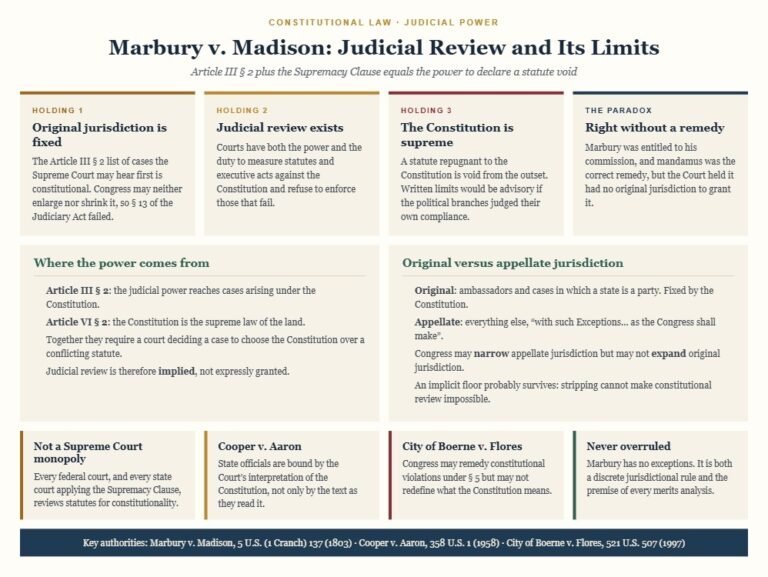 Marbury v. Madison and the Power of Judicial Review
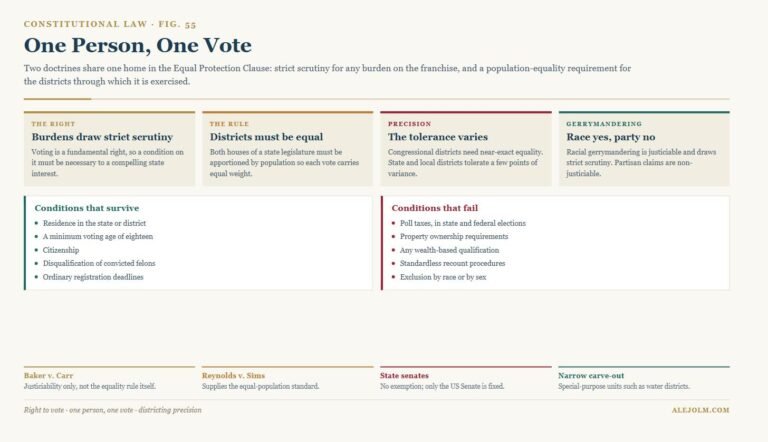 One Person, One Vote: Voting Rights Under Equal Protection
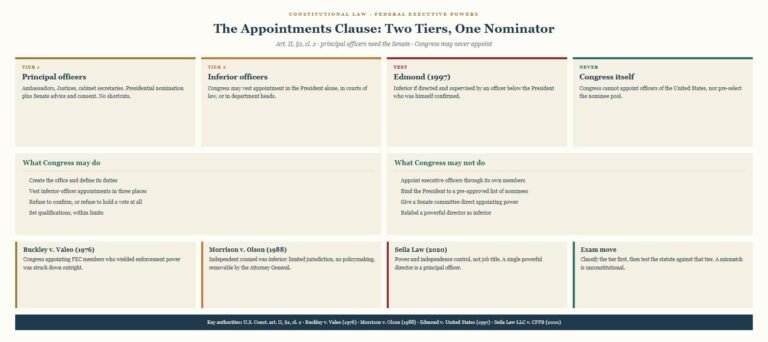 The Appointment Power: Principal and Inferior Officers
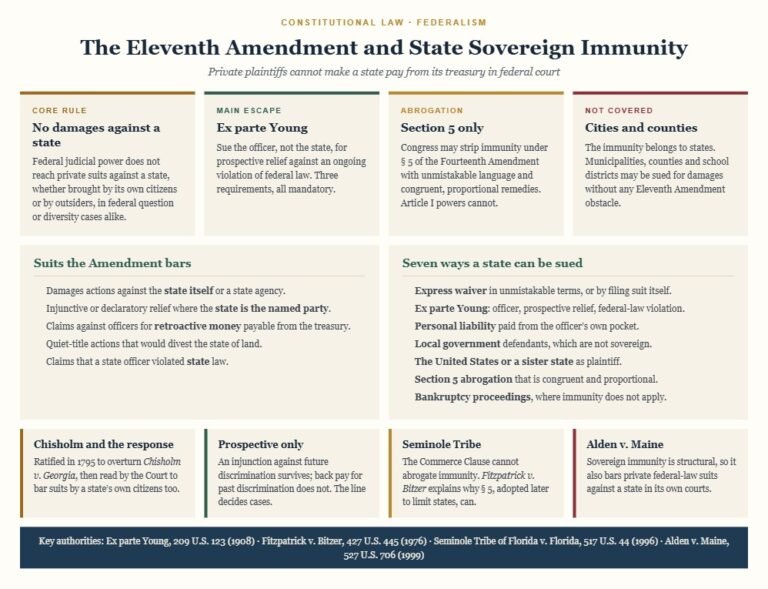 The Eleventh Amendment and State Sovereign Immunity
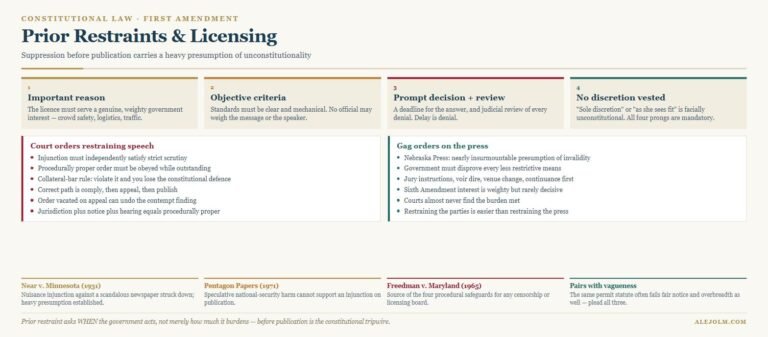 Prior Restraint and Licensing: The Freedman Safeguards
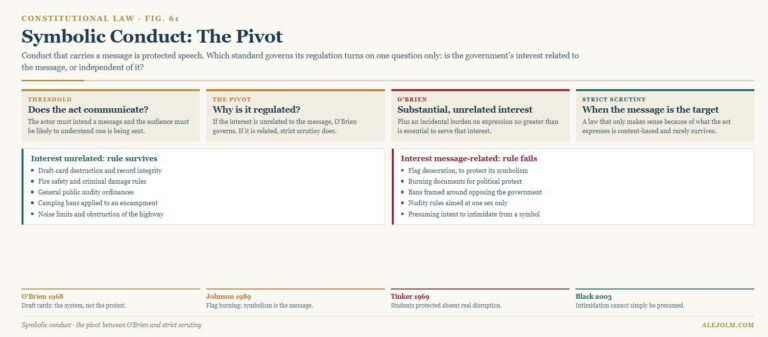 Symbolic Conduct and the O’Brien Test: The Pivot Question
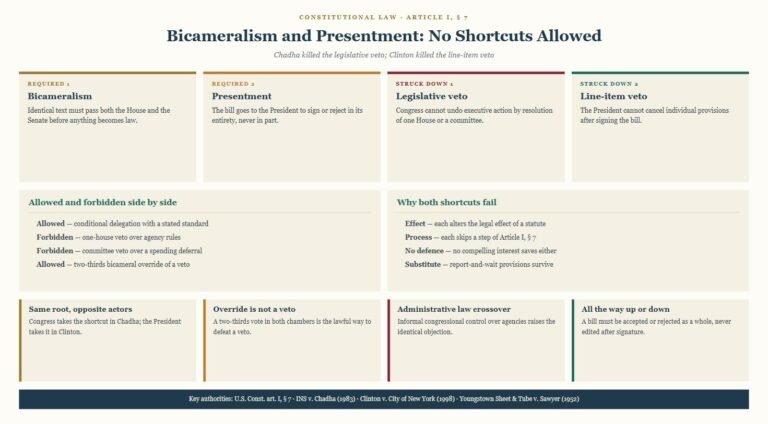 Bicameralism and Presentment: Two Vetoes Struck Down
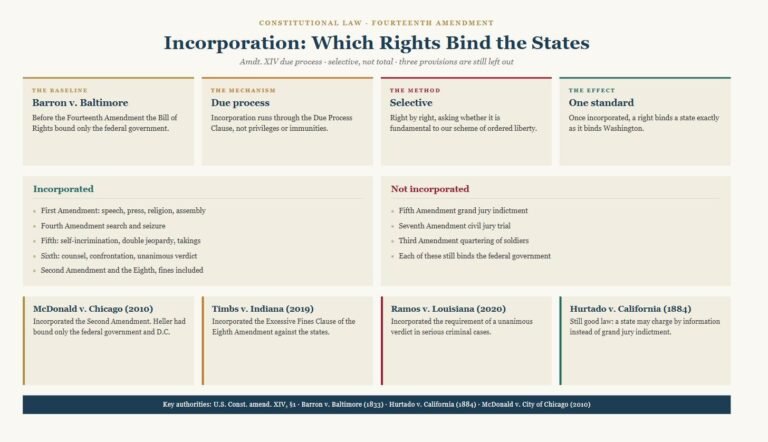 Incorporation Doctrine: Which Rights Bind the States
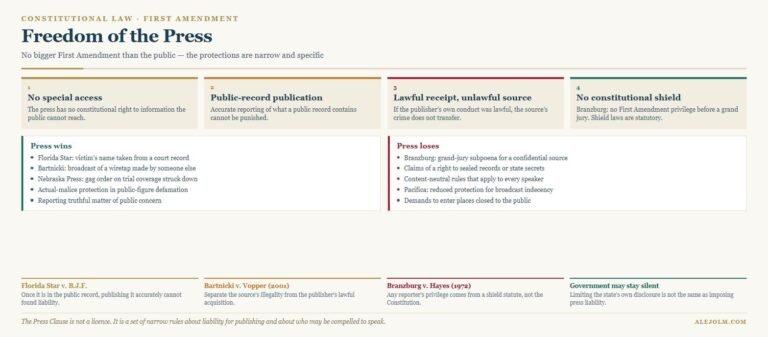 Freedom of the Press: Publication Liability and Limits
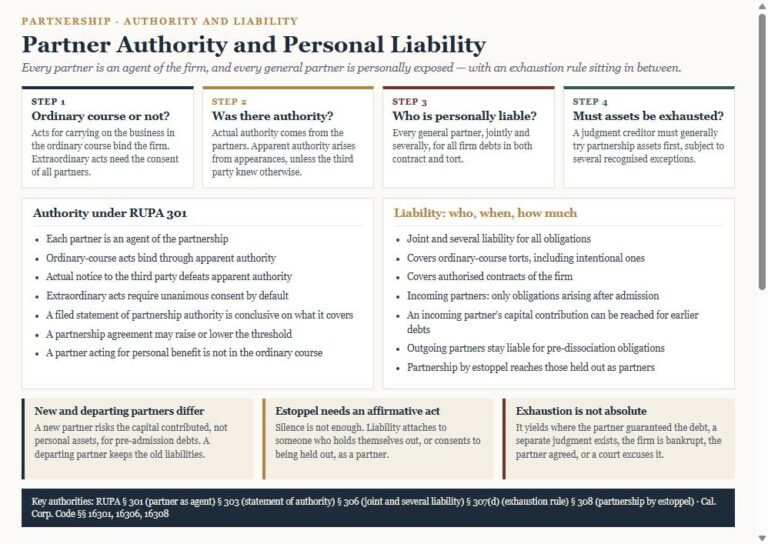 Partner Liability and Authority Under RUPA Explained
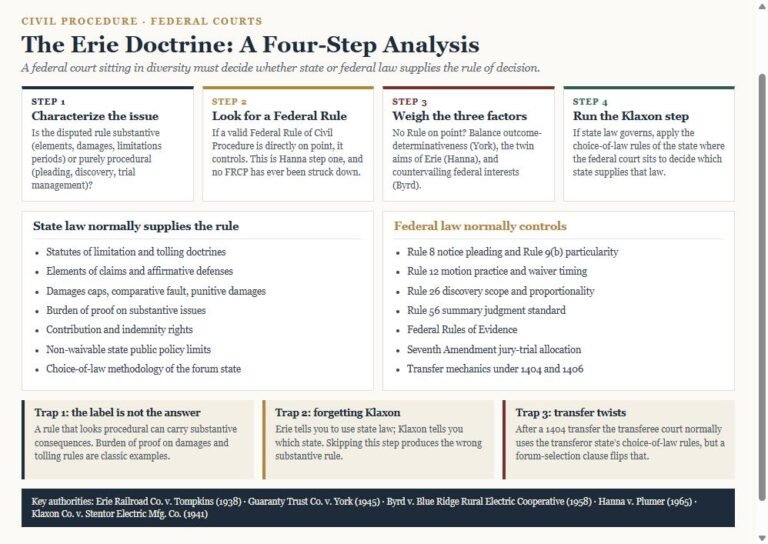 The Erie Doctrine Explained: A 4-Step Bar Exam Guide
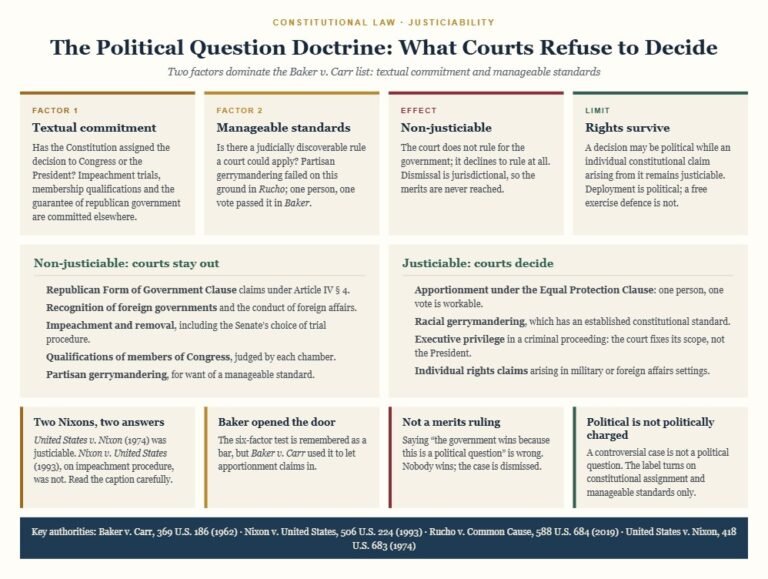 Political Question Doctrine: What Courts Will Not Decide