
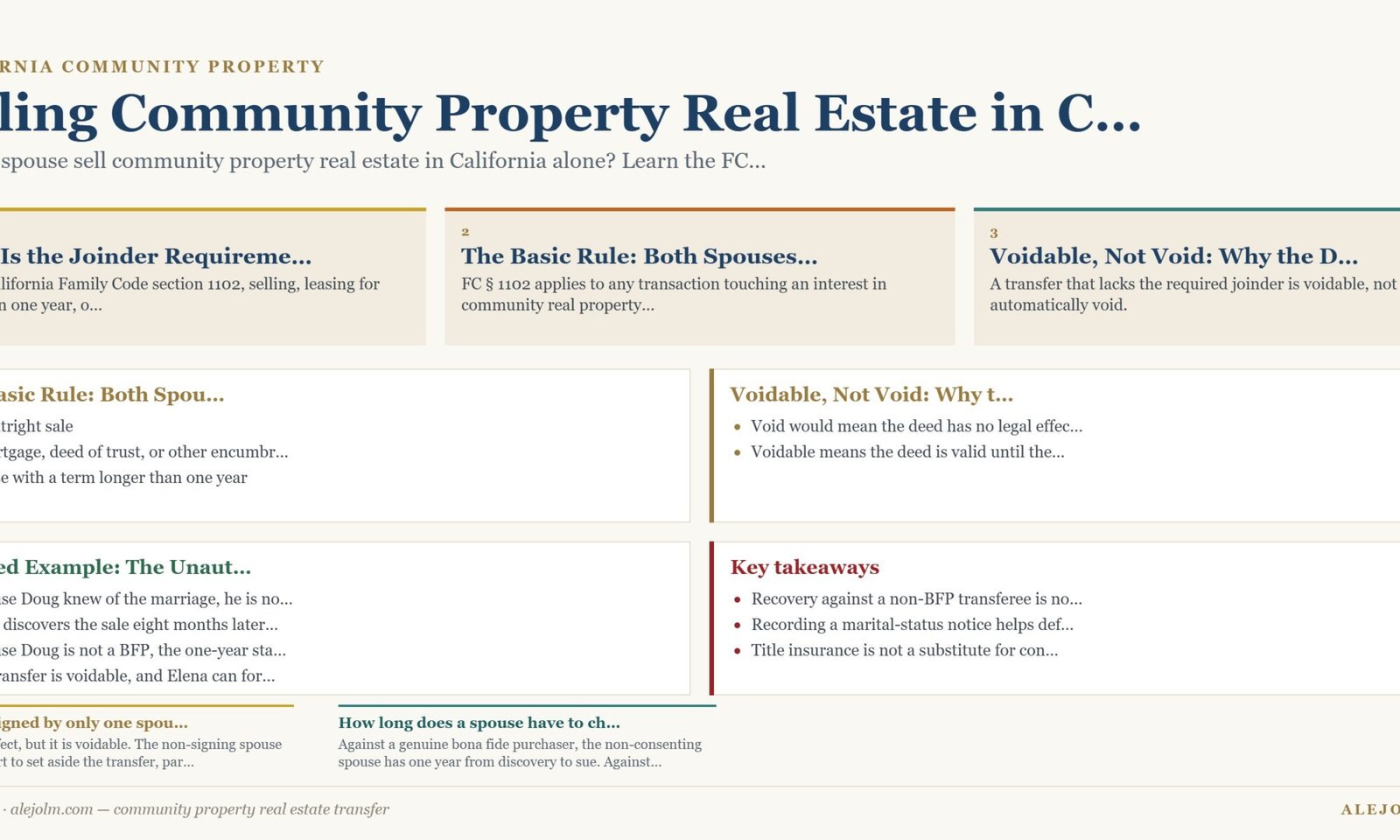

What Is the Joinder Requirement for Community Property Real Estate?
Under California Family Code section 1102, selling, leasing for more than one year, or encumbering community property real estate requires the signed participation — the “joinder” — of both spouses. A deed signed by only one spouse is not automatically invalid, but it is voidable at the request of the non-signing spouse. This single rule protects the largest asset most California couples own: the family home.
If you are studying for the California Bar Exam, FC § 1102 shows up constantly in community property essays, usually paired with a fact pattern involving a secretive spouse, an unsuspecting buyer, and a ticking statute of limitations. Master the framework and the analysis becomes almost mechanical.
The Basic Rule: Both Spouses Must Sign
FC § 1102 applies to any transaction touching an interest in community real property, including:
- An outright sale
- A mortgage, deed of trust, or other encumbrance
- A lease with a term longer than one year
Neither spouse can unilaterally give away, sell, or mortgage “their half” of the community’s real estate. Because community property is an undivided whole during marriage, the entire interest — not a fractional share — moves with any conveyance, and the law requires both owners to authorize that move.
Voidable, Not Void: Why the Distinction Matters
A transfer that lacks the required joinder is voidable, not automatically void. That distinction is worth memorizing for exam purposes:
- Void would mean the deed has no legal effect from the start, for anyone, forever.
- Voidable means the deed is valid until the non-consenting spouse takes action to unwind it.
Practically, this means the transferee (the buyer, lender, or lessee) holds some interest in the property until the non-consenting spouse successfully challenges the transaction. The non-consenting spouse can seek rescission of the deed or pursue the transferring spouse for the loss to the community.
The Bona Fide Purchaser Exception
California balances spousal protection against the need for a reliable real estate market. If the transferee is a bona fide purchaser (BFP) — someone who paid value and had no knowledge that the seller was married — that BFP’s interest gets special protection:
| Scenario | Result |
|---|---|
| Transferee knew of the marriage (not a BFP) | Transfer remains voidable; no one-year deadline applies |
| Transferee is a genuine BFP, unaware of the marriage | Non-consenting spouse has only one year to sue to set aside the transfer |
| Non-consenting spouse sues within one year against a BFP | Transfer can be rescinded, but consideration received must be restored |
| Non-consenting spouse waits past one year against a BFP | BFP’s interest is protected; transfer stands |
The one-year clock is a defense available only to true BFPs. A friend, relative, or anyone who had reason to suspect the seller was married does not get the shortened limitations period.
Recording a Marital Status Notice
Because the BFP defense hinges on the buyer’s lack of knowledge, California allows a notice of marital status to be recorded in the chain of title. This does not stop a bad-faith spouse from attempting a sale, but it puts future buyers and lenders on constructive notice that the property might be community property requiring both signatures — which defeats a later BFP claim.
Worked Example: The Unauthorized Sale to a Friend
Marco and Elena own their Sacramento home as community property. Without telling Elena, Marco signs a deed selling the house to his friend Doug for $500,000. Doug knows Marco is married but never asks Elena to sign anything.
- Because Doug knew of the marriage, he is not a BFP.
- Elena discovers the sale eight months later and sues to set the transfer aside.
- Because Doug is not a BFP, the one-year statute of limitations that would otherwise apply to BFPs is irrelevant — Elena’s claim is not time-barred merely because Doug lacked notice-based protection.
- The transfer is voidable, and Elena can force rescission of the deed and recovery of the property for the community.
Now change one fact: Doug has never met Marco or Elena, genuinely believed Marco was single, and paid fair market value. Doug is a BFP. If Elena waits eighteen months to sue, the one-year window has closed, and Doug’s interest in the home is protected — Elena’s only remedy becomes a claim against Marco personally for the community’s loss.
Common Mistakes Bar Candidates Make
A frequent scored error is assuming that once a deed is recorded with only one spouse’s signature, the transaction is settled and the other spouse has no recourse. That is wrong. The non-signing spouse can bring an action to set aside a transfer of community real property, sometimes years later if the transferee was not a BFP, and title insurance does not necessarily protect a buyer against a spousal-consent defect.
Another mistake is treating “voidable” as if it means “automatically unwound.” The non-consenting spouse must actually act — file suit, seek rescission, or otherwise assert the claim — within the applicable time limits.
Practical Protection for Buyers and Lenders
Because title insurance may not cover a spousal-consent defect, real estate practitioners routinely require:
- Signatures from both spouses on any deed or deed of trust affecting real property, regardless of how title is held.
- A sworn declaration from the seller confirming marital status and, if married, that the property is separate rather than community property.
- A title search for any recorded notice of marital status.
FAQ
Is a deed signed by only one spouse valid in California?
It can take effect, but it is voidable. The non-signing spouse can go to court to set aside the transfer, particularly if the buyer knew about the marriage or is not a bona fide purchaser.
How long does a spouse have to challenge an unauthorized sale of community real estate?
Against a genuine bona fide purchaser, the non-consenting spouse has one year from discovery to sue. Against a transferee who was not a BFP, no comparable one-year bar applies.
Does recording the deed protect the buyer from a spousal challenge?
No. Recording only establishes public notice of the transaction; it does not cure a missing joinder or convert a non-BFP buyer into a protected one.
Key Takeaways
- FC § 1102 requires both spouses to join in any sale, encumbrance, or long-term lease of community real property.
- A transfer without joinder is voidable, not void.
- A true BFP’s interest is protected once one year passes without a challenge from the non-consenting spouse.
- Recovery against a non-BFP transferee is not limited by the same one-year window.
- Recording a marital-status notice helps defeat future BFP claims.
- Title insurance is not a substitute for confirming spousal consent before closing.
This article is educational and is not legal advice. Consult a licensed California attorney about your situation.
Related guides
- community property gift rules
- family law attorney real property lien
- community property presumptions
- adverse possession elements
- recording acts