
Who Runs the Family Business When It’s Community Property?
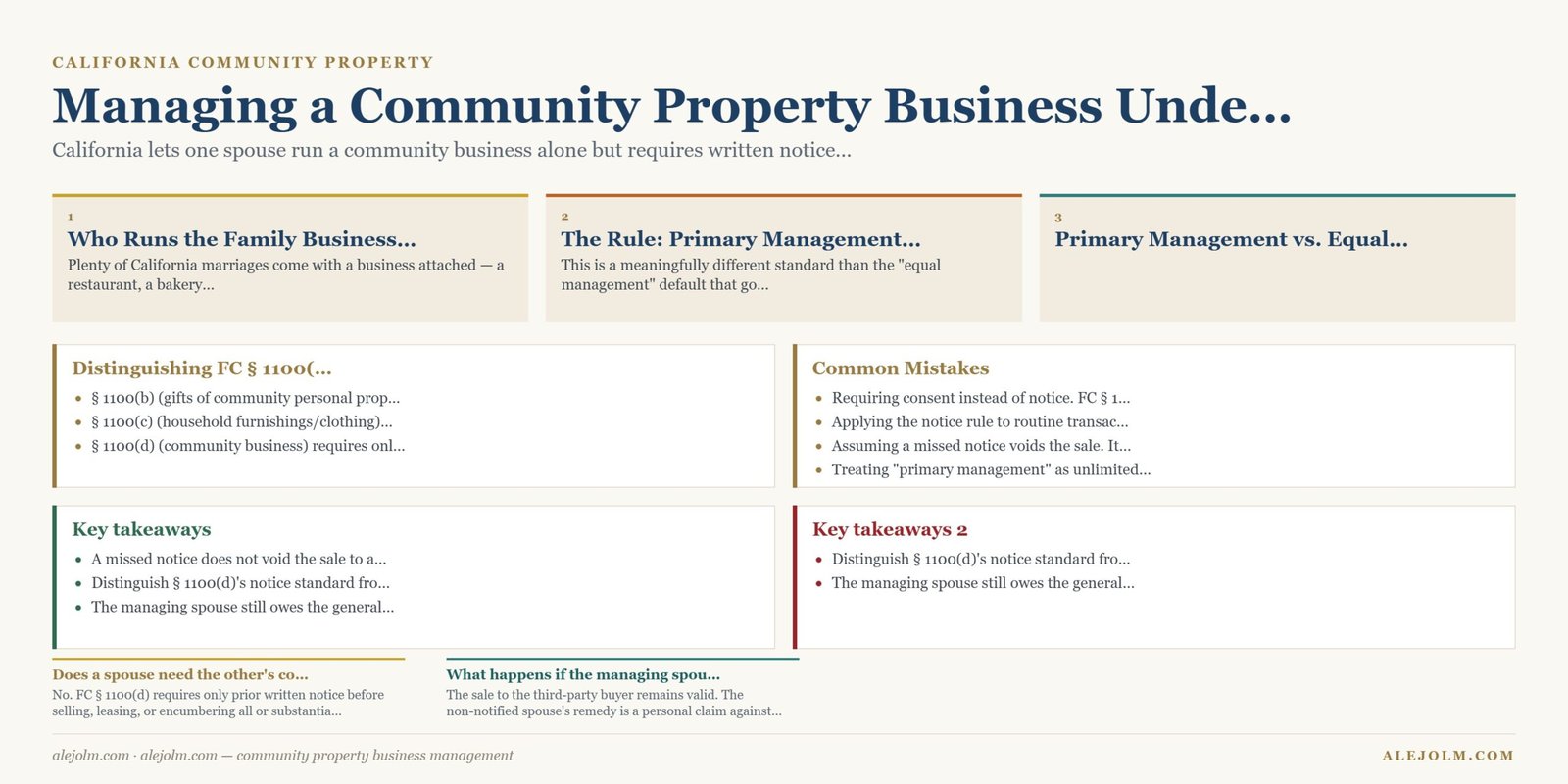
Plenty of California marriages come with a business attached — a restaurant, a bakery, a contracting company. If that business is community property, applying the strict “both spouses must consent” rule to every decision would make it unworkable; a business needs a single decision-maker who can act fast. California’s answer is FC § 1100(d): give one spouse primary control, but require a warning before the biggest moves.
The Rule: Primary Management, With a Notice Trigger
Under Family Code § 1100(d), the spouse who manages a community-property business has primary management and control over it and may act alone in business transactions, but must give the other spouse prior written notice before selling, leasing, or encumbering all or substantially all of the business’s personal property.
This is a meaningfully different standard than the “equal management” default that governs most community property. The operating spouse isn’t just equal — they’re in charge, for as long as the business needs day-to-day decisions made.
Primary Management vs. Equal Management
| Feature | Equal Management (FC § 1100(a) default) | Primary Management — Business (FC § 1100(d)) |
|---|---|---|
| Who decides? | Either spouse, independently | The spouse operating the business |
| Routine transactions | No consent/notice needed | No consent/notice needed |
| Major disposition | Varies by asset type | Prior WRITTEN NOTICE required (substantially all business personalty) |
| Consent required? | Depends on asset (real property, gifts) | No — notice only |
What Triggers the Written Notice Requirement
The notice obligation is narrow. It applies only when the managing spouse is about to sell, lease, or encumber all or substantially all of the business’s personal property — think liquidating the equipment, selling the inventory wholesale, or pledging nearly everything the business owns as loan collateral.
Ordinary transactions — restocking supplies, paying vendors, hiring an employee, making routine sales to customers — need no notice at all. The managing spouse handles those unilaterally, exactly as the “primary management” label suggests.
What Happens if Notice Isn’t Given
This is where FC § 1100(d) differs sharply from the real-property and gift rules elsewhere in § 1100. A failure to give the required written notice does not invalidate the sale as to a third-party buyer. The business counterparty who bought the equipment or took the collateral keeps what they bargained for.
Instead, the remedy runs against the managing spouse personally: if the undisclosed transaction substantially impaired the other spouse’s half interest in the community estate, that spouse can pursue a claim against the managing spouse — not undo the sale to the buyer.
Worked Example: The Bakery Retooling
Wife primarily manages the couple’s community-owned bakery. She decides to sell all of the bakery’s ovens, mixers, and display cases to fund a full retooling.
Analysis: Selling essentially all the business’s equipment disposes of substantially all of its personal property, triggering the FC § 1100(d) notice requirement. Wife must give Husband prior written notice before completing the sale. If she skips notice and the sale substantially impairs the community’s interest — say, she sold everything for far less than it was worth — Husband has a remedy against Wife personally. The sale to the equipment buyer, however, remains valid.
Worked Example: The Routine Restock
Wife orders a routine restock of flour, sugar, and packaging supplies for the bakery.
Analysis: This is an ordinary-course transaction, nowhere close to disposing of substantially all business personalty. No written notice to Husband is required — this is exactly the kind of everyday decision that primary management authority exists to streamline.
Distinguishing FC § 1100(d) From the Other § 1100 Exceptions
Bar candidates frequently mix up the different subsections of § 1100. Keep them separate:
- § 1100(b) (gifts of community personal property) requires written consent.
- § 1100(c) (household furnishings/clothing) requires written consent, with no statute of limitations on the set-aside remedy.
- § 1100(d) (community business) requires only written notice — a materially lower bar, reflecting the practical need for a business to be run by one decision-maker.
Confusing “notice” with “consent” is one of the most common errors on this topic, and examiners often build fact patterns specifically to test whether you catch the distinction.
Common Mistakes
- Requiring consent instead of notice. FC § 1100(d) only demands prior written notice for major business dispositions — not the other spouse’s agreement.
- Applying the notice rule to routine transactions. Day-to-day business decisions need neither notice nor consent.
- Assuming a missed notice voids the sale. It doesn’t, as to the third-party buyer; the exposure is personal liability of the managing spouse to the other spouse.
- Treating “primary management” as unlimited. The managing spouse still owes the general FC § 1101 fiduciary duty and can be liable for transactions that substantially impair the community’s interest.
FAQ
Does a spouse need the other’s consent to sell a community business’s assets?
No. FC § 1100(d) requires only prior written notice before selling, leasing, or encumbering all or substantially all of the business’s personal property — not the other spouse’s consent.
What happens if the managing spouse fails to give the required notice?
The sale to the third-party buyer remains valid. The non-notified spouse’s remedy is a personal claim against the managing spouse if the transaction substantially impaired the community’s interest.
Does the notice requirement apply to routine business transactions?
No. Ordinary-course transactions like restocking supplies or making regular sales require neither notice nor consent under FC § 1100(d).
Key Takeaways
- FC § 1100(d) gives the operating spouse primary management of a community business, allowing unilateral action for ordinary transactions.
- Prior written notice — not consent — is required only before selling, leasing, or encumbering substantially all of the business’s personal property.
- A missed notice does not void the sale to a third-party buyer; it exposes the managing spouse to personal liability toward the other spouse.
- Distinguish § 1100(d)’s notice standard from the written-consent standards under § 1100(b) (gifts) and § 1100(c) (household furnishings).
- The managing spouse still owes the general FC § 1101 fiduciary duty even while exercising primary management.
Related guides
- management and control of community property
- spousal consent for community property disposition
- household furnishings exception
Sources and further reading
- Cal. Fam. Code § 1100 — Management of Community Property
- California Bar Examination — Admissions Overview
This article is educational and is not legal advice. Consult a licensed California attorney about your situation.