
What Is Chain of Custody in Evidence Law?
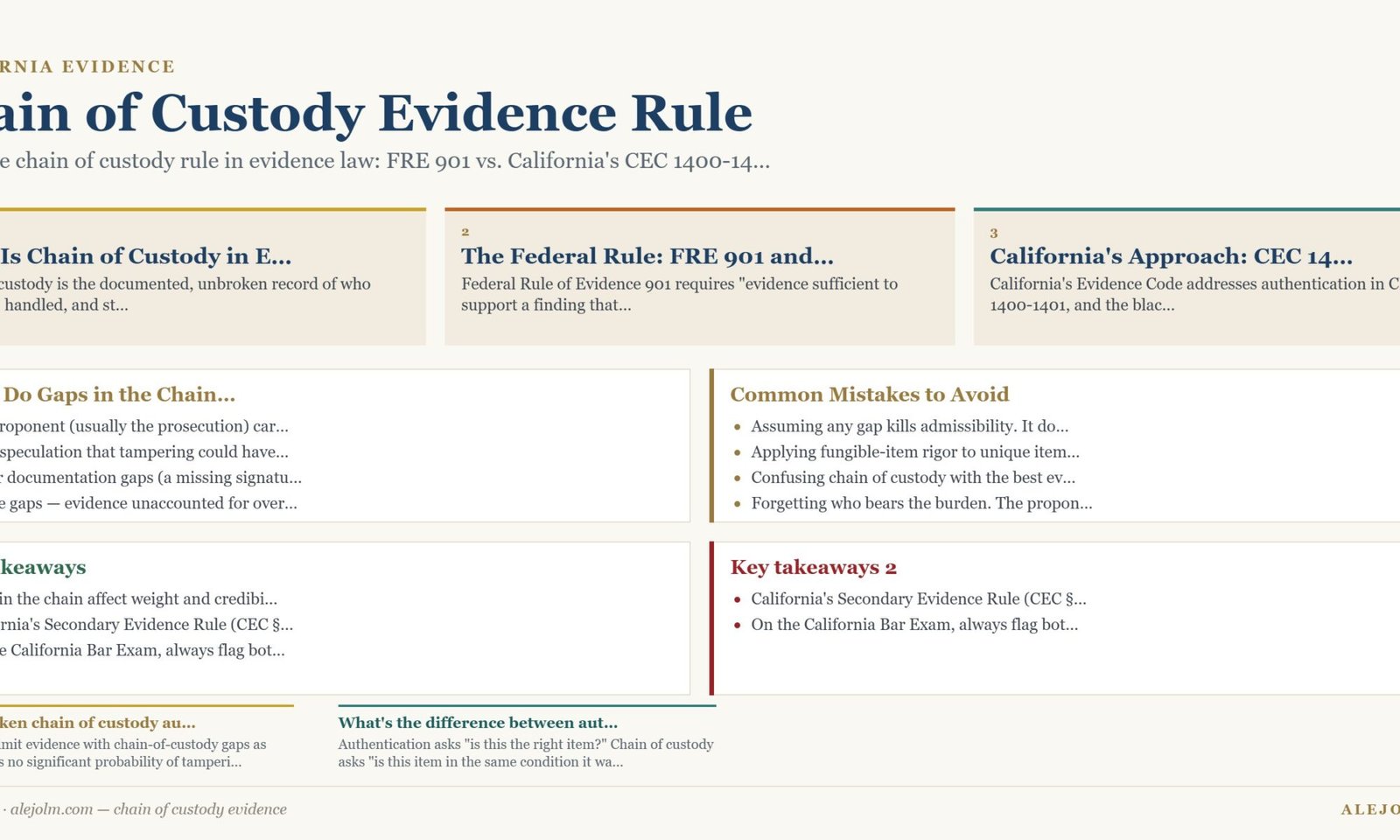
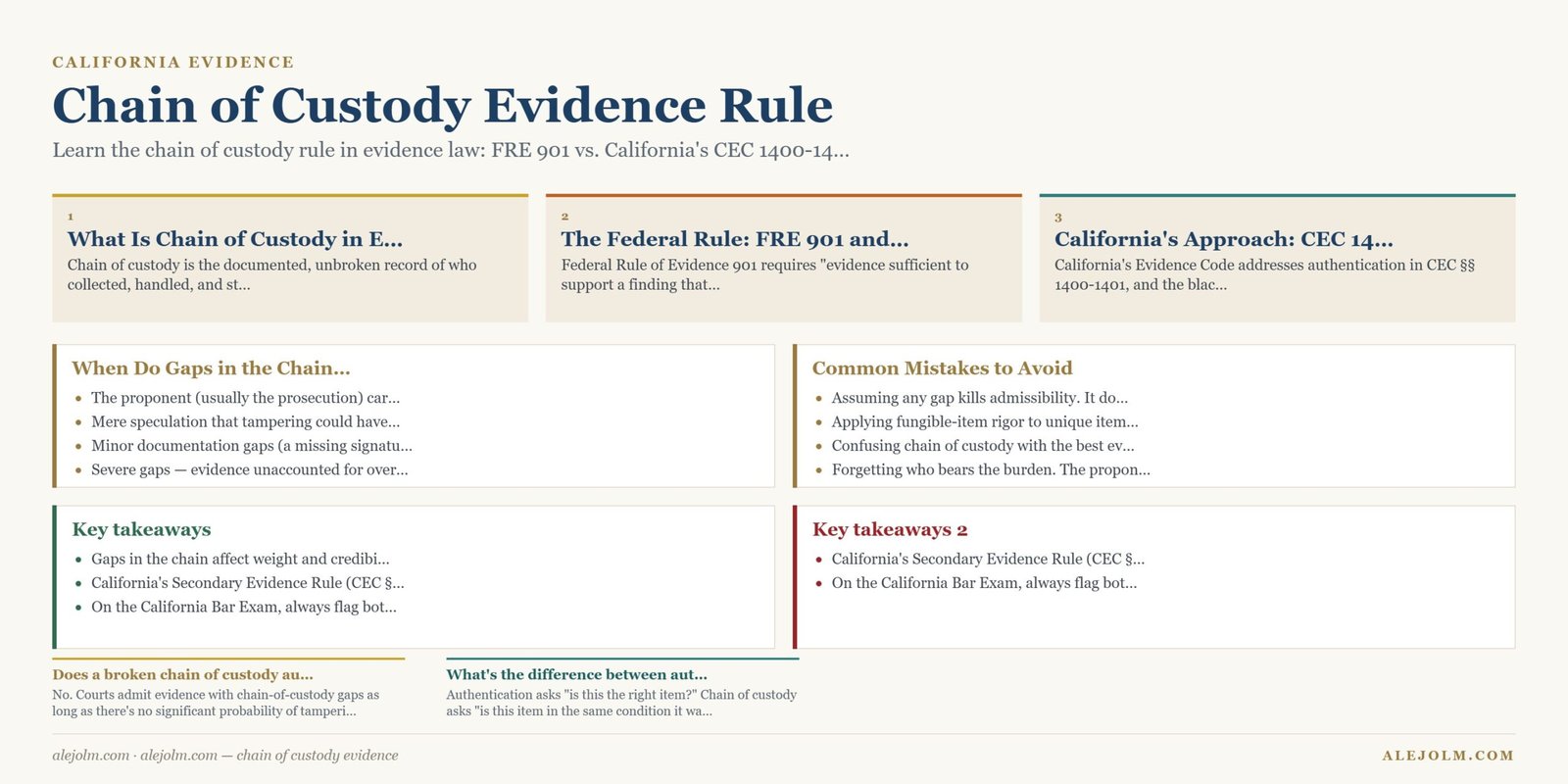
Chain of custody is the documented, unbroken record of who collected, handled, and stored a piece of physical evidence from the moment it was seized until it’s offered at trial. It’s a species of authentication: the proponent must show the item is what it claims to be, and hasn’t been tampered with or swapped along the way.
You’ll see this issue constantly on the California Bar Exam, usually buried inside a criminal-law fact pattern involving drugs, a weapon, or a blood sample. The examiners want to know whether you can spot the difference between a fatal gap in the chain and one that merely affects weight.
The Federal Rule: FRE 901 and the Authentication Standard
Federal Rule of Evidence 901 requires “evidence sufficient to support a finding that the item is what the proponent claims it is.” That’s a low bar. The judge isn’t asked to find the item is authentic — only that a reasonable jury could find it is, based on the evidence offered.
Chain of custody becomes the authentication method of choice for fungible, non-unique items: a bag of white powder, a vial of blood, a stack of cash. These items are indistinguishable from thousands of similar items by sight alone, so the proponent has to trace custody instead of relying on a witness saying “yes, that’s the knife I saw.”
Contrast that with unique evidence — a knife with a distinctive engraving, a photograph, a signed letter. For those items, a witness can often authenticate on sight, and a full custody chain isn’t required.
California’s Approach: CEC 1400-1401 and the Secondary Evidence Rule
California’s Evidence Code addresses authentication in CEC §§ 1400-1401, and the black-letter concept tracks federal law closely: authentication means proving the writing or thing is what it’s claimed to be. But there’s a trap on this topic that catches a lot of Bar candidates.
CEC § 1400 is not California’s version of the best evidence rule, even though students often assume it is because it sits near other document-related sections. California’s actual best-evidence analogue is the Secondary Evidence Rule, found at CEC §§ 1520-1523, which governs when a copy can substitute for an original writing. Chain of custody and authentication are a completely separate inquiry from the Secondary Evidence Rule.
FRE 901 vs. California CEC 1400-1401: Key Differences
| Issue | Federal Rule (FRE) | California Rule (CEC) |
|---|---|---|
| Governing statute | FRE 901-902 | CEC §§ 1400-1401 |
| Standard | Evidence sufficient to support a finding of genuineness | Substantially identical standard — proof the item is what it’s claimed to be |
| Best evidence / originals rule | FRE 1002 (separate rule) | Secondary Evidence Rule, CEC §§ 1520-1523 (separate statute — do not confuse with § 1400) |
| Digital/electronic evidence | Addressed under FRE 901(b)(9) and case law | California courts require chain-of-custody-style tracing for electronic devices and data, similar to physical evidence |
| Constitutional overlay | Due process reliability floor | Same due process floor, plus occasionally heightened scrutiny in death-penalty cases |
When Do Gaps in the Chain Actually Matter?
This is the single most tested point on chain of custody: gaps go to weight, not admissibility, unless the gap is so severe it creates a real probability the evidence was altered or contaminated. Courts don’t require an airtight, minute-by-minute chain. They require enough evidence that a reasonable person could conclude the item wasn’t swapped or tampered with.
A few practical rules of thumb:
- The proponent (usually the prosecution) carries the burden of laying foundation — not the defendant.
- Mere speculation that tampering could have happened isn’t enough to exclude evidence; the defense needs something more concrete.
- Minor documentation gaps (a missing signature, a few unexplained hours) are cured through custodian testimony and don’t defeat admissibility.
- Severe gaps — evidence unaccounted for over days, broken seals, no records at all — can trigger due process exclusion because admitting them would be fundamentally unfair.
- Defense counsel should raise authenticity challenges early, ideally via a motion in limine, rather than ambushing the custodian at trial.
Worked Example: The Missing Notebook
Officer Reyes collects a baggie of what she believes is methamphetamine from a car during a traffic stop in Fresno. She logs it into the evidence locker the same day. Two days later, lab analyst Kim signs it out for testing but loses her intake notebook, leaving no written record of exactly when she picked it up or who else may have briefly had access to the locker during a two-hour window.
Is the drug evidence admissible? Yes. The gap is explained — a documentation failure, not evidence of tampering — and the prosecution can still call Officer Reyes and Kim to testify about standard evidence-locker procedures. The defense can cross-examine about the missing notebook to attack credibility and weight, but that two-hour gap, standing alone, doesn’t come close to the “significant probability of alteration” needed to exclude the drugs outright.
Common Mistakes to Avoid
- Assuming any gap kills admissibility. It doesn’t. Only a gap severe enough to suggest real tampering does.
- Applying fungible-item rigor to unique items. A recognizable knife needs far less custody documentation than a bag of powder.
- Confusing chain of custody with the best evidence rule. They test different things — the integrity of physical evidence vs. proof of a writing’s contents.
- Forgetting who bears the burden. The proponent must affirmatively lay foundation; the objecting party doesn’t have to disprove authenticity from scratch.
FAQ
Does a broken chain of custody automatically make evidence inadmissible?
No. Courts admit evidence with chain-of-custody gaps as long as there’s no significant probability of tampering or alteration. Gaps typically go to the weight a jury gives the evidence, not whether it comes in at all.
What’s the difference between authentication and chain of custody?
Authentication asks “is this the right item?” Chain of custody asks “is this item in the same condition it was in when it was collected?” They’re related but distinct foundational requirements, especially for fungible items like drugs or blood samples.
Is CEC § 1400 California’s best evidence rule?
No — that’s a common Bar Exam trap. CEC § 1400 governs authentication. California’s best-evidence analogue is the Secondary Evidence Rule at CEC §§ 1520-1523, an entirely separate statute.
Key Takeaways
- Chain of custody is a foundational authentication tool required mainly for fungible, non-unique physical evidence.
- FRE 901 and CEC §§ 1400-1401 impose essentially the same low threshold: evidence sufficient to support a finding of genuineness.
- Gaps in the chain affect weight and credibility, not admissibility, unless they’re severe enough to raise due process concerns.
- California’s Secondary Evidence Rule (CEC §§ 1520-1523), not CEC § 1400, is the state’s counterpart to the federal best evidence rule.
- On the California Bar Exam, always flag both the fungible-vs-unique distinction and the weight-vs-admissibility distinction.
This article is educational and is not legal advice. Consult a licensed California attorney about your situation.
Related guides
- hearsay exceptions and the Confrontation Clause
- how character evidence is treated at trial
- California Evidence Code vs. Federal Rules of Evidence
- FRE 403 balancing test explained