
What Is the FRE 403 Balancing Test?
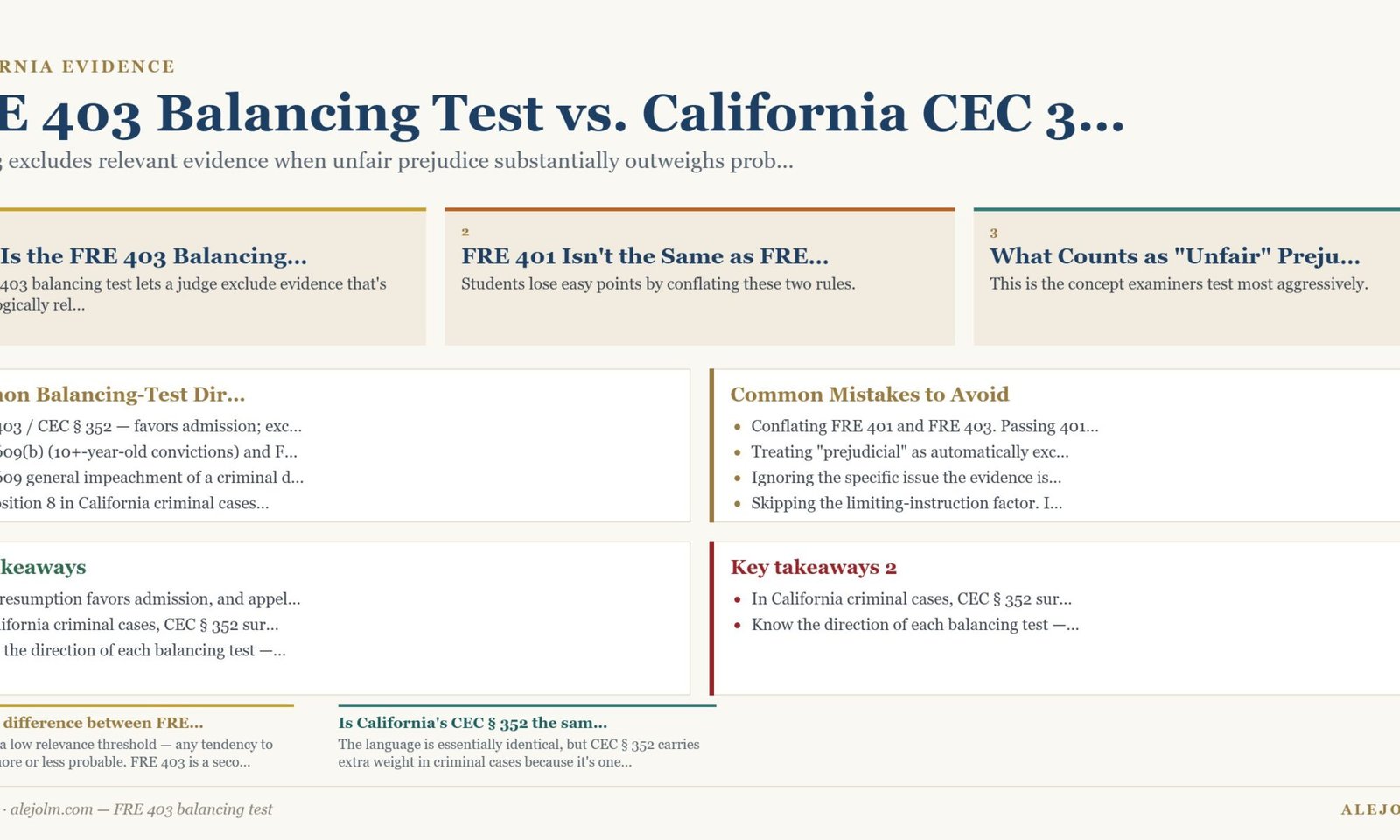
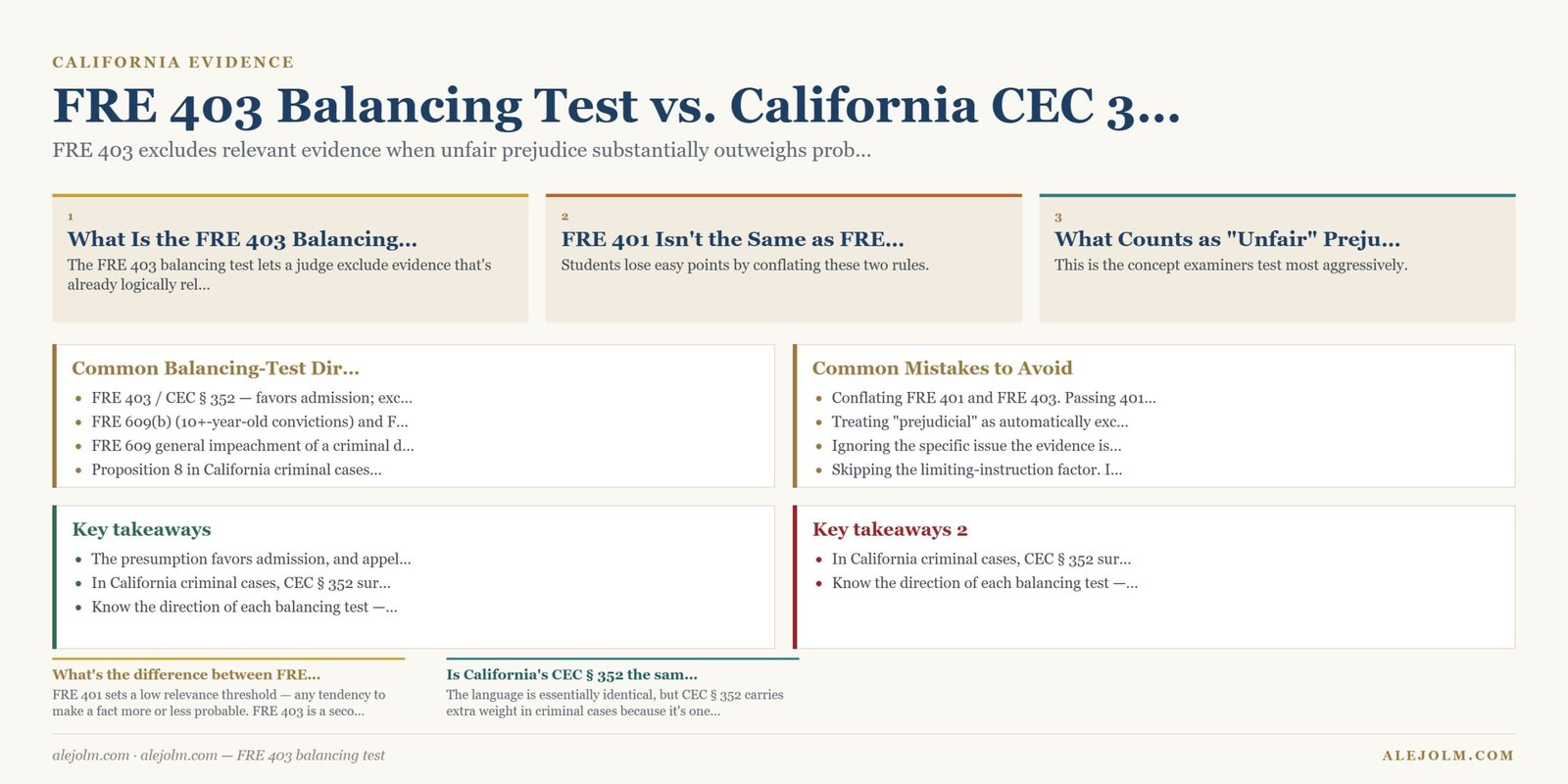
The FRE 403 balancing test lets a judge exclude evidence that’s already logically relevant if its probative value is substantially outweighed by a danger of unfair prejudice, jury confusion, undue delay, or needless cumulative evidence. It’s a discretionary, judge-applied filter that kicks in only after evidence clears the low bar of FRE 401 relevance.
Nearly every close-call evidence question on the California Bar Exam eventually funnels into a 403 analysis, because relevance alone rarely resolves a hard fact pattern — the real fight is almost always about the balancing.
FRE 401 Isn’t the Same as FRE 403
Students lose easy points by conflating these two rules. FRE 401 asks only whether evidence has any tendency to make a fact more or less probable — an easy threshold almost anything clears. FRE 403 asks a completely different question: even though the evidence is relevant, should it still come in, given the risk it poses?
The test is deliberately asymmetrical. Probative value must be substantially outweighed by unfair prejudice — not just outweighed. That “substantially” creates a strong presumption favoring admission, and appellate courts review a trial judge’s 403 ruling only for abuse of discretion, which is a hard standard to win on appeal.
What Counts as “Unfair” Prejudice?
This is the concept examiners test most aggressively. Unfair prejudice isn’t just prejudice — nearly all effective evidence is prejudicial to someone. Unfair prejudice specifically means the risk that the jury will decide the case on an improper basis: raw emotion, character reasoning, or something else that has nothing to do with the actual merits.
The judge weighs several factors in combination:
- How strongly the evidence bears on the specific fact it’s offered to prove.
- How significant that fact is to the case — central and disputed, or peripheral and conceded.
- The nature and severity of the prejudicial risk.
- Whether less prejudicial alternatives exist — stipulations, sanitized versions of the evidence, or a limiting instruction.
Old Chief v. United States (1997) is the classic illustration: the Supreme Court held that where a stipulation to a prior conviction serves the narrow evidentiary purpose (proving felon status) without the inflammatory detail of the underlying crime, the prosecution’s insistence on the full record can be excluded under 403 as needlessly prejudicial.
California’s CEC § 352: Textually Identical, Applied Distinctly
California’s CEC § 352 uses essentially the same language as FRE 403. But California courts have, in certain sensitive fact patterns — child-victim cases, sexual-assault prosecutions, traumatic testimony — applied the balancing test somewhat more expansively than a typical federal court might. And in criminal cases, CEC § 352 does double duty: it’s one of the five categories Proposition 8 expressly preserves, meaning it becomes the primary safety valve for evidence that would otherwise be barred by an overridden CEC exclusion.
FRE 403 vs. CEC 352: The Comparison
| Issue | Federal Rule (FRE) | California Rule (CEC) |
|---|---|---|
| Governing statute | FRE 403 | CEC § 352 |
| Standard | Probative value “substantially outweighed” by unfair prejudice, confusion, delay | Functionally identical language |
| Presumption | Favors admission (high bar to exclude) | Same presumption |
| Standard of appellate review | Abuse of discretion | Abuse of discretion |
| Role in criminal cases | Applies on its own terms | Survives Prop 8 — becomes the residual filter for evidence that would otherwise be barred by an overridden CEC exclusion |
| Applied more expansively in | No special carve-out | Child-victim and traumatic-testimony contexts, per California case law |
Common Balancing-Test Directions to Memorize
Not every balancing test in Evidence law tilts the same way, and the Bar loves to test whether you know the direction of the presumption:
- FRE 403 / CEC § 352 — favors admission; exclusion requires probative value to be substantially outweighed.
- FRE 609(b) (10+-year-old convictions) and FRE 412 civil cases — reverse test; the proponent must show probative value substantially outweighs prejudice, a presumption of exclusion.
- FRE 609 general impeachment of a criminal defendant — closer to neutral; probative value must simply outweigh prejudice.
- Proposition 8 in California criminal cases — creates a presumption of admissibility, with CEC § 352 as the only residual check.
Worked Example: The Distant Safety Record
In a negligence suit over a warehouse injury, the plaintiff offers evidence that the defendant company had safety violations at a different facility five years earlier. The defense objects under 403.
The evidence is technically relevant (FRE 401) — it has some tendency to suggest a careless corporate culture. But its probative value on this incident, at this facility, is thin, while the risk that the jury will reason “this company is a bad actor generally” is significant. A court is likely to exclude it under FRE 403. Change the facts so the prior violation happened at the same facility, on the same equipment, six months earlier, and the balance shifts sharply toward admission — the probative value on causation is now much higher.
Common Mistakes to Avoid
- Conflating FRE 401 and FRE 403. Passing 401 doesn’t mean the evidence survives 403 — they test entirely different things.
- Treating “prejudicial” as automatically excludable. The rule requires unfair prejudice, and even then, only when it substantially outweighs probative value.
- Ignoring the specific issue the evidence is offered on. Probative value is measured against the particular fact at stake, not the case generally.
- Skipping the limiting-instruction factor. If an instruction can adequately reduce the prejudicial risk, that cuts in favor of admission.
FAQ
What’s the difference between FRE 401 and FRE 403?
FRE 401 sets a low relevance threshold — any tendency to make a fact more or less probable. FRE 403 is a second, discretionary filter applied after relevance is established, allowing exclusion when unfair prejudice substantially outweighs probative value.
Is California’s CEC § 352 the same as FRE 403?
The language is essentially identical, but CEC § 352 carries extra weight in criminal cases because it’s one of the narrow exceptions Proposition 8 preserves, making it the main check on evidence that would otherwise be admissible under the Prop 8 override.
Does a limiting instruction affect the 403/352 analysis?
Yes. If a limiting instruction can adequately reduce the danger of unfair prejudice, courts are more likely to find that probative value is not substantially outweighed, favoring admission.
Key Takeaways
- FRE 403 and CEC § 352 both allow exclusion of relevant evidence only when probative value is substantially outweighed by unfair prejudice or related dangers.
- Unfair prejudice means the risk of an improper decision basis, not mere prejudice against a party.
- The presumption favors admission, and appellate review is for abuse of discretion.
- In California criminal cases, CEC § 352 survives Proposition 8 as the residual filter on otherwise-admissible evidence.
- Know the direction of each balancing test — 403/352 favors admission, while FRE 609(b) and FRE 412 (civil) reverse the presumption.
This article is educational and is not legal advice. Consult a licensed California attorney about your situation.
Related guides
- limiting instructions in evidence law
- character evidence rules
- California Evidence Code vs. Federal Rules of Evidence
- liability insurance and FRE 411