
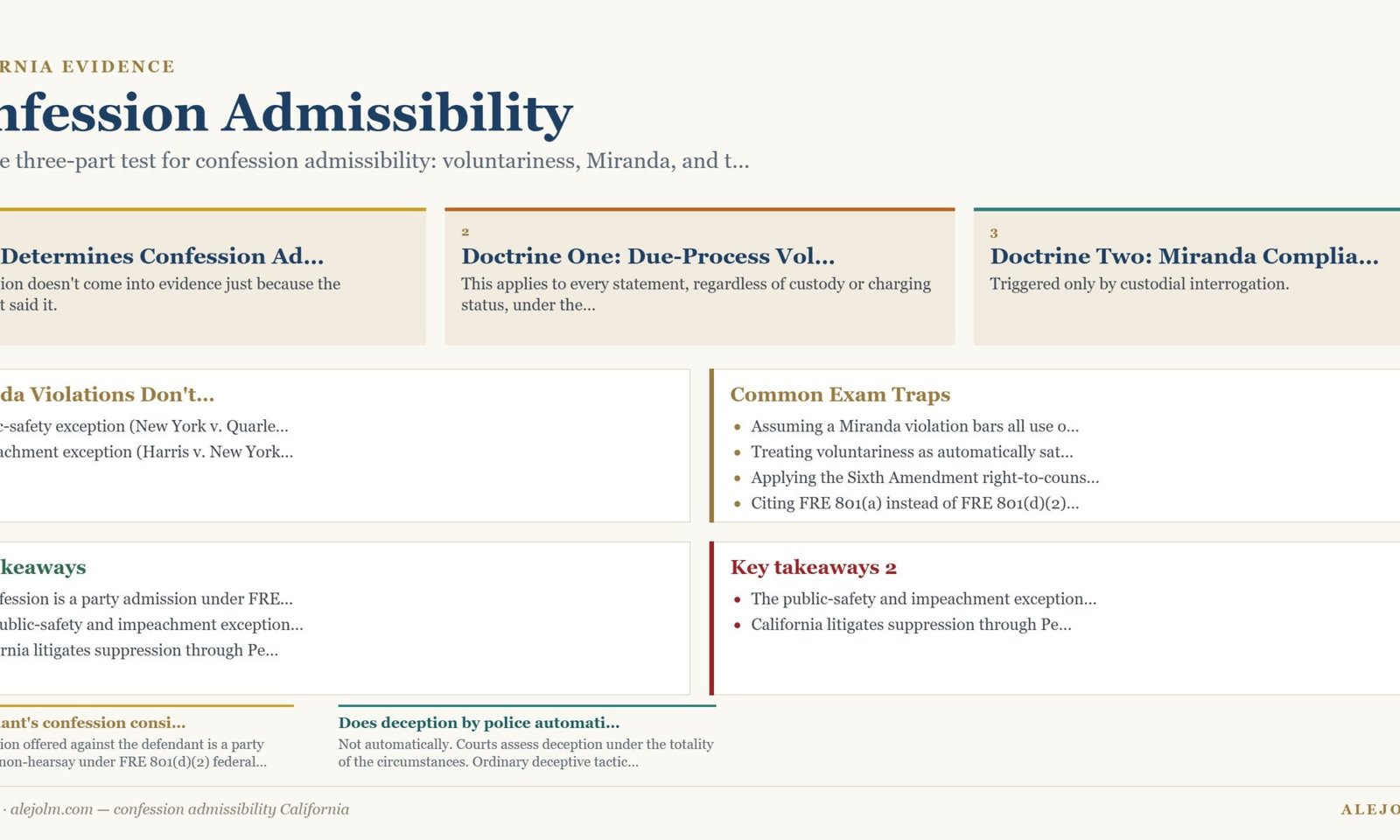

What Determines Confession Admissibility?
A confession doesn’t come into evidence just because the defendant said it. It has to clear three separate, independently required doctrines, and bar examiners deliberately blend fact patterns to see whether students can tell them apart instead of lumping everything into one “confession rule.”
California and federal courts run essentially the same three-part analysis, but California adds its own suppression-hearing statute and, in places, arguably broader constitutional protection. Getting the three doctrines straight — and knowing which one a given fact triggers — is the real skill being tested here.
Confession admissibility depends on three independent requirements: due-process voluntariness, Miranda compliance for custodial interrogation, and the Sixth Amendment right to counsel once it has attached — and failing any one renders the confession inadmissible.
Doctrine One: Due-Process Voluntariness
This applies to every statement, regardless of custody or charging status, under the totality of the circumstances. The touchstone is official coercion. Under Colorado v. Connelly (1986), private psychological pressure or even a defendant’s own mental illness doesn’t make a confession involuntary — only police coercion does. Courts weigh threats, promises, physical abuse, prolonged detention, and sleep or food deprivation. The prosecution bears the burden of proving voluntariness by a preponderance of the evidence at a suppression hearing held outside the jury’s presence.
Doctrine Two: Miranda Compliance
Triggered only by custodial interrogation. Miranda v. Arizona (1966) requires warning a suspect of the right to remain silent, that anything said can be used against them, the right to counsel, and that counsel will be appointed if they can’t afford one. Once a suspect clearly and unambiguously invokes the right to remain silent or to counsel, questioning must stop. Under Davis v. United States (1994), an equivocal statement like “maybe I should talk to a lawyer” doesn’t require police to stop questioning — the invocation has to be clear.
Doctrine Three: The Sixth Amendment Right to Counsel
This one is easy to overlook. Once the right to counsel has attached — after formal charge, indictment, information, or arraignment — Massiah v. United States (1964) bars the government from deliberately eliciting incriminating statements outside counsel’s presence, even through a secret informant. This doctrine doesn’t require custody at all, which is exactly what makes it distinct from Miranda.
CEC vs. FRE: Party Admissions and Procedural Differences
A confession offered against the defendant isn’t hearsay in either system — it’s a party admission. But California and federal law diverge on the procedural mechanism for challenging a confession’s admissibility, and on the source of the party-admission rule itself.
| Issue | Federal Rule (FRE) | California Rule (CEC) |
|---|---|---|
| Party admission (non-hearsay) rule | FRE 801(d)(2) — an opposing party’s own statement | CEC § 1220 — party admission exception |
| Voluntariness hearing | Jackson v. Denno hearing, outside jury’s presence | State-law equivalent suppression hearing, also outside jury’s presence |
| Statutory suppression mechanism | Motion to suppress under federal criminal procedure | Penal Code § 1538.5 — a dedicated statutory suppression-motion mechanism |
| State constitutional protection | N/A | Some California case law recognizes protections under the state constitution paralleling but sometimes extending beyond the Fifth Amendment |
| Miranda exceptions | Public-safety exception (New York v. Quarles); impeachment use of voluntary-but-unwarned statements (Harris v. New York) | Same exceptions generally apply |
The main takeaway for exam purposes: don’t cite “FRE 801(a)” for the party-admission rule — that provision merely defines “statement.” The operative rule is FRE 801(d)(2) federally and CEC § 1220 in California.
Miranda Violations Don’t Bar Everything
Two frequently tested exceptions soften a Miranda violation’s effect:
- Public-safety exception (New York v. Quarles, 1984) — unwarned statements necessary to address an imminent danger remain admissible.
- Impeachment exception (Harris v. New York, 1971) — a voluntary statement obtained in violation of Miranda is barred from the prosecution’s case-in-chief but may still be used to impeach the defendant if he testifies inconsistently at trial. Note the limit: a truly involuntary (coerced) confession stays barred for all purposes, including impeachment — voluntariness and Miranda compliance are separate gates.
Worked Hypothetical
Facts: California police arrest Marcus on suspicion of robbery and place him in an interrogation room. Without giving Miranda warnings, an officer asks, “Where’s the gun?” because a 911 caller reported the weapon was dropped somewhere in a crowded shopping mall. Marcus answers, revealing the gun’s location. Two hours later, now properly Mirandized, Marcus waives his rights and gives a full confession after officers falsely tell him his accomplice already confessed.
Analysis: The first statement — “where’s the gun” — implicates the public-safety exception under New York v. Quarles. Because the officer’s question addressed an imminent danger to the public (a loaded gun in a crowded mall), the unwarned answer is likely admissible despite the Miranda violation. The second statement raises a different issue: Miranda warnings were given and waived, so Miranda compliance is satisfied. But voluntariness is a separate doctrine — deception about a codefendant’s confession is a recognized interrogation tactic that courts often tolerate, though extreme or fabricated deception can tip the balance toward involuntariness under the totality of the circumstances. If Marcus’s confession was still the product of his own free will despite the lie, it’s voluntary and admissible; if the deception was so extreme it overbore his will, both the confession and any evidence derived from it are subject to exclusion. In California, this entire analysis would be litigated through a Penal Code § 1538.5 suppression motion.
Common Exam Traps
- Assuming a Miranda violation bars all use of a confession — forgetting the public-safety and impeachment exceptions.
- Treating voluntariness as automatically satisfied once Miranda warnings are given — they’re independent requirements.
- Applying the Sixth Amendment right-to-counsel analysis before the right has actually attached (before formal charge, indictment, or arraignment).
- Citing FRE 801(a) instead of FRE 801(d)(2) for the party-admission rule.
- Forgetting that only official coercion, not private mental illness or manipulation, renders a confession involuntary under Colorado v. Connelly.
FAQ
Is a defendant’s confession considered hearsay?
No. A confession offered against the defendant is a party admission — non-hearsay under FRE 801(d)(2) federally and CEC § 1220 in California — because it’s the defendant’s own statement offered against him.
Does deception by police automatically make a confession involuntary?
Not automatically. Courts assess deception under the totality of the circumstances. Ordinary deceptive tactics, like falsely claiming a codefendant confessed, often don’t render a confession involuntary, though sufficiently extreme deception can tip the balance.
Can an unwarned confession ever be used at trial?
Yes, in limited situations. The public-safety exception allows unwarned statements addressing imminent danger, and a voluntary-but-unwarned statement can be used to impeach a defendant’s inconsistent trial testimony — though it can’t be used in the prosecution’s case-in-chief, and a truly coerced confession remains barred for any purpose.
Key Takeaways
- Confession admissibility requires clearing three independent doctrines: due-process voluntariness, Miranda compliance, and the Sixth Amendment right to counsel once attached.
- Only official coercion renders a confession involuntary under Colorado v. Connelly — private mental illness or pressure doesn’t count.
- A confession is a party admission under FRE 801(d)(2) or CEC § 1220, not hearsay.
- The public-safety and impeachment exceptions can save an otherwise Miranda-defective statement, but never a truly involuntary one.
- California litigates suppression through Penal Code § 1538.5, running parallel to but procedurally distinct from federal practice.
This article is educational and is not legal advice. Consult a licensed California attorney about your situation.
Related guides
- Fifth Amendment privilege against self-incrimination
- Miranda rights overview
- hearsay exceptions
- witness competency and impeachment rules